What You Can Do With a Master's in Sports Psychology
A master's degree in sports psychology opens the door to a surprisingly wide range of career paths, even without pursuing a doctorate. The key is understanding exactly what you can and cannot do at this level, so you can build a career that matches your goals.
Career Titles and Roles
Graduates with a master's in sports psychology step into roles across competitive sport, education, corporate settings, and youth development. Some of the most common job titles include:
- Mental performance consultant: Work one-on-one or with teams to develop mental skills like focus, confidence, and pre-competition routines.
- Collegiate athletic department staff: Serve within a university's athletic department providing mental performance support to student-athletes.
- Corporate wellness consultant: Apply performance psychology principles in business settings, helping executives and teams manage stress, set goals, and perform under pressure.
- Sport science researcher: Contribute to applied research at universities, sport institutes, or private organizations studying the mental side of athletic performance.
- Youth sport program director: Design and lead mental skills training programs for young athletes, often within clubs, academies, or community organizations.
Common work settings include college athletics departments, private consulting practices, national and regional sport organizations, and military human performance programs, where demand for mental performance professionals has grown steadily.
The CMPC Credential
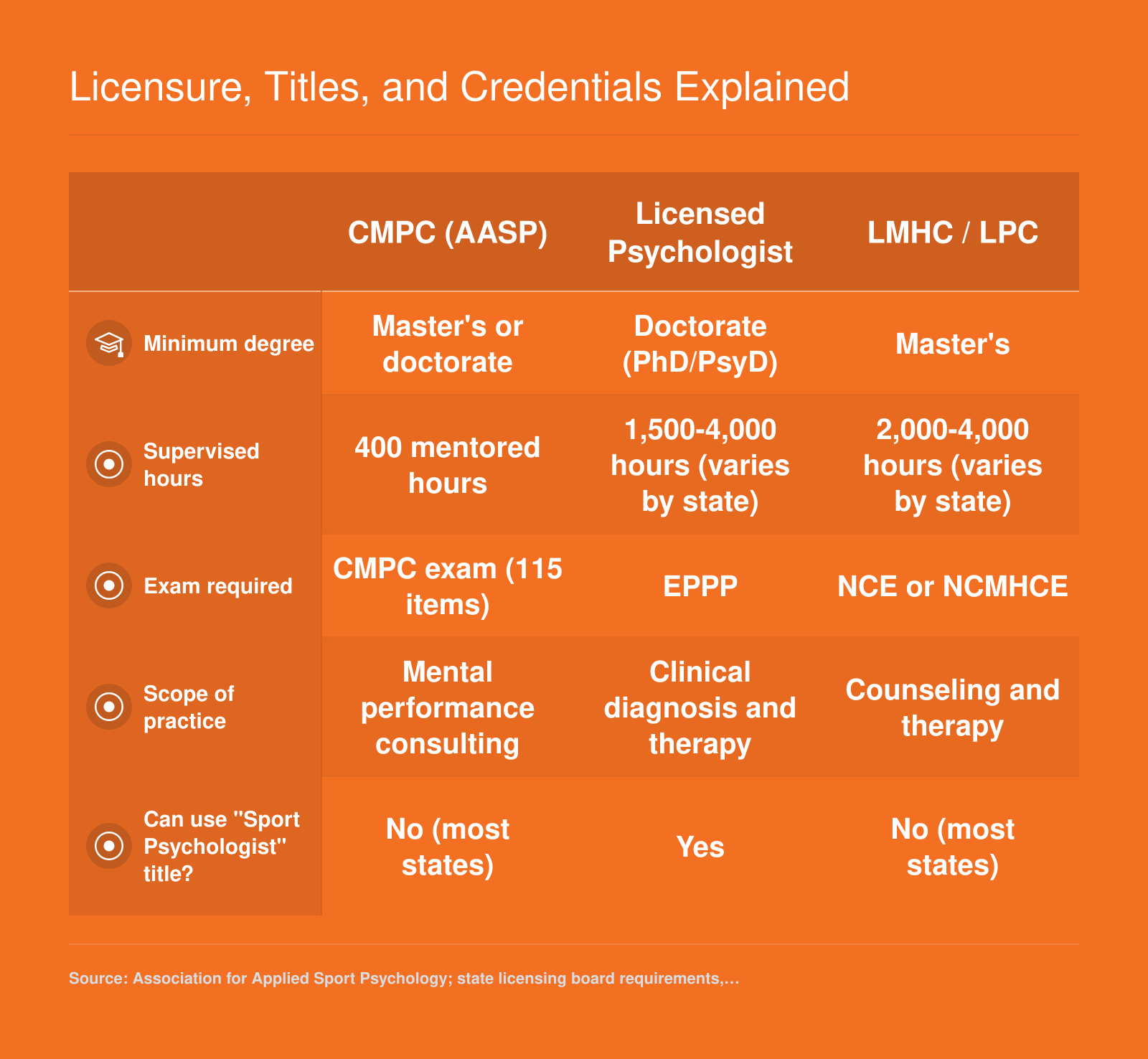
For master's-level graduates, the Certified Mental Performance Consultant (CMPC) credential through the Association for Applied Sport Psychology (AASP) is the gold-standard professional designation. To earn the CMPC, you need a graduate degree in a related field, specific coursework in sport psychology and its foundations, a supervised mentored experience (typically 400 or more hours of direct client contact), and a passing score on the certification exam. Holding the CMPC signals to employers, coaches, and athletes that you meet a recognized standard of competence in applied sport psychology.
Scope-of-Practice Limits to Keep in Mind
One of the most important distinctions at the master's level involves what falls outside your scope of practice. Master's-level mental performance consultants typically cannot diagnose or treat clinical mental health disorders such as depression, anxiety disorders, or eating disorders. You also cannot use the title "psychologist," which is legally protected in every U.S. state and reserved for doctoral-level, licensed professionals. Billing insurance for psychological services is generally off the table as well.
These boundaries matter. If an athlete you work with presents signs of a clinical disorder, your role is to recognize those signs and refer them to a licensed professional.
Expanding Your Clinical Scope Through Counseling Licensure
Some master's graduates choose to pursue state licensure as a Licensed Mental Health Counselor (LMHC) or Licensed Professional Counselor (LPC), depending on the state. This path requires a master's degree in counseling or a closely related field, supervised post-graduate clinical hours (often 2,000 to 3,000), and passing a licensure exam.
Earning an LMHC or LPC allows you to work with clinical issues, accept insurance, and provide a broader range of mental health services. The important distinction is that you would practice under a counseling title, not as a psychologist. For professionals who want to blend mental performance consulting with clinical work, pairing the CMPC with a counseling license can be a powerful combination that keeps career options flexible without the time and cost commitment of a doctorate.