How to Become a Sports Psychologist: Your Complete Career Roadmap

From undergraduate coursework to licensure and certification — every step mapped out with timelines, costs, and credential options.

By Aleah HockridgeReviewed by SportsPsychology.org TeamUpdated May 15, 202610+ min read
How to Become a Sports Psychologist: Step-by-Step Guide

Key Takeaways

  • Licensed sports psychologists need a doctorate plus supervised clinical hours, while Certified Mental Performance Consultants need a master's degree.
  • The full pathway from bachelor's degree to licensure typically takes 10 to 12 years of education and supervised experience.
  • In most U.S. states the title psychologist is legally protected, so using it without a valid license can result in penalties.
  • Sports psychologists and mental performance consultants overlap in skills but differ in legal authority, clinical scope, and required credentials.

Demand for mental performance professionals has surged across the NFL, NCAA programs, U.S. military special operations units, and Olympic training centers, yet the path into the field remains one of the most misunderstood in all of applied psychology. Titles like "sports psychologist" and "mental performance consultant" sound interchangeable but carry very different education requirements, legal authorities, and salary ceilings.

The core tension is straightforward: a master's degree with certification can put you in front of athletes in roughly three years, while a doctorate with state licensure typically takes eight to twelve years of schooling and supervised practice. Each route opens distinct doors and closes others. In most U.S. states, only the doctoral path grants legal permission to use the title "psychologist" at all. Whether you are a recent graduate or a former competitor planning an athlete to sports psychologist career change, this guide walks you through every step, from choosing a major to earning your credential.

What Does a Sports Psychologist Do?

A sports psychologist helps athletes, coaches, and teams navigate the mental side of performance. That work spans a broad spectrum, from teaching a college softball player how to manage pre-game anxiety to diagnosing and treating clinical depression in a professional football player recovering from a career-threatening injury. Because licensed sports psychologists hold doctoral-level clinical or counseling credentials, they are qualified to assess and treat diagnosable mental health conditions such as eating disorders, substance abuse, mood disorders, and trauma. This clinical authority is what sets them apart from non-licensed practitioners who focus exclusively on performance enhancement skills.

Day-to-day responsibilities vary significantly depending on where you work. Below is a closer look at four common settings.

College Athletics

Sports psychologists embedded in university athletic departments often juggle a packed caseload. On any given week you might run a group workshop on focus and confidence for the swim team, hold one-on-one sessions with a student-athlete struggling with disordered eating, consult with coaches on team culture, and coordinate referrals with the campus counseling center. The rhythm follows the academic calendar, with demand surging around rivalry weeks, conference championships, and the transition period when seniors face life after sport.

Professional Teams

At the pro level, a sports psychologist may be part of a larger performance staff that includes strength coaches, nutritionists, and athletic trainers. Sessions often center on pressure management, injury rehabilitation mindset, interpersonal dynamics in the locker room, and helping athletes cope with public scrutiny. Travel is common, and discretion is paramount because trust determines whether players will seek help voluntarily.

Private Practice

Clinicians in private practice enjoy more autonomy over scheduling and client selection. Your roster might include youth athletes, weekend competitors, retired professionals adjusting to post-sport identity, and performing artists who benefit from similar mental skills training. Revenue depends on your referral network, insurance panel participation, and reputation within local sport communities.

Military and Tactical Settings

The U.S. Department of Defense and agencies like the Army's Comprehensive Soldier and Family Fitness program employ sports psychologists to build resilience, optimize decision-making under stress, and treat service members dealing with performance-related anxiety or trauma. The work shares many parallels with elite sport: high stakes, time pressure, and a culture that can stigmatize help-seeking.

Emerging Work Settings

Beyond these established paths, the field is expanding. Esports organizations now hire mental performance professionals to help competitive gamers manage burnout and screen-related stress, making esports psychology one of the fastest-growing niches. Olympic and Paralympic training centers rely on sports psychologists year-round to prepare athletes for the unique pressure of representing their country. Youth sport organizations are also increasingly investing in mental wellness programming, creating roles for practitioners who specialize in developmental and family-systems approaches. For a deeper look at how these roles differ, explore the various branches of sports psychology.

Regardless of the setting, the core mission stays the same: help people perform closer to their potential while protecting their psychological well-being.

Sports Psychologist vs. Mental Performance Consultant: Key Differences

One of the most common questions aspiring professionals ask is what separates a sports psychologist from a mental performance consultant. The two roles overlap in many ways, yet they differ significantly in education, legal authority, and scope of practice. Understanding this distinction early will help you choose the right career path and avoid costly missteps.

Education and Credentials

A licensed sports psychologist holds a doctoral degree (Ph.D. or Psy.D.) in psychology and has completed state licensure requirements, which typically include thousands of supervised clinical hours and a licensing exam.1 This path usually takes seven to ten years of post-secondary education and training.

A Certified Mental Performance Consultant (CMPC), credentialed through the AASP certification program, needs at minimum a master's degree in sport science, kinesiology, or a related field.1 CMPC candidates must complete 400 mentored hours, including at least 200 hours of direct client contact, 100 hours in a sport context, and 40 hours of mentorship (with at least 20 of those in individual mentorship).3 After meeting these requirements, candidates sit for a computer-based multiple-choice exam.4 The certification is valid for five years and requires 75 continuing education units for renewal.5

Scope of Practice

This is where the distinction matters most in day-to-day work:

  • Licensed sports psychologists can diagnose and treat clinical mental health conditions such as anxiety disorders, depression, eating disorders, and substance use issues. They integrate clinical therapy with performance-focused interventions.
  • CMPCs focus on performance enhancement techniques like goal setting, visualization, attentional focus, and self-talk strategies. They cannot diagnose or treat clinical disorders.

In practice, a CMPC might help a collegiate swimmer develop a pre-race routine, while a licensed sports psychologist could treat that same swimmer for clinical anxiety that interferes with competition and daily life.

Title Protection: Why It Matters

The single most misunderstood distinction in this field is title protection. In most U.S. states, the title "psychologist" is legally protected. Only individuals who hold state licensure may use it in their professional title or marketing materials. In California, for example, misusing the title is classified as a misdemeanor.1 The CMPC credential, while respected, does not carry the same legal title protection.1

This means a CMPC holder who works with athletes on mental skills cannot advertise themselves as a "sports psychologist," even if their daily work looks similar from the outside. Doing so can result in legal penalties and disciplinary action from state licensing boards.

Where Each Professional Works

Both licensed sports psychologists and CMPCs work in collegiate athletics departments, professional sports organizations, private practice, military performance programs, and Olympic training centers. The practical reality is that many CMPCs operate in the same environments as licensed psychologists, but they must be careful about how they describe their services. Titles like "mental performance consultant" or "mental performance coach" are common alternatives that stay within legal boundaries.

If you already know you want to treat clinical conditions alongside performance work, plan on pursuing a doctoral degree and licensure. If your interest centers on helping athletes sharpen their mental game without clinical treatment, the CMPC pathway offers a faster, more focused route. For a deeper look at how these two tracks compare in terms of coursework and career outcomes, explore our guide on clinical vs performance sports psychology. Both paths lead to meaningful careers, but choosing the right one from the start saves time, money, and professional complications down the road.

Step 1: Earn a Bachelor's Degree

Your path toward a career in sports psychology begins with a four-year undergraduate degree. The good news: you do not need to lock into a single "correct" major. Graduate programs in sport and exercise psychology care far more about the courses on your transcript than the title printed on your diploma.

Choosing the Right Major

Psychology is the most common and strategically versatile major for aspiring sports psychologists. It gives you direct exposure to foundational theories of human behavior, research design, and clinical frameworks that graduate admissions committees want to see. That said, majors in kinesiology, exercise science, or a general science field paired with a psychology minor can work just as well, provided you complete the prerequisite coursework that most master's and doctoral programs require. If you are weighing an exercise science to sport psychology transition, planning your electives carefully during undergrad makes the graduate school shift much smoother.

Prerequisite Courses to Prioritize

Regardless of your major, plan your course schedule around the classes that graduate programs expect to see. These typically include:

  • Abnormal Psychology: Covers the identification and classification of psychological disorders, a cornerstone for any clinical or applied track.
  • Statistics: Builds the quantitative reasoning skills you will rely on throughout graduate-level research.
  • Research Methods: Teaches you how to design, conduct, and evaluate scientific studies in psychology.
  • Developmental Psychology: Explores how people grow and change across the lifespan, which is essential when working with athletes of all ages.
  • Introduction to Sport and Exercise Psychology: Not every university offers this course at the undergraduate level, but if yours does, take it. It demonstrates genuine interest in the field and gives you a head start on graduate coursework.

GPA Benchmarks and What Makes You Competitive

Most master's programs expect a minimum GPA of 3.0, while doctoral programs become genuinely competitive at 3.5 or above. A strong GPA matters, but it is not the only thing admissions committees evaluate. Hands-on research experience can set your application apart. Seek out a position as an undergraduate research assistant in a psychology or kinesiology lab, especially one that focuses on sport, performance, or exercise behavior. Faculty mentors in those labs can also write detailed, discipline-specific letters of recommendation that carry significant weight.

Beyond the classroom, look for extracurricular activities that signal commitment to the field. Volunteering with campus athletic departments, joining sport psychology student organizations, or completing an internship with a local sport performance center all strengthen your application while helping you confirm that this career path genuinely fits.

Timeline

A bachelor's degree takes four years of full-time study. Use that time intentionally. By the end of your junior year, you should have your prerequisite courses completed, at least one meaningful research or applied experience on your resume, and a clear sense of whether you plan to pursue a master's degree, a doctorate, or both. Starting these conversations early with academic advisors and mentors gives you the strongest possible foundation for the next step in your education.

Questions to Ask Yourself

Do you want to diagnose and treat clinical mental health conditions in athletes, or focus purely on performance enhancement?
This single question shapes your entire path. Treating clinical issues like anxiety, depression, or eating disorders requires a doctorate and licensure as a psychologist, while performance consulting can begin with a master's degree and a certification such as the CMPC.
Are you pivoting from a related career like coaching, athletic training, or counseling?
Existing credentials and fieldwork may count toward graduate admission prerequisites or supervised experience hours. A background in counseling, for example, could significantly shorten your timeline to working with athletes professionally.
Are you comfortable committing roughly 7 to 10 years of education, or do you need a faster route?
A doctoral path (Ph.D. or Psy.D.) plus supervised hours typically spans 7 to 10 years post-bachelor's. A master's degree paired with a Certified Mental Performance Consultant credential can get you into the field in about 2 to 3 years of graduate study.
How important is it to you to use the legally protected title 'sports psychologist'?
In most U.S. states, only licensed psychologists may call themselves sports psychologists. If using that title matters for your career goals or credibility with certain employers, plan for the doctoral and licensure route from the start.

Step 2: Complete a Graduate Degree (Master's or Doctorate)

Graduate school is where your sports psychology career takes shape, and the degree you choose will determine the scope of work you can legally and professionally perform. There are two main pathways, each leading to a distinct professional identity.

Pathway 1: A Master's Degree in Sport or Performance Psychology

A master's program typically takes two to three years and prepares you for applied mental performance consulting. Graduates of these programs are eligible to pursue the Certified Mental Performance Consultant (CMPC) credential through the Association for Applied Sport Psychology. With a CMPC, you can work directly with athletes and teams on goal setting, focus, confidence, and other performance skills.

Master's programs are available in sport psychology, performance psychology, kinesiology with a sport psychology concentration, and related fields. Format options are expanding: while many programs are on-campus, a growing number of hybrid and fully online master's programs now serve working professionals, former athletes, and career changers who need scheduling flexibility.

Pathway 2: A Doctoral Degree (PhD or PsyD) for Licensure

If your goal is to use the legally protected title of "psychologist," diagnose mental health conditions, or bill insurance for clinical services, you will need a doctoral degree. Most aspiring sports psychologists on this track pursue a PhD or PsyD in clinical psychology or counseling psychology, selecting sport-focused coursework, practica, and dissertation topics along the way.

Doctoral programs are significantly more competitive and time-intensive, typically requiring five to seven years of full-time study plus a predoctoral internship. Nearly all accredited doctoral programs are delivered on campus due to the intensive clinical training and supervision requirements involved. The trade-off is a broader, more versatile scope of practice that combines clinical mental health treatment with performance consulting.

Do I Need a PhD to Work in Sports Psychology?

The short answer: it depends on what you want to do. If your interest centers on applied mental performance work and the CMPC credential, a master's degree is sufficient, and no doctoral training is required. If you want to diagnose anxiety, depression, eating disorders, or other clinical conditions in athletes, or if you want to hold the title "psychologist," a doctorate and state licensure are non-negotiable.

Be honest with yourself about your timeline, financial resources, and career goals before committing. A PhD or PsyD is a serious investment, and the admissions process is highly selective.

Career Pivot Pathways Into Graduate Study

You do not need to follow a straight line from an undergraduate psychology degree into graduate school. Licensed professional counselors, athletic trainers, and coaches who already hold master's degrees may qualify for the CMPC credential if their coursework and mentored experience align with eligibility requirements. Some of these professionals also bridge into doctoral programs with advanced standing, shortening their path to licensure.

If you are coming from a related field, review the specific course and experience requirements for either the CMPC or doctoral licensure track early. Identifying gaps now saves time and tuition later. sportspsychology.org offers program comparison tools that can help you evaluate which graduate pathway matches your background and professional ambitions.
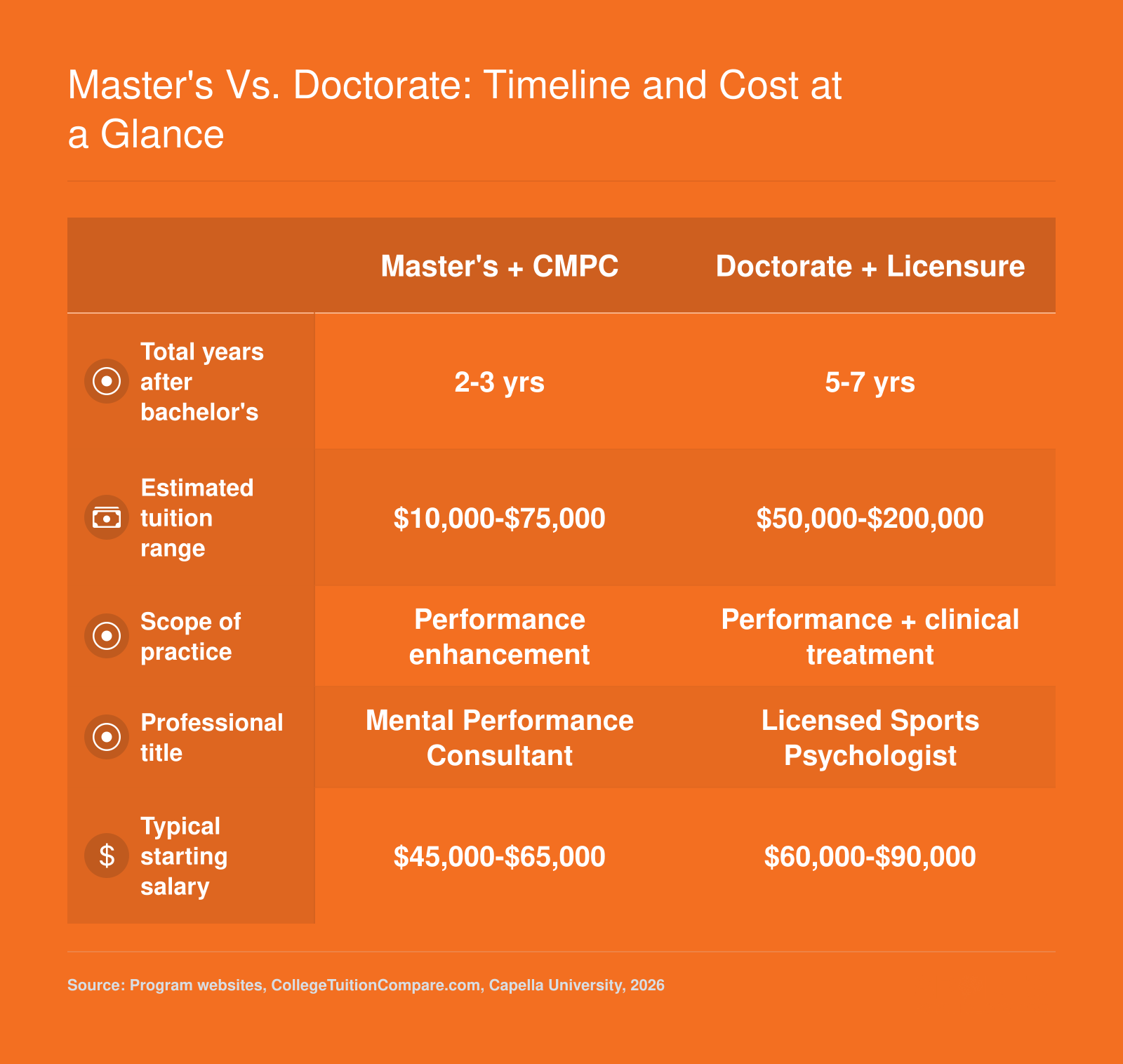
Master's vs. Doctorate: Timeline and Cost at a Glance

Choosing between a master's degree with CMPC certification and a doctoral degree with licensure is one of the biggest decisions you will make on this career path. The table below compares the two routes across five key attributes so you can weigh time, cost, and scope of practice side by side.

Comparison of master's plus CMPC and doctoral plus licensure pathways across total years, tuition cost, scope of practice, title, and starting salary in 2026

Step 3: Gain Supervised Experience and Clinical Hours

Classroom learning builds the foundation, but supervised, hands-on experience is what transforms you into a competent practitioner. The number of hours you need and the timeline for completing them depend entirely on whether you are pursuing mental performance consulting, clinical licensure, or both.

Hour Requirements at a Glance

The two main credentialing paths have very different thresholds:

  • CMPC (Certified Mental Performance Consultant): A minimum of 400 mentored hours of mental performance work completed under an AASP-approved mentor. These hours focus on performance enhancement techniques such as imagery, goal setting, and team dynamics rather than clinical diagnosis or therapy.
  • Licensed psychologist: Typically 1,500 to 4,000 or more supervised clinical hours, depending on your state. This total usually includes a predoctoral internship (often one year, full-time) and, in many states, an additional postdoctoral supervised year. Hours must be accrued under a licensed psychologist and cover direct client contact, assessment, and intervention.

If you plan to use the legally protected title of "sports psychologist," you will generally need to satisfy the clinical licensure requirements, not just the CMPC standard.

Where to Accumulate Hours

Opportunities exist across a range of settings, and diversifying your placements can strengthen your resume:

  • University athletic departments and college counseling centers
  • Private practices that specialize in sport or performance psychology
  • Sports medicine clinics and rehabilitation facilities
  • U.S. Olympic and Paralympic Training Centers
  • Military installations with human performance programs

Many doctoral programs build practicum rotations and internship placements into the curriculum, which helps you log clinical hours without having to arrange them on your own. For CMPC candidates in a master's program, mentored hours can sometimes be embedded in graduate assistantships or applied practica.

Realistic Timelines

Context matters more than raw numbers. The 400 mentored hours required for the CMPC can often be completed during a master's program plus one to two additional years of post-degree work, especially if you begin accumulating hours early. Clinical licensure hours, by contrast, typically take two to three years after you finish your doctorate, factoring in both the predoctoral internship and a postdoctoral supervised period.

Plan Ahead for Mentorship Access

One challenge that catches many aspiring consultants off guard is the limited availability of AASP-approved mentors in certain regions. If you live or study in an area without a nearby approved mentor, you may need to arrange remote mentorship or relocate for a practicum placement. Check the AASP mentor directory early in your graduate program, ideally before you enroll, so you can confirm that a viable mentorship pathway exists. Starting this search late can add months or even a full year to your timeline.

Whether you are aiming for the CMPC, a psychology license, or both, the supervised experience phase is where your professional identity truly takes shape. Treat it as an investment, not just a box to check.

Step 4: Get Licensed or Certified, Understanding Your Options

Once you have completed your graduate degree and supervised experience, the final step is obtaining a credential that authorizes you to practice. This is where many aspiring professionals get confused, because there are two distinct credential types in sports psychology, and they serve very different purposes.

Certification vs. Licensure: Why the Distinction Matters

Certification and licensure are not interchangeable terms. Licensure is a state-regulated legal authorization to practice psychology and use the title "psychologist." Without it, calling yourself a sports psychologist is prohibited in most states. Certification, on the other hand, is a voluntary professional credential that signals specialized competence in applied sport and performance psychology. The most recognized certification in this field is the Certified Mental Performance Consultant (CMPC) credential, administered by the Association for Applied Sport Psychology (AASP).

You can hold one or both. Practitioners who carry a state psychology license alongside the CMPC maximize both their legal scope of practice and their credibility with athletic organizations, teams, and individual clients.

The CMPC Certification Process

Earning the CMPC requires meeting several requirements:

  • Education: You must hold a graduate degree (master's or doctoral) with specific coursework in sport and performance psychology, research methods, and related areas.
  • Mentored experience: You need a defined period of mentored applied work under an approved mentor, demonstrating competence in real-world performance consulting.
  • Portfolio and exam: Candidates submit a portfolio documenting their education, mentorship, and applied experience, then pass a certification examination.
  • Fees: AASP charges application and examination fees, and candidates must maintain AASP membership throughout the process.
  • Renewal: The CMPC must be renewed on a regular cycle, which includes continuing education requirements to keep the credential active.

State Licensure for Psychologists

If your goal is to use the title "psychologist" and provide clinical services such as diagnosing and treating mental health conditions, you need a state license. The cornerstone of licensure in most jurisdictions is the Examination for Professional Practice in Psychology, known as the EPPP.

As of 2026, the EPPP Part 1 is a computer-based multiple-choice exam delivered through Pearson VUE testing centers.1 It contains 225 items, of which 175 are scored, and candidates have 255 minutes to complete the test.1 The exam covers eight content domains, and the passing scaled score is 500.1 Exam fees typically range from $600 to $700.2 An updated integrated version of the EPPP is planned for launch in fall 2027, so candidates should monitor updates from the ASPPB's future EPPP content areas page.3

Beyond the EPPP, most states require a jurisprudence exam covering state-specific laws and ethics related to psychology practice. Application fees and administrative requirements vary by jurisdiction.

Supervised Hours Vary Significantly by State

One of the biggest variables in the licensure process is how many supervised postdoctoral hours your state requires. Here are a few examples that illustrate the range:

  • Colorado: 2,000 hours4
  • California: 3,000 hours5
  • Texas: 3,000 hours4
  • Massachusetts: 3,200 hours4
  • New York: 3,500 hours4

That difference of 1,500 hours between the lowest and highest on this list can translate into a full extra year of supervised practice. If you are considering relocating, research your target state's requirements early so you can plan your postdoctoral training accordingly.

Holding Both Credentials

Many of the most versatile sports psychology professionals hold both a psychology license and the CMPC. The license allows them to provide therapy, conduct clinical assessments, and use the protected title of psychologist. The CMPC signals to coaches, athletic directors, and sports organizations that the practitioner has specialized training in mental performance. Together, these credentials open the widest range of career opportunities, from private clinical practice to embedded roles with professional and Olympic teams.

How Long Does It Take to Become a Sports Psychologist?

"How many years of schooling does it take to become a sports psychologist?" is one of the most common questions aspiring professionals ask, and the honest answer is: it depends on which credential you are pursuing. A Certified Mental Performance Consultant (CMPC) designation through a master's degree is the fastest route, while a licensed psychologist track through a doctoral program takes considerably longer. If you are pivoting from a related field, prior coursework and experience may shorten the timeline by one to three years.

PathwayKey StepsTotal Years (Approx.)
CMPC Only (Master's Degree)4-year bachelor's degree, 2-year master's in sport/performance psychology, supervised mentorship hours, CMPC exam6 to 8 years
Licensed Psychologist (Doctoral Degree)4-year bachelor's degree, 4 to 6 year PhD or PsyD in clinical or counseling psychology (with sport psychology focus), predoctoral internship, 1 to 2 years of postdoctoral supervised hours, state licensure exam10 to 12 years
Career Pivot from a Related FieldCredit transfer or advanced standing in a graduate program based on prior credentials (e.g., counseling, kinesiology, clinical psychology), completion of remaining coursework, supervised hours, and certification or licensure requirementsVariable (may reduce total timeline by 1 to 3 years)

Sports Psychologist Salary, Job Outlook, and Career Competitiveness

Understanding the financial landscape of sports psychology helps you plan realistically. Because the Bureau of Labor Statistics does not break out "sports psychologist" as a separate occupation, you will need to start with broader psychology salary data and then zoom in on what sport-focused practitioners actually report earning.

What the National Data Tell Us

The BLS groups most licensed practitioners under clinical and counseling psychologists. As of the most recent published data, the median annual wage for that category was approximately $96,100, with a mean closer to $106,600.1 The range is wide: earners at the 10th percentile reported roughly $48,820, while those at the 90th percentile earned around $168,870.1 Looking more broadly, the median annual wage across all psychologist categories was $94,310, with total employment in the broader "psychologists" category standing at about 204,300 positions.2

These figures provide a useful benchmark, but sport psychology salaries can fall above or below the median depending on your setting, credentials, and client base.

Salary Progression by Career Stage

Earnings in sport psychology vary considerably across career stages and work settings.

  • Entry-level (university or college counseling center): Salaries often start in the $50,000 to $70,000 range, particularly for early-career professionals working under supervision or in postdoctoral roles.
  • Mid-career (private practice or institutional consulting): Practitioners who build a steady referral network and combine clinical work with performance consulting may earn $80,000 to $120,000 annually.
  • High-end (professional teams, Olympic programs, military contracts): A smaller number of well-established consultants working with elite organizations can earn $150,000 or more, though these positions are highly competitive and rarely advertised publicly.

Many practitioners piece together income from multiple streams, including private clients, part-time teaching, workshops, and organizational consulting. A single full-time salaried position devoted entirely to sport psychology remains the exception rather than the rule.

Job Growth and Emerging Opportunities

The BLS projects about 6 percent job growth for psychologists overall through 2032, which translates to roughly 11,800 new positions across all specialties.2 That pace is about as fast as the average for all occupations.

Within sport psychology specifically, two trends are expanding the applied market. First, the NCAA's evolving mental health best practices now encourage (and in some cases require) member institutions to provide mental health resources for student-athletes, creating demand in collegiate athletic departments. Second, military performance psychology programs continue to grow, with the Department of Defense funding positions for mental performance professionals who work alongside service members on resilience, focus, and high-stakes decision-making.

A Realistic Look at Career Competitiveness

Honesty matters here. The number of sport psychology graduate programs has grown noticeably over the past decade, and that expansion has outpaced the creation of dedicated full-time roles. Competition for positions with professional teams, national governing bodies, and well-funded university programs is intense.

That does not mean opportunity is scarce, but it does mean you should approach the field with flexibility. Successful practitioners often build a career incrementally, starting with part-time consulting and clinical work before landing a marquee role. Diversifying your skill set, whether through licensure, certification, or specialized training in areas like concussion management or organizational leadership, strengthens your marketability and opens doors that a narrow focus alone might not.

Frequently Asked Questions About Becoming a Sports Psychologist

Below are the questions aspiring sports psychology professionals ask most often. Each answer draws on the education, licensing, and career details covered throughout this guide on sportspsychology.org.

How many years does it take to become a sports psychologist?
Most people need 8 to 12 years of post-secondary education and training. That typically breaks down to four years for a bachelor's degree, two to six years for a graduate degree (master's or doctorate), and one to two additional years of supervised clinical hours before licensure. The exact timeline depends on whether you pursue a master's, PsyD, or PhD track.
Do I need a PhD to be a sports psychologist?
Not necessarily, but it depends on your career goals. A doctoral degree (PhD or PsyD) is required in most states if you want to use the legally protected title "psychologist" and provide clinical services. If you plan to focus on performance consulting rather than clinical treatment, a master's degree paired with a certification like the CMPC may be sufficient.
Can you be a sports psychologist with just a master's degree?
You can work in the field with a master's degree, but you generally cannot call yourself a "sports psychologist" without doctoral-level licensure. Master's-level professionals often practice as licensed counselors, licensed mental health professionals, or Certified Mental Performance Consultants (CMPCs). These roles let you serve athletes in performance enhancement and, in some cases, clinical settings.
What certifications do sports psychologists need?
The most recognized credential is the Certified Mental Performance Consultant (CMPC) designation, awarded by the Association for Applied Sport Psychology (AASP). Licensed psychologists may also pursue board certification in sport psychology through the American Board of Sport Psychology. Certification requirements typically include a qualifying degree, mentored experience hours, and passing an exam.
How much does a sports psychologist make?
Salaries vary widely based on setting, location, and experience. According to recent Bureau of Labor Statistics data, psychologists overall earn a median annual salary in the range of roughly $90,000 to $106,000. Sports psychologists in private practice, collegiate athletics, or professional sports may earn above that range, while those early in their careers or in nonprofit settings may earn less.
What is the difference between a sports psychologist and a mental performance consultant?
A sports psychologist holds a doctoral degree and state licensure in psychology, which allows them to diagnose and treat clinical mental health conditions such as anxiety, depression, and eating disorders. A mental performance consultant (often holding the CMPC credential) focuses on performance optimization, including skills like goal setting, visualization, and focus training, but does not provide clinical therapy.
Can I become a sports psychologist if I'm already a licensed counselor or athletic trainer?
Yes, and your existing credentials give you a meaningful head start. Licensed counselors can often transition into sport-focused clinical work by pursuing additional training and the CMPC credential. Athletic trainers who want the full "psychologist" title will still need a doctoral degree and licensure, but their firsthand knowledge of athlete culture and rehabilitation is a strong professional advantage.

Recent Articles