Best Online Sports Psychology Degree Programs for 2026

Compare accredited programs by cost, format, CMPC prep, and career outcomes to find your ideal fit.

By Alexis MeyersReviewed by SportsPsychology.org TeamUpdated May 15, 202610+ min read
Best Online Sports Psychology Degrees & Programs (2026)

Key Takeaways

  • Online sports psychology program costs range from roughly $20,000 at public universities to over $100,000 at private institutions.
  • CMPC certification, granted by the Association for Applied Sport Psychology, is the key credential for applied mental performance work.
  • Degree levels from bachelor's through doctorate open distinct career doors, so matching your goal to the right tier matters most.
  • sportspsychology.org ranks programs using transparent criteria covering accreditation, curriculum alignment, delivery format, and certification preparation.

Demand for mental performance professionals has outpaced the supply of qualified practitioners for several consecutive years, and the number of regionally accredited online sports psychology programs has grown in response. Still, choosing among them is harder than it looks. Tuition can range from under $20,000 to well over $100,000 depending on degree level and institution, and not every program aligns with CMPC certification requirements or state licensure prerequisites.

The programs ranked here were filtered for online-delivery eligibility and ordered using a composite of institutional quality metrics. The real tension for most applicants is balancing cost, credential outcomes, and format flexibility, because a degree that does not lead to the certification or license you need is an expensive detour.

Best Online Sports Psychology Programs

Finding the right online sports psychology program takes more than a quick Google search. The landscape of accredited programs changes every year, with new options emerging and existing ones updating their curricula, delivery formats, and certification alignment. Rather than hand you a static list that may be outdated by the time you read it, this section will walk you through exactly how to research and evaluate programs on your own so you can make a confident, well-informed decision.

Start With Accreditation and Professional Association Resources

The single most important starting point is verifying that any program you consider holds proper regional accreditation. Regional accreditation ensures that the institution meets recognized academic standards, that your credits can transfer, and that your degree will be respected by employers and licensing boards. You can verify a school's accreditation status through the U.S. Department of Education's Database of Accredited Postsecondary Institutions and Programs.

Beyond institutional accreditation, look into whether a program's coursework aligns with the knowledge areas recognized by the Association for Applied Sport Psychology (AASP). AASP maintains resources on its website that outline the specific competencies and coursework expected for professionals pursuing the Certified Mental Performance Consultant (CMPC) credential. If CMPC certification is part of your career plan, and for many aspiring sport psychology practitioners it should be, checking a program's alignment with these standards early saves you time and potential frustration down the road.

Use University Program Pages as Primary Sources

Once you have a shortlist of accredited institutions, go directly to each university's program page. Aggregator sites can be helpful for discovery, but they sometimes carry outdated tuition figures or incomplete curriculum details. On the official program page, look for:

  • Credit hours: Master's programs typically range from 30 to 60 credits, while doctoral programs may require 60 to 90 or more. The number of credits directly affects both cost and time to completion.
  • Thesis vs. non-thesis options: Some programs offer both tracks. A thesis track is often better preparation for doctoral work or research careers, while a non-thesis or applied capstone track may suit practitioners who want to move into consulting or coaching roles more quickly.
  • Practicum and fieldwork requirements: Even in online programs, applied experience is critical. Check whether the program requires supervised hours, how those hours are arranged, and whether you can complete them in your local area.
  • Faculty credentials: Review the faculty bios. Are instructors actively publishing in sport psychology journals? Do they hold the CMPC credential or are they licensed psychologists with a sport focus? Faculty expertise directly shapes the quality of mentorship you will receive.
  • Delivery format: Some programs are fully asynchronous, meaning you can complete coursework on your own schedule. Others blend synchronous video sessions with asynchronous modules, or require brief on-campus residencies. Make sure the format fits your life.

Check Government and Industry Data for Career Context

While evaluating programs, it helps to understand what the job market looks like on the other side of graduation. The Bureau of Labor Statistics (BLS.gov) publishes salary data and employment projections for psychologists and related occupations. Though the BLS does not always break out sport psychology as its own category, the data for psychologists overall gives you a useful baseline. You can also find state-level salary information, which is valuable if you plan to practice in a specific region.

Professional associations like AASP and Division 47 (Exercise and Sport Psychology) of the American Psychological Association also publish career resources, including practice guidelines and emerging trends in the field. These can help you gauge which specializations within sport psychology are growing and where are sports psychologists most needed.

Build a Comparison Framework

As you research, create a simple spreadsheet or document to compare programs side by side. Useful columns include tuition per credit, total credit hours, estimated total cost, whether the program aligns with CMPC knowledge areas, practicum requirements, and whether a thesis is required or optional. Having everything in one place makes it far easier to weigh trade-offs. A slightly higher tuition at a program that offers robust mentorship and direct CMPC alignment, for example, may be worth more than a lower-cost program where you need to supplement your training independently.

Taking the time to do this research yourself, rather than relying solely on rankings, puts you in control of one of the most consequential investments you will make in your career. The resources are freely available. Use them strategically, and you will find a program that fits your goals, your budget, and your life.
How We Ranked These Online Sports Psychology Programs

Transparency matters when you are choosing a program that will shape your career. Here is exactly how we built the rankings on sportspsychology.org, what data we used, and what falls outside the scope of our scoring.

Step 1: Filtering for Online Delivery

Before any scoring took place, we narrowed the field to programs that offer a fully online or primarily online format. Programs that require full-time, on-campus residency were excluded. Some programs do include brief in-person intensives or supervised practicum hours, and those are noted in individual program profiles.

Step 2: Building the Composite Score

Each qualifying program was scored using a weighted composite that draws on several measurable factors:

  • Institutional quality metrics: Graduation rate and first-year retention rate help signal how well a school supports students through completion.
  • Graduate earnings: Post-graduation earning figures give a practical snapshot of what graduates can expect in the job market.
  • Affordability: Net tuition cost and overall price of attendance factor into the score so that value, not just prestige, is reflected.
  • Student debt outcomes: We looked at typical borrowing levels and repayment trajectories to flag programs where debt loads may outpace earning potential.

These data points come from federal scorecard data (including IPEDS) for cost, completion, and earnings metrics. We supplemented the federal data with our own editorial research on program format and curriculum details.

Step 3: What the Ranking Does Not Measure

No ranking captures everything. Ours deliberately excludes subjective reputation scores, faculty research output tallies, and student satisfaction surveys. Those factors can matter to individual learners, but they are difficult to standardize and often reflect name recognition more than educational quality. We encourage you to weigh those considerations on your own as you compare programs.

A Note on CMPC Certification Alignment

If you plan to pursue the Certified Mental Performance Consultant credential, you will notice that some program profiles include an editorial flag indicating alignment with CMPC coursework and mentored-experience requirements. This flag is based on our editorial review of program curricula and is surfaced as supplemental information. It is not weighted into the composite score itself. We include it because CMPC eligibility is a top concern for many readers, and we want that detail to be easy to find even though it sits outside the quantitative ranking model.

By separating the objective score from the CMPC alignment flag, we aim to give you both a data-driven ranking and the credential-specific context you need to make a confident decision.

Questions to Ask Yourself

Do you want to become an applied sport psychology consultant (CMPC) or pursue a clinical/counseling license?
These two paths require different coursework, supervised hours, and credentialing exams. Choosing the wrong program track can add years of additional training before you qualify for the credential you actually need.
Can you complete practicum and supervised experience requirements from where you live, or will you need to relocate or travel?
Many online programs still require in-person fieldwork with athletes or teams. If local placements are scarce in your area, you may face added travel costs or need to negotiate site arrangements well in advance.
Is the total cost, including out-of-state tuition, fees, and practicum travel, manageable after factoring in assistantships or other funding?
Some online programs charge out-of-state rates that double tuition, while others offer flat-rate pricing. Researching graduate assistantships, employer tuition benefits, and federal aid eligibility before you apply can prevent costly surprises midway through the program.

Programs That Prepare You for CMPC Certification

If your goal is to work directly with athletes on mental performance, focus, and competitive mindset outside of a clinical therapy setting, the Certified Mental Performance Consultant (CMPC) credential should be on your radar. Granted by the Association for Applied Sport Psychology and accredited by the National Commission for Certifying Agencies, the CMPC is the recognized standard for professionals who coach mental skills rather than diagnose or treat clinical disorders. It signals to teams, athletic departments, and individual athletes that you have completed rigorous graduate training and supervised practice in applied sport psychology.

What the CMPC Requires

Earning the CMPC is not simply a matter of passing a test. The certification pathway has several interlocking components, and understanding them early will help you choose a program that sets you up for success.

  • Graduate degree: You need a master's or doctoral degree in a related field from a regionally accredited institution.1
  • Coursework across eight knowledge areas: Your transcript must demonstrate graduate-level coverage of AASP-approved topics, including sport psychology foundations, professional ethics, research methods, psychopathology, helping relationships, and diversity. AASP defines eight required knowledge areas in total.1
  • Mentored experience totaling 400 hours: This breaks down into at least 200 hours of direct client contact (with a minimum of 100 of those hours involving athletes in competitive sport settings), at least 150 hours of support activities such as case conceptualization and program design, and a minimum of 50 hours of mentorship meetings (at least 20 of which must be individual sessions with your mentor).2
  • Mentor approval: Your mentor, who must be a current CMPC, formally verifies your readiness before you can sit for the exam.1
  • Certification exam: You must pass a proctored exam, available at testing centers or online, within a six-month eligibility window. Applications are submitted through the Certemy platform.1

AASP updated its mentorship hour structure in 2025, adding more specificity around individual mentorship and competitive-sport contact hours.2 An additional application review schedule update takes effect July 1, 2026, so applicants should check current AASP guidance before submitting.3

How Aligned Programs Make the Path Smoother

AASP does not publish an official list of "CMPC-approved" programs, which means you will need to do some detective work.1 The strongest indicator of alignment is a program that maps its required courses to all eight AASP knowledge areas and embeds a supervised practicum with enough hours to fulfill the mentored experience requirement. Programs in the rankings on sportspsychology.org that meet these criteria are noted in their individual profiles.

Not all alignment claims carry the same weight. There is an important distinction between programs that simply state "our curriculum aligns with AASP standards" on a marketing page and programs whose faculty are active CMPCs who personally mentor students through the certification process. Faculty who hold the CMPC credential understand the documentation requirements, can sign off as mentors, and often maintain relationships with athletic departments or sport organizations where students log their direct client contact hours. When evaluating a program, look for faculty bios that list CMPC after their name, and ask admissions whether practicum supervisors are eligible to serve as your certification mentor.

What if a Program Does Not Advertise CMPC Alignment?

A program that does not formally market itself as CMPC-aligned is not necessarily a dead end. If the curriculum covers most or all of the eight knowledge areas, you may be able to fill gaps with electives or independent study. You can also arrange mentored experience independently by connecting with a CMPC mentor outside your program, though this requires more initiative and careful planning to ensure your hours meet AASP requirements.

That said, self-arranging the entire process adds real complexity. You will need to identify a willing CMPC mentor, coordinate practicum placements that provide competitive sport contact hours, and track documentation across multiple settings. Programs that bake these elements into their degree structure save you significant time and reduce the risk of logging hours that do not count.

Practical Takeaway

If CMPC certification is part of your career plan, prioritize programs that cover all eight AASP knowledge areas in required coursework, include a structured practicum with enough hours to meet the 400-hour mentored experience threshold, and employ faculty who hold active CMPC credentials. These features compress the timeline from enrollment to certification and give you a support system that self-arranged pathways simply cannot match. As you explore the program profiles on sportspsychology.org, look for these markers in the curriculum and faculty sections of each listing.

Which Degree Level Is Right for You? Bachelor's Through Doctorate

Choosing the right degree level is one of the most consequential decisions you will make on your path into sport psychology. Each tier opens different doors, from entry-level roles in coaching and fitness to advanced clinical practice and independent consulting. The table below compares four common pathways across the dimensions that matter most: time commitment, career access, credentialing eligibility, and approximate cost.

Bachelor's (BS/BA)Master's (MS/MA)Doctorate (PhD/PsyD)Graduate Certificate
Typical DurationArray
Career Roles It Qualifies You ForArray
CMPC Certification EligibilityArray
Clinical Licensure EligibilityArray
Approximate Total Cost RangeArray
Best Suited ForArray

Online vs. On-Campus Sports Psychology Programs

Choosing between an online and on-campus sports psychology program comes down to your lifestyle, career stage, and learning preferences. Both formats can prepare you for roles in applied sport psychology, but they differ in practical ways that matter day to day. Hybrid models that blend online coursework with intensive residency weekends are also growing in popularity and may offer the strongest combination of flexibility and face-to-face mentorship.

Pros

  • Flexible scheduling lets working professionals and current athletes complete coursework around training, games, and job responsibilities.
  • Geographic freedom opens access to a broader range of accredited programs, so you are not limited to schools near your home.
  • Total cost is often lower when you factor in savings on housing, relocation, commuting, and campus fees.
  • Asynchronous lectures and discussion boards allow you to engage with material at peak focus times rather than fixed class hours.
  • Hybrid options that pair online learning with short residency intensives provide hands-on skill practice without requiring a full move.

Cons

  • Practicum and supervised fieldwork placements may need to be arranged locally on your own, which can require extra legwork.
  • Organic networking with peers and faculty is harder to replicate online, potentially limiting mentorship and referral opportunities.
  • State authorization rules mean not every online program is approved for enrollment in every state; always verify eligibility before applying.
  • Self-directed formats demand strong time management skills, and students who thrive on in-person accountability may find the adjustment difficult.
  • Some employers or licensure boards may scrutinize online credentials more closely, so choosing a regionally accredited, well-regarded program is essential.

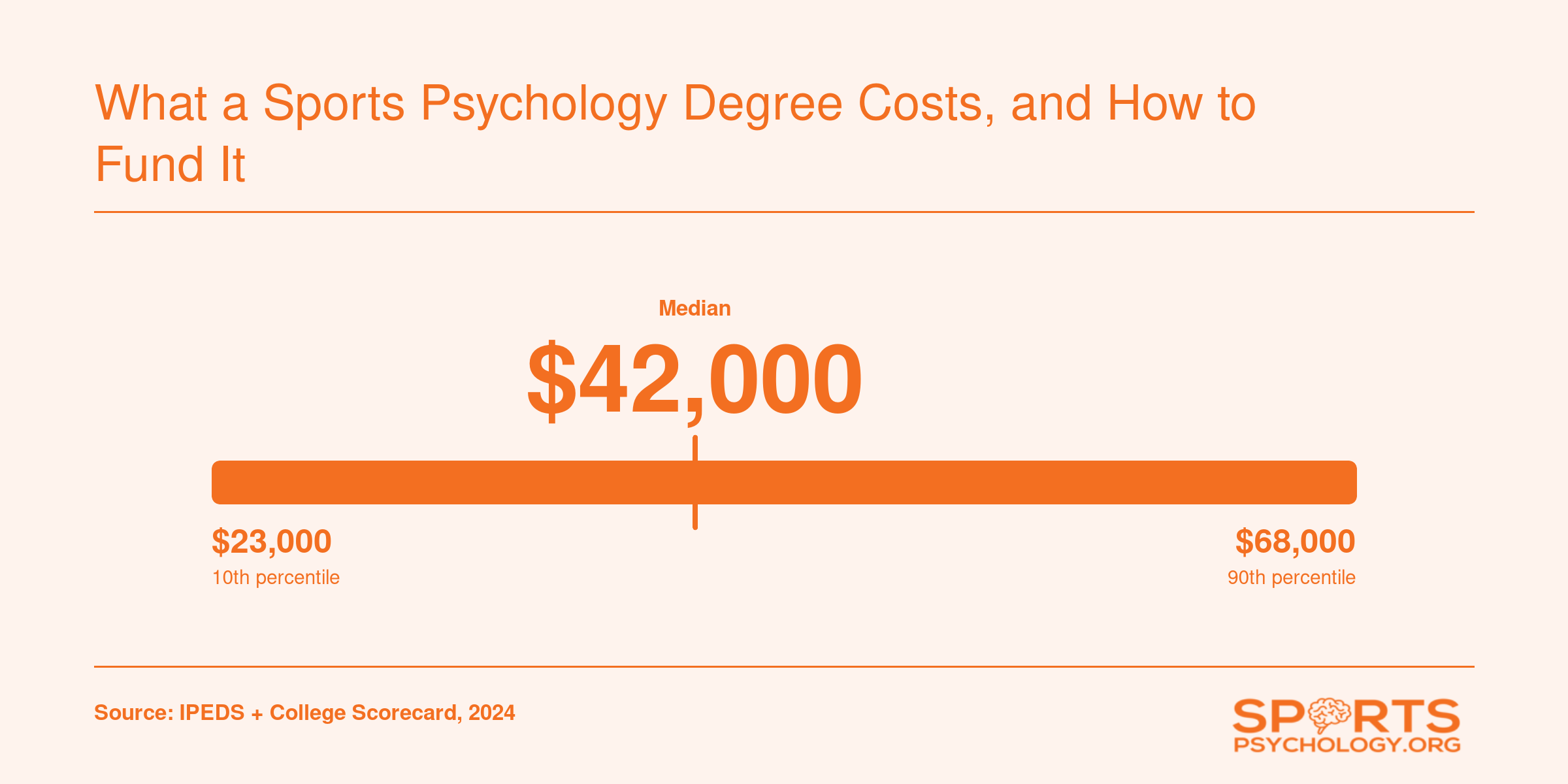
What a Sports Psychology Degree Costs, and How to Fund It

Tuition for online sports psychology programs varies widely depending on degree level, institution type, and residency status. Across the ranked programs on sportspsychology.org, total degree costs can range from roughly $20,000 at in-state public universities to well over $100,000 at private doctoral programs. To offset these costs, look into graduate assistantships (especially common in kinesiology and athletics departments), employer tuition reimbursement programs, federal financial aid including Direct Unsubsidized Loans, and scholarships offered through AASP. The cost-vs-return snapshot below shows the typical spread of median debt at graduation alongside first-year earnings for graduates of these programs, helping you weigh the investment against early career payoff.

Median first-year earnings for sports psychology graduates range from $23,000 at the 10th percentile to $68,000 at the 90th percentile, based on College Scorecard data

Admission Requirements and What to Expect in an Online Program

Knowing what admissions committees look for, and what daily life inside a program actually feels like, can help you prepare a stronger application and set realistic expectations for the years ahead. Requirements vary by degree level and institution, but a few patterns hold across most online sport psychology programs.

Typical Master's-Level Admission Requirements

Most master's programs in sport psychology ask for the following:

  • Minimum GPA: A cumulative undergraduate GPA of 3.0 on a 4.0 scale is the most common threshold, though some programs admit conditionally at 2.75.
  • GRE scores: An increasing number of programs have dropped the GRE requirement or made it optional. If a program still requests scores, competitive applicants typically land at or above the 50th percentile in verbal and quantitative reasoning.
  • Prerequisite coursework: Expect to show foundational credits in psychology, kinesiology, or a closely related field. Common prerequisites include introductory psychology, research methods, and statistics.
  • Letters of recommendation: Two to three letters from professors or professional supervisors who can speak to your academic ability and interest in the field.
  • Personal statement: A written essay outlining your career goals, relevant experience (coaching, athletic training, counseling), and reasons for pursuing sport psychology specifically.

What Doctoral Programs Add to the Mix

Doctoral programs in sport psychology typically require a completed master's degree for admission. On top of the criteria listed above, expect additional steps such as faculty interviews, a writing sample or published research, and a clear statement of research interests that align with faculty expertise at the institution. Fit between your goals and a potential advisor's lab can be a deciding factor.

The Online Student Experience

Online sport psychology coursework is delivered in one of two formats, or a blend of both. Asynchronous courses let you watch lectures, complete readings, and participate in discussion boards on your own schedule. Synchronous sessions, held via video conference at a set time, are more common in cohort-based programs and seminars that rely on group discussion or role-play exercises.

Program length generally falls in predictable ranges: two to three years for a master's degree, and four to six years for a doctorate. Most programs offer both full-time and part-time enrollment tracks, which is a significant advantage for working professionals or current athletes.

Practicum Hours and Capstone Options

One of the most important distinctions you will encounter is the choice between applied and research tracks. Applied or professional tracks emphasize supervised practicum hours and case studies, preparing you to work directly with athletes, teams, or organizations. Expect 200 to 400 or more supervised contact hours, often arranged at sites near your home with program approval. Research tracks, by contrast, center on a thesis or dissertation and prioritize publication, preparing graduates for academic or research careers.

Many master's programs let you choose between a thesis and a non-thesis capstone (such as a comprehensive exam or applied project). If you plan to pursue doctoral study later, completing a thesis can strengthen your application. If you intend to enter practice immediately after your master's, a non-thesis option paired with robust practicum hours may serve you better. Match the track to your career goal rather than defaulting to the path that seems quicker or easier.

Career Outcomes and Salary Potential for Sports Psychology Graduates

A sports psychology degree opens the door to several distinct career paths, each with its own timeline, earning potential, and professional requirements. Understanding what lies ahead can help you choose the right degree level and specialization from the start.

Primary Career Paths

Graduates of sport psychology programs typically pursue one of five professional directions:

  • Certified Mental Performance Consultant (CMPC): Work directly with athletes, teams, or performers on goal setting, focus, anxiety management, and mental skills training. CMPCs practice in private settings, with collegiate programs, or embedded in professional sports organizations.
  • Licensed Clinical or Counseling Psychologist (Sport Specialization): Diagnose and treat clinical conditions such as anxiety disorders, depression, and eating disorders within athletic populations. This path requires a doctoral degree plus supervised clinical hours.
  • Collegiate Athletics Staff: Serve in academic advising, student-athlete mental health support, or athletic department wellness roles. NCAA policy changes have increased demand for dedicated mental health professionals on campus.
  • Researcher or Professor: Conduct studies on performance, motivation, or athlete well-being while teaching at a university. A doctoral degree is typically required.
  • Corporate or Military Performance Consultant: Apply mental performance principles outside traditional sports. The U.S. military's growing investment in human performance optimization and the rise of esports psychology are expanding this lane considerably.

What Graduates Earn

Because sport psychology sits within the broader psychology field, salary data from the Bureau of Labor Statistics Occupational Outlook Handbook provides a useful baseline. Psychologists across all specialties earned a median annual wage of $94,310 as of 2024.1 Clinical and counseling psychologists earned a median of roughly $95,830.2 Those classified under the broader "all other psychologists" category, which can include performance consultants, reported a higher median of $117,580.1

Earnings vary widely by setting. Psychologists working in government roles earned a median of about $103,850, while those in hospitals and ambulatory healthcare services earned close to $98,600 to $98,700.1 Psychologists in educational settings earned less, with a median near $86,180. At the top end, clinical and counseling psychologists at the 90th percentile earned over $170,000 annually.2

Program-level earnings data from the schools ranked on sportspsychology.org can offer additional context. Where available, these figures show what graduates of specific programs earn one to two years after completing their degrees, providing a concrete complement to the broader national statistics. Keep in mind that early-career earnings often reflect entry-level or pre-licensure positions and tend to rise significantly once practitioners obtain full credentials.

How Long the Journey Takes

Timeline is one of the most common questions prospective students ask. From the start of a bachelor's program to becoming an independent, CMPC-eligible practitioner, expect roughly six to eight years, which includes an undergraduate degree plus a master's with mentored experience. If your goal is licensure as a clinical or counseling psychologist specializing in sport, plan for eight to twelve years total, factoring in a doctoral program and the supervised clinical hours required by most states.

Where Demand Is Growing

The job outlook for psychologists is favorable. The BLS projects 6% growth for psychologists overall from 2024 to 2034, with approximately 11,800 openings expected annually.1 Clinical and counseling psychologists specifically are projected to grow at an even faster rate of about 11% over a ten-year window.2

Three areas are driving particularly strong demand right now:

  • Collegiate athlete mental health, fueled by evolving NCAA mental health policies and greater institutional investment in student-athlete well-being.
  • Military performance optimization, where branches of the armed forces are hiring performance psychologists and mental skills consultants in increasing numbers.
  • Esports psychology, a newer but rapidly growing niche as competitive gaming organizations recognize the value of structured mental performance support.

While sport psychology remains a specialized field, its growth trajectory and the breadth of settings where graduates can work make it a career path with strong long-term potential.

Frequently Asked Questions About Sports Psychology Degrees

Choosing the right sports psychology degree involves a lot of moving parts, from program format and timeline to certification pathways and career options. Below are answers to the questions prospective students ask most often.

Can you get a sports psychology degree entirely online?
Yes. Many accredited universities now offer bachelor's, master's, and even doctoral programs in sport psychology fully online. Some programs do require a supervised practicum or residency component that involves in-person hours, but the coursework itself can typically be completed remotely. Always confirm a program's format before enrolling so you know exactly what is expected.
How long does it take to get a sports psychology degree?
A bachelor's degree generally takes about four years of full-time study. A master's degree adds roughly two years, and a doctoral program (PhD or PsyD) typically requires four to seven years beyond the bachelor's level. Accelerated and part-time options can shorten or extend these timelines. Prior coursework or transfer credits may also affect total time to completion.
What degree do you need to be a sports psychologist?
If you want to use the title "sport psychologist" and provide clinical services, most states require a doctoral degree in psychology plus licensure. If your goal is mental performance consulting and Certified Mental Performance Consultant (CMPC) certification, a master's degree in sport psychology or a closely related field is the minimum. Your intended career path determines the degree level you need.
How much does a sports psychology degree cost?
Tuition varies widely. Online master's programs in sport psychology can range from roughly $20,000 to over $60,000 total, depending on the school, residency status, and program length. Doctoral programs cost more and span more years. Financial aid, graduate assistantships, employer tuition benefits, and scholarships can significantly reduce out-of-pocket expenses.
What is the difference between a CMPC and a licensed sport psychologist?
A CMPC (Certified Mental Performance Consultant) focuses on performance enhancement skills such as goal setting, imagery, and focus training. This credential requires a master's degree plus supervised mentoring hours. A licensed sport psychologist holds a doctorate in psychology and state licensure, which allows them to diagnose and treat clinical mental health conditions in addition to addressing performance.
Do online sports psychology programs require in-person residencies or practica?
It depends on the program. Many online master's programs include a practicum or internship that must be completed in a real-world setting, such as working with a college athletic department or sports organization near you. Some doctoral programs also require brief on-campus residencies. Check each program's specific requirements so you can plan travel and scheduling accordingly.
What jobs can you get with a sports psychology degree?
Graduates work as mental performance consultants for professional, collegiate, or Olympic teams. Other common roles include academic researcher, wellness coordinator, rehabilitation counselor, or coach educator. With a doctoral degree and licensure, you can also provide clinical therapy. Employers range from universities and private practices to military organizations, corporate wellness programs, and youth sport academies.

Recent Articles