Best Sports Psychology Programs in Idaho for 2026

Compare degrees, costs, and career pathways at Idaho's top sport psychology schools

By Ryan Marston, MS, BCSReviewed by SportsPsychology.org TeamUpdated June 6, 202624 min read
Best Sports Psychology Programs in Idaho (2026 Guide)

What you’ll learn in this article…

  • Northwest Nazarene University is the only Idaho school offering a dedicated sports psychology bachelor's program in 2026.
  • Idaho recognizes three practice pathways: licensed psychologist, licensed counselor, and CMPC certified mental performance consultant.
  • Psychologist positions are projected to grow 6 percent nationally through 2032, driven by rising athlete mental health awareness.
  • Online accredited programs from out of state can fill gaps left by Idaho's limited local degree inventory.

Idaho's mix of Division I athletic programs, a thriving outdoor sports culture, and proximity to Olympic training facilities in Sun Valley creates steady demand for mental performance professionals. Yet the state currently offers just one dedicated sports psychology bachelor's program, housed at Northwest Nazarene University in Nampa, and no in-state doctoral track specifically titled "sport psychology."

That scarcity shapes every decision prospective students face: whether to pursue an undergraduate degree locally and transfer out for graduate work, enroll in an accredited online program, or relocate entirely. Students in states with similar geographic constraints, such as those exploring best online sports psychology degrees Alaska, often navigate the same tradeoffs. Earning the Certified Mental Performance Consultant credential, the field's gold-standard designation through AASP, still requires a graduate degree and supervised mentorship hours, a pipeline that Idaho is only beginning to build.

Best Sports Psychology Programs in Idaho: Rankings & Comparison

Idaho's sports psychology landscape is small but focused. Only one institution currently offers a dedicated sports psychology major at the undergraduate level, which means prospective students face fewer local options but can benefit from a highly specialized, well-structured program. If you are set on studying in Idaho, the program below merits serious consideration. If you need more variety in degree level or delivery format, you may also want to explore neighboring states or online programs reviewed elsewhere on sportspsychology.org.

Factors considered
  • Net price and affordability
  • Institutional graduation rate
  • Program curriculum and depth
  • Faculty ratio and student support
  • Graduate earnings outcomes
Data sources

Northwest Nazarene University

#1

Nampa, ID · $25,000 – $30,000/yr

Best for: Future grad students seeking hands-on sport psych training

Northwest Nazarene University in Nampa is the only Idaho institution offering a distinct Bachelor of Arts in Sports Psychology. The program is co-administered by the Department of Sport and Exercise Science and the Department of Psychology, giving students genuine dual-discipline training rather than a concentration tacked onto a single department. NNU's institution-wide graduation rate sits at roughly 71%, with a 14:1 student-to-faculty ratio, and the average net price comes in around $29,580. Note that the graduation rate reflects the university overall, not this specific major. Grounded in a faith-based framework, the program emphasizes ethical, compassionate care in athletic performance settings and is explicitly designed to prepare graduates for advanced study in sports psychology.

  • Bachelor of Arts requiring 52 total credits across two departments
  • 25 kinesiology credits paired with 27 psychology credits
  • Includes Introduction to Sport Psychology and Motor Development courses
  • Psychology and Techniques of Coaching prepares for real-world application
  • NFHS Level 1 National Coaching Certification required for graduation
  • Field experience and practicum work with athletes and teams
  • Courses in Abnormal Psychology, Social Psychology, and Research Design
  • Explicitly designed as a pipeline to graduate programs in sport psychology

Types of Sports Psychology Degrees Available in Idaho

Understanding the different degree levels in sports psychology, and which ones you can actually pursue in Idaho, is one of the first steps toward building a career in this field. The landscape can be confusing because program names vary widely across institutions, and Idaho's options are more limited than those in larger states. Here is a breakdown of what is available, what is accessible online, and how related programs can help you get where you want to go.

Bachelor's Degrees: Building the Foundation

Idaho's universities do not currently offer a standalone bachelor's degree labeled "sport psychology." That is fairly common nationwide. Instead, most aspiring sport psychologists start with a bachelor's in psychology, kinesiology, or exercise science at schools like Boise State University, the University of Idaho, or Idaho State University. These programs provide essential coursework in human behavior, anatomy, physiology, and research methods. Some allow you to take electives or concentrations that touch on sport and performance topics, giving you early exposure to the field before graduate school.

A bachelor's degree alone will not qualify you to practice as a sport psychologist, but it is the necessary launching pad. Think of it as your generalist training that positions you for a more specialized master's or doctoral program.

Master's and Doctoral Programs

Most practicing sport psychologists hold at least a master's degree, and those who want to provide clinical or counseling services typically need a doctorate. Within Idaho, you will find master's programs in counseling, exercise science, and related fields at several state universities. While none are specifically branded as a "sport psychology" master's program, a counseling psychology degree with a sport-focused emphasis can serve as a strong pathway, especially if paired with supervised applied experience in athletic settings.

For doctoral-level training in sport psychology, Idaho residents generally need to look at online or out-of-state options. Several nationally recognized programs offer online or hybrid doctoral degrees that Idaho students can complete without relocating. Students in similar situations may also want to explore sports psychology programs for Alaska students, since that state shares comparable geographic constraints and relies heavily on online pathways.

Graduate Certificates

Graduate certificates in sport psychology are increasingly popular for professionals who already hold a master's degree in a related discipline and want to add sport-specific credentials. These are typically available through online programs offered by out-of-state universities and can be completed in one to two semesters.

Clearing Up the Confusion: Sport Psychology vs. Related Fields

One of the most common sources of confusion is the overlap between sport psychology, kinesiology, exercise science, and counseling psychology. Here is a quick way to think about the distinctions:

  • Sport psychology focuses specifically on the mental and emotional factors that influence athletic performance, including motivation, focus, anxiety management, and team dynamics.
  • Kinesiology and exercise science emphasize the physical and biomechanical aspects of movement and fitness, though some programs include a sport psychology track.
  • Counseling psychology trains you to diagnose and treat mental health conditions, which becomes relevant if you want to work clinically with athletes dealing with issues like depression, eating disorders, or trauma.

A "true" sport psychology program integrates performance enhancement techniques with behavioral science. If your goal is to become a Certified Mental Performance Consultant (CMPC) or a licensed psychologist who works with athletes, pay close attention to whether a program's curriculum aligns with the competencies required by the Association for Applied Sport Psychology or your state's licensing board.

Using Idaho's Adjacent Programs as Stepping Stones

Even without a dedicated sport psychology program in the state, Idaho students have practical options. Pursuing a degree in counseling at Idaho State University, for example, provides the clinical training needed for licensure, and you can supplement it with sport-specific coursework or practicum placements with college athletic departments. Professionals already working in mental health may find value in leveraging your mental health background for a career in sports psychology. Similarly, exercise science programs at Boise State or the University of Idaho can pair well with a graduate certificate in sport psychology from an accredited online provider.

The key is to be intentional about building a curriculum that combines foundational science, applied mental performance training, and supervised experience with athletes.
Questions to Ask Yourself

Do you want to work directly with athletes as a mental performance consultant, or focus on clinical psychology with a sports emphasis?
This distinction shapes your entire degree path. A mental performance route typically leads to CMPC certification, while a clinical sports psychology track requires a doctoral degree and state licensure, meaning significantly more time and cost.
Are you open to earning your degree online from an out-of-state institution, or do you need an on-campus experience in Idaho?
Idaho has a limited number of dedicated sport psychology programs. Being open to accredited online options expands your choices considerably, but on-campus programs offer face-to-face mentorship and local practicum placements with Idaho athletic teams.
Do you plan to pursue CMPC certification, state licensure as a psychologist, or both?
CMPC certification requires a graduate degree with specific sport psychology coursework and a mentored experience. Idaho psychologist licensure requires a doctorate and supervised clinical hours. Pursuing both demands careful planning so your program satisfies overlapping requirements.
What is your timeline, and how will you fund your education?
A master's degree may take two to three years, while a doctorate can take five to seven. Tuition, assistantship availability, and whether you qualify for Idaho resident rates all affect the total investment and how quickly you can begin practicing.
Are you drawn to working with elite or professional athletes, youth sports, or a broader wellness population?
Your target clientele influences which program fits best. Some programs emphasize performance optimization for competitive athletes, while others integrate counseling skills suited for youth development or general mental health practice with an athletic population.

How Much Do Sports Psychology Programs Cost in Idaho?

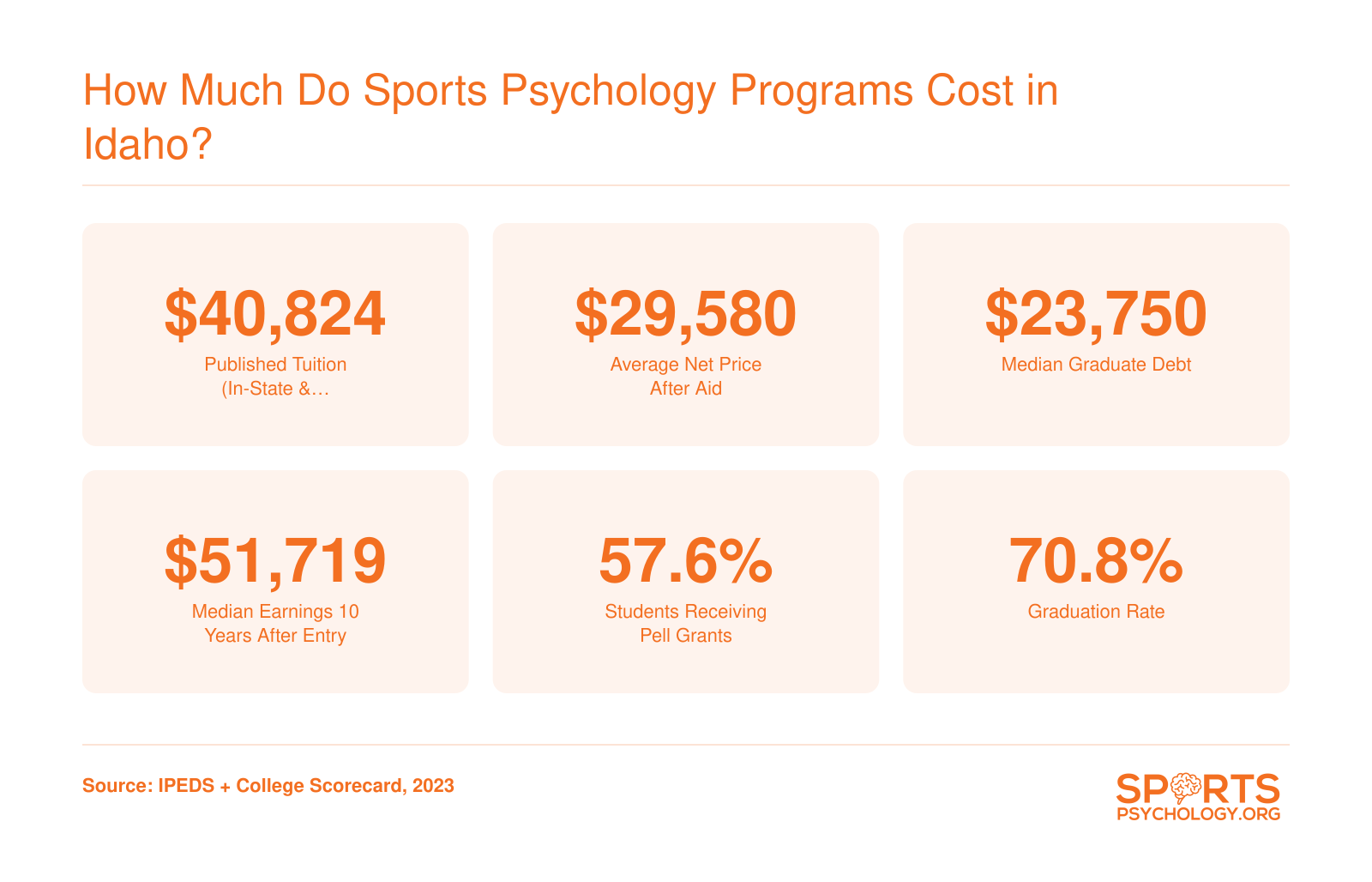
Idaho currently has one dedicated Sports Psychology bachelor's program, offered at Northwest Nazarene University in Nampa. Below is a cost snapshot to help you plan your investment. Keep in mind that the net price shown is an institution-wide average after financial aid and does not represent a guaranteed quote for every student.

Northwest Nazarene University sports psychology cost snapshot: $40,824 tuition, $29,580 net price, $23,750 median debt, $51,719 median earnings at 10 years

Online vs. On-Campus Sports Psychology Programs in Idaho

Idaho's in-state program inventory for sports psychology is relatively small, which means many aspiring practitioners will weigh online options from accredited out-of-state schools alongside the handful of local campus programs. Both formats have genuine advantages, and the right choice depends on your career stage, learning preferences, and how much you value hands-on access to Idaho's athletic community. Here is a practical breakdown to help you decide.

Pros

  • Online programs offer scheduling flexibility that works well for working coaches, athletes, or professionals already employed in Idaho's sports industry.
  • Studying online expands your options significantly, giving you access to AASP-aligned curricula from accredited programs nationwide without relocating.
  • Online tuition and total program costs are often lower because you avoid campus fees, housing expenses, and commuting costs.
  • Asynchronous coursework lets you complete assignments around practice schedules, game days, or other athletic commitments.
  • On-campus programs in Idaho provide direct practicum access with university athletic departments, club teams, and local sports organizations.
  • Attending in person supports stronger mentorship relationships with faculty and practicing sport psychology professionals in the region.
  • Campus-based students benefit from networking at Idaho sporting events, conferences, and community partnerships that can lead to supervised experience hours.
  • In-person lab work and applied research opportunities are easier to coordinate when you are physically present on a university campus.

Cons

  • Online students may struggle to secure local practicum placements or supervised hours required for CMPC certification without proactive planning.
  • Remote learning can feel isolating, making it harder to build the peer and professional network that supports long-term career growth in Idaho.
  • On-campus options in Idaho are limited, so students committed to in-person learning may face fewer program choices or longer commutes.
  • Campus programs typically carry higher total costs when you factor in housing, transportation, and mandatory on-campus fees.
  • Hybrid or on-campus schedules are less forgiving for students balancing full-time employment or athletic training responsibilities.
  • Some online programs from out-of-state schools may not align with Idaho-specific licensure requirements, so careful vetting is essential before enrolling.

Admissions Requirements & Application Tips for Idaho Sport Psychology Programs

Getting into a sport psychology program takes more than strong grades. Admissions committees want to see that you understand the field, have relevant experience, and can articulate why you belong in the profession. Here is what to expect and how to put your best application forward.

GPA Thresholds and Prerequisite Coursework

Most master's programs in sport psychology require a minimum undergraduate GPA between 2.75 and 3.0. The University of Western States' online M.S. in Sport and Performance Psychology sets the bar at 2.752, while programs like those at the University of Idaho and Idaho State University typically require a 3.0.34 Doctoral programs raise the stakes further, generally expecting a 3.0 at minimum and preferring applicants with a 3.3 to 3.5 or higher.

Regardless of your undergraduate major, expect to complete prerequisite coursework in areas such as general psychology, research methods, and statistics before enrolling. Some programs also look for courses in exercise science, human development, or abnormal psychology. If you are coming from a different field, our guide on exercise science, performance psychology transitions can help you map out the prerequisite path. If you are missing prerequisites, community college or online courses can fill those gaps before you apply.

GRE Expectations and Test-Optional Trends

The GRE landscape has shifted significantly in recent years. Some Idaho-accessible programs, including the University of Idaho's graduate offerings, do not require standardized test scores at all.3 Idaho State University requires the GRE or MAT for certain programs but may waive the requirement for applicants with a GPA of 3.5 or above.4 Doctoral programs are more likely to still require GRE scores, so check each school's current policy well before your target deadline. If a program is test-optional, consider whether a strong GRE score could strengthen an otherwise borderline application.

Crafting a Strong Application

Your personal statement is often the most influential piece of your application. Admissions committees want to understand the thread connecting your background in athletics, coaching, or mental performance to your goals in sport psychology. Be specific: describe a moment that sparked your interest, the populations you hope to serve, and how the program's curriculum aligns with your career vision. Generic statements about "helping athletes" rarely stand out. If you are wondering how to become a sports psychologist and what admissions teams really look for, breaking your story into concrete experiences will serve you well.

Beyond your essay, prepare these key components:

  • Letters of recommendation: Most master's programs require two to three letters. Seek recommenders who can speak to your academic ability and your engagement with psychology or sport, such as psychology faculty, coaches, or supervisors from volunteer work.
  • Relevant experience: Volunteer hours with college athletic departments, youth sport organizations, or campus counseling centers demonstrate initiative. Even informal peer mentoring or coaching roles can strengthen your candidacy.
  • Background check: Some programs, including the University of Western States, require a background check as part of the admissions process.2
  • English proficiency: International applicants should note that programs like the University of Idaho require a TOEFL score of at least 79 or an IELTS score of 6.5.3

Application Deadlines to Keep in Mind

Most graduate sport psychology programs operate on a fall admission cycle. For master's programs, application deadlines typically fall between January and March, giving you the summer to prepare before classes begin in August or September. Doctoral programs often have earlier deadlines, frequently in the first two weeks of December. Start gathering materials at least three to four months before the deadline so you have time to request transcripts, secure recommendation letters, and revise your personal statement.

Planning ahead and presenting a cohesive narrative across your application materials will set you apart in a competitive applicant pool. Use each school's admissions page to confirm the most current requirements before you begin.

Sports Psychology Licensure & CMPC Certification in Idaho

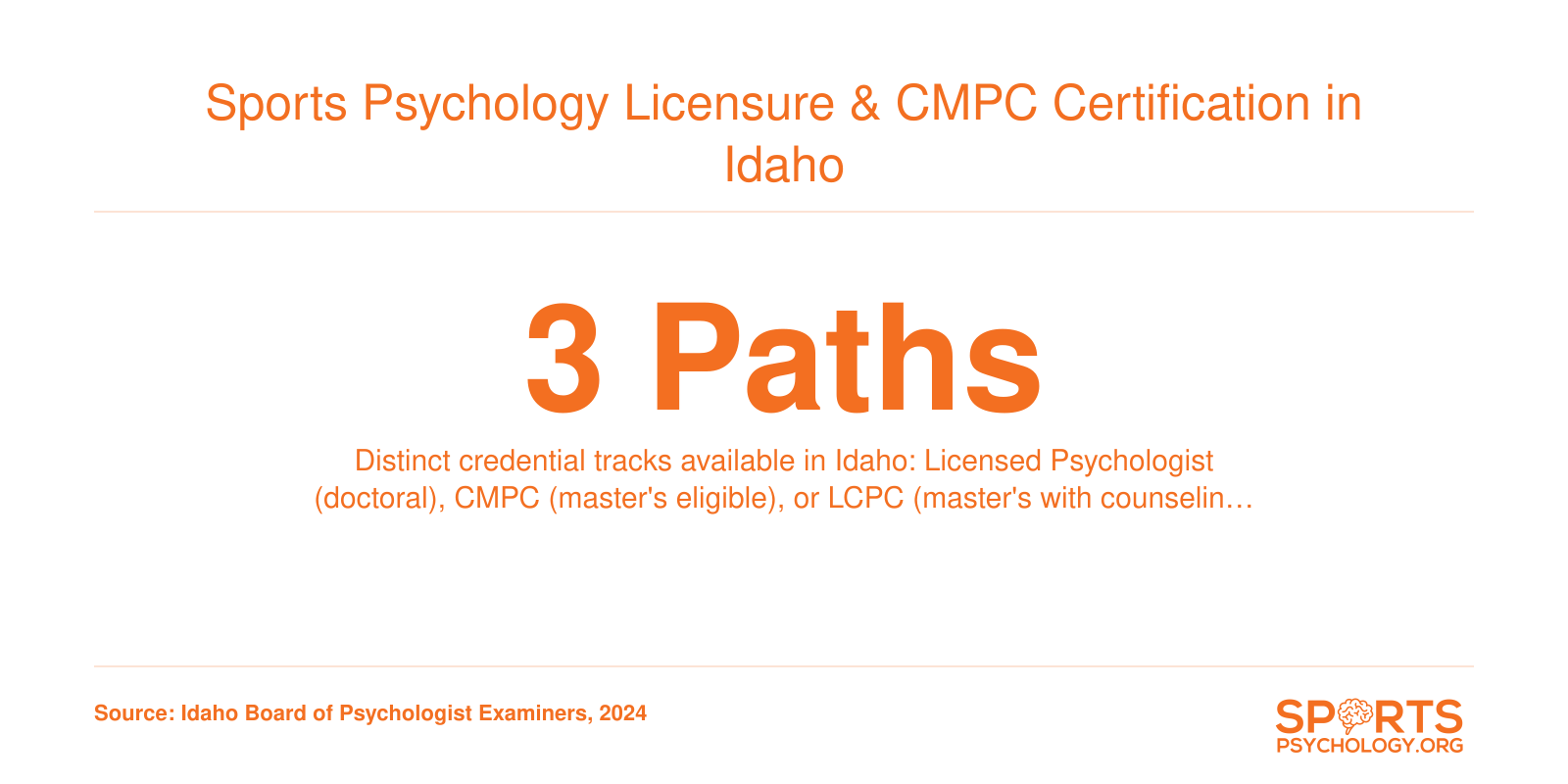
Idaho offers three distinct pathways to practice sports psychology, each with different education levels and scopes of practice. Licensed psychologists must earn a doctoral degree and pass the EPPP through the Idaho Board of Psychologist Examiners. Those with a master's degree can pursue CMPC certification through AASP to work as mental performance consultants, or earn Licensed Clinical Professional Counselor (LCPC) status to provide counseling with a sport psychology focus. The doctoral track requires approximately 2,000 supervised hours (including up to 1,000 postdoctoral hours), while the CMPC path requires mentored experience and a certification exam at the master's level.

Infographic showing three credential pathways for sports psychology practice in Idaho as of 2026.

The Bureau of Labor Statistics projects a 6 percent growth rate for psychologist positions between 2022 and 2032, outpacing many other occupations. As athlete mental health awareness continues to rise across collegiate and professional sports, demand for specialized sport psychology professionals is expected to grow even faster in the years ahead.

Sports Psychology Careers & Salary Outlook in Idaho

So what can you do with a sports psychology degree in Idaho? The answer depends on your education level and career goals, but the state offers a surprisingly diverse set of pathways, from hands-on work with athletes to remote consulting roles that reach clients across the country.

Career Roles to Explore

A degree in sports psychology can prepare you for several rewarding roles:

  • Mental performance consultant: Work directly with athletes and teams to develop focus, resilience, and competitive mindset skills. Many consultants pursue the Certified Mental Performance Consultant (CMPC) credential through the Association for Applied Sport Psychology.
  • Sport counselor or mental health counselor: With appropriate licensure, you can address clinical concerns such as performance anxiety, burnout, eating disorders, and identity transitions in athletes.
  • Academic researcher: Pursue faculty or research positions at universities, studying topics like motivation, team dynamics, or injury recovery psychology.
  • College athletic department staff: Idaho's university athletic programs, including Boise State University, hire professionals in student-athlete wellness, academic support, and sport science.
  • Private practice: Launch or join a private sports performance clinic serving recreational athletes, youth sport organizations, or professional clients.

If you're weighing whether to pursue the clinical sports psychology path or focus purely on performance enhancement, that decision will shape both your degree requirements and your long-term career options.

Salary Landscape in Idaho

Salary expectations vary widely depending on the role and credential level. According to Bureau of Labor Statistics data from May 2023, clinical and counseling psychologists in Idaho earned a median annual wage of roughly $65,600, while the broader "all other psychologists" category (which can include sport-focused roles) reported a median of about $105,700, though that category represented only about 50 employed professionals statewide.1 Mental health counselors in Idaho earned a median of approximately $58,400.1

For context, graduates of Northwest Nazarene University, which offers a dedicated sports psychology bachelor's degree, reported median earnings of about $51,700 ten years after enrollment across all programs at the institution. Program-specific earnings data for the sports psychology major are not yet available, so treat that figure as a general institutional benchmark rather than a sport psychology salary projection.

In the Southwestern Idaho region, clinical and counseling psychologists earned a median annual wage near $93,800 as of May 2024, according to Idaho Department of Labor estimates, reflecting a competitive market in the Boise metro area.2

Local Practicum and Employment Opportunities

Idaho may be a smaller market, but it has genuine opportunities for aspiring sport psychology professionals. Boise State athletics is the state's highest-profile collegiate program and a natural practicum or employment setting. The Idaho Steelheads (ECHL hockey) and other semi-professional teams can offer applied consulting experience. Sun Valley's competitive ski programs provide a niche pathway for those interested in winter sports performance. High school athletic departments statewide increasingly recognize the value of mental skills training, and youth sports psychologist roles are growing in visibility. Private sports performance clinics in the Boise area represent an expanding sector as well.

Thinking Beyond State Lines

Here is the honest reality: Idaho's sports psychology job market is relatively small. Total employment of psychologists in the state numbers in the hundreds, and dedicated sport psychology positions are a fraction of that.1 Many Idaho-trained graduates build careers by working remotely with clients across the country, leveraging telehealth and virtual coaching platforms. Others relocate to larger metro areas with more professional and collegiate teams.

Rather than viewing this as a drawback, consider it a strategic advantage. A degree earned in Idaho, especially one grounded in applied fieldwork and practicum hours, positions you to serve a growing nationwide demand for mental performance services. The flexibility of remote consulting means you can live in Boise or Sun Valley while building a client roster that spans multiple states. Idaho's lower cost of living compared to major metro areas makes this an especially attractive model for early-career professionals building a practice.

How to Choose the Right Sports Psychology Program in Idaho

Choosing the right sports psychology program is one of the most consequential decisions you will make on this career path. Idaho has a limited but growing selection of programs, so a structured decision framework will help you evaluate each option clearly and avoid costly missteps.

Start With Accreditation and Certification Alignment

Before anything else, confirm that any program you are considering holds regional accreditation. If you plan to pursue a doctoral degree with the goal of clinical licensure, look for APA accreditation or a program that meets state licensing board requirements. Equally important for aspiring performance consultants: verify whether the curriculum aligns with the coursework requirements set by the Association for Applied Sport Psychology (AASP) for the Certified Mental Performance Consultant (CMPC) credential. Not every program that mentions sport psychology in its title will cover the specific content areas AASP requires, including performance enhancement, counseling skills, sport science foundations, and supervised applied experience. If CMPC certification is your goal, cross-reference each program's course catalog against AASP's published requirements before you apply.

Evaluate Faculty Credentials and Practicum Access

The people who teach and mentor you matter as much as the coursework. Look for faculty who hold the CMPC designation, maintain active research agendas, or have hands-on consulting experience with athletes. Programs where faculty are publishing in peer-reviewed journals or presenting at conferences tend to offer richer mentorship and stronger professional networks. Practicum placements are another critical factor. Ask specifically where students complete applied hours, whether with university athletic departments, community sport organizations, or clinical settings, and how many supervised hours are available before graduation.

Match the Program to Your Career Goal and Lifestyle

Your ideal program depends on where you want to end up professionally. Understanding the distinction between the clinical vs. performance focus is essential before committing to a degree path.

  • Clinical licensure path: You will likely need a doctoral program in counseling or clinical psychology with a sport psychology emphasis.
  • Performance consulting path: A master's program aligned with CMPC coursework requirements may be sufficient to begin consulting work.
  • Coaching or education path: An undergraduate or master's degree in exercise science or kinesiology with sport psychology coursework can open doors in coaching, teaching, or youth development.

Consider practical fit factors as well. If you are working full-time or live far from a campus, an online or hybrid format may be the better choice. Compare tuition, fees, and financial aid packages across programs. Idaho's public universities generally offer lower in-state tuition, but some private or out-of-state online programs may provide competitive scholarship opportunities that close the gap. Students in neighboring states face similar challenges; those exploring sports psychology in Wyoming will find comparable considerations around program availability and format.

Contact Program Directors Directly

One of the most underused strategies is simply reaching out to program directors or department chairs. A brief email or phone call can reveal information you will not find on a website, such as recent graduate outcomes, typical practicum placement sites, faculty-to-student ratios, and whether current students feel supported in their professional development. Ask about mentorship structures, thesis or capstone expectations, and how the program helps graduates transition into careers or advanced training. The quality of the response you receive can itself be a telling indicator of program culture.

Taking the time to work through these considerations methodically will help you invest your time and tuition dollars in a program that genuinely moves you toward the career you want in sports psychology.

Frequently Asked Questions About Sports Psychology Programs in Idaho

Below you will find answers to some of the most common questions prospective students ask about pursuing sports psychology education in Idaho. For deeper coverage of any topic, explore the corresponding sections earlier in this guide on sportspsychology.org.

What colleges in Idaho offer sports psychology degrees?
Idaho does not currently have a standalone sports psychology major at most institutions. However, Boise State University and the University of Idaho offer related programs in kinesiology, exercise science, and psychology with sport and performance emphases. Some smaller Idaho colleges also incorporate sport psychology coursework into their exercise science or coaching programs. Students looking for a dedicated sport psychology track may also consider online options from regionally accredited universities.
Can you get a sports psychology degree online in Idaho?
Yes. While Idaho based institutions offer limited dedicated sport psychology programs, several regionally accredited universities outside the state provide fully online bachelor's and master's degrees in sport psychology that Idaho residents can complete. Online programs offer scheduling flexibility and sometimes lower tuition. When evaluating online options, confirm that the program aligns with certification requirements from organizations like the Association for Applied Sport Psychology (AASP).
What is the difference between a sports psychology degree and a kinesiology degree?
A sports psychology degree focuses on the mental and emotional factors that influence athletic performance, including motivation, anxiety management, and team dynamics. A kinesiology degree centers on the science of human movement, covering biomechanics, exercise physiology, and physical rehabilitation. There is overlap, and some kinesiology programs include sport psychology coursework. Your choice should depend on whether your career goals lean more toward mental performance consulting or physical performance and rehabilitation.
How do you become a licensed sports psychologist in Idaho?
In Idaho, the title "psychologist" requires licensure through the Idaho Bureau of Occupational Licenses. You typically need a doctoral degree in psychology, supervised clinical hours, and a passing score on the Examination for Professional Practice in Psychology (EPPP). If you prefer a non clinical path, you can pursue the Certified Mental Performance Consultant (CMPC) credential through AASP, which requires a master's degree or higher, mentored experience, and a certification exam.
Are there any AASP-approved sports psychology programs in Idaho?
As of 2026, no Idaho institution holds a specific AASP approved graduate program designation. Students interested in earning the CMPC credential can still meet AASP coursework requirements by combining relevant classes from Idaho universities or by enrolling in AASP approved programs offered online by out of state institutions. Checking the AASP directory regularly is a good practice, as program approvals are updated periodically.
What can you do with a sports psychology degree in Idaho if you don't want to be a therapist?
Plenty of non clinical career paths exist. With a sports psychology background you can work as a mental performance consultant for college or high school athletic departments, coach wellness and resilience programs, or join corporate settings that use performance psychology principles. Roles in sports media, athletic administration, strength and conditioning coordination, and youth sport development organizations are also viable options in Idaho's growing sports community.

Recent Articles