No South Dakota university offers a standalone sport psychology degree, so online accredited programs are the primary pathway.
Two career tracks exist: licensed psychologist requiring a doctorate or Certified Mental Performance Consultant requiring a master's degree.
Combining undergraduate coursework at USD or SDSU with an online graduate program creates a cost-effective route into the field.
The Bureau of Labor Statistics projects 6 percent job growth for psychologists over the next decade, boosting demand statewide.
No university in South Dakota currently offers a standalone sport psychology degree at the undergraduate or graduate level. For students in the state, that creates a real tension: the demand for mental performance work with athletes is growing, but the closest accredited programs are hundreds of miles away or, increasingly, online.
The practical solution is straightforward. Regionally accredited online programs across the country accept South Dakota residents, and their curricula align with the coursework requirements set by both the South Dakota Board of Examiners of Psychologists and the Association for Applied Sport Psychology's CMPC credential. South Dakota's licensure process does not require that your degree come from an in-state institution, so an online master's or doctorate can put you on the same professional track as graduates of traditional campus programs. Students in neighboring states face a similar landscape, as online sports psychology programs north dakota also rely heavily on remote options. What matters most is choosing a program that matches your target credential and includes supervised applied hours you can complete locally.
Best Online Sports Psychology Programs for South Dakota Students
South Dakota does not currently offer a dedicated sport psychology degree program at any in-state college or university. The good news: a growing number of nationally accredited schools deliver high-quality sports psychology programs entirely online, making them fully accessible to students in Sioux Falls, Rapid City, or anywhere across the state. The programs below were evaluated using a mixed quality composite that weighs institutional outcomes, affordability, and program-level strengths. Program-level earnings data is not yet available for these specific programs, so the institution-wide figures reported below reflect median earnings across all graduates ten years after enrollment.
Factors considered
Institution graduation and retention rates
Net price after financial aid
Program curriculum and delivery format
Certification and career alignment
Institution-wide graduate earnings
Data sources
NCES-IPEDS federal institutional data — nces.ed.gov
Best for: Undergrads seeking a sport counseling foundation
Arizona State University combines strong institutional outcomes with a fully online bachelor's program focused on sport and performance counseling. With an institution-wide graduation rate of 68% and a net price of $14,967, ASU gives South Dakota students access to a large research university's resources without relocating. The 120-credit curriculum includes a required internship, and graduates report institution-wide median earnings of $62,668 ten years after enrollment.
Counseling and Applied Psychological Science, Sport and Performance Counseling — Online
Online Bachelor of Science degree
Sport and Performance Counseling concentration
120 credit hours across 40 accelerated 7.5-week courses
Required internship in a sport or mental health setting
Admission options include 3.00 GPA or top 25% class rank
ACT/SAT scores optional for admission
Earned Admission pathway available for 2.75 GPA applicants
Best for: Graduate students preparing for CMPC certification
Southern Illinois University-Edwardsville stands out for its 100% online master's program that directly aligns coursework with Certified Mental Performance Consultant (CMPC) certification requirements. The program can be completed in as few as 12 months, making it one of the faster graduate options on this list. With a net price of $14,889 and an institution-wide graduation rate of 57%, SIUE offers solid value for South Dakota residents who want a focused, career-ready credential.
MS in Kinesiology, Exercise and Sport Psychology — Hybrid
Master of Science with Exercise and Sport Psychology specialization
100% online with evening and asynchronous course options
Completable in 12 to 22 months
Coursework aligned with CMPC certification requirements
Strong faculty mentoring and personalized advising
Connects students to Division I athletics environment
Best for: Working adults wanting an accelerated online bachelor's
California Baptist University offers a fully asynchronous Bachelor of Science in Sport and Performance Psychology that can be completed in just 16 months of full-time study. Six entry points per year and year-round admissions make it especially transfer-friendly. The institution-wide graduation rate is about 62%, and institution-wide median earnings reach $61,504 at the ten-year mark. The net price of $26,285 is higher than the public options on this list, but the accelerated timeline can offset total cost.
Sport and Performance Psychology, BS — Online
Online Bachelor of Science, 100% asynchronous
49 units required, completable in 16 months full-time
$520 per unit plus fees
Six entry points per year with rolling admissions
Covers exercise physiology, behavioral and cognitive psychology
Southern Connecticut State University delivers a hybrid Master of Science in Exercise Science with a Sport Psychology concentration, explicitly designed to prepare students for the CMPC exam. The 33-to-34-credit interdisciplinary program draws faculty from three departments, and tuition discounts through the NEBHE Flexible Program may lower costs for qualifying students. The institution-wide graduation rate is about 50%, and the net price sits at $20,857. An 11-to-1 student-to-faculty ratio means more direct interaction with professors.
Exercise Science, M.S., Sport Psychology — Hybrid
Master of Science, 33 to 34 credits
Sport Psychology concentration with CMPC exam prep
Hybrid format combining online and on-campus coursework
Interdisciplinary faculty from three academic departments
Tuition discounts available through NEBHE Flexible Program
Covers health psychology, counseling, and performance enhancement
Texas A&M University-Kingsville offers a hybrid M.S. in Kinesiology with a Performance Psychology concentration that aligns with the Association for Applied Sport Psychology's standards. Students choose from three degree plans: a 36-credit course-only track, a 36-credit option with an internship or research project, or a 30-credit thesis track. With a net price of just $12,090, it is among the most affordable graduate options on this list. The institution-wide graduation rate is about 42%.
M.S. in Kinesiology, Performance Psychology — Hybrid
Performance Psychology concentration within Kinesiology M.S.
Troy University provides a hybrid Master of Science in Kinesiology with a Sports Psychology concentration that balances online flexibility with hands-on internship experiences alongside athletes. The program has no set application deadline, giving South Dakota students the ability to apply when ready. Institution-wide median earnings stand at $42,062 at ten years, and the net price is $16,527. The institution-wide graduation rate is roughly 50%.
Master of Science in Kinesiology, Sports Psychology — Hybrid
Master of Science with Sports Psychology concentration
Flexible online coursework with some on-campus components
Hands-on internships working directly with athletes
No application deadline for admissions
Curriculum covers motor skills and mental performance
Faculty bring professional sports psychology experience
Kent State University's fully online Bachelor of Science in Sport, Exercise and Performance Psychology covers motivation, mental training, stress management, and injury psychology across 120 credit hours. The program includes a practicum for applied experience and prepares graduates for coaching roles or graduate study. The institution-wide graduation rate is about 64%, and the net price is $20,787. Institution-wide median earnings reach $45,388 ten years after enrollment.
Sport, Exercise and Performance Psychology — Online
100% online Bachelor of Science, 120 credit hours
Covers motivation, stress management, and injury psychology
Includes a practicum for applied experience
Designed for completion in four years
Transfer students and international students accepted
National University stands apart by offering sports psychology programs at every degree level: bachelor's, master's, and doctorate, all 100% online. Weekly start dates and a no-application-fee policy make enrollment straightforward for South Dakota students on any timeline. Multiple master's tracks align with CMPC and AASP certification standards, and the doctoral program includes a dissertation with personalized faculty mentoring. The net price is $22,878, and institution-wide median earnings reach $67,548, the highest on this list.
Adams State University offers one of the most affordable online master's options on this list, with a net price of $12,980 and a 36-credit M.S. in Kinesiology emphasizing Applied Sport Psychology. The fully online program can be completed in two years and includes internships plus a capstone project. No entrance exam is required for admission. The institution-wide graduation rate is about 39%, and median earnings institution-wide are $44,372 at ten years.
Master of Science in Kinesiology, Applied Sport Psychology — Online
36-credit online program with Applied Sport Psychology emphasis
Completable in two years
Covers mental strength, ethics, case studies, and diversity
Includes internships and a capstone project
No entrance exam required for admission
All coursework delivered online for working professionals
Springfield College brings the highest institution-wide graduation rate on this list at about 74% and pairs it with a fully asynchronous online Master of Education in Sport and Exercise Psychology. The 36-credit program features a 135-hour supervised internship with remote supervision, making it practical for South Dakota students who cannot travel. An 11-to-1 student-to-faculty ratio supports close mentoring. The net price of $30,587 is the highest here, reflecting its private-institution status.
MEd in Sport and Exercise Psychology Online — Online
36-credit Master of Education, 100% asynchronous online
Completable in 18 months full-time
Courses offered in 7-week and 15-week formats
135-hour applied internship with remote supervision
No entrance exam required for domestic applicants
Rolling admissions with fall semester start
Interdisciplinary approach blending theory and practice
Why South Dakota Students Turn to Online Sports Psychology Programs
If you have searched for sports psychology programs in South Dakota, you have probably noticed a gap. No university in the state currently offers a standalone sport psychology degree at the undergraduate or graduate level. That reality sends many motivated students toward online programs, and the good news is that the online route can be every bit as rigorous and career-ready as an on-campus option.
What South Dakota Schools Do Offer
The University of South Dakota (USD) and South Dakota State University (SDSU) both maintain strong departments in psychology and kinesiology, respectively. You can earn a solid foundation in either discipline at these institutions, but neither campus has combined those fields into a dedicated sport psychology track. Students in neighboring states face a similar landscape, as sports psychology programs for North Dakota students also lean heavily on online options. A later section of this guide walks through how to strategically pair coursework from USD or SDSU with a specialized online program to build a competitive credential.
Advantages of Going Online From South Dakota
Online programs open doors that geography otherwise closes. Here are several reasons South Dakota students find the format especially appealing:
CACREP-accredited options: Several online master's programs in clinical mental health counseling carry CACREP accreditation and include sport psychology concentrations, meeting the gold standard many state licensing boards expect.
AASP-aligned curricula: Programs designed around Association for Applied Sport Psychology guidelines prepare you for the Certified Mental Performance Consultant (CMPC) credential, a widely recognized mark of competence in the field.
In-state practicum flexibility: Because coursework happens remotely, you can stay in South Dakota and complete practicum or fieldwork hours with local athletic departments, sports medicine clinics, or collegiate teams rather than relocating.
Scheduling around existing commitments: Many aspiring sport psychologists in South Dakota are former or current athletes, coaches, or working professionals. Asynchronous course delivery lets you build your education around your life instead of the other way around.
Meeting South Dakota Licensure Standards Through Online Study
One concern students frequently raise is whether an online degree will satisfy the South Dakota Board of Examiners of Psychologists. The short answer: yes, provided the program holds proper regional and programmatic accreditation. Accredited online doctoral and master's programs are treated the same as their on-campus counterparts when you apply for licensure. Students in the Upper Midwest region, including those exploring best sports psychology programs in Minnesota, often navigate the same accreditation questions. The specifics of what the Board requires, including supervised practice hours and exam thresholds, are covered in the licensure section of this guide.
The bottom line is straightforward. South Dakota may not have a homegrown sport psychology degree, but the combination of quality online programs and local fieldwork opportunities means you do not have to leave the state to launch this career.
Questions to Ask Yourself
Do you want to provide clinical therapy to athletes or focus on mental performance coaching?
This choice determines your entire educational path. Licensed psychologists diagnose and treat clinical conditions like anxiety and depression in athletes, while Certified Mental Performance Consultants (CMPCs) specialize in skill building, focus, and competitive mindset without a clinical scope.
Are you prepared to commit five to seven years to a doctoral program, or would you prefer entering the field sooner with a master's degree?
A doctoral route (Ph.D. or Psy.D.) is required for clinical licensure in South Dakota, but a master's degree can qualify you for CMPC certification and allow you to begin consulting with athletes in roughly two to three years.
Can you complete supervised practice hours within South Dakota, or are you open to relocating temporarily?
South Dakota has a limited number of approved supervisors in sport psychology. If local placements are scarce, you may need to arrange remote supervision or relocate briefly to accumulate the required hours for licensure or CMPC certification.
Does your budget support a residential program, or do you need the flexibility of an online degree?
Online programs let you stay in South Dakota, maintain employment, and reduce relocation costs. However, some residential programs offer funded assistantships and direct access to collegiate athletic departments that can strengthen your practicum experience.
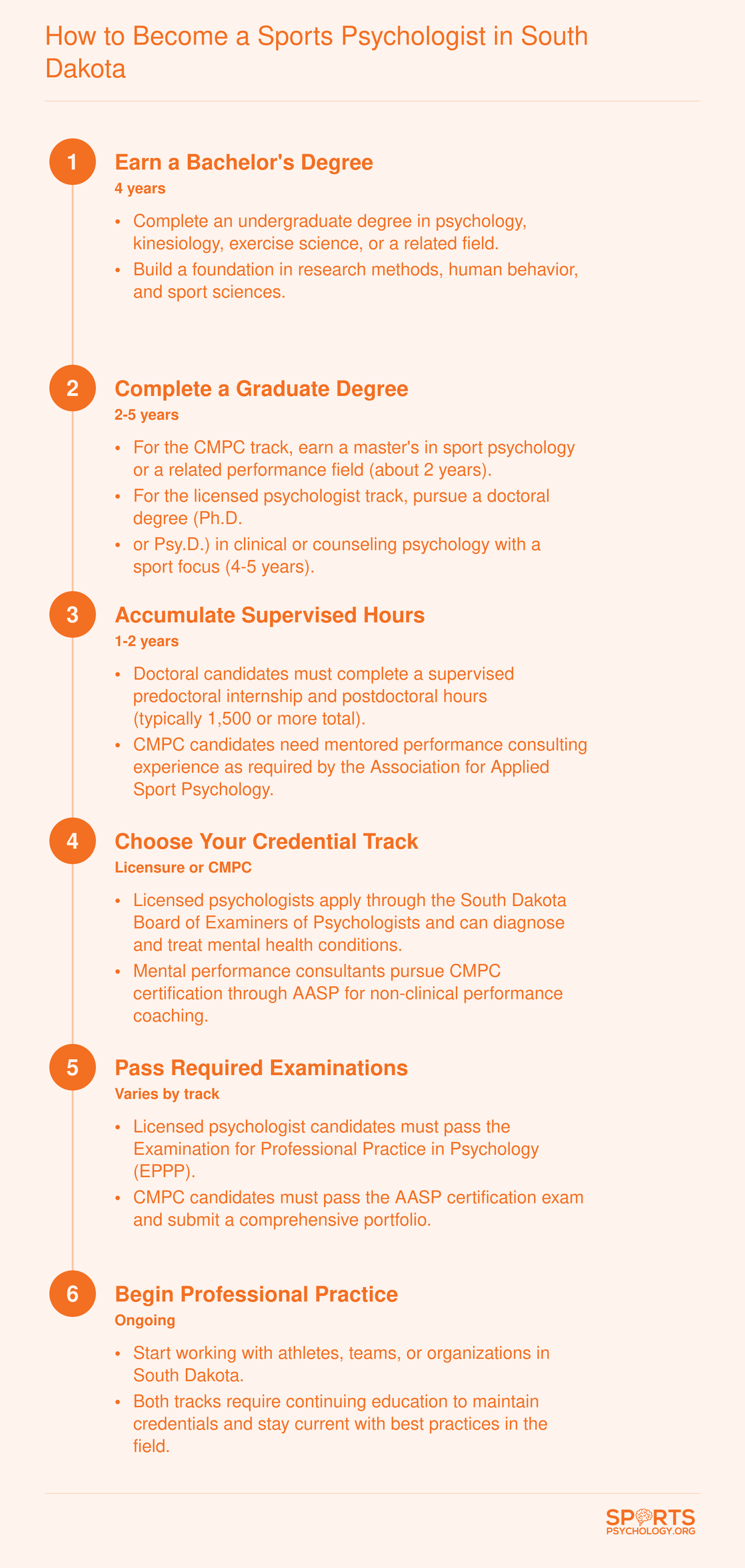
How to Become a Sports Psychologist in South Dakota
There are two distinct tracks to working in sports psychology in South Dakota. The licensed psychologist path requires a doctorate and allows you to diagnose and treat clinical conditions, while the Certified Mental Performance Consultant (CMPC) path requires a master's degree and focuses on non-clinical performance coaching. Here is the step-by-step roadmap for both.
South Dakota Licensure and Certification Requirements for Sports Psychologists
If you want to call yourself a psychologist in South Dakota, you need a license from the state Board of Examiners of Psychologists. If your goal is strictly performance enhancement work, a national certification may be the better fit. Understanding both pathways will help you choose the right degree and avoid costly detours.
Psychologist Licensure Through the SD Board of Examiners
South Dakota requires a doctoral degree (Ph.D. or Psy.D.) from a regionally accredited institution.1 APA accreditation is not a strict requirement under state rules, which opens the door for graduates of regionally accredited online or hybrid doctoral programs.2 That said, some employers and insurance panels still favor APA-accredited credentials, so you should weigh marketability alongside board eligibility.
Once you hold the doctorate, you must complete the following before receiving a full license:
Predoctoral internship: At least 1,800 hours, completed within two years. You must receive a minimum of two hours of individual supervision per week plus one hour of supervised learning activities, all under the guidance of a doctoral-level psychologist.1
Postdoctoral supervised practice: One full year of full-time work (40 hours per week) with at least two hours of supervision each month from a licensed doctoral-level psychologist.1
EPPP exam: You must pass the Examination for Professional Practice in Psychology with a minimum score of 500. South Dakota does not currently require the EPPP Part 2 (Skills).
Provisional license: South Dakota does offer a provisional license, which allows you to begin practicing under supervision while you complete postdoctoral requirements.1
Can an Online Doctorate Satisfy SD Requirements?
Because South Dakota accepts doctoral degrees from regionally accredited programs regardless of delivery format, an online or hybrid Psy.D. or Ph.D. can satisfy the board's education requirement.1 The critical factor is accreditation status, not classroom modality. Before enrolling, confirm that the program holds regional accreditation and that its practicum and internship structure will allow you to accumulate the required supervised hours.
The CMPC Pathway: A Non-Licensure Alternative
The Certified Mental Performance Consultant (CMPC) credential, administered by the Association for Applied Sport Psychology (AASP), is designed for professionals who want to focus on performance enhancement rather than clinical treatment. Eligibility requires a master's degree or higher in sport science or a closely related field, completion of specific coursework in sport psychology foundations, a mentored experience under an approved mentor, and a passing score on the CMPC examination.
CMPCs work with athletes on goal setting, visualization, focus, and confidence, but they cannot diagnose mental health disorders or provide psychotherapy. If an athlete presents with clinical concerns such as depression, anxiety, or an eating disorder, a CMPC must refer that individual to a licensed psychologist or other mental health professional.
Scope-of-Practice Differences at a Glance
Licensed psychologist: Can diagnose and treat mental health conditions, prescribe evidence-based interventions, bill insurance, and provide both clinical and performance-related services.
CMPC: Focuses exclusively on mental performance skills, cannot diagnose or treat clinical disorders, and typically works on a private-pay or organizational-contract basis.
Many practitioners eventually pursue both credentials to offer the widest possible range of services.
Interstate Practice and Mobility
South Dakota students who plan to work across state lines should be aware of interstate practice considerations. The Psychology Interjurisdictional Compact (PSYPACT) allows licensed psychologists in member states to practice telepsychology or conduct temporary in-person services in other PSYPACT states without obtaining a separate license. As of 2026, South Dakota is a PSYPACT member, which is a notable advantage if you want to serve athletes in neighboring states. Aspiring practitioners in those areas can explore sports psychology programs Nebraska or review sports psychology in Wyoming for additional regional options. For CMPC holders, the credential is national and does not require state-by-state authorization, making it inherently portable.
Whichever path you choose, map your degree, supervision plan, and credentialing timeline before you enroll. Both routes reward careful planning, and sportspsychology.org provides program details to help you match your goals to the right next step.
Licensed Psychologist Vs. Mental Performance Consultant in South Dakota
One of the most common questions aspiring sports psychology professionals ask is whether to pursue licensure as a psychologist or certification as a mental performance consultant. Both paths lead to rewarding careers working with athletes, but they differ significantly in education requirements, scope of practice, and timeline. The comparison below breaks down the key differences to help you decide which route aligns with your goals.
Dimension
Licensed Psychologist (Sport Focus)
Certified Mental Performance Consultant (CMPC)
Education Required
Doctoral degree (Ph.D. or Psy.D.) in psychology, typically 5 to 7 years of graduate study
Master's degree or higher in sport science, kinesiology, or a related field, typically 2 to 3 years of graduate study
Credentialing Body
South Dakota Board of Examiners of Psychologists issues the state license
Association for Applied Sport Psychology (AASP) awards the CMPC certification nationally
Scope of Practice
Can diagnose and treat clinical mental health conditions (anxiety, depression, eating disorders) in addition to performance optimization
Focuses on mental performance skills such as goal setting, imagery, focus, and confidence building; cannot diagnose or treat clinical disorders
Supervised Experience
Minimum of two years of supervised professional experience, including a predoctoral internship and postdoctoral hours
Completion of a mentored experience totaling at least 400 hours of direct contact with clients under an approved mentor
Typical Timeline to Practice
Approximately 8 to 12 years from the start of undergraduate study to independent licensure
Approximately 6 to 8 years from the start of undergraduate study to earning the CMPC credential
Common Employers in South Dakota
University counseling centers, private practices, hospitals, collegiate athletic departments
College and high school athletic departments, private consulting practices, youth sport organizations, fitness and wellness centers
Continuing Education
South Dakota requires ongoing continuing education credits to maintain licensure, set by the state board
AASP requires continuing education units on a renewal cycle to maintain CMPC status
Combining USD and SDSU Degrees for a Sport Psychology Career
South Dakota does not currently have a dedicated sport psychology degree program at either of its flagship universities. That might sound like a disadvantage, but it actually opens the door to a practical, cost-effective strategy: combine relevant undergraduate coursework at the University of South Dakota (USD) or South Dakota State University (SDSU) with an online sport psychology graduate degree. This approach lets you benefit from in-state tuition on the front end while accessing specialized training from accredited programs across the country.
Building a Foundation at USD
USD offers well-regarded clinical and counseling psychology programs that cover core competencies you will need in any sport psychology career. Coursework in abnormal psychology, research methods, behavioral assessment, and counseling techniques maps directly onto the knowledge base required by both licensed psychologists and certified mental performance consultants. If you are interested in eventually pursuing licensure as a psychologist who specializes in sport, USD's psychology curriculum provides a strong starting point for doctoral-level work down the line.
Leveraging SDSU's Kinesiology and Exercise Science Offerings
SDSU's Department of Health and Nutritional Sciences houses programs in health science, exercise science, and related fields. These courses give you something a psychology-only track does not: a deep understanding of human movement, sport physiology, and the physical demands athletes face every day. Graduate admissions committees at sport psychology programs routinely look for applicants who demonstrate competence in both the psychological and the physical performance sides of the discipline. Pairing SDSU's exercise science coursework with a psychology minor (or vice versa at USD) creates a well-rounded transcript.
Transitioning to an Online Graduate Program
Once you have completed your bachelor's degree in state, you can enroll in an online master's or doctoral program in sport psychology without relocating. Students in neighboring states like Idaho face a similar challenge, and many have found success with sports psychology programs in Idaho that blend online and in-person components. This two-phase plan offers several advantages:
Tuition savings: In-state undergraduate rates at USD and SDSU are significantly lower than out-of-state or private university tuition, freeing up resources for graduate school.
Flexible scheduling: Many online sport psychology programs allow you to maintain employment or coaching roles in South Dakota while earning your advanced degree.
Prerequisite alignment: Admissions requirements for most graduate sport psychology programs include foundational psychology courses and, in many cases, coursework in kinesiology or exercise science. Completing both areas at SD universities positions you as a competitive applicant.
Why This Strategy Matters
Most guides on breaking into sport psychology assume you live near a university that offers a dedicated program. This workaround is tailored to South Dakota residents who want to build a career without leaving the state for their entire education. By combining what USD and SDSU already offer with the growing landscape of accredited online graduate programs, you can construct a pathway that is both financially practical and academically rigorous. The programs profiled elsewhere on sportspsychology.org include several online options that pair well with an in-state South Dakota foundation.
Sports Psychology Career Opportunities and Salary in South Dakota
South Dakota's sports psychology job market is smaller than what you will find in major metro areas, but that does not mean opportunity is scarce. It means the career path often looks different here, blending sport-focused work with broader clinical practice, telehealth services, or consulting roles that reach across state lines. Understanding the salary landscape and the types of employers in the region will help you plan a realistic, rewarding career.
Psychologist Salaries in South Dakota and Nearby States
According to the Bureau of Labor Statistics, the national median annual wage for psychologists was approximately $94,310 as of the most recent published data (May 2024).1 In South Dakota, psychologists classified under the broader "all other" category earn a mean annual wage of roughly $128,560, though the range is wide. Wages at the 10th percentile sit near $33,470, reflecting early-career or part-time positions, while those at the 90th percentile can reach approximately $165,280.2
These figures cover all psychologists in the state, not sport psychology specialists alone, so treat them as a general benchmark rather than a precise predictor for sport-focused roles. Neighboring states show varied compensation levels as well. Markets in Minnesota and Iowa tend to offer more positions due to larger populations and more professional sports infrastructure, while states like sports psychology programs in montana, how to become a sports psychologist in wyoming, and North Dakota share South Dakota's pattern of fewer dedicated sport psychology openings and a heavier reliance on hybrid or telehealth-based practices. Nebraska falls somewhere in between, buoyed by its large university athletic programs.
Common Employers in South Dakota
Sport psychology professionals in South Dakota typically find work with a mix of institutional and private employers:
University athletic departments: USD Coyotes and SDSU Jackrabbits both field Division I programs and increasingly recognize the value of mental performance support for student-athletes.
High school athletics programs: South Dakota's strong tradition in wrestling, basketball, track, and football creates demand for mental skills training at the prep level, though positions are often contracted rather than full-time.
Private practices: Many practitioners open their own practice or join an existing group, serving athletes alongside general therapy clients.
Military installations: Ellsworth Air Force Base near Rapid City employs psychologists and counselors who may work with service members on performance optimization, resilience training, and readiness, areas that overlap significantly with sport psychology skill sets.
Typical Job Titles to Watch For
When searching for openings, cast a wide net. Relevant titles include sports psychologist, mental performance consultant, athletic counselor, and clinical psychologist with a sport specialization. Some positions, especially at universities or military sites, may be listed under broader titles like "clinical psychologist" or "performance psychology specialist," so reading beyond the job title is essential.
Navigating a Smaller Market
South Dakota's population and professional sports footprint are modest, which means most practitioners combine sport-focused work with general clinical practice. A licensed psychologist might see therapy clients during the week and consult with a college volleyball team on game-day mental strategies. Others build telehealth-based consulting businesses that serve athletes in multiple states, an approach that has grown significantly since the early 2020s and continues to expand. If you hold licensure in South Dakota and obtain credentials recognized across state lines (through tools like PSYPACT for licensed psychologists), you can serve clients well beyond the region without relocating.
The bottom line: a career in sport psychology in South Dakota is achievable, but flexibility is your greatest asset. Those who pair clinical licensure with sport-specific certification and a willingness to diversify their caseload tend to build the most sustainable practices.
What Online Sports Psychology Graduates Earn
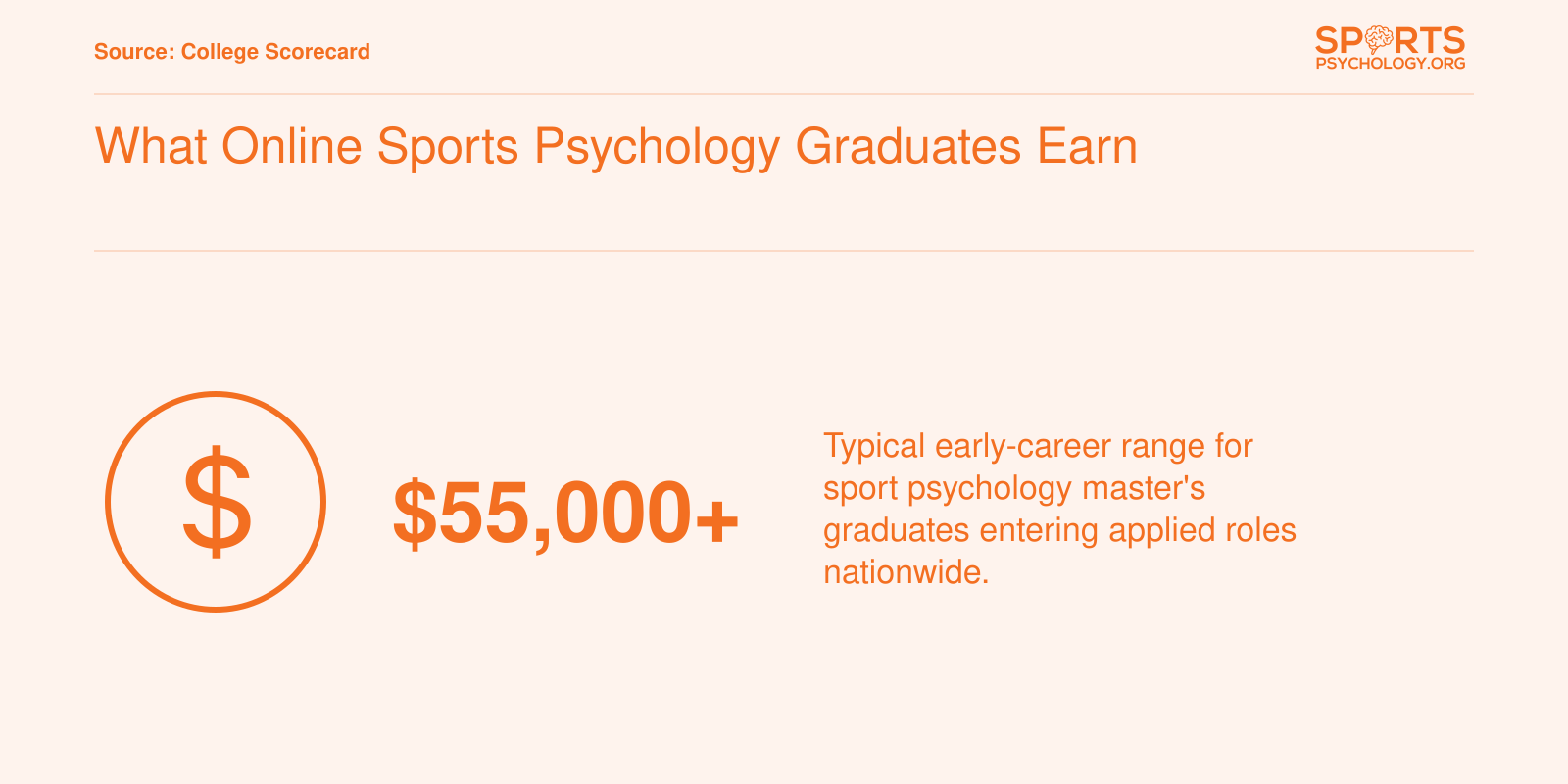
Program-level median earnings for online sport psychology graduates are not yet available for the programs featured in this article. College Scorecard publishes earnings data as programs mature, but many online sport psychology concentrations are newer offerings and have not yet reported one-year post-completion outcomes. As data becomes available, sportspsychology.org will update this section with program-specific figures.
Practicum and Fieldwork Opportunities in South Dakota
Finding hands-on practicum and fieldwork placements is one of the most important steps on your path to becoming a sports psychologist, and South Dakota offers a unique mix of opportunities and challenges. Whether you are enrolled in an online program or studying at a local university, planning your practicum strategy early will help you build the supervised hours you need for licensure or certification.
Where to Find Practicum Sites in South Dakota
South Dakota may be a smaller state, but it has a solid network of athletic organizations and health systems that can serve as practicum settings. Consider reaching out to these potential partners:
USD and SDSU athletic departments: Both Division I programs work with student-athletes across a wide range of sports and may offer practicum arrangements for qualified graduate students pursuing sport psychology training.
NAIA and Division II programs: Schools like Augustana University and other NAIA institutions across the state provide access to competitive athletes who can benefit from mental performance services.
Sanford Health network: As one of the largest integrated health systems in the region, Sanford Health operates sports medicine programs that may accommodate practicum students interested in the intersection of clinical psychology and athletic performance.
Avera Sports Institute: Avera's sports medicine and performance offerings represent another potential practicum site, particularly for students focused on rehabilitation psychology or performance enhancement in clinical settings.
Navigating the Supervision Challenge
One real concern for students pursuing fieldwork in South Dakota is the limited pool of locally based supervisors who hold specialized sport psychology credentials. The state has a small but growing number of practitioners.1 For example, Wallace Mental Performance and Athletic Counseling in Rapid City provides mental performance support for athletes and high performers.2 Andy Gillham is listed as a mentor through the Association for Applied Sport Psychology (AASP), which can be a valuable connection for students seeking mentorship toward the Certified Mental Performance Consultant (CMPC) credential.3
Still, finding an AASP-approved mentor or a licensed psychologist with deep sport specialization within state borders can require creative problem-solving.
Strategies for Securing Quality Supervision
If local supervision options are limited, you have several paths forward:
Telepsychology supervision: South Dakota's participation in emerging telehealth frameworks means you may be able to arrange remote supervision with an out-of-state expert. For instance, Erin Haugen, a CMPC and licensed psychologist credentialed in North Dakota and Minnesota, is a PSYPACT provider, which can facilitate cross-state supervision relationships.4
High school athletics partnerships: Connecting with the South Dakota High School Activities Association or individual school districts can open doors to fieldwork with younger athletes, giving you practical experience while filling a gap in services that many communities need.
USOPC training pipeline: Students interested in elite-level sport psychology can explore connections with the United States Olympic and Paralympic Committee's network, which occasionally supports practicum placements or mentorship for emerging consultants.
Program-assisted placements: Many reputable online sport psychology programs maintain relationships with practicum sites across the country and will help place students locally, regardless of state. When evaluating online programs, ask admissions teams specifically about their track record placing students in rural or less populated states like South Dakota.
Making the Most of Limited Resources
The AASP's searchable CMPC directory is a practical starting point for identifying potential supervisors or mentors in or near South Dakota. Students interested in neighboring states may also want to explore sports psychology programs in Iowa, where additional mentorship connections may be available. Because the field is still growing in the state, students who proactively build relationships with local athletic departments, health systems, and regional practitioners often find themselves well positioned for career opportunities after graduation. The practitioners you connect with during your fieldwork may become long-term colleagues or referral partners as you establish your own practice in the region.
Planning your practicum path early, staying flexible about supervision formats, and leveraging the resources your program provides will set you up for success even in a state where sport psychology infrastructure is still developing.
South Dakota may not offer a dedicated in-state sports psychology degree, but that is not a barrier to entering the field. Online accredited programs, combined with local practicum sites and the South Dakota Board of Examiners of Psychologists licensure process, create a clear and viable path. The key is selecting a program aligned with your target credential, whether that is a psychology license or the CMPC designation.
The Bureau of Labor Statistics projects a 6 percent job growth rate for psychologists through the next decade, outpacing many other occupations. At the same time, the Association for Applied Sport Psychology has outlined ambitious expansion goals in its 2023 to 2026 Strategic Plan, reflecting surging demand for qualified mental performance professionals across collegiate and professional sports.
Frequently Asked Questions About Sports Psychology in South Dakota
Below are answers to the most common questions prospective students ask about pursuing sports psychology in South Dakota. Each response draws on the licensure details, program options, and career data discussed throughout this article.
Are there any sports psychology programs in South Dakota?
South Dakota does not currently offer a dedicated sports psychology degree at its in-state universities. However, students can build a strong foundation by combining kinesiology, exercise science, or psychology coursework at the University of South Dakota (USD) or South Dakota State University (SDSU) with an online sports psychology graduate program from a regionally accredited institution.
Can I get a sports psychology degree online and practice in South Dakota?
Yes. Many regionally accredited universities offer online master's and doctoral programs in sport psychology or closely related fields. Graduates of these programs can pursue licensure in South Dakota as psychologists or work as mental performance consultants. The key is ensuring your program meets the South Dakota Board of Examiners of Psychologists requirements if you plan to seek licensure.
How much do sports psychologists make in South Dakota?
Exact sports psychology salaries in South Dakota are not widely reported due to the niche nature of the field. General psychologist salaries in the state tend to fall below the national median, though professionals who combine private consulting, collegiate athletics work, and telehealth services can expand their earning potential. Refer to the salary section of this article for additional context.
What is the difference between a licensed sports psychologist and a mental performance consultant?
A licensed sports psychologist holds a doctoral degree in psychology, completes supervised clinical hours, and is authorized to diagnose and treat mental health conditions. A mental performance consultant, often certified through the Association for Applied Sport Psychology (CMPC credential), focuses on performance enhancement skills such as goal setting, visualization, and focus training but does not provide clinical therapy.
Does South Dakota accept online doctoral degrees for psychologist licensure?
South Dakota's Board of Examiners of Psychologists requires that doctoral programs be from regionally accredited institutions and meet specific curricular standards. Online doctoral programs that fulfill these criteria are generally accepted. Applicants should verify their program's accreditation status and confirm it includes the supervised practicum and internship hours the board requires.
How long does it take to become a sports psychologist in South Dakota?
The typical timeline is eight to twelve years of post-secondary education and training. This includes four years for a bachelor's degree, two to three years for a master's, four to six years for a doctoral degree (if pursuing licensure), plus one to two years of supervised postdoctoral experience. Students who pursue the mental performance consultant route can enter the field sooner, often after completing a master's degree and required mentored hours.
Are there practicum opportunities for sport psychology students in South Dakota?
Yes. Students can arrange practicum placements with USD and SDSU athletic departments, community sports organizations, and high school athletics programs across the state. Military installations such as Ellsworth Air Force Base also offer performance psychology opportunities. Many online programs allow students to complete fieldwork locally, making South Dakota a viable setting for supervised experience.
More Online Sports Psychology Programs for South Dakota Students
Beyond our top-ranked programs, South Dakota students have even more options through these online sports psychology programs. Each offers flexible remote learning and is open to out-of-state students.
Faulkner University
Faulkner University offers an online Bachelor of Science in Sports Psychology, integrating a Christian worldview with small class sizes for personalized learning. The program prepares students for roles in coaching, athletic counseling, and fitness instruction.
Parker University offers a fully online Bachelor of Science in Sport Psychology, exploring the mind-athletic performance connection through courses like exercise physiology and injury rehabilitation. The program prepares students for graduate studies or careers in coaching and health promotion.
The online Master of Science in Sports Psychology at University of the Southwest covers team dynamics, performance enhancement, and injury recovery, preparing graduates for coaching, mentoring, and teaching roles.
Northern Michigan University offers an online Master of Science in Applied Sport Psychology with two tracks: Certification as a Mental Performance Consultant or Licensure as a Limited Psychologist. The asynchronous format provides flexibility for working professionals.
This 100% online Master of Science in Sport and Performance Psychology aligns with CMPC certification and offers flexible full-time or part-time options, with no GRE required. The curriculum emphasizes experiential learning and mental skills training.
East Central University's online Master of Science in Sport Psychology prepares students for CMPC certification through a 45-credit curriculum with a supervised internship. Courses are primarily online with some synchronous components.
The online Master of Science in Experimental Psychology with a Health and Sports Psychology concentration includes core research methods, theory courses, and a practicum. The program prepares graduates for doctoral studies or careers in health and sports psychology.
Kent State University at Stark offers a 100% online Bachelor of Science in Sport, Exercise and Performance Psychology, focusing on motivation, mental training, and stress management. The program includes a practicum and prepares graduates for careers in coaching or graduate study.
This 100% online Bachelor of Science in Sport, Exercise and Performance Psychology covers motivation, mental training, stress management, and injury psychology. Graduates are prepared for careers as mental performance or athletic coaches.
Kent State University at Trumbull offers a 100% online Bachelor of Science in Sport, Exercise and Performance Psychology with a focus on mental skills training, stress management, and injury psychology. The program includes a practicum.
This online Bachelor of Science in Sport, Exercise and Performance Psychology from Kent State University at Salem emphasizes psychological factors in athletic success, including motivation and stress management. The flexible online format allows remote completion.
Kent State University at Ashtabula offers a 100% online Bachelor of Science in Sport, Exercise and Performance Psychology, covering motivation, mental training, and sport injury psychology. The curriculum includes a practicum and prepares graduates for coaching careers.
This online Bachelor of Science in Sport, Exercise and Performance Psychology focuses on psychological factors in athletic success, including motivation, mental training, and ethical principles. The program is 100% online and includes a practicum.
Kent State University at Geauga offers a 100% online Bachelor of Science in Sport, Exercise and Performance Psychology, covering motivation, mental training, stress management, and ethics. Graduates are prepared for careers as mental performance coaches or graduate study.