Fewer than 200 full-time embedded sport psychologist roles exist across all major U.S. professional leagues combined.
College athletics, the U.S. military, and private practice account for the largest volume of open positions nationwide.
Demand is growing fastest in nontraditional settings like corporate performance coaching and performing arts programs.
Consulting arrangements far outnumber salaried positions, especially for early career professionals building a client base.
Since 2020, every major North American professional league has introduced or expanded mental health mandates, and NCAA programs have followed closely behind. Yet the certified workforce remains strikingly small, with roughly 3,000 to 4,000 practitioners nationwide serving millions of athletes at all levels.
Demand is growing fast, but it is not growing evenly. Geography, employer type, and competitive setting all shape where sports psychologists are most needed, and the gap between supply and demand is widest in places most aspiring professionals overlook. The highest concentration of open roles sits not in pro sports but in college athletics, military human performance programs, and private practice networks anchored to metropolitan training hubs.
Are Sports Psychologists in Demand Right Now?
The short answer is yes, and the trajectory points upward. While the Bureau of Labor Statistics does not track sport psychology as its own occupational category, the broader psychology field offers a useful baseline, and several forces unique to the sports world are accelerating demand well beyond that baseline.
What the Federal Data Tell Us
According to the Occupational Outlook Handbook for psychologists, psychologists overall are projected to see about 6 percent job growth from 2024 to 2034, with roughly 12,900 openings anticipated each year across the profession.1 Clinical and counseling psychologists, a closer comparison group, have been projected to grow at an even faster clip of 11 percent.2 Those numbers already outpace the average for all occupations, and sport psychology sits inside that expanding pie.
The catch is that sport psychology is a niche subset, so federal labor surveys do not break it out separately. That means you will not find a tidy government chart showing exactly how many sport psychologist positions exist or how fast they are multiplying. Still, industry signals strongly suggest this specialty is growing faster than the broader field.
The Post-COVID Visibility Shift
Athlete mental health entered mainstream conversation in a way it never had before when Simone Biles stepped back from competition at the Tokyo Olympics and Naomi Osaka spoke publicly about the psychological toll of elite sport. Those moments did not just raise awareness; they gave leagues, federations, and universities permission (and public pressure) to fund mental performance and mental health services that previously sat at the bottom of the budget.
The ripple effects are tangible. The NFL's collective bargaining agreement now includes provisions for team-employed behavioral health clinicians. The NBA requires every franchise to have a licensed mental health professional on staff. NCAA institutions increasingly list sport psychology support as part of their athletic department offerings. Each of these policy shifts represents net-new funded positions that did not exist a decade ago. For a closer look at what colleges are doing, see our guide to student athlete mental health resources.
A Significant Supply Gap
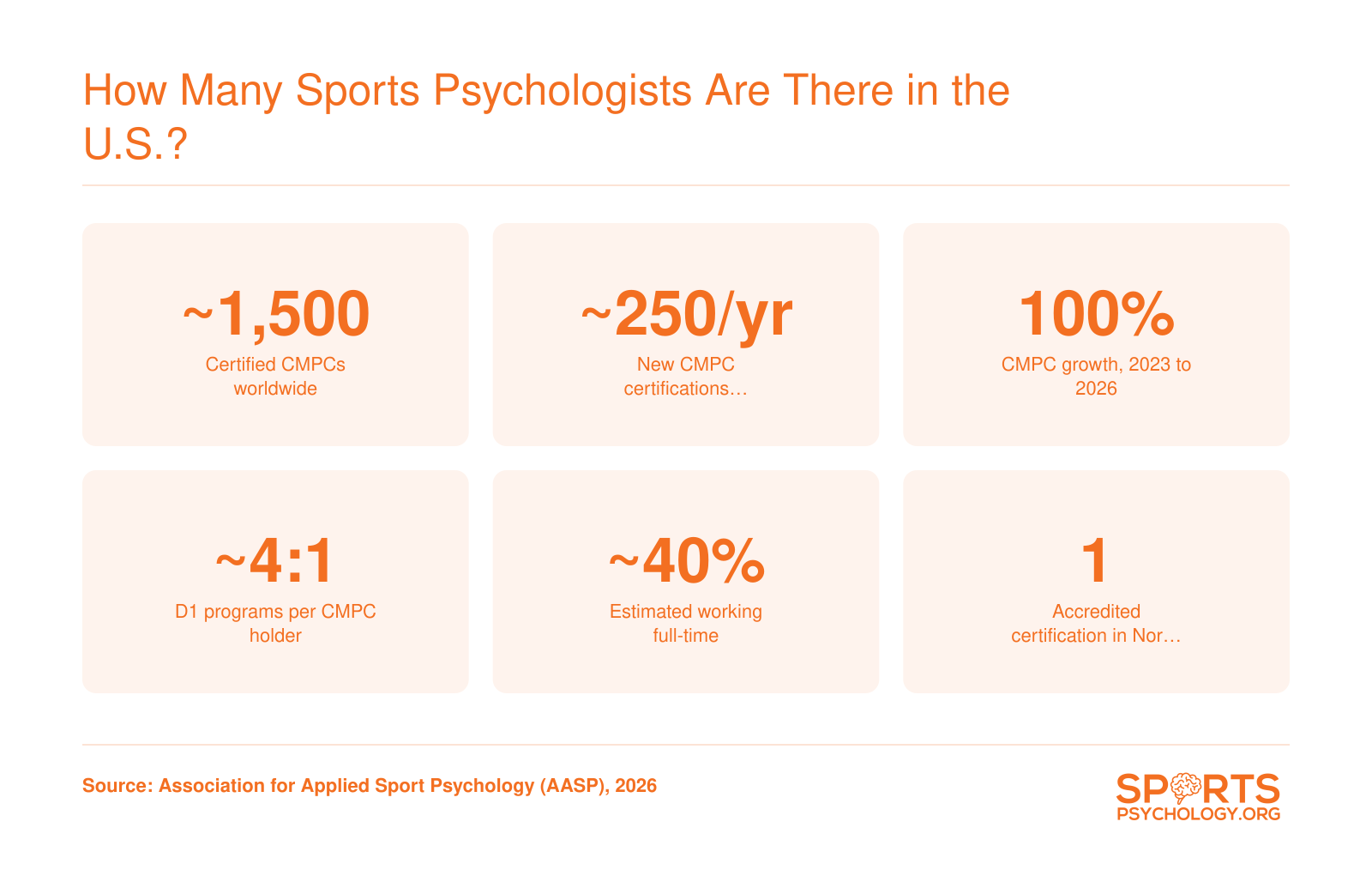
Despite growing demand, the pipeline of qualified professionals remains small. The Association for Applied Sport Psychology (AASP) has certified roughly 3,000 to 4,000 consultants in total. Set that number against the landscape of need: hundreds of thousands of youth, high school, collegiate, and professional teams, plus individual athletes, military service members, and performing artists who could benefit from sport psychology services. The math reveals a clear mismatch.
This supply gap means that aspiring professionals who earn the right credentials, whether through CMPC certification, licensure as a psychologist, or both, are entering a market where qualified practitioners are genuinely scarce relative to demand. It also means that many athletes, particularly at the youth and high school levels, still have no access to sport psychology support at all.
What This Means for Your Career Planning
If you are weighing whether sport psychology is a viable career path, the demand picture in 2026 is more encouraging than at any point in the field's history. Cultural stigma around athlete mental health is fading, league mandates are creating structured positions, and the overall psychology workforce is projected to grow steadily through 2034. The field is not saturated; it is undersupplied. Positioning yourself with the right education, supervised experience, and certification can place you squarely in the path of that demand. Explore our sport psychology resources for guidance on next steps.
How Many Sports Psychologists Are There in the U.S.?
Sport psychology remains a remarkably small field relative to the demand it serves. Multiple credentialing bodies certify practitioners, but even combined, the total workforce is tiny compared to the number of athletes, teams, and programs that could benefit. Licensure complexity, niche doctoral training pipelines, and inconsistent state-by-state credential requirements all keep the practitioner pool limited.
Where in the Country Are Sports Psychologists Needed Most?
Geography plays a surprisingly large role in shaping your career options in sport psychology. Demand is not evenly distributed across the United States, and understanding where the gaps are can help you plan your education, licensure strategy, and relocation decisions well before you enter the job market.
High-Concentration Hubs
The densest clusters of sport psychology positions tend to overlap with three institutional anchors: professional sports franchises, Division I athletic programs, and military installations. States like California, Texas, Florida, and New York check all three boxes, which is why they consistently account for the largest share of posted positions. The broader Sun Belt corridor deserves special attention in 2026 because expanding MLS, NWSL, and USL franchises in cities like Charlotte, Nashville, Austin, and San Diego are building out performance staffs that increasingly include mental performance professionals. Military bases across the South and West, including Fort Liberty (North Carolina), Joint Base San Antonio (Texas), and Fort Moore (Georgia), also generate steady demand through the Department of Defense's Human Performance Optimization programs.
Underserved and Emerging Markets
While major metro areas attract most practitioners, rural regions and states with smaller college athletic footprints remain significantly underserved. Athletes in these areas often have no local access to a qualified sport psychology professional, which creates opportunity for practitioners willing to set up telehealth practices or relocate to less competitive markets. States in the northern Great Plains, parts of Appalachia, and the rural Mountain West are prime examples. Community colleges and NAIA programs in these regions are beginning to invest in mental health support but rarely have the budget for a full-time hire, making part-time consulting a realistic entry point.
How Licensing Variation Shapes the Map
Not every state treats the title "sport psychologist" the same way, and this has a direct effect on where you can practice and what services you can offer. Some states require a doctoral-level clinical or counseling psychology license to use the word "psychologist" in any professional context. In those states, holding a Certified Mental Performance Consultant (CMPC) credential alone limits you to performance enhancement work and prevents you from advertising clinical services or using the psychologist title. Other states are more flexible, recognizing CMPC holders as mental performance professionals who can practice independently within their scope of competency.
Before you commit to a region, research that state's licensing board requirements. A practitioner with a clinical license has the widest scope of practice and the most geographic flexibility. If you plan to hold only the CMPC, you will find fewer regulatory hurdles in states like Florida, Texas, and Arizona, where the performance consulting model is well established and the demand for non-clinical mental performance work is high.
Regions Worth Watching
If you are mapping out your next move, four areas stand out heading into 2026 and beyond:
Sun Belt expansion cities: Charlotte, Nashville, Austin, and San Diego are adding professional franchises and performance facilities at a rapid pace.
Military corridor (South and West): Installations in North Carolina, Texas, Georgia, and Colorado continue to fund embedded mental performance roles.
Big Ten and SEC footprints: The Midwest and Southeast house the largest collegiate athletic departments in the country, many of which now employ two or more sport psychology staff members.
Pacific Northwest: Portland and Seattle combine professional teams, strong university systems, and a cultural openness to mental health services that supports private practice growth.
Thinking strategically about location early in your training, whether that means choosing a graduate program in a target region or completing a practicum at a nearby military base, can give you a meaningful head start when it is time to land your first role.
Questions to Ask Yourself
Are you drawn to elite athletes on a pro roster, or do you see yourself serving college students, military personnel, or private-practice clients?
Each setting demands a different mix of skills, travel tolerance, and credentialing. Knowing your preferred population early helps you choose the right doctoral track and practicum placements.
Does your state's licensing structure allow you to practice as a sport psychologist, or would you need to relocate or earn additional credentials?
Licensure requirements vary widely by state. Some states require a clinical or counseling psychology license to use the title, which can add years of supervised hours if your degree is in sport science rather than psychology.
Would you prefer the stability of a full-time embedded role or the flexibility of consulting with multiple teams and organizations?
Embedded positions offer steady income and deeper relationships with athletes, but they are still relatively rare. Consulting lets you diversify your client base and income streams, though it requires stronger business development skills.
Which Organizations Hire Sports Psychologists?
Sports psychologists work across a surprisingly wide range of sectors, and understanding where positions actually exist can help you target your training and networking strategically. The table below breaks down the major hiring sectors by role type, estimated position volume, and whether demand is trending upward. One standout: the U.S. military is the single largest employer of sport and performance psychologists in the country, according to APA data, employing more professionals in this specialty than any other single sector.
Sector
Typical Role Type
Estimated Positions
Demand Trend
U.S. Military (Army, Navy, Air Force, Special Operations)
Full-time, embedded
Hundreds of positions across branches, the largest single employer of performance psychologists
Growing steadily, with expanding programs in resilience and human performance optimization
Professional Sports Teams (NFL, NBA, MLB, NHL, MLS, WNBA)
Mix of full-time, part-time, and consulting
Roughly 100 to 200 across major leagues, though not every team employs one
Growing, as more teams invest in mental performance staff
NCAA and College Athletics
Full-time or part-time, often shared across multiple teams
Several hundred positions at Division I, II, and III programs combined
Growing, driven by increased awareness of student athlete mental health
U.S. Olympic and Paralympic Committee (Team USA)
Full-time staff and contracted specialists
A small, specialized team of fewer than two dozen core staff
Stable, with periodic expansion around Olympic cycles
Youth Sports Organizations and Academies
Consulting and part-time
Difficult to quantify, but a growing number of travel clubs, academies, and national governing bodies contract sport psychologists
Growing, especially in elite development programs
Private Practice
Self-employed, consulting
Thousands of practitioners nationally, serving individual athletes, teams, and organizations on a fee-for-service basis
Growing, though competition varies significantly by region
Corporate Wellness and Performance
Consulting, part-time, or contract
An emerging market with a smaller but increasing number of roles in executive coaching and organizational performance
Growing, as companies adopt performance psychology frameworks from sport
How Many Pro and Olympic Teams Have a Sports Psychologist?
How many professional sports teams actually have a psychologist on staff? It's one of the most common questions aspiring practitioners ask, and the answer is more nuanced than a single number. While exact team-by-team counts shift seasonally, we can build a reliable picture using league mandates, association directories, and reporting from the field.
A League-by-League Snapshot
Across the five major North American men's leagues and Team USA, total estimates point to roughly 260 to 520 mental performance and mental health professionals interacting with teams in some capacity as of 2026. That range splits into these league-level windows:
NFL: 60 to 130 professionals, reflecting a mix of team clinicians, performance coaches, and shared EAP counselors.
NBA: 60 to 110, driven by the league's 2019 rule requiring every team to have a licensed mental health professional.
MLB: 70 to 120, including around 60 to 70 mental skills coaches and 60 to 80 mental health professionals, with some staff serving both roles.
NHL: 40 to 80, a number that has grown quietly but steadily since the league launched its player assistance program.
MLS: 30 to 60, with Real Salt Lake making history by naming Dr. Tom Golightly as the league's first full-time embedded sport psychologist.3
USOPC / Team USA: 30 to 60, spread across Olympic and Paralympic training sites for the 2024-2028 cycle.
These figures come from aggregating public staff directories, AASP and APA Division 47 affiliations, and direct reporting in outlets like The Mind Room1 and interviews with practitioners such as Dr. Jonathan Fader2. The overlap between mental skills coaches, licensed psychologists, and EAP counselors makes a precise headcount difficult, which is why ranges are more honest than a single tally.
What the Mandates Actually Require
A key driver of these numbers is league-level policy. The NBA was the first to require every team to retain at least one licensed mental health professional, a mandate that went into effect in 2019. The NFL followed suit through its 2019 Collective Bargaining Agreement, which obligated teams to provide mental health resources, including a credentialed behavioral health clinician. MLB does not have a per-team licensing rule but operates an Employee Assistance Program that each club must offer, typically through a shared network of counselors rather than dedicated team psychologists.
The NHL and MLS lack explicit mandates forcing teams to hire a psychologist, yet both leagues have seen organic growth. The NHL's player assistance program creates a structure that often leads to team-affiliated mental health consultants, while MLS clubs are increasingly following Real Salt Lake's model of embedding a full-time professional directly into the technical staff.
Team USA's Embedded Model
The U.S. Olympic and Paralympic Committee staffs sport psychologists differently from pro leagues. Rather than assigning one per sport, psychologists and mental performance consultants are embedded at major training centers: Colorado Springs, Chula Vista, and Lake Placid. Some travel with teams to Games, but the backbone is a centralized staff that serves multiple sports. This model allows for consistent support across less-funded Olympic disciplines that could never afford a dedicated team psychologist on their own.
The Access Gap: Consultant vs. Embedded
Here's the distinction that matters most for career planning. When a league announces that every team "has access" to a psychologist, that often means a shared EAP counselor who may be on call for multiple clubs, not a sport psychology specialist embedded in the locker room day to day. A fully embedded professional attends practices, sits in on coaching meetings, and builds ongoing relationships with athletes. That role is far rarer: historical estimates put the count of truly embedded sport psychologists in MLB at only around 10 before the recent expansion of mental skills staff2. Even today, many teams technically comply with mandates through part-time or remote arrangements. For practitioners, understanding this gap helps you target the jobs where you can do the most hands-on work versus roles that check a compliance box.
Full-Time Embedded Roles Vs. Consulting Arrangements
Most sport psychologists, especially those early in their careers, work as consultants rather than holding a single full-time position with one organization. Full-time embedded roles do exist, but they are concentrated in professional sports leagues, U.S. military installations, and well-funded Division I athletic programs. Understanding the trade-offs between these two career models can help you plan your path more strategically.
Dimension
Full-Time Embedded Role
Consulting or Part-Time Arrangement
Typical Salary Range
Roughly $80,000 to $150,000+ per year, depending on the league or program budget
Varies widely; many consultants earn $50,000 to $100,000 annually, scaling with client volume and hourly rates (often $150 to $350 per session)
Job Stability
High stability with a regular paycheck and benefits; contracts often renewed annually or multi-year
Less predictable income, particularly in the first few years; client rosters can fluctuate seasonally
Depth of Athlete Relationships
Deep, ongoing relationships built through daily access to athletes, coaches, and support staff
Relationships can be meaningful but are typically limited by fewer contact hours and less day-to-day presence
Professional Autonomy
Lower autonomy in some respects; you operate within the organization's culture, schedule, and chain of command
Greater autonomy to set your own schedule, choose clients, and design your service model
Number of Organizations Served
Usually one organization at a time, with your focus dedicated entirely to that team or program
Multiple clients across several teams, schools, or private practice settings simultaneously
Career Ceiling and Growth
Can advance to director-level roles (e.g., Head of Mental Performance for a league or military branch), though openings are rare
Ceiling is largely self-determined; experienced consultants can build national reputations, launch group practices, or add revenue through speaking and media work
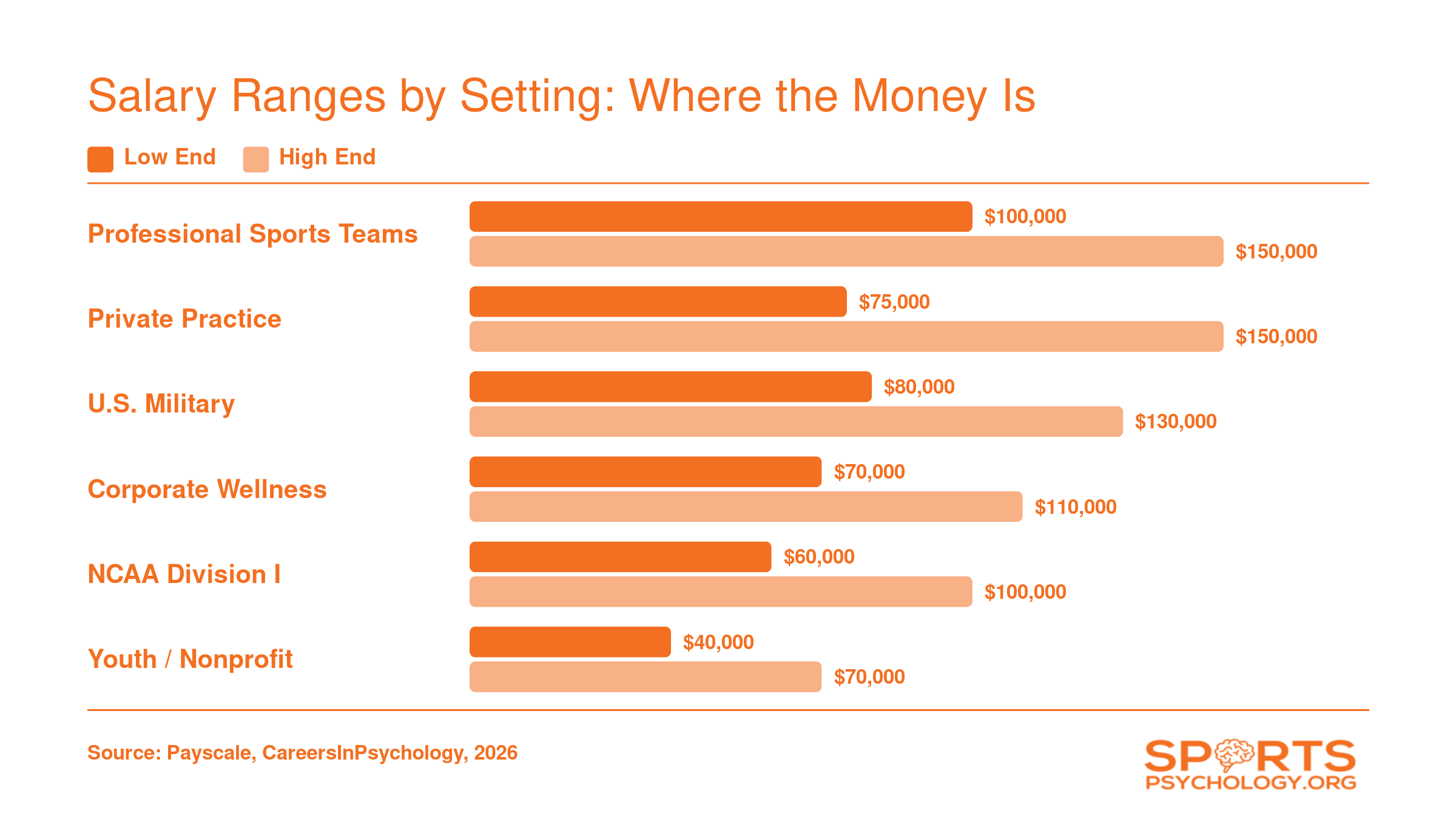
Salary Ranges by Setting: Where the Money Is
Compensation for sport psychologists varies widely depending on the work setting. Professional sports teams and private practices offer the highest earning potential, but those roles tend to be the most competitive. Military performance psychology positions also command strong salaries and benefits, though openings are limited. Here is a side-by-side look at estimated low-end and high-end salary ranges across six common settings.
Emerging Settings: Military, Corporate, and Performing Arts
If your mental image of a sports psychologist is someone standing on the sideline of a professional game, it is time to zoom out. Some of the fastest-growing demand for mental performance expertise sits well outside traditional athletics, and these emerging settings deserve a prominent place in your career planning.
U.S. Military Performance Psychology
The Department of Defense runs several well-established programs that rely on performance psychologists. The Army's Master Resilience Training (MRT) program embeds psychological skills instruction across units worldwide. The Navy and Marine Corps operate Operational Stress Control programs focused on sustaining cognitive performance in high-stakes environments. The Air Force invests in performance optimization specialists who work with pilots, pararescuemen, and other operators. Across bases, special operations commands, and service academies, the DoD employs hundreds of performance psychologists, making it one of the single largest employers of professionals with sport psychology training. Positions often come with competitive federal salaries, clear advancement tracks, and benefits that rival or exceed what most private-sector roles offer.
Corporate Wellness and Executive Performance
Corporate interest in mental performance coaching has surged over the past several years. Companies recognize that the same goal-setting, focus, and stress-management techniques used with elite athletes translate directly to executive leadership, sales teams, and high-pressure workplaces. Organizations hire performance consultants to lead workshops, coach C-suite leaders one on one, or build resilience curricula for entire departments. To learn more about this growing niche, see our guide on sports psychology in corporate wellness. This adjacent market is expanding quickly, and professionals who can articulate sport psychology principles in business-friendly language often find a steady, well-compensated client base with more predictable hours than pro sports consulting.
Performing Arts, Surgical Teams, First Responders, and Esports
Mental performance consulting is gaining traction in settings that share the pressure-and-precision demands of sport.
Performing arts: Musicians, dancers, and actors face performance anxiety, perfectionism, and burnout cycles remarkably similar to those of competitive athletes.
Surgical teams: Hospitals are beginning to adopt pre-performance routines and focus strategies borrowed from sport psychology to reduce errors in the operating room.
First responders: Police, firefighters, and paramedics benefit from the same resilience and arousal-regulation skills taught to military personnel.
Esports: Competitive gaming organizations increasingly hire mental performance coaches to help players manage stage anxiety, team dynamics, and grueling practice schedules.
Of these niches, esports psychology is arguably evolving the fastest, with dedicated coaching roles now appearing in major franchise leagues around the world.
Why These Settings Matter for Your Career
These non-traditional paths offer three practical advantages. First, competition for positions is lighter because fewer graduates target them, meaning your application stands out more easily. Second, the client base is broader, which can stabilize your income rather than tying it to a single team's budget cycle. Third, many of these roles come with more predictable schedules and better work-life balance than traveling with a professional franchise. As you map out your career, consider building competencies that position you for at least one of these emerging sectors alongside any traditional sport goals you pursue.
Most aspiring sport psychologists picture themselves courtside for an NBA team, but fewer than 200 full-time roles exist across all major U.S. pro leagues combined. The real volume of demand is in college athletics, the military, and private practice. Broaden your lens early so you can build the right training, connections, and credentials for the settings that are actually hiring.
How to Position Yourself for High-Demand Settings
Breaking into a competitive, network-driven field takes more than talent. It takes deliberate planning at every stage of your education and early career. Below is a practical roadmap for aspiring sports psychologists who want to land roles in the settings where demand is growing fastest.
Follow the Credentialing Pathway
The foundation is a doctoral degree, typically in sport psychology, clinical psychology, or counseling psychology. After completing your doctorate, you will accumulate supervised professional hours (the exact count depends on your state and credential type). From there, two main credentials open doors:
Certified Mental Performance Consultant (CMPC): Awarded through the Association for Applied Sport Psychology (AASP), the CMPC signals expertise in performance enhancement and is widely recognized across athletics and the military.
State clinical licensure: Earning a license as a psychologist, licensed professional counselor, or similar clinician allows you to diagnose and treat mental health conditions, not just provide performance consulting.
After securing one or both credentials, you can pursue a specialization in a particular population or setting, such as collegiate athletics, tactical performance, or performing arts.
Prioritize Practicum and Internship Placements Strategically
Hiring in sport psychology is heavily relationship-driven. The single most effective thing you can do during graduate school is place yourself inside the setting you eventually want to work in. If your goal is a college athletic department, seek a practicum embedded with a Division I or Division II program. If you are drawn to military performance, apply for internships at installations or through Department of Defense programs. If elite sport is the target, explore placements at U.S. Olympic and Paralympic Training Centers.
These placements do more than build clinical skills. They put you shoulder to shoulder with the gatekeepers who make hiring decisions later. For those coming from a competitive athletics background, the transition can feel natural; our guide on the athlete to sports psychologist career path outlines how former competitors leverage their experience at this stage.
Build Dual Competency
One of the most strategic moves you can make is combining sport psychology training with full clinical licensure. Professional leagues, the NCAA, and military branches increasingly mandate that mental health support come from licensed clinicians rather than performance consultants alone. Holding both a CMPC and a clinical license makes you eligible for league-mandated mental health provider roles and traditional performance consulting, doubling the number of positions you can compete for.
Take Actionable Networking Steps Now
Even before you finish your degree, there are concrete steps that will accelerate your career:
Join AASP and attend their annual conference. This is the single largest gathering of sport psychology professionals, and many job leads circulate informally during sessions and social events.
Seek mentorship from practitioners who are already embedded in your target setting. A brief introductory email or a conversation at a conference can lead to a lasting professional relationship.
Build referral pipelines through adjacent professionals. Athletic trainers, team physicians, strength and conditioning coaches, and physical therapists interact with athletes daily and often serve as the first point of contact for mental performance or mental health concerns. When these professionals know and trust you, they refer athletes your way.
Present research or case studies at regional and national conferences to raise your visibility within the professional community.
Positioning yourself for high-demand settings is not something you do after graduation. It is a process that begins the moment you choose your doctoral program, and every practicum, conference, and professional relationship you build along the way compounds your advantage.
Frequently Asked Questions About Sports Psychology Demand
Below are answers to the most common questions aspiring professionals ask about demand, work settings, and qualifications in sports psychology. Each response reflects the latest available data as of 2026.
Are sports psychologists in demand?
Yes. The Bureau of Labor Statistics projects faster than average growth for psychologists overall through the early 2030s, and sports psychology is one of the specialty areas driving that expansion. Growing public awareness of mental health in athletics, combined with new league wellness policies, has pushed demand higher across professional, collegiate, and youth settings. Employers in military and corporate performance sectors are also adding positions, further widening the opportunity pool.
Are professional sports teams required to have a psychologist on staff?
No blanket federal or state law mandates it. However, several leagues now have their own mental health policies. The NBA, NFL, and Major League Baseball each require clubs to provide access to licensed mental health professionals, though the exact staffing model (full time vs. consulting) varies by team. The NCAA similarly encourages member institutions to offer mental health services, and many Power Five programs now employ dedicated sport psychology staff.
How many sports psychologists work with Olympic teams?
The U.S. Olympic and Paralympic Committee maintains a Sport Psychology and Mental Health division that typically employs or contracts a small core team, often fewer than a dozen full time practitioners. During major Games cycles the number grows significantly, as additional consultants are brought in for specific sports. Other national Olympic committees follow a similar model, scaling up around competition periods rather than maintaining large year round rosters.
What is the job outlook for sports psychologists over the next decade?
Projections are favorable. The broader psychology field is expected to grow roughly 6 to 11 percent through the mid 2030s, depending on specialty. Sports psychology positions are expanding even faster in certain sectors, particularly collegiate athletics, military human performance programs, and esports. Practitioners who hold both licensure and certification from the Association for Applied Sport Psychology (CMPC) tend to be the most competitive candidates in this growing market.
Where do most sports psychologists work?
The largest share work in colleges and universities, either as faculty, campus counseling staff, or embedded athletic department practitioners. Private practice is the second most common setting, followed by professional sports organizations, military performance centers, and rehabilitation clinics. A smaller but growing number work in corporate wellness, performing arts organizations, and esports. Geographic hotspots include major metro areas with professional franchises and states with large university athletic programs.
Do you need a PhD to be a sports psychologist?
It depends on how you want to practice. If you plan to use the title "psychologist" and provide clinical or counseling services, most U.S. states require a doctoral degree (PhD or PsyD) plus licensure. However, you can work as a mental performance consultant with a master's degree and earn the Certified Mental Performance Consultant (CMPC) credential. The doctoral path opens more doors in clinical, academic, and professional team settings, while the master's path is common in coaching and consulting roles.