No Alaska university offers a dedicated sport psychology degree, so accredited online programs are the primary route for state residents.
Alaska practitioners must obtain either a Licensed Professional Counselor or Licensed Psychologist credential, each requiring supervised postgraduate hours.
Military bases, university athletics, school districts, and telehealth services create a small but growing job market across Alaska.
Online master's programs can cost significantly less than sticker price after financial aid, making out-of-state tuition more manageable.
Alaska has no in-state sport psychology degree programs at any level, a geographic reality that pushes residents toward online options from accredited universities in the lower 48. The practical challenge is real: earning a credential that satisfies Alaska's LPC or Licensed Psychologist requirements while completing supervised hours in a state with a small but growing mental performance community.
Top-ranked online programs now accept Alaska students with full remote flexibility, covering degree levels from graduate certificates through doctoral programs. For students who want to move quickly, understanding how long does it take to become a sports psychologist can help set realistic expectations. Alaska's licensure structure, salary expectations for roles at military installations and university athletic departments, and available practicum sites all shape which program makes the most strategic fit. For a field where the nearest in-person cohort may be thousands of miles away, program selection carries outsized weight.
Best Online Sports Psychology Programs for Alaska Students
Alaska has no in-state sport psychology degree programs, so residents looking to enter this field need to look beyond state borders. The good news: a strong set of nationally available online programs can be completed entirely from Anchorage, Fairbanks, Juneau, or any rural community with an internet connection. Every school listed below participates in NC-SARA, meaning it is authorized to enroll online students living in Alaska. We ranked these programs using a composite that weighs academic quality, graduation outcomes, affordability, and online accessibility rather than any single metric alone.
NCES-IPEDS federal institutional data — nces.ed.gov
Arizona State University
#1
Tempe, AZ · $15,000/yr
Best for: Remote learners wanting a counseling foundation
Arizona State University is a large public research university in Tempe, Arizona, recognized for its innovation-driven approach to online education. Its ASU Online platform serves students in all 50 states, and Alaska-based learners receive dedicated success coaching, tele-behavioral health training, and coursework emphasizing multicultural competence that translates well to Alaska Native and rural communities. With an institution-wide graduation rate of 68% and median earnings of $62,668 ten years after enrollment, ASU provides a strong return on investment. Out-of-state tuition is listed at $33,139, though the net price after aid averages $14,967.
Counseling and Applied Psychological Science, Sport and Performance Counseling — Online
Online B.S. with Sport and Performance Counseling concentration
120 credit hours across 40 accelerated 7.5-week classes
Required internship in a sport or mental health setting
Covers motivation, confidence, anxiety, and injury recovery
Earned Admission pathway for students with a 2.75 GPA
Prepares for behavioral health specialist and counselor roles
Best for: Graduate students pursuing CMPC certification
Southern Illinois University-Edwardsville is a public university that pairs affordable tuition with strong faculty mentorship in its graduate kinesiology programs. For Alaska students, SIUE's Exercise and Sport Psychology specialization is delivered fully online with synchronous evening sessions scheduled in Central Time, making late-afternoon attendance feasible from Alaska. Tuition is the same for in-state and out-of-state students at $10,488, and the institution-wide graduation rate stands at 57%. The program explicitly aligns coursework with Certified Mental Performance Consultant (CMPC) requirements.
MS in Kinesiology, Exercise and Sport Psychology — Hybrid
Master of Science with Exercise and Sport Psychology specialization
Fully online delivery, completable in 12 to 22 months
Evening synchronous sessions with asynchronous options
Coursework aligned with CMPC certification standards
Individualized mentoring and career-focused advising
Field experiences can be arranged in student's home region
Best for: Faith-oriented students seeking an accelerated bachelor's
California Baptist University is a private institution in Riverside, California, offering a 100% asynchronous online bachelor's degree in Sport and Performance Psychology. With six enrollment start dates per year and courses beginning every eight weeks, CBU provides scheduling flexibility that suits Alaska residents navigating seasonal work or unpredictable travel. The 49-unit program can be completed in as few as 16 months at $520 per unit. The institution-wide graduation rate is about 62%, and the school integrates a faith-based perspective into coursework on ethics, diversity, and performance.
Sport and Performance Psychology, BS — Online
Online B.S. requiring 49 units, completable in 16 months
100% asynchronous, no campus visits needed
Six entry points per year with rolling admissions
Covers exercise physiology and cognitive psychology
Integrates Christian faith with ethical practice
Transfer-friendly for students with prior college credits
Southern Connecticut State University offers an interdisciplinary Master of Science in Exercise Science with a Sport Psychology concentration, drawing faculty from three departments: Health and Movement Sciences, Counseling and School Psychology, and Psychology. The 33- to 34-credit program is one of the more affordable master's options in the Northeast and aligns with AASP requirements for the CMPC credential. While SCSU participates in NC-SARA and accepts Alaska applicants, some practicum components may require in-person attendance, so prospective students should confirm logistics with the program coordinator. Out-of-state tuition is $21,727 and the institution-wide graduation rate is about 50%.
Exercise Science, M.S., Sport Psychology — Hybrid
Master of Science with Sport Psychology concentration
33 to 34 credit interdisciplinary program
Structured to meet CMPC certification requirements
Faculty spanning three academic departments
Covers health psychology, counseling, and performance
Some in-person components may apply, confirm before enrolling
11:1 student-to-faculty ratio for personalized attention
Texas A&M University-Kingsville houses a Performance Psychology concentration within its M.S. in Kinesiology, offering three completion tracks: a 36-credit course-only plan, a 36-credit plan with a research project or internship, and a 30-credit thesis option. The program aligns with CMPC exam preparation and carries an affordable out-of-state tuition of $14,560. However, Alaska students should note that some required courses are delivered face-to-face in Kingsville, Texas, meaning full remote completion is not currently available. The institution-wide graduation rate is approximately 42%.
M.S. in Kinesiology, Performance Psychology — Hybrid
Performance Psychology concentration with three degree tracks
Options range from 30 credits (thesis) to 36 credits
Curriculum prepares graduates for the CMPC examination
Some face-to-face courses in Kingsville are required
Research project, internship, or thesis capstone choices
Troy University is a public institution in Alabama with a well-established online platform that serves military-affiliated and geographically dispersed students, a profile that naturally fits many Alaska residents. Its M.S. in Kinesiology with a Sports Psychology concentration is delivered largely online through TROY Online, with internships that can be arranged in the student's home community. Out-of-state tuition is $17,100, and the institution-wide graduation rate is about 50%. Troy's familiarity with remote learners in varied time zones is a practical advantage for students in Alaska's far-flung communities.
Master of Science in Kinesiology, Sports Psychology — Hybrid
Sports Psychology concentration delivered through TROY Online
Most coursework completed online with flexible pacing
Internships can be arranged in the student's local area
No application deadline, rolling enrollment
Strong support infrastructure for military-affiliated students
Faculty bring professional sport psychology experience
Kent State University, a public research institution in Ohio, offers a fully online Bachelor of Science in Sport, Exercise and Performance Psychology. The 120-credit program covers motivation, mental training, stress management, and sport injury psychology, and its practicum can be completed in the student's home community with an approved local supervisor. Kent State applies a single online tuition rate that reduces the gap between in-state and non-state pricing. The institution-wide graduation rate is about 64%, and out-of-state tuition is $21,575.
Sport, Exercise and Performance Psychology — Online
100% online B.S. covering 120 credit hours
Practicum completable in the student's local community
Covers motivation, stress management, and injury psychology
Single online tuition rate reduces out-of-state surcharge
Includes ethics in sport and mental skills training
Minimum 2.0 GPA required, transfer students accepted
National University, a private nonprofit in San Diego, stands out for the breadth of its sport psychology offerings: a Bachelor of Arts, two distinct Master of Arts concentrations (Applied Mental Performance and Theoretical Mental Performance), a Master of Science, and a fully online PhD specialization in Sport and Performance Psychology. All programs are delivered 100% online with no residency requirement, and fieldwork can be completed locally, making the school particularly accessible for Alaska students at every degree level. Tuition is $16,416 for both in-state and out-of-state students, and the institution reports median earnings of $67,548 ten years after enrollment.
Master of Science in Sport Psychology — Online
36 semester credits across 12 courses, 18 to 21 months
100% online, aligned with AASP certification standards
Optional fieldwork in the student's local community
No application fee, essays, or entrance exams
Covers counseling skills, ethics, diversity, and kinesiology
Adams State University is a small public university in Alamosa, Colorado, offering one of the most budget-friendly online master's degrees in sport psychology. Its M.S. in Kinesiology with an Applied Sport Psychology emphasis requires 36 credits and can be completed in two years, with all coursework delivered online. Practicum and capstone projects can be arranged in the student's home community, a major benefit for Alaska residents in rural areas. Out-of-state tuition is just $5,898, the lowest on this list, and the 14:1 student-to-faculty ratio supports close mentoring at a distance.
Master of Science in Kinesiology, Applied Sport Psychology — Online
Applied Sport Psychology emphasis, 36 credits
Fully online, designed for two-year completion
Out-of-state tuition of $5,898, among the lowest available
Practicum and capstone arranged in student's home area
Covers mental strength, ethics, and case studies
No entrance exam required for admission
14:1 student-to-faculty ratio for individualized support
Springfield College, a private institution in Massachusetts with deep roots in physical education and human services, offers a fully online and asynchronous Master of Education in Sport and Exercise Psychology. The 36-credit program can be finished in 18 months of full-time study and includes a required 135-hour applied internship with remote supervision by CMPC-credentialed faculty. This supervised structure is especially valuable for Alaska students, where local CMPC mentors are scarce. The institution-wide graduation rate of about 74% is the highest on this list, and the 11:1 student-to-faculty ratio reflects the school's commitment to close mentoring. Tuition is $33,722 with a net price of $30,587.
MEd in Sport and Exercise Psychology Online — Online
36-credit M.Ed., completable in 18 months full-time
100% asynchronous with 7- and 15-week course formats
135-hour applied internship with remote CMPC supervision
Internship can be completed in student's home community
Rolling domestic admissions, fall semester start
Highest institution-wide graduation rate on this list (74%)
Why Alaska Students Often Choose Online Sports Psychology Programs
If you have been searching for a sports psychology degree at the University of Alaska Anchorage, the University of Alaska Fairbanks, or any other campus in the state, you have probably noticed that no Alaska institution offers a dedicated sport psychology program. That reality holds true at every degree level, from bachelor's through doctorate. For Alaska residents who want to enter this field, the path forward almost always leads to online programs hosted by universities in the Lower 48.
Far from being a compromise, studying online actually solves several problems unique to life in Alaska.
No Relocation, No Disruption
Moving out of state for a two- or three-year graduate program means uprooting your life, leaving behind community ties, and absorbing the cost of housing in an unfamiliar city. For students who already hold jobs in Alaska's tight-knit economy, whether coaching high school athletes in Juneau, working in healthcare in Anchorage, or serving in the military at Joint Base Elmendorf-Richardson, relocation can be a non-starter. Online programs let you keep your income, your housing, and your professional network intact while earning the credential you need.
Time-Zone Flexibility
Alaska Standard Time puts students one or two hours behind Pacific Time and four hours behind the East Coast. Many online programs deliver coursework asynchronously, meaning you watch lectures, complete readings, and submit assignments on your own schedule rather than logging in at a fixed hour. Even programs that include live sessions typically offer evening options that land at reasonable hours for Alaska-based learners.
Tuition That Ignores State Lines
One of the biggest financial advantages of going online is the flat-rate tuition model many universities now use. Rather than charging out-of-state surcharges, a growing number of accredited programs set a single per-credit rate for all online students regardless of where they live. In practice, this means an Alaska resident can pay the same tuition as a student living five miles from the host campus, often making online study competitive with, or even cheaper than, relocating to attend in person. If budget is a top concern, explore the most affordable online master's in sports psychology to compare per-credit costs across programs.
Local Practicum and Internship Hours
A common concern is whether studying remotely means missing out on hands-on training. In most accredited programs, practicum and internship hours can be completed at an approved site near you. Alaska offers a range of placement possibilities, from university athletic departments and high school sports programs to military installations and community mental health centers. For general advice on securing placements, our guide on sports psychology internships walks through the process step by step. We cover specific Alaska-based practicum opportunities later in this article, so keep reading for concrete ideas on where to log your supervised hours without leaving the state.
Sports Psychology Degree Levels Explained
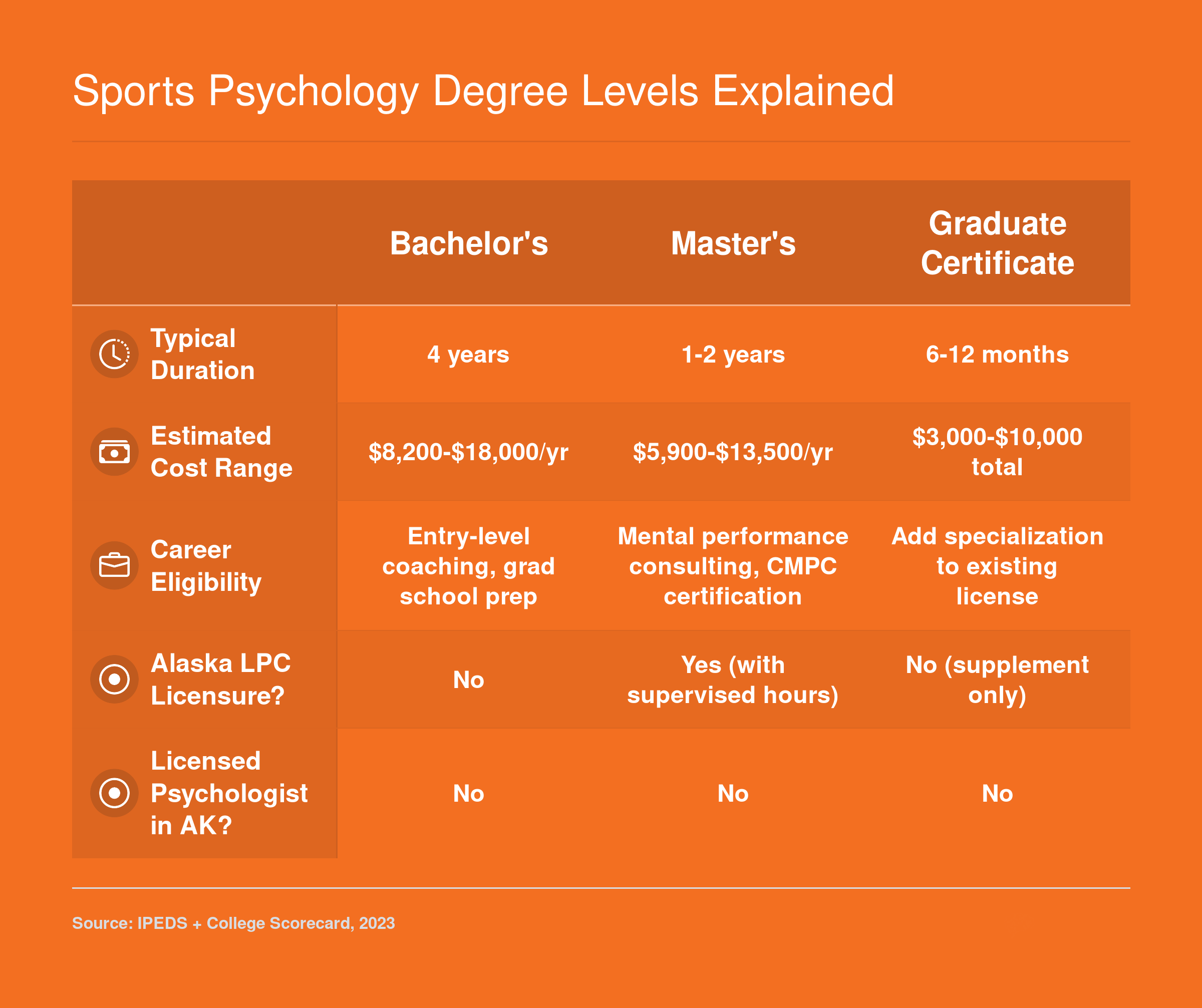
Choosing the right degree level is one of the most important decisions you will make on your path to a sport psychology career. In Alaska, a master's degree is the minimum requirement for most clinical sport psychology practice and for Licensed Professional Counselor (LPC) eligibility, while only a doctoral degree qualifies you for the Licensed Psychologist title. Graduate certificates are a smart option for clinicians who are already licensed and want to add a sport psychology specialization without completing an entirely new degree.
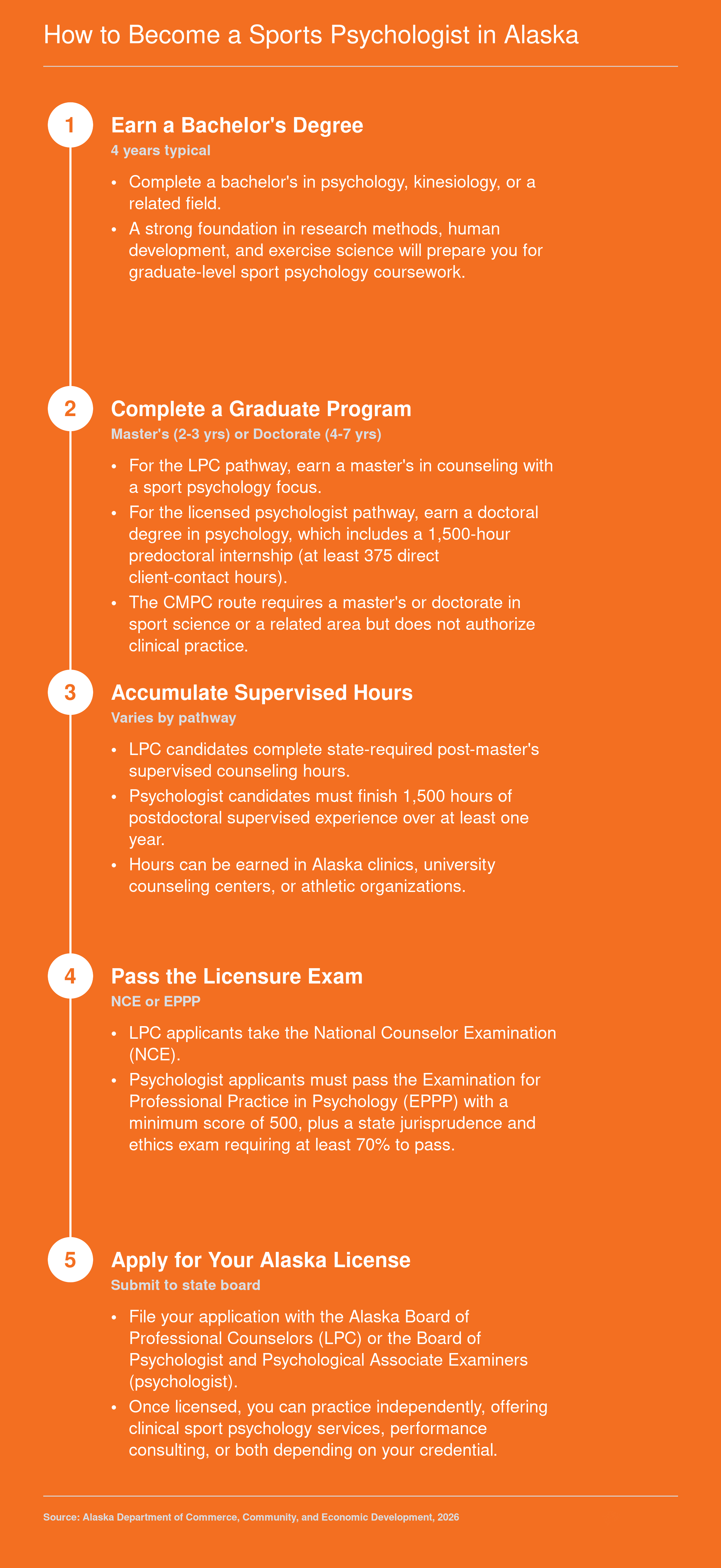
Alaska does not offer a sport-psychology-specific license, so aspiring practitioners follow one of two routes: the Licensed Professional Counselor (LPC) pathway at the master's level or the Licensed Psychologist pathway at the doctoral level. A third, non-clinical option is the Certified Mental Performance Consultant (CMPC) credential, which allows performance consulting but not clinical diagnosis or treatment. The steps below outline the full credentialing ladder from undergraduate study to independent practice.
Alaska Sports Psychology Licensure Requirements: LPC Vs. Licensed Psychologist
If you want to practice sport psychology in Alaska, you will need to understand the two main licensure routes available to you. Each pathway opens different doors in terms of the work you can do, the clients you can serve, and how long it takes to get there. Alaska does not currently have a sport-psychology-specific license or title protection, so practitioners typically pursue one of the two general mental health credentials below, or a national certification focused on performance consulting. For a broader look at the education-to-career pipeline, see our guide on how to become a sports psychologist.
Licensed Professional Counselor (LPC)
The LPC pathway is generally the faster route into the field. Here is what it involves:
Minimum degree: Master's or doctoral degree in counseling or a closely related field1
Supervised hours: 3,000 hours of post-degree supervised clinical experience1
Licensing exam: National Counselor Examination (NCE) or National Clinical Mental Health Counseling Examination (NCMHCE)1
Scope of practice: LPCs can diagnose and treat mental health conditions, which means you can address clinical issues such as anxiety, depression, and disordered eating in athletes, alongside performance-related concerns
Approximate timeline: Roughly three to four years after completing a master's degree, depending on how quickly you accumulate supervised hours
Licensing board: Alaska Board of Professional Counselors2
Reciprocity: Alaska offers a licensure-by-credentials/endorsement pathway for counselors already licensed in another state2
Licensed Psychologist
The Licensed Psychologist route requires a higher level of education but provides the broadest scope of practice, including psychological testing and assessment.
Minimum degree: Doctoral degree (Ph.D. or Psy.D.) in psychology4
Supervised hours: 4,000 hours total, including postdoctoral supervised experience3
Licensing exam: Examination for Professional Practice in Psychology (EPPP)4
Scope of practice: Full clinical diagnosis, psychological testing, treatment of mental health disorders, and performance optimization work with athletes
Approximate timeline: Six to eight years beyond a bachelor's degree, factoring in doctoral coursework, internship, and postdoctoral supervision
Licensing board: Alaska Board of Psychologist Examiners4
Reciprocity: Licensure by credentials/endorsement is available for psychologists licensed elsewhere4
If you are weighing the differences between these two tracks in more depth, our article on clinical vs. performance focus breaks down the educational and career implications of each path.
The CMPC Alternative for Performance Consulting
Not every sport psychology career requires a clinical license. If your goal is to focus on mental performance consulting rather than diagnosing or treating clinical conditions, the Certified Mental Performance Consultant (CMPC) credential from the Association for Applied Sport Psychology (AASP) may be a strong fit. The CMPC is a nationally recognized, non-licensure credential that signals expertise in performance enhancement, goal setting, imagery, and related mental skills training. You can explore additional options in our overview of sport psychology certification pathways.
However, CMPC holders in Alaska cannot independently diagnose or treat mental health conditions without also holding a state-issued clinical license. If you plan to work strictly on performance optimization, such as helping a college hockey team with focus and competition readiness, the CMPC can serve as your primary professional credential. Many practitioners pair it with an LPC or Licensed Psychologist credential to offer both clinical and performance services.
Does Alaska Have Sport-Psychology-Specific Provisions?
As of 2026, Alaska does not have a dedicated sport psychology license or any statutory title protections for "sport psychologist." Legislative efforts in various states have explored these distinctions, but Alaska's regulatory framework currently channels sport psychology practitioners through the existing LPC or Licensed Psychologist pathways. This is worth monitoring, as professional organizations continue to advocate for clearer definitions at the state level. For now, choosing between the LPC and Licensed Psychologist tracks comes down to your career goals, the depth of clinical training you want, and how much time you are prepared to invest before entering practice.
Questions to Ask Yourself
Do you want to diagnose and treat clinical mental health conditions in athletes, or focus on performance optimization and mental skills training?
This distinction shapes your entire education path. Clinical work requires licensure as a psychologist or counselor, while performance consulting may need only a master's degree and a certified mental performance consultant credential.
Are you willing to invest six to eight years in a doctoral program, or would you prefer entering the field sooner with a master's degree?
A doctoral route opens doors to the licensed psychologist title and clinical privileges, but a master's in counseling or sport psychology lets you begin practicing in roughly two to three years at a lower total cost.
Do you plan to build your career in Alaska long term, and if so, does private practice or institutional work better fit this market?
Alaska's population is small, so independent client volume can be limited. Positions with military installations, universities, or state athletic organizations may offer steadier demand and more predictable income than solo practice.
Sports Psychology Careers and Salaries in Alaska
Alaska's job market for sport psychology professionals is small but uniquely positioned. A combination of military installations, university athletics, school districts, and expanding telehealth services creates real opportunities for graduates who are willing to build a flexible practice. Here is what the salary landscape looks like and where you can expect to find work.
What Psychologists Earn in Alaska
According to Bureau of Labor Statistics data, clinical and counseling psychologists in Alaska earned a median hourly wage of $49.77 in May 2023, which translates to roughly $103,500 per year.1 The mean annual wage for the same group was $109,300.1 School psychologists in the state earned a median hourly wage of $44.60, with a mean annual salary of about $102,590.1 For the broader "Psychologists, All Other" category, which can encompass sport psychology specialists, BLS data from 2020 reported a mean annual wage of $118,270.2
These figures sit well above the national average for psychologists, reflecting Alaska's cost-of-living adjustments. Federal and military employers often layer additional locality pay on top of base salaries, which can push total compensation even higher for practitioners working on or near military bases.
Program-level earnings data specific to sport psychology graduates is not yet available for the online programs most commonly chosen by Alaska students. However, the state-level BLS figures provide a strong benchmark for what licensed professionals can expect once they are established in Alaska.
Total Employment and Market Size
Alaska reported approximately 120 clinical and counseling psychologists and 80 school psychologists as of 2023.1 There is no separate BLS count for sport psychology practitioners specifically, because most are captured within these broader categories. The takeaway: full-time, dedicated sport psychology roles are limited, and most professionals in Alaska blend sport psychology work with other counseling or clinical services. Understanding the distinction between clinical sports psychology and applied performance work can help you decide which blend of services fits your career goals.
Realistic Work Settings Across the State
Alaska offers several viable employment paths for sport psychology graduates:
Joint Base Elmendorf-Richardson (JBER): The military's growing investment in human performance optimization programs means JBER near Anchorage regularly seeks professionals trained in sports performance psychology. These roles often come with federal pay scales and locality adjustments that make them among the highest-paying positions in the field statewide.
University athletics: The University of Alaska Anchorage and the University of Alaska Fairbanks both maintain athletics departments where sport psychology consultation can support student-athletes, though these positions may be part-time or contracted rather than full-time staff roles.
School district counseling: With 80 school psychologists employed statewide, districts across Anchorage, the Matanuska-Susitna Valley, and Fairbanks represent a steady source of demand. Sport psychology skills, particularly around youth performance anxiety and team dynamics, are increasingly valued in K-12 settings.
Private practice in Anchorage and Fairbanks: Alaska's two largest population centers offer the most realistic market for building a private caseload of athletes, coaches, and recreational competitors.
Telehealth across rural Alaska: Much of the state is inaccessible by road, and telehealth has become a critical delivery model for mental health services. Sport psychology practitioners who are comfortable with virtual sessions can serve athletes, outdoor recreation guides, and performance-oriented clients in remote communities without relocating.
The Alaska Pay Premium
One detail that often surprises newcomers: Alaska salaries for psychologists tend to run 10 to 20 percent above Lower 48 averages, even after accounting for higher living costs. Federal employers at JBER and within the Department of Veterans Affairs apply General Schedule locality pay tables that reflect Alaska's unique cost environment. For sport psychology professionals considering a move north or building a remote practice that serves Alaskan clients, this pay premium can meaningfully offset the higher expenses associated with housing, food, and travel in the state.
The bottom line is that Alaska will not offer the volume of sport psychology positions you would find in a major metro area in the Lower 48. But the combination of military demand, university needs, school-based roles, and telehealth flexibility means that motivated professionals can carve out a rewarding and well-compensated career here.
Most Affordable Online Sports Psychology Programs for Alaska Students
When comparing the cost of a sports psychology degree, Alaska students should look beyond published tuition rates. The net price after financial aid can differ significantly from the sticker price, sometimes by thousands of dollars. Since Alaska has no in-state sports psychology programs, online degrees are the most practical route, and many of these schools offer flat online tuition rates regardless of where you live. Be sure to confirm with each school whether Alaska residents qualify for a flat rate or pay out-of-state tuition. The five programs below are ranked by net price, giving you a focused cost comparison separate from the quality-based ranking elsewhere on this page.
School
Program Offered
Degree Level
Program Type
Out-of-State Tuition
Net Price (After Aid)
East Central University
M.S. in Sport Psychology
Master's
Online
$12,236
$8,683
Kent State University at Stark
B.S. in Sport, Exercise and Performance Psychology
Bachelor's
Online
$17,969
$10,897
Kent State University at Trumbull
B.S. in Sport, Exercise and Performance Psychology
Bachelor's
Online
$17,969
$11,135
Kent State University at Geauga
B.S. in Sport, Exercise and Performance Psychology
Bachelor's
Online
$17,969
$12,044
Texas A&M University, Kingsville
M.S. in Kinesiology (Performance Psychology)
Master's
Hybrid
$14,560
$12,090
Internship and Practicum Opportunities for Sport Psychology Students in Alaska
Most online sport psychology programs require practicum or internship hours, and the good news is that Alaska offers several supervised experience sites even if the state's mental performance community is relatively small. The key is knowing where to look and being willing to make a strong case for yourself when a formal practicum pipeline does not already exist.
Military Human Performance Programs at JBER
Joint Base Elmendorf-Richardson (JBER) in Anchorage is one of Alaska's most promising practicum environments. The base houses a Holistic Health and Fitness (H2F) program embedded within Army brigades.1 H2F teams typically include physical therapists, dietitians, occupational therapists, athletic trainers, and strength and conditioning coaches, and the program's mission centers on optimizing soldier readiness across physical, mental, and emotional domains. JBER also runs a Health and Wellness Center (HAWC) that oversees fitness programming and has exercise physiologists on staff.2
While JBER's practicum opportunities in sport and performance psychology are not always formally advertised, students interested in mental performance optimization can reach out to the installation's behavioral health or human performance leadership to propose a placement. Military installations are often open to hosting graduate-level practicum students, especially when the student's program coordinator can formalize the arrangement through a memorandum of understanding.
University Athletics Departments
The UAA Seawolves and UAF Nanooks athletics departments are natural fits for practicum placements. Even if a department does not employ a dedicated sport psychologist, athletic trainers, team physicians, and student-athlete support staff frequently collaborate with mental health professionals. Reaching out to the athletics director or the student services coordinator with a clear proposal outlining how your practicum would benefit student-athletes can open doors that did not previously exist.
Alaska school districts with established counseling programs represent another option, particularly for students pursuing a Licensed Professional Counselor (LPC) pathway. Districts in Anchorage, Fairbanks, and the Matanuska-Susitna Valley employ school counselors who may be willing to supervise practicum hours focused on youth performance and well-being.
How to Pitch an Informal Practicum Site
Many Alaska organizations have never hosted a sport psychology practicum student, so you may need to create the opportunity yourself. Given how few practitioners work in this field statewide, it helps to understand where sports psychologists are most needed. A strong pitch includes:
A clear scope of work: Outline exactly what services you would provide (workshops, individual sessions, team building) and how many hours you need.
Supervisor logistics: Explain that your academic program may allow an off-site supervisor, meaning the host organization does not need a licensed psychologist on staff.
Liability coverage: Confirm that your university's malpractice or liability insurance extends to the practicum site.
Mutual benefit: Frame the placement as a free resource for the organization while fulfilling your academic requirements.
Finding Supervision and CMPC Mentorship
Private practice supervisors in Anchorage can oversee practicum hours for students pursuing licensure, but availability is limited. If you are in a remote part of the state, telehealth-based supervision is increasingly accepted by both licensing boards and academic programs. Confirm with your program that remote supervision meets their requirements before committing.
For students on the Association for Applied Sport Psychology (AASP) pathway toward Certified Mental Performance Consultant (CMPC) certification, specific mentorship hours under an AASP-certified professional are required. Alaska has very few CMPC holders, which can make this step challenging. However, AASP permits remote mentorship, and connecting with a certified consultant in the lower 48 or even internationally through video sessions is a practical workaround. The largest sport psychology organization directory is the best starting point for identifying mentors who accept remote mentees.
Alaska's practicum landscape rewards initiative. The sites are there, from military installations to university athletics to private practices, but students who proactively build relationships and propose structured placements will find the most success.
While Alaska does not offer in-state sport psychology degree programs, the career market is viable and growing. Opportunities through military installations, university athletics, telehealth services, and private practice make the field accessible across the state. Accredited online degrees allow students in Anchorage, Fairbanks, Juneau, or remote communities to complete their education without relocating, then build a local career serving Alaska's athletes and active-duty populations.
Frequently Asked Questions About Sports Psychology in Alaska
Aspiring sports psychology professionals in Alaska often have questions about degree options, licensure pathways, and career prospects in the state. Below, we answer the most common questions to help you plan your education and career with confidence.
Are there any sports psychology programs in Alaska?
As of 2026, no Alaska-based university offers a dedicated sports psychology degree program. The University of Alaska system provides related coursework in psychology and kinesiology, but students seeking a specialized sport psychology degree typically enroll in accredited online programs from institutions in the lower 48 states. This is a common path for Alaska residents, and many programs are designed with remote learners in mind.
Can you get a sports psychology degree entirely online?
Yes. Multiple accredited universities offer fully online bachelor's, master's, and doctoral degrees in sport psychology or closely related fields such as performance psychology. Some programs may require brief on-campus residencies or in-person practicum hours, but many allow students to complete supervised experience in their home state. Alaska students should confirm practicum flexibility before enrolling.
What license do you need to practice sports psychology in Alaska?
Alaska does not offer a sport psychology-specific license. Professionals who provide clinical services typically pursue licensure as a Licensed Professional Counselor (LPC) through the Alaska Board of Professional Counselors or as a Licensed Psychologist through the Alaska Board of Psychologist and Psychological Associate Examiners. Each path has distinct education, supervised hours, and examination requirements. Non-clinical mental performance consultants may practice without a license but cannot offer therapy.
What is the difference between a sports psychologist and a mental performance consultant?
A sports psychologist holds a doctoral degree and state licensure in psychology, allowing them to diagnose and treat clinical mental health conditions in athletes. A mental performance consultant, often certified through the Association for Applied Sport Psychology (CMPC credential), focuses on performance enhancement skills such as visualization, focus, and confidence building. Mental performance consultants do not provide clinical therapy unless they also hold a separate clinical license.
How much does a sports psychologist make in Alaska?
Specific salary data for sports psychologists in Alaska is limited due to the small number of practitioners in the state. However, licensed psychologists in Alaska earn a median annual salary that generally exceeds the national average for psychologists, partly reflecting the state's higher cost of living. Professionals who combine private practice with consulting for athletic organizations or university teams may see additional income variability.
Can I complete supervised hours for licensure while living in Alaska?
Yes, though finding qualified supervisors in Alaska can require planning. Licensed psychologists and licensed professional counselors in the state can serve as clinical supervisors. Some Alaska residents arrange supervision through telehealth-based arrangements or partner with community mental health agencies, university counseling centers, or military installations. It is important to verify that your supervision arrangement meets your licensing board's specific requirements before you begin accruing hours.
Are online sport psychology degrees respected by employers?
Regionally accredited online degrees are widely respected by employers, licensing boards, and professional organizations. What matters most is that the program holds proper accreditation and aligns with your career goals. For clinical paths, programs accredited by CACREP (counseling) or APA (psychology) carry the strongest recognition. Employers also value hands-on experience, so look for programs that include practicum or internship components relevant to sport and performance settings.
Additional Online Sports Psychology Programs for Alaska Students
Beyond the top-ranked programs, these additional online options offer flexible pathways for Alaska students seeking sports psychology degrees. Each program is designed to be completed remotely, allowing you to pursue your education from anywhere in the state. Explore the details below to find a program that fits your goals.
Faulkner University
Faulkner University offers an online Bachelor of Science in Sports Psychology, preparing students for roles like coaching, athletic counseling, and fitness instruction. The program features small class sizes and a Christian worldview.
Parker University's online Bachelor of Science in Sport Psychology covers psychological theory, scientific research, and practical skills. The fully online format offers flexibility for working adults.
The Master of Science in Sports Psychology at University of the Southwest prepares students for careers in coaching, mentoring, and athletics. The program focuses on team dynamics, performance enhancement, and injury recovery.
Northern Michigan University offers a Master of Science in Applied Sport Psychology online. The program features two tracks: Mental Performance Consultant certification or limited psychologist licensure, designed for working professionals.
The 100% online Master of Science in Sport and Performance Psychology at Commonwealth University of Pennsylvania offers flexible full-time or part-time options, with no GRE required. The curriculum aligns with CMPC certification.
East Central University's online Master of Science in Sport Psychology requires 45 credit hours and prepares students for CMPC certification. The program includes a supervised internship and can be completed in 1-2 years.
The University of West Alabama offers an online Master of Science in Experimental Psychology with a Health and Sports Psychology concentration. The program prepares graduates for doctoral studies or careers in health and sports psychology.
Kent State University at Stark offers a Bachelor of Science in Sport, Exercise and Performance Psychology online. The program covers motivation, mental training, and stress management, with a practicum component.
Kent State University at Tuscarawas offers the same online Bachelor of Science in Sport, Exercise and Performance Psychology. The curriculum includes courses like Psychology of Coaching and Sport Performance Psychological Interventions.
Kent State University at Trumbull delivers an online Bachelor of Science in Sport, Exercise and Performance Psychology. The program focuses on mental skills training, injury psychology, and ethical practice.
Kent State University at Salem offers an online Bachelor of Science in Sport, Exercise and Performance Psychology. The program covers psychological factors in athletic performance and includes a practicum.
Kent State University at Ashtabula provides an online Bachelor of Science in Sport, Exercise and Performance Psychology. Students learn about motivation, mental training, and stress management.
Kent State University at East Liverpool offers an online Bachelor of Science in Sport, Exercise and Performance Psychology. The curriculum covers motivation, mental training, and stress management, preparing graduates for careers in coaching or mental performance.
Kent State University at Geauga provides an online Bachelor of Science in Sport, Exercise and Performance Psychology. The program focuses on psychological factors in athletic and performance success.