Clinical or Performance Track? How to Choose Your Sports Psychology Path

Compare training timelines, credentials, salaries, and day-to-day work for each educational route so you can pick the right fit.

By Alexis MeyersReviewed by SportsPsychology.org TeamUpdated May 19, 202625+ min read
Clinical vs. Performance Sports Psychology: Which Track?

What you’ll learn in this article…

  • Clinical sport psychologists need a doctoral degree and licensure, while performance specialists can practice with a master's degree and a CMPC credential.
  • The clinical track takes roughly 7 to 10 years of education and supervised training, compared to 2 to 3 years for the performance track.
  • Licensed clinical sport psychologists can both treat mental health conditions and deliver performance consulting, offering the widest career flexibility.
  • Switching from the performance track to clinical requires returning for a doctorate, but moving from clinical to performance consulting is relatively straightforward.

Both clinical sport psychologists and performance psychology specialists work with athletes, yet the training gap between them is striking: one path requires a doctoral degree, supervised clinical hours, and state licensure, while the other can begin with a master's degree and a Certified Mental Performance Consultant (CMPC) credential. That difference shapes everything from the clients you can legally serve to the salary range you can expect.

A clinical sport psychologist is a licensed therapist who diagnoses and treats mental health conditions such as anxiety, depression, and eating disorders in athletic populations. A performance psychology specialist focuses on mental skills training, teaching techniques like imagery, self-talk, and attentional focus to help athletes perform under pressure. No diagnosis, no therapy.

The practical tension is real. The clinical route typically demands seven to nine years of post-baccalaureate training and six-figure tuition costs, but it also grants the broadest legal scope of practice in the field. Many professionals who pursue this longer path, including former competitors building a career in performance psychology, find the investment worthwhile for the flexibility it provides. The performance route is faster and less expensive, yet it restricts practitioners from addressing the clinical issues that frequently surface in athlete populations.

Clinical vs. Performance Sports Psychology at a Glance

Before diving into the details of each educational track, it helps to see how they compare side by side. The table below summarizes the most important differences across degree requirements, timelines, credentials, scope of practice, and work settings. One critical distinction to keep in mind: the clinical track qualifies you to do everything the performance track does (mental skills training, peak performance consulting) plus diagnose and treat mental health conditions, but that broader scope comes with significantly more training time and cost.

DimensionClinical TrackPerformance Track
Typical DegreePsyD or PhD in Clinical or Counseling Psychology (often with a sport psychology concentration)MA, MS, or EdD in Sport and Performance Psychology, Kinesiology, or a related field
Training Timeline5 to 7 years (includes doctoral coursework, practicum hours, and a supervised internship year)2 to 4 years (master's programs are typically 2 years; an EdD may take 3 to 4 years)
Primary CredentialState licensure as a psychologist (required to practice independently and use the title 'psychologist')Certified Mental Performance Consultant (CMPC) through the Association for Applied Sport Psychology
Scope of PracticeDiagnosis and treatment of mental health disorders (e.g., anxiety, depression, eating disorders), psychotherapy, and mental skills training for performanceMental skills training (e.g., visualization, goal setting, arousal regulation, focus strategies); cannot diagnose or treat clinical disorders
Title ProtectionThe title 'sport psychologist' or 'psychologist' is legally protected in most U.S. states and requires licensureThe title 'mental performance consultant' is not a protected title and does not require state licensure
Typical Work SettingsPrivate practice, university counseling centers, hospitals, professional sports teams, Olympic training centers, military programsCollege and professional athletic departments, private consulting, corporate performance programs, military human performance programs
Supervised Clinical Hours RequiredApproximately 3,000 to 4,000 hours of supervised clinical experience (varies by state)No clinical hours required; CMPC certification requires mentored experience in applied sport psychology (typically 400 or more hours)
Client PopulationsAthletes and non-athletes experiencing clinical issues such as trauma, substance use, identity crises, or performance anxiety rooted in mental health conditionsPrimarily healthy, high-performing athletes, coaches, teams, and other performers (musicians, surgeons, executives) seeking skill optimization

What Does a Clinical Sport Psychologist Do Day to Day?

The title might suggest a steady stream of elite athletes sitting on a couch, but the daily reality of a clinical sport psychologist is more varied, more demanding, and often more rewarding than that image implies. Understanding what sports psychologists do on a typical week can help you decide whether the clinical track aligns with your strengths and interests.

A Realistic Weekly Schedule

Most clinical sport psychologists spend the largest portion of their week conducting individual therapy sessions. These are not limited to pre-game jitters. Sessions regularly address clinical diagnoses such as generalized anxiety disorder, major depression, eating disorders, substance use issues, and identity crises that surface during career transitions or after serious injuries. In between sessions, documentation takes up a significant chunk of time: writing progress notes, updating treatment plans, coordinating with other providers, and handling insurance or billing paperwork.

A week might also include one or two team consultations, where you meet with coaching staff to discuss athlete well-being, facilitate group workshops on stress management, or contribute to return-to-play decisions alongside sports medicine professionals. Some weeks bring crisis calls, requiring rapid intervention for an athlete experiencing suicidal ideation or a traumatic event.

The Mixed-Caseload Reality

If you picture yourself working exclusively with athletes from day one, it is important to adjust that expectation. Especially early in a career, caseloads in private practice and university counseling centers almost always include a mix of athlete and non-athlete clients. A university counseling center psychologist might see a Division I swimmer struggling with bulimia in one hour and a graduate student dealing with panic attacks in the next. Pure sport-only caseloads do develop over time, particularly for those who build reputations and referral networks, but they are the exception rather than the rule in the first several years of practice.

Where Clinical Sport Psychologists Work

Work settings span a wide range, each shaping the day-to-day experience differently:

  • Private practice: Maximum autonomy over scheduling and specialization, but requires building your own client base and managing business operations.
  • University counseling centers: Steady caseloads, benefits, and direct access to student-athletes, though sport-specific work may be only a fraction of your role.
  • Sports medicine clinics: Collaborative environment alongside physicians, physical therapists, and athletic trainers, often focusing on injury-related psychological recovery.
  • VA and military facilities: Working with service members on performance optimization and clinical issues such as PTSD, traumatic brain injury, and transition-related depression.
  • Embedded roles with professional teams: The most coveted positions, where you serve as an in-house resource for a single organization. These roles are limited in number and typically require years of experience.

The Emotional Weight of Clinical Work

This is the dimension that separates the clinical track most clearly from performance-focused work. Clinical sport psychologists routinely sit with athletes through their darkest moments: trauma disclosures, active substance abuse, grief after career-ending injuries, and acute psychiatric crises. The emotional toll is real. Supervision, peer consultation, and your own self-care practices are not optional extras; they are professional necessities. Many practitioners who once competed themselves find that their athlete to sports psychologist journey deepens their empathy in these moments. If you are drawn to helping people at their most vulnerable and feel energized rather than depleted by deep therapeutic relationships, the clinical track may be a natural fit. If that kind of intensity feels unsustainable, the performance track covered in the next section offers a meaningfully different day-to-day experience.

What Does a Performance Psychology Specialist Do Day to Day?

If you choose the performance track, your daily work revolves around helping athletes and other high performers sharpen the mental side of their craft. Rather than diagnosing or treating mental health conditions, you teach skills: how to focus under pressure, how to recover mentally after a bad play, how to stay motivated through a grueling season. The work is hands-on, collaborative, and often conducted in athletic facilities rather than clinical offices. For a closer look at typical routines across the profession, see our guide on what does a sports psychologist do on a daily basis.

A Typical Week on the Performance Track

No two weeks look identical, but a representative schedule might include:

  • Individual mental skills sessions: Meeting one-on-one with athletes to work on goal setting, visualization, self-talk strategies, arousal regulation, and pre-performance routines. Sessions typically run 30 to 60 minutes.
  • Team workshops: Leading group sessions on topics like communication, team cohesion, or handling competitive anxiety. These often happen during the preseason or before major tournaments.
  • Game-day and pre-game routines: Being present at competitions to help athletes lock in their mental preparation, manage nerves, and debrief after performance.
  • Film review with coaches: Sitting in on video sessions to observe how athletes respond to mistakes, identify patterns in focus or confidence, and align mental skills work with tactical coaching.
  • Travel: Accompanying teams to away games, tournaments, or training camps, sometimes for days at a time.

This schedule can shift dramatically depending on the sport's competitive calendar, making flexibility a core requirement of the role.

Scope-of-Practice Boundaries

One of the most important distinctions for performance consultants is knowing where mental skills training ends and clinical treatment begins. If an athlete presents signs of depression, an eating disorder, substance abuse, or another clinical concern, performance consultants are expected to refer that individual to a licensed mental health professional. Crossing this boundary without a clinical license is both unethical and, in most jurisdictions, illegal. Recognizing these red flags is a skill you will develop during your training, and strong referral networks are essential to responsible practice.

Where Performance Specialists Work

The performance track opens doors to a range of settings:

  • Collegiate athletic departments, often embedded with specific sports programs
  • Professional sports teams across leagues like the NFL, NBA, MLS, and NWSL
  • Olympic and national governing body programs supporting elite-level athletes
  • Military human performance programs, where mental toughness training parallels athletic applications
  • Private consulting practices serving athletes, first responders, performing artists, or corporate executives

The growing demand for mental performance coaching in business settings is also worth noting. Some specialists now apply their skills in sports psychology in corporate wellness programs, working with executives and teams outside the traditional athletic world.

The Independent Contractor Reality

It is worth knowing that many performance psychology specialists, especially early in their careers, work as independent contractors rather than salaried employees. This often means juggling multiple teams or clients to build a sustainable income. You might consult with a college soccer program in the morning, see private clients in the afternoon, and travel with a different team on weekends. The lifestyle is dynamic and rewarding, but it requires comfort with irregular hours, significant travel, and the entrepreneurial side of running your own business. If you thrive on variety and do not mind living out of a suitcase during certain stretches of the year, the performance track can be deeply fulfilling.

Questions to Ask Yourself

Are you drawn to helping athletes work through clinical struggles like anxiety, trauma, and disordered eating, or does coaching already-healthy athletes toward peak performance energize you more?
This distinction shapes your entire career. Clinical work requires diagnosing and treating mental health conditions, while performance consulting centers on skill-building techniques like visualization, focus training, and pre-competition routines for athletes who are functioning well.
Are you prepared for five to seven years of doctoral training plus supervised clinical hours, or would you prefer entering the field in two to three years with a master's degree?
The clinical track demands a doctorate in psychology, followed by a supervised internship and postdoctoral hours before licensure. The performance track typically requires only a master's degree and applied experience, letting you begin consulting significantly sooner.
Do you picture yourself in a therapy office or on the sideline during competition?
Clinical sport psychologists often split time between private practice sessions and sport settings, conducting confidential therapy. Performance consultants tend to embed directly with teams, working courtside or on the field during practices and games.
Is it important to you to be able to treat the full range of a client's mental health needs, not just sport-related goals?
Only licensed clinical psychologists can diagnose and treat conditions such as depression, eating disorders, or substance use. If you want that broader scope of practice, the clinical track is the path that provides it.

Education and Training: Degrees, Timelines, and Costs

The educational path you choose in sports psychology depends largely on whether you want to diagnose and treat mental health conditions or focus on mental skills training and performance optimization. Each track requires a different degree, a different time investment, and a different financial commitment. Here is what to expect as you plan your route.

Clinical Track: Doctoral Programs

Becoming a clinical sport psychologist typically requires a doctoral degree, either a PhD or a PsyD, in clinical or counseling psychology. These programs generally take five to seven years to complete, including a one-year predoctoral internship and additional postdoctoral supervised hours. Students who pursue sport psychology within a clinical doctoral program often complete specialized coursework or a concentration in sport and exercise psychology alongside their core clinical training.

Tuition for APA-accredited doctoral programs varies widely. Funded PhD programs at research universities may cover full tuition and offer annual stipends, often in the range of $20,000 to $30,000 per year. PsyD programs, which are frequently housed at professional schools, tend to carry higher out-of-pocket costs, with total tuition sometimes exceeding $150,000 over four to five years. Funding packages differ significantly from one institution to the next, so reviewing each program's financial aid and assistantship information directly on its website is essential.

You can verify a program's accreditation status through the American Psychological Association's website, which maintains a searchable directory of accredited doctoral programs in clinical and counseling psychology.

Performance Track: Master's Programs

If your goal is to work as a mental performance consultant rather than a licensed psychologist, a master's degree in sport and exercise psychology or a closely related field is the standard entry point. These programs typically run two to three years and prepare you to pursue the Certified Mental Performance Consultant (CMPC) credential through the Association for Applied Sport Psychology. Joining sports psychology organizations early in your graduate training can help you build connections and stay informed about credentialing requirements.

Tuition for master's programs in sport and exercise psychology tends to range from roughly $15,000 to $60,000 in total, depending on whether the institution is public or private and whether you qualify for a graduate assistantship. Some programs offer assistantships that include tuition waivers and modest stipends, particularly at larger state universities. A growing number of programs also offer online or low-residency formats, which can reduce costs and increase flexibility for working professionals or those who cannot relocate. Because program offerings, delivery formats, and tuition rates change frequently, always confirm details directly through the program's website or through graduate school directories.

Funding Resources and Cost Research

Before committing to a program, take these steps to understand the full financial picture:

  • APA program directory: Search for accredited doctoral programs and review each program's funding structure, including whether it offers tuition remission or stipends.
  • AASP resources: The Association for Applied Sport Psychology maintains a graduate program directory for sport and exercise psychology, which can help you compare master's and doctoral options side by side.
  • BLS.gov: The Bureau of Labor Statistics publishes employment projections and general salary data for psychologists, which can help you weigh the cost of your degree against expected earning potential after graduation.
  • Program websites: Contact admissions offices directly to ask about assistantships, scholarships, and typical student debt loads at graduation.

Weighing Cost Against Career Flexibility

The clinical doctoral path costs more in both time and money, but it opens the door to a broader scope of practice, including the ability to treat clinical conditions like anxiety, depression, and eating disorders alongside performance work. The master's-level performance track is shorter and often less expensive, making it an appealing option if you are confident that mental skills training is where you want to build your career. Neither path is inherently better; the right choice depends on how you want to serve athletes and what kind of professional identity you envision for yourself.

For program-specific tuition figures, funding availability, and the latest accreditation details, sportspsychology.org recommends visiting individual program websites and the directories maintained by APA and AASP. Data in this space changes frequently, so verifying directly will always give you the most accurate and current information.


Clinical vs. Performance Track: Training Timeline Compared

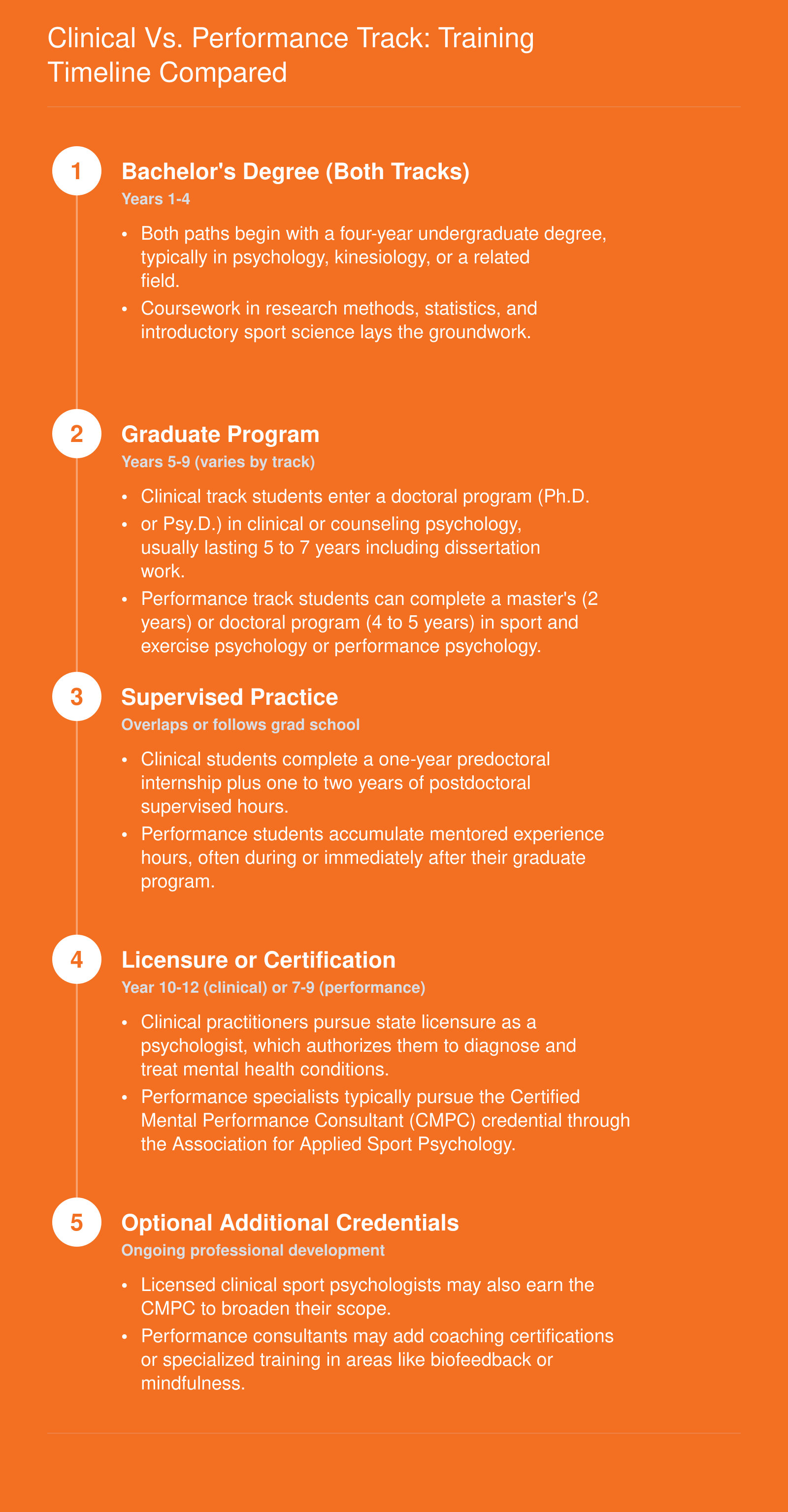
The clinical and performance tracks in sports psychology follow different timelines and milestones. Below, both paths are shown side by side so you can see how each stage stacks up in terms of time investment. The clinical route typically takes 10 to 12 years from your first day of college to full independent practice, while the performance route can be completed in roughly 7 to 9 years.

Side-by-side training timelines showing 10 to 12 years for the clinical sports psychology track and 7 to 9 years for the performance psychology track

Licensure, CMPC, and Other Credentials Compared

Credentials matter in sports psychology, and the specific letters after your name determine where you can practice, what services you can legally offer, and how employers evaluate your qualifications. The clinical and performance tracks each have a flagship credential, and understanding the differences will help you plan your training timeline wisely.

State Licensure for Clinical Sport Psychologists

If you follow the clinical track, your primary credential is a state-issued license to practice psychology. Every state requires a doctoral degree (PhD or PsyD in clinical or counseling psychology), but the supervised-experience requirements vary considerably.

  • California: Requires 3,000 hours of supervised professional experience, at least 1,500 of which must be accrued postdoctorally. California also enforces strict title protection: only licensed individuals may call themselves "psychologists."
  • Texas: Requires a minimum of 3,500 supervised hours, split between predoctoral internship hours and postdoctoral experience. Texas uses the title "Licensed Psychologist" and restricts the practice of psychology to license holders.
  • New York: Requires 3,500 supervised hours total, with at least 1,750 completed post-doctorally. New York's title-protection laws are equally firm, prohibiting unlicensed individuals from representing themselves as psychologists in any setting.

All three states (and every other U.S. state) also require candidates to pass the Examination for Professional Practice in Psychology (EPPP). Some states have added a jurisprudence exam covering local ethics and law. From start to finish, earning licensure typically takes two to three years beyond graduation, depending on how quickly you accumulate supervised hours.

The CMPC for Performance Psychology Specialists

The Certified Mental Performance Consultant (CMPC) credential, administered by the Association for Applied Sport Psychology, is the primary certification for the performance track. As of 2025 and 2026, requirements include:

  • A master's or doctoral degree in sport science or psychology from a regionally accredited institution.1
  • Coursework covering eight designated knowledge areas, ranging from sport psychology foundations to ethics and diversity.2
  • A structured mentored-experience component totaling 400 hours. Of those, at least 200 must involve direct client contact, with a minimum of 100 hours spent working with competitive-sport performers. An additional 150 hours of support activities (such as case review, program design, or observation) are required, along with 40 hours of formal mentorship, at least 20 of which must be individual sessions.3
  • A 115-question knowledge exam completed within a 90-minute window. Candidates who do not pass must wait 90 days before retaking, and the exam authorization is valid for six months.4

CMPC certification must be renewed every five years2, and the credential recently received NCCA reaccreditation in February 2026, reinforcing its standing as the field's recognized performance-psychology certification.5 It is also worth noting that beginning July 1, 2026, AASP will implement a new application-review schedule, so candidates planning to apply later this year should check current timelines.5

Which Settings Require Which Credential?

The distinction between these credentials has real consequences in the job market. Private practice therapy legally requires a state license in every jurisdiction, so performance consultants without licensure cannot diagnose or treat clinical conditions such as depression, anxiety disorders, or eating disorders. Professional sports teams and military human-performance programs increasingly prefer (and sometimes require) licensed psychologists who can handle both clinical presentations and performance enhancement. Many collegiate athletic departments, on the other hand, hire CMPC holders for mental-skills training roles, especially when a licensed counselor is already available through the campus counseling center.

The Dual-Credential Gold Standard

Some professionals hold both a state license and the CMPC, which represents the most versatile credential combination in the field. These individuals can legally provide therapy, diagnose mental health conditions, and deliver performance-enhancement consulting, all under one roof. The trade-off is time: earning both credentials means completing a full doctoral program, accumulating thousands of supervised clinical hours, passing the EPPP, and separately fulfilling the CMPC's mentored-experience and exam requirements. If you are committed to maximum career flexibility and the broadest possible scope of practice, the dual path is worth the investment. If your goals are more narrowly focused on mental-skills training without therapy, the CMPC alone may be the right fit.

Salary and Job Market Outlook by Track

Compensation in sports psychology varies widely depending on whether you follow the clinical track or the performance consulting track, and the setting you work in matters just as much as the credential you hold. Here is how to research realistic salary figures and what the available data tells us heading into 2026.

Clinical Track: What the Federal Data Shows

The Bureau of Labor Statistics (BLS) publishes annual wage estimates for clinical psychologists under SOC code 19-3031. You can access this data for free at bls.gov/oes. As of the most recent published estimates, the national median annual wage for clinical psychologists sits in the range of approximately $90,000 to $96,000, though top earners in metropolitan areas or hospital systems can exceed $130,000. Settings matter considerably:

  • Private practice: Income varies by caseload and payer mix, but established clinical sport psychologists in private practice often report earnings between $80,000 and $150,000 or more once they build a referral network.
  • University counseling centers: Salaries typically range from $70,000 to $105,000, with the benefit of stable employment, tuition remission for dependents, and retirement contributions.
  • Hospitals and integrated health systems: Compensation tends to land at or above the BLS median, often between $90,000 and $120,000, reflecting the demand for licensed psychologists in healthcare.

The BLS projects employment of clinical psychologists to grow faster than average through the end of the decade, fueled by increased recognition of mental health needs across populations, including athletes.

Performance Track: Piecing Together the Picture

Salary data for Certified Mental Performance Consultants (CMPC) and other performance-focused practitioners is harder to pin down because no single federal dataset tracks this niche. The Association for Applied Sport Psychology (AASP) periodically surveys its membership on compensation. If AASP has not published a recent survey, you can contact their office or check their website for the latest available figures. Based on available industry reports and practitioner disclosures, ranges tend to look like this:

  • Professional and Olympic sport teams: Full-time roles with NBA, NFL, MLB, or national governing bodies can pay anywhere from $80,000 to $180,000 or higher, but these positions are scarce and highly competitive.
  • Military and Department of Defense contracts: The U.S. Army Master Resilience Training program and similar initiatives hire performance psychology professionals at salaries commonly reported between $75,000 and $120,000, depending on contract terms and location.
  • Independent consulting: Earnings vary enormously. Early-career consultants may earn $40,000 to $60,000 while building a client base, whereas established consultants with elite-sport clients can earn well into six figures.

How to Verify Salary Claims Yourself

Do not rely on a single source. Cross-reference what you find using this approach:

  • Start with the BLS Occupational Employment and Wage Statistics page for the clinical baseline.
  • Search current job postings on university career pages, professional team HR portals (most major league teams post openings on their official sites), and military contractor job boards to see advertised ranges.
  • Use PayScale or Glassdoor to filter by titles such as "sport psychologist" or "mental performance consultant" and adjust by location. Pay close attention to sample sizes: a median based on fewer than 30 responses may not be reliable.
  • Reach out directly to AASP for any published salary survey data or member-reported compensation benchmarks.

Job Market Realities to Keep in Mind

The clinical track generally offers more plentiful and more stable job openings because a licensed sports psychologist can serve broader populations beyond athletes. Performance consulting roles are growing, especially in collegiate athletics, the military, and corporate high-performance settings, but full-time salaried positions remain limited compared to the number of graduates entering the field each year. Many performance consultants cobble together income from multiple sources: a part-time university appointment, private consulting clients, and speaking or workshop fees. If financial stability early in your career is a priority, the clinical license provides a wider safety net while still allowing you to specialize in sport.

Salary Ranges: Clinical vs. Performance Track by Work Setting

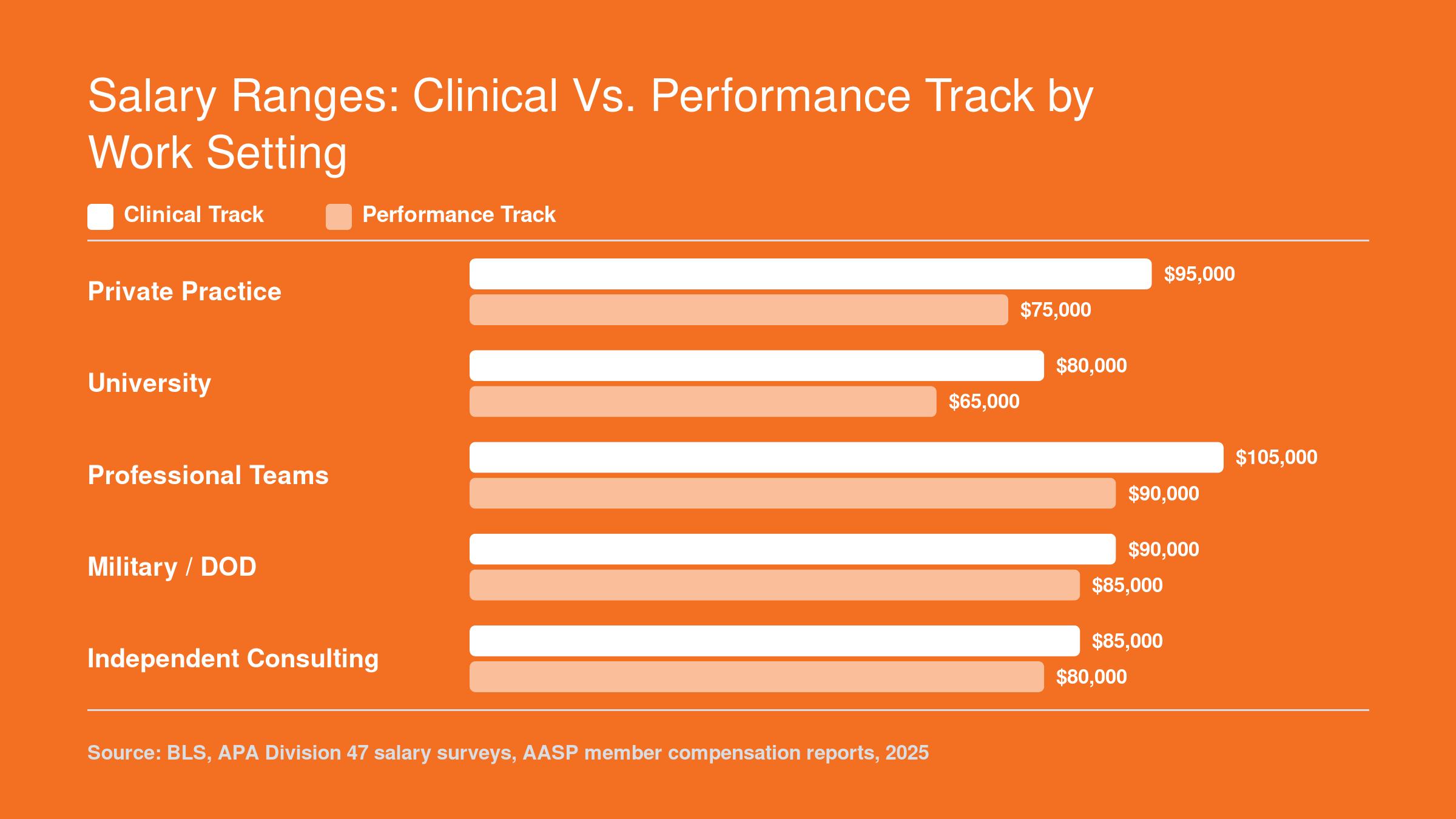
Compensation in sports psychology varies widely depending on your credential track and where you practice. Clinical sport psychologists, who hold doctoral degrees and licensure, generally command higher salaries in medical and institutional settings. Performance psychology specialists can earn competitively in elite sport and military environments. The ranges below reflect approximate annual earnings across five common work settings.

Grouped bar chart comparing approximate salary midpoints for clinical and performance sport psychologists across five work settings including private practice, universities, pro teams, military, and consulting

Can You Switch Tracks or Pursue a Hybrid Path?

One of the most common questions aspiring sports psychology professionals ask is whether they can change direction after they have already started down one educational path. The short answer: yes, but the ease of switching depends entirely on which direction you are moving.

Pivoting From Performance to Clinical

If you complete a master's degree in sport and exercise science or performance psychology and later decide you want to diagnose and treat clinical mental health conditions, the transition is significant. You will essentially need to enter the clinical pipeline from scratch, which means enrolling in a doctoral program in clinical or counseling psychology, completing supervised clinical practica, finishing a predoctoral internship, accumulating postdoctoral hours, and obtaining state licensure. Some of your prior coursework in sport psychology foundations or research methods may transfer and reduce your doctoral course load slightly, but the core clinical training requirements cannot be bypassed. Expect to add five to seven years to your timeline if you make this switch.

Pivoting From Clinical to Performance

Moving in the opposite direction is far more manageable. A licensed psychologist who already holds a doctorate can pursue the Certified Mental Performance Consultant (CMPC) credential by completing additional sport-specific coursework and accumulating mentored performance consulting hours under a qualified supervisor. No new degree is required. Many licensed psychologists add this credential within one to two years while continuing to practice, which makes the clinical-to-performance pivot one of the more accessible career expansions in the field.

Emerging Hybrid Doctoral Programs

For students who know early on that they want both clinical authority and performance expertise, a growing number of doctoral programs now blend the two tracks. Programs at institutions such as the University of North Texas, Boston University, and formerly JFK University (now part of National University) have offered clinical psychology doctorates with embedded sport psychology concentrations. Graduates of these programs are positioned to pursue both state licensure and CMPC certification upon completion, giving them the broadest possible scope of practice from day one.

The Strategic Default: Lean Clinical if You Are Unsure

If you are genuinely torn between the two tracks and you have the time and financial resources to commit to a doctoral program, the clinical route preserves the most flexibility. A licensed psychologist can always layer on performance consulting work, but a performance consultant cannot add clinical services without returning to school for a doctorate and full licensure. Think of the clinical track as the wider doorway: it opens into both rooms, while the performance track opens into only one. This does not make the performance path less valuable, but it does mean that choosing it requires greater certainty about your professional goals.

For a deeper look at both educational tracks and the credentials each one unlocks, explore the program comparison tools and career guides available on sportspsychology.org.

Self-Assessment: Which Sports Psychology Track Fits You?

Choosing between the clinical and performance tracks is one of the most consequential decisions you will make early in your career. Rather than leaving it to chance, work through the questions and decision logic below to clarify which path aligns with your interests, timeline, and long-term goals.

Eight Questions to Guide Your Decision

Grab a notebook and answer honestly. There are no wrong responses, only informative ones.

  • Question 1: Does the idea of diagnosing and treating conditions like depression, eating disorders, or anxiety excite you, or would you rather teach athletes visualization, focus, and arousal-regulation techniques?
  • Question 2: Are you comfortable committing to six or more years of graduate education (doctoral program plus supervised hours), or do you prefer entering the field in two to three years with a master's degree?
  • Question 3: Do you value the security and scope of practice that come with licensure, or does the entrepreneurial flexibility of independent consulting appeal to you more?
  • Question 4: Can you see yourself working in a hospital, counseling center, or VA clinic alongside athletes, or do you picture yourself on the sidelines, in locker rooms, and at training facilities?
  • Question 5: How important is it to you to be able to bill insurance for your services?
  • Question 6: Do you enjoy research design and data analysis enough to complete a dissertation?
  • Question 7: Would you like the option to work with non-athlete populations (first responders, surgeons, military personnel) without needing additional credentials?
  • Question 8: If finances tightened, would you feel safer holding a clinical license that qualifies you for a broad range of mental health positions?

If most of your answers lean toward treating mental health conditions, committing to doctoral training, and valuing licensure, the clinical track is likely your fit. If you gravitate toward coaching peak performance, entering the workforce sooner, and building a consulting practice, the performance track deserves your focus. And if you are genuinely torn but can invest the time, the clinical track offers the widest flexibility because it qualifies you for both mental health treatment and performance work.

Prerequisite Coursework for Either Track

Regardless of which direction you choose, certain undergraduate courses strengthen any application.

  • Abnormal psychology
  • Research methods and statistics
  • Exercise science or kinesiology
  • Developmental psychology

Clinical programs additionally favor applicants who have logged clinical practica hours and participated in faculty-led research. Performance-track applicants benefit from coaching experience, sport science labs, or internships with college athletic departments.

Practical Next Steps

Once you have a preliminary answer, turn insight into action. Start by researching programs recognized by the Association for Applied Sport Psychology. Reach out to at least two professionals, one licensed clinical sport psychologist and one Certified Mental Performance Consultant, for informational interviews. If possible, shadow each for a day to observe the real differences in clientele, session structure, and work environment. These conversations often reveal nuances that no website or brochure can capture.

For a curated list of accredited programs and additional career resources, explore the guides available on sportspsychology.org. If you are also curious about emerging niches, the field of esports psychology is expanding rapidly and draws from both tracks. The sooner you gather firsthand perspectives, the more confident your decision will be.

Frequently Asked Questions About Clinical and Performance Sports Psychology

Below are the questions aspiring sports psychology professionals ask most often. Each answer draws on the educational, credentialing, and career details covered throughout this article on sportspsychology.org. If your question is not listed here, the self-assessment and comparison sections above may help.

What is the difference between a sports psychologist and a therapist?
A clinical sport psychologist holds a doctoral degree in psychology and a state license, which allows them to diagnose and treat mental health conditions such as anxiety, depression, and eating disorders in athletes. A performance psychology specialist (often called a mental performance consultant) focuses on mental skills training, including goal setting, visualization, and focus, but cannot diagnose or treat clinical disorders. The distinction comes down to scope of practice: one treats mental health, the other trains mental performance.
Do you need a doctorate for sports performance psychology?
Not necessarily. Many performance psychology specialists enter the field with a master's degree in sport and exercise psychology or a related discipline. A master's is the minimum required to pursue the Certified Mental Performance Consultant (CMPC) credential. However, a doctorate can open additional doors, particularly in higher education, research, or elite professional sport settings where advanced credentials carry more weight.
How do you become a clinical sports psychologist?
The typical path includes earning a doctoral degree (PhD or PsyD) in clinical or counseling psychology, completing supervised practicum and internship hours, and obtaining state licensure as a psychologist. From there, you build sport-specific expertise through coursework, supervised work with athletes, and potentially earning the CMPC credential. Expect the full process to take roughly seven to ten years of post-undergraduate training.
What is the salary difference between clinical and performance sports psychologists?
Salaries vary by setting, geography, and experience, but clinical sport psychologists generally command higher base pay because they hold doctoral degrees and clinical licenses. Many earn between roughly $80,000 and $120,000 or more, especially in private practice or professional sports. Performance consultants with a master's degree typically start in the $50,000 to $75,000 range, though those working with elite teams or running established private practices can earn well above that.
Can you switch from a performance track to a clinical track later in your career?
Yes, but it requires significant additional education. You would need to complete a doctoral program in clinical or counseling psychology, accumulate the required supervised clinical hours, and pass your state's licensing examination. Some professionals find the transition worthwhile because a clinical license broadens the populations and issues they can address. Planning early and choosing a doctoral program that values sport psychology can streamline the process.
What does CMPC stand for, and is it required to work with athletes?
CMPC stands for Certified Mental Performance Consultant, a credential administered by the Association for Applied Sport Psychology (AASP). It is not legally required to work with athletes, but it is widely recognized as the professional standard in applied sport and performance psychology. Earning the CMPC signals to teams, coaches, and athletes that you have met rigorous education, mentored experience, and examination requirements.
Is clinical sport psychology the same as clinical psychology?
Not exactly. Clinical sport psychology is a specialization within the broader field of clinical or counseling psychology. Both share the same doctoral training foundation, supervised hours, and licensure requirements. The key difference is focus: a clinical sport psychologist applies clinical skills specifically to athlete populations and sport contexts, addressing issues like performance anxiety, identity concerns, injury recovery, and co-occurring mental health disorders unique to competitive sport environments.

Recent Articles