Telehealth sessions can cost as little as $25 per athlete visit.
NCAA mental health requirements now apply to all divisions, including D3.
Targeted grants and community partnerships fund support without new budget lines.
The NCAA's 2024 Mental Health Best Practices now require all member institutions to provide mental health resources to student-athletes, a mandate that falls unevenly across divisions. A Division III liberal arts college with 300 athletes and a single part-time counselor confronts a different reality than a Power Five school with a dedicated sports psychology staff.
On small campuses, the closeness that builds team trust also magnifies pressure. An athlete struggling with anxiety may hesitate to seek help when the campus counselor knows their coach, roommate, or professor, discouraging them from using services even when they exist.
Yet the funding landscape is shifting. Low-cost telehealth platforms offer licensed, confidential support for as little as $25 per session, and grants now target mental health at resource-constrained schools. Small colleges that once saw athlete mental health as a budgetary impossibility are finding affordable entry points.
The Unique Mental Health Challenges Facing Small-College Athletes
Small liberal arts colleges face a more complex mental health landscape for athletes than large universities precisely because their intimate, tight-knit communities can magnify pressure while offering fewer resources.
A Resource Gap That Hits Hard
Large athletic departments often employ dedicated sport psychologists, mental health coordinators, and wellness staff embedded within teams. At a small liberal arts college, these roles rarely exist. Counseling centers might have two or three clinicians for the entire student body, and athletic staff infrequently have formal training in mental health intervention. Coaches often become de facto crisis managers while also managing recruiting, practice plans, and travel logistics. When a student-athlete needs support, they frequently encounter a waiting list rather than immediate care, adding to the stress of an already demanding dual role as a dual-career athlete.
When Everyone Knows Your Name
Close-knit campuses create a double-edged sword. The strong sense of community can be a protective factor, but it also raises the stakes around confidentiality and stigma. An athlete who visits the counseling center on a campus of 1,500 students is far more likely to be recognized by a professor, a teammate, or an opposing player than someone on a 30,000-student campus. This visibility fuels a fear that seeking help will label them as weak, unreliable, or unable to handle the pressure, which can discourage athletes from speaking up until a crisis develops. The overlapping social circles mean that roommates, classmates, and teammates are often the same people, leaving little anonymous space to process personal struggles.
The Data Behind the Distress
Recent NCAA Student-Athlete Well-Being Surveys paint a sobering picture. Among Division III respondents, nearly one-third reported feeling overwhelming anxiety, and more than a quarter experienced depression that made daily functioning difficult. Yet these same athletes are the least likely to have access to on-campus mental health resources for student athletes. The combination of high prevalence and resource scarcity creates a quiet crisis on small campuses, one that often goes unmeasured until an athlete transfers, burns out, or suffers a more serious mental health episode.
Without proactive intervention, these programs risk losing talented athletes to transfers, watching performance suffer under unmanaged stress, and facing institutional liability for failing to meet emerging NCAA mental health expectations.
NCAA Requirements and Best Practices for Mental Health Support
NCAA requirements and best practices for mental health support refer to the set of recommendations and, in some cases, mandatory policies that guide how intercollegiate athletic programs should protect and promote athlete mental well-being. These standards are not one-size-fits-all; they vary by division and are designed to help departments build a culture where psychological care is as routine as physical care. For small liberal arts colleges, understanding these expectations is the first step toward creating a compliant, athlete-first environment without overextending limited resources.
Understanding the NCAA's Mental Health Best Practices
The NCAA Sport Science Institute publishes a Mental Health Best Practices document that serves as the foundational guide for member institutions. This document outlines key components including ensuring access to licensed mental health professionals, establishing emergency action plans for mental health crises, and promoting mental health literacy among student-athletes, coaches, and staff. While it is a set of recommendations, many conferences and institutions treat it as a de facto standard, and adherence is increasingly expected during compliance reviews.
A core concept within the best practices is the "layering of care" model. This approach envisions multiple levels of support, from front-line coach education and peer support networks to professional clinical intervention. This ensures that no single person carries the full burden; instead, a web of trained individuals creates safety nets that catch issues before they escalate. For Division III and small-college settings, this model can be adapted so that existing personnel (such as athletic trainers, faculty advisors, or campus counselors) fulfill different layers in coordination.
Division III Compliance and Where to Look
Small liberal arts colleges primarily compete in Division III, which has its own governance structure and handbook. The NCAA Division III Handbook includes sections on health and safety that establish minimum expectations for member schools. Athletic directors and compliance officers should regularly review these sections for updates, as language around mental health can evolve. Conference offices often issue additional policies that may be more specific, so checking your conference website is a practical first step.
The NCAA also provides educational webinars and archived resources on ncaa.org that explain how the best practices translate to Division III environments. These resources often highlight case studies from similar institutions and offer concrete strategies for meeting expectations without hiring a full-time sports psychologist. For the most accurate picture, contact your school's compliance officer or the NCAA's Legislative Services database to verify current requirements.
Adapting Best Practices for Limited Budgets
Small colleges rarely have the resources to build an in-house sports psychology department. The NCAA acknowledges this and points to several lean approaches that still align with best practices. Start by forming a partnership with your campus counseling center; many centers are willing to designate a liaison for athletes or adjust appointment availability during peak seasons. Local community mental health providers can also be engaged on a contract basis, offering direct services while the institution covers only a portion of the cost.
Tele-mental health platforms have become another cost-effective layer, providing round-the-clock access to licensed therapists via phone, video, or chat. When evaluating these services, look for providers that understand the sport context and prioritize confidentiality. Professional associations such as the American College Health Association (ACHA) and the National Athletic Trainers' Association (NATA) publish tiered implementation guides that map out how schools can progress from basic to comprehensive care incrementally. Finally, the NCAA's "Small College" resources and the Division III Governance structure offer direct support for navigating compliance with financial constraints. By layering these external resources, even a small athletic department can build a credible mental health support system.
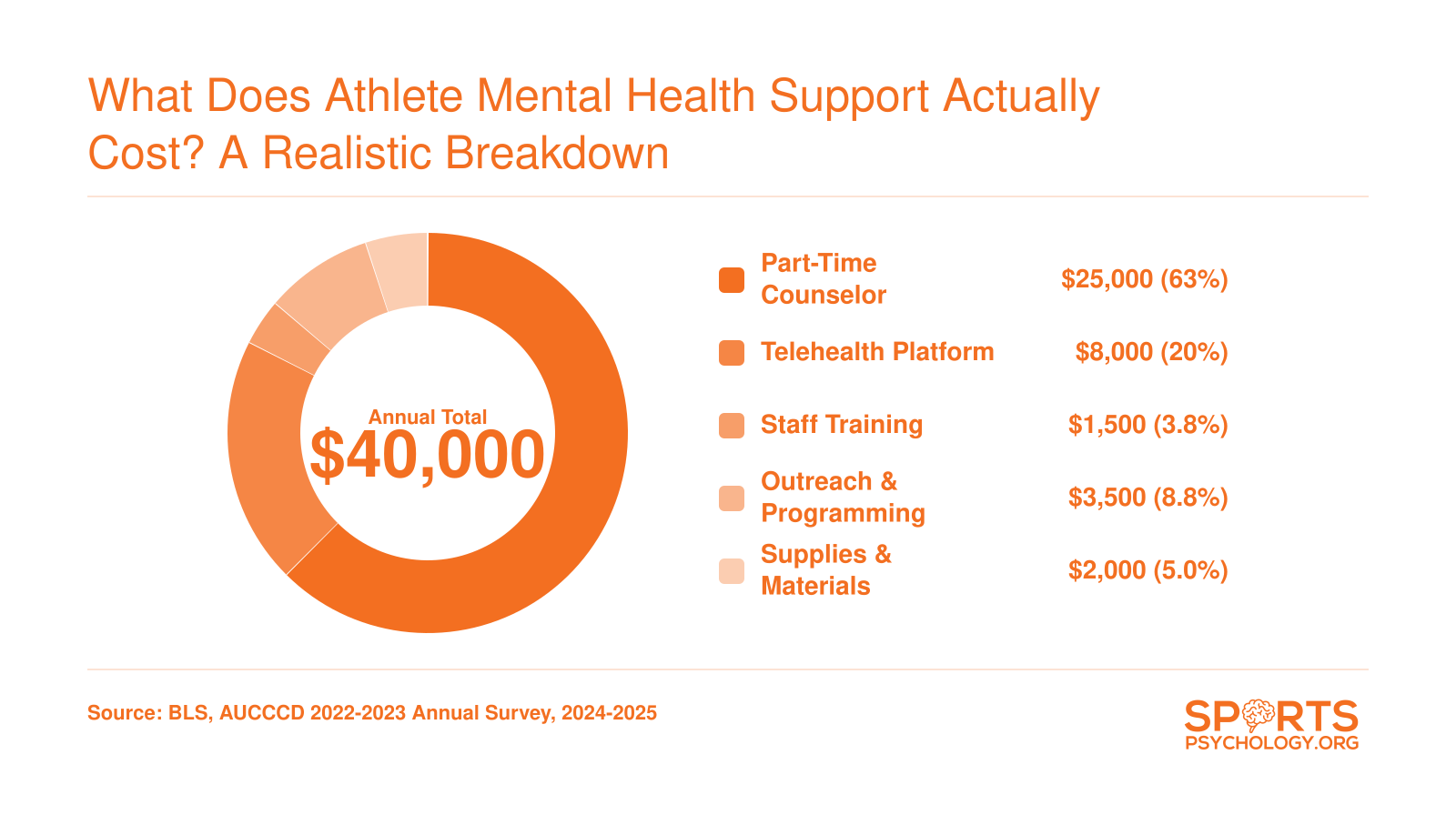
What Does Athlete Mental Health Support Actually Cost? A Realistic Breakdown
Building a mental health support program for roughly 300 student-athletes does not require a six-figure budget, but it does require honest math. The breakdown below reflects realistic estimates drawn from published counseling center surveys, regional salary benchmarks, and peer-institution spending patterns. Start by checking salary data from the Bureau of Labor Statistics for your region, then adjust each category for your institution's cost of living.
Did You Know?
Telehealth counseling can cost as little as $25 per session per athlete, compared to over $100 for a typical campus counseling center visit, according to industry reports from student mental health telehealth providers. Many student-athletes actually prefer the added privacy, since virtual sessions mean fewer chances of running into teammates or coaches in a waiting room.
Creative Funding Strategies: Grants, Partnerships, and Budget Reallocation
Securing dollars for athlete mental health at a small liberal arts college rarely means launching a new line item from scratch. More often, it takes a mix of strategically targeted grants, low-cost community partnerships, and a hard look at where your current sports medicine or wellness dollars already go. The goal is to build a support system that feels integrated, not bolted on.
Federal and State Grants You Can Apply For
Grant dollars can fill the gap between what you dream of offering and what your line-item budget allows. Here are several programs worth exploring (amounts and deadlines reflect recent cycles; check agency sites for current years):
GLS Campus Suicide Prevention Grants (SAMHSA): These three-year awards totaled up to $306,000 in the 2025 cycle, with awards ranging from roughly $25,000 to $75,000 annually and $8.8 million available that year.1 They fund comprehensive suicide prevention and behavioral health programming on college campuses.
Mental Health Awareness Training (MHAT) Grants (SAMHSA): With $22 million available in 2025, these grants train educators, coaches, and other gatekeepers to recognize and respond to mental health challenges.2
DOJ Campus Safety Grants: Up to $300,000 can support initiatives that improve campus safety, including mental health response and crisis intervention training for athletics staff.3
Title V Hispanic-Serving Institutions: HSIs can access awards up to $3 million over five years to strengthen institutional capacity, a portion of which can be directed toward student well-being and mental health.3
State-Level Funds: Illinois launched Mental Health Early Action on Campus with $7 million in FY20264; Ohio’s Campus-Community Collaborative Grants explicitly encourage partnerships between campuses and local mental health agencies.5 The Illinois Community College Board offers Strengthening Mental Health Supports Grants ($50,000, $180,000), with applications accepted between July 2026 and September 2027.6
Smaller, High-Impact Awards: The American College Health Foundation’s College Well-Being Award ($3,500)7 and the Stephan D. Weiss Student Mental Health Award ($5,000, with a January 2026 deadline)8 can fund pilot projects, awareness campaigns, or telehealth setups.
Build Partnerships With Local Providers
When grants aren’t available, lean on the community. Many small colleges form agreements with community mental health centers, hospital-based outpatient clinics, or university-affiliated graduate training clinics to offer counseling on a sliding scale or per-session rate to athletes. These arrangements often let the athletic department pay only for sessions actually used, rather than carrying a full-time salary.
Telehealth partnerships add another layer of affordability. Some platforms offer discounted per-member-per-month pricing for small schools, and a few states (like New York, through the SUNY Mental Health First Aid grants up to $8,000)9 help offset the cost of training staff to support virtual care. The key is to negotiate a contract that includes after-hours and weekend availability when student athletes most often need to talk.
Reallocate Existing Budgets Creatively
Sometimes the money is already there, just labeled differently. Athletic directors who have successfully expanded mental health care often repurpose a portion of their sports medicine budget to cover a mental health coordinator’s stipend, or move wellness programming dollars under the counseling center to create a shared position. For example, money formerly spent on college athlete injury prevention workshops might be redirected to train strength coaches in mental health first aid, leveraging existing personnel rather than hiring new staff.
Similarly, travel meal per diems or equipment fund surpluses can be modestly trimmed to fund a year of telehealth access for all rostered athletes. This kind of reallocation is easier to justify when you show that untreated anxiety or depression also drags down academic performance and retention, directly hitting the institution’s bottom line.
A Real-World Example: Small College Collaboration
A liberal arts college in Ohio used a state Campus-Community Collaborative Grant to partner with a local family counseling center. The center agreed to hold four on-campus hours per week specifically for athletes, billing the college a flat monthly rate. At the same time, the college applied a portion of its existing health and wellness fee revenue to add a telehealth subscription that covered 24/7 chat and video sessions.
Within two years, athletes’ use of mental health services doubled, and the athletic department avoided hiring a full-time psychologist. The blended model cost less than $20,000 annually, a fraction of a single full-time salary, and became the blueprint other coaches asked to replicate.
Leveraging Telehealth for Affordable, Confidential Care
When a small liberal arts college weighs mental health options for athletes, the choice usually narrows to two models: institutional subscription platforms with predictable annual fees, and pay-per-session services that start affordably but add up fast. Telehealth bridges both by eliminating geographic barriers and costing far less than a full-time sports psychologist. Choosing the right platform means balancing affordability, confidentiality safeguards, and whether the provider truly understands the athlete experience, all underscoring the importance of sports psychology for athletes.
Comparing Platform Models and Costs
No two telehealth services structure pricing the same way, so small athletic departments need to look beyond sticker price.
TimelyMD/TimelyCare: Institutional subscription with per-student pricing negotiated by the college. Predictable budgeting: unlimited visits for all students, athletes included. Campuses can route athletes to counselors comfortable with performance pressures, though it is not a dedicated sport-psychology track3
BetterHelp: Direct-pay, $65-$100 per session (2026 rates). No campus integration gives athletes complete separation from the athletic department, a plus for privacy. Downside: no sports specialization and state-licensed providers only, so continuity can break when athletes travel or go home during breaks1
Talkspace: Weekly plans with one live session plus messaging run $69-$129 per week (2026). Generalist like BetterHelp, but it permits aggregated de-identified reporting, helping colleges spot campus trends without compromising individual privacy2
Mantra Health: Quote-based institutional pricing designed specifically for college mental health. Providers hold multi-state licenses, and it integrates with campus counseling centers, smoother referrals, though less invisible to athletic staff3
Sports-psychology specialized providers: At $150-$300 per session, these offer performance-oriented expertise and often use PSYPACT to practice across state lines, but high cost usually limits them to targeted referrals rather than broad access3
Athletic-Specific and NCAA-Endorsed Options
The NCAA has not endorsed a specific telehealth provider, but its mental health best practices emphasize removing barriers to care. TimelyMD’s subscription model aligns with equitable access, making it a common choice3. Mantra Health, while not sport-specific, serves higher education and is adopted by many athletic programs wanting a single campus-wide platform3. Both are HIPAA-compliant and keep coaches out of clinical information unless a student consents3.
Licensing Compacts That Open the Provider Map
For a small liberal arts college in a rural state, interstate licensing compacts are transformative. PSYPACT lets psychologists practice across participating states without extra licenses, dramatically expanding the pool of sport-informed telehealth clinicians. The Counseling Compact works similarly for licensed professional counselors. Platforms like Mantra Health and TimelyMD roster providers who hold multi-state credentials under these compacts, so a swimmer in Vermont and a baseball player in Maine can see the same culturally competent therapist with zero regulatory friction for the athletic department3.
Confidentiality That Athletes Actually Trust
Building trust with athletes requires more than a confidentiality policy; when athletes worry their therapist might talk to the coach, trust erodes. While all platforms reviewed are HIPAA-compliant, features differ. TimelyMD and Mantra Health isolate clinical notes from campus records, and coaches are blocked from any individual data3. BetterHelp offers the strongest wall: no institutional contract means the college never knows an athlete is using it1. That privacy can overcome stigma, though athletes pay out of pocket unless the department creates a voucher system or reimburses privately.
Questions to Ask Yourself
Would your athletes actually use an app if it guaranteed anonymity?
Fear of coaches or teammates finding out often stops athletes from seeking help. A private, confidential telehealth option removes that barrier and may drive far higher engagement than an on-campus office ever could.
Could you redirect even 2% of your sports medicine budget to a telehealth pilot?
A small reallocation, not a new line item, can fund a semester-long trial. This tests demand and outcomes before committing to a larger, permanent investment.
What's the cost of not offering care when an athlete needs it?
Untreated distress can lead to injury, withdrawal, or worse, plus liability exposure and NCAA compliance risk. Weigh that against the modest price of a telehealth subscription.
Overcoming Stigma and Protecting Privacy: Practical Steps for Small Campuses
Stigma in college athlete mental health refers to the negative attitudes, beliefs, and social pressures that discourage student-athletes from acknowledging psychological struggles or seeking professional support. On small campuses, where everyone knows everyone, these barriers can feel even more pronounced. Yet the same close-knit environment that amplifies fear of judgment can become a powerful advantage when leaders deliberately cultivate openness and trust.
Understanding the Stigma Landscape
Research consistently shows that NCAA athletes experience higher levels of mental health stigma compared to their non-athlete peers.1 According to a review of NCAA athlete mental health, roughly 60 percent of athletes who experience mental health concerns do not seek treatment. Help-seeking rates for conditions like anxiety and depression hover between just 10 and 25 percent2, even though approximately one in three male athletes and nearly half of female athletes report symptoms of depression or anxiety3.
Certain groups face steeper barriers. Male athletes, BIPOC athletes, and those competing at higher competitive levels tend to report stronger stigma-related concerns.4 Many athletes believe they should be able to handle problems on their own, viewing help-seeking as a sign of weakness that contradicts the mental toughness expected in sport. On a 200-student athletic roster where word travels fast, the fear that a coach or teammate might discover a counseling visit can override the desire for support.
FERPA and HIPAA Basics for Athletic Staff
Protecting confidentiality is not just ethical but legally required. Under the Family Educational Rights and Privacy Act, mental health records maintained by campus counseling centers are generally protected from disclosure to coaches, athletic directors, and other staff without the student's written consent. The Health Insurance Portability and Accountability Act adds another layer of protection when licensed healthcare providers are involved.
What does this mean practically? Coaches cannot access counseling notes or diagnoses unless the athlete explicitly authorizes disclosure through a signed consent form. Athletic departments should structure these forms carefully, specifying exactly what information can be shared, with whom, and for what purpose. A well-designed consent process empowers athletes to control their own narrative while still allowing coordination when they want it.
Actionable Stigma-Reduction Strategies
Small colleges can implement low-cost, high-impact initiatives that shift team culture:
Mental health minutes: Reserve five minutes at the start of weekly team meetings for brief check-ins, breathing exercises, or short educational segments. Normalizing these conversations reduces the sense that mental health is separate from athletic performance.
Peer ambassador programs: Train two or three athletes per team to serve as informal points of contact. Peers often feel more comfortable approaching a trusted teammate before seeking professional help, and ambassadors can bridge that gap.
Confidential drop-in hours: Offer walk-in sessions at the counseling center during times when athletes are less likely to be spotted by teammates, such as early morning or during class blocks when most students are occupied.
Coach modeling: When a head coach openly discusses their own experiences with stress, therapy, or mental health education, it signals that vulnerability is acceptable. A single candid comment from a respected leader can reshape team norms faster than a semester of programming.
Why Small Campuses Have an Advantage
At a large university, an athlete might never cross paths with the athletic director outside of formal events. At a small liberal arts college, those same leaders share dining halls, walking paths, and campus traditions with students daily. This proximity creates repeated opportunities for informal relationship-building. When athletes see administrators and coaches treating mental health as a normal part of well-being rather than a taboo, trust develops quickly. The intimacy that initially feels risky can become the foundation for a genuinely supportive culture, one where asking for help is seen not as weakness but as the same kind of discipline that drives athletic excellence.
Reducing stigma isn't just about posters. It's about everyday language from coaches and teammates that normalizes seeking help.