Wisconsin's two dedicated sports psychology graduate programs are both housed within the University of Wisconsin System.
UW-Milwaukee professor Barbara Meyer has served as a sport psychology consultant at every Winter Olympics since 2002.
Graduates choose between CMPC certification for performance consulting and full psychology licensure through Wisconsin DSPS for clinical work.
Wisconsin residents benefit from public university tuition rates well below the national average for comparable graduate programs.
Wisconsin is home to just two dedicated sports psychology master's programs, both within the UW System, which means admission competition is tighter than the state's broad acceptance rates might suggest. For aspiring mental performance consultants, that concentrated pipeline has a practical upside: both programs align with CMPC certification requirements, and graduates enter a labor market shaped by NFL, Big Ten, and youth athletics demand that continues to outpace the supply of qualified professionals.
The real tension for most applicants is not choosing between dozens of schools but deciding whether a performance-focused master's degree meets their career goals or whether full psychology licensure, requiring a doctorate and 3,000-plus supervised hours, is worth the additional investment. That distinction affects everything from the clients you can legally serve to your long-term earning ceiling in the state. If you are weighing nearby options, comparing sports psychology programs in illinois or best sports psychology programs in minnesota can help you gauge how Wisconsin's offerings stack up regionally.
Best Sports Psychology Programs in Wisconsin: Rankings Overview
Wisconsin offers a small but focused selection of dedicated sports psychology graduate programs, both housed within the University of Wisconsin System. Rather than overwhelming you with dozens of loosely related options, the state's two standout programs deliver specialized, CMPC-aligned training rooted in applied practice with local athletes, teams, and performance organizations. Below, we break down what each program offers so you can find the right fit for your goals.
Factors considered
Program specialization and curriculum depth
CMPC certification pathway alignment
Tuition, net price, and affordability
Applied practicum and research opportunities
Institution-wide graduation and retention rates
Data sources
Independent program research
NCES-IPEDS federal institutional data — nces.ed.gov
Best for: Aspiring performance consultants seeking research depth
The University of Wisconsin-Milwaukee is a large public research university in Milwaukee that houses a performance psychology program through its College of Health Professions. UWM's Laboratory for Sport Psychology and Performance Excellence (LSPPE) anchors applied research and consulting partnerships across Wisconsin, including work with varsity athletics, youth sport organizations, first responders, and tactical professionals. With a 17-to-1 student-to-faculty ratio and an institution-wide graduation rate of 49.3%, UWM provides a multidisciplinary environment where sport psychology students can collaborate with athletic training and sports medicine professionals under experienced, CMPC-credentialed faculty.
MS Rehabilitation Science and Technology Intervention and Consultation in Performance Psychology (MS-RST ICPP) — On-Campus
On-campus master's program requiring 30 credit hours
Curriculum aligned with CMPC certification knowledge areas
Thesis or capstone project options with faculty advisor
Rolling admissions with bachelor's degree and 2.75 GPA required
Practicum access through the LSPPE with local teams and orgs
Prerequisites in statistics, natural sciences, and psychology
Best for: Career changers who value mentored, hands-on training
The University of Wisconsin-Green Bay is a public university in northeastern Wisconsin known for its close-knit, student-centered graduate programs. Its Sport, Exercise, and Performance Psychology program features CMPC-certified faculty and strong community partnerships with local schools, clubs, and collegiate athletics across the region. With in-state tuition around $10,244 and a net price of approximately $13,369, UW-Green Bay offers one of the more affordable paths into the field. Note that the institution-wide graduation rate is 48.2%, which reflects the broader student body rather than this specific program.
Master of Science in Sport, Exercise, and Performance Psychology — On-Campus
Two tracks: Applied (39 credits) and Course-Based (30 credits)
CMPC certification alignment with credentialed faculty mentors
No undergraduate psychology major required for admission
Practicum placements with Wisconsin schools, teams, and orgs
Priority admissions deadline of January 15 each year
Covers injury psychology, multicultural psychology, and ethics
Scholarships and grants available to help fund education
Campus-based delivery in a small, individualized setting
Types of Sports Psychology Degrees Available in Wisconsin
If you are exploring sports psychology programs in Wisconsin, one of the first things you will notice is that the field spans several degree levels, each opening different career doors. Programs may also appear under a range of titles, so knowing what to look for will save you time and help you find the right fit.
Bachelor's-Level Concentrations
Wisconsin universities generally do not offer a standalone bachelor's degree in sports psychology. Instead, you will find sport psychology concentrations or emphases housed within broader programs such as kinesiology, exercise science, or psychology. These undergraduate tracks introduce foundational topics like motivation, group dynamics, and performance enhancement. A bachelor's degree alone will not qualify you to practice as a sports psychologist, but it provides the academic base you need before applying to graduate school.
Master's Programs in Applied Sport Psychology
A master's degree is the most common entry point for professionals who want to work directly with athletes on mental performance. The University of Wisconsin-Green Bay, for example, offers a dedicated M.S. in Sport, Exercise, and Performance Psychology.1 That 39-credit program includes both an Applied Track and a Course-Based Track, giving students flexibility depending on whether they plan to pursue hands-on consulting or further academic study.2 Admission for fall 2026 carries a priority deadline of January 15, and cohorts have historically filled quickly after that date.3
Graduates of master's-level applied programs typically pursue the Certified Mental Performance Consultant (CMPC) credential, which qualifies them to help athletes, coaches, and performers with goal setting, focus, confidence, and related mental skills. This path centers on performance optimization rather than clinical diagnosis or treatment.
Doctoral Programs With a Sport Focus
If your goal is to diagnose and treat clinical conditions such as anxiety disorders, depression, or eating disorders in athlete populations, you will need a doctorate in clinical or counseling psychology. Some doctoral programs allow students to specialize in sport psychology through elective coursework, practicum placements with athletic departments, or a dissertation focused on athlete well-being. Completing a doctorate and meeting Wisconsin's supervised-practice requirements leads to licensure as a psychologist, a distinction that carries a broader scope of practice than the CMPC alone.
Certificate Programs and Graduate Minors
Not everyone needs a full degree to add sport psychology expertise to their toolkit. Certificate programs and graduate minors are designed for professionals already working in coaching, athletic training, counseling, or related fields. These shorter credential options let you layer sport psychology knowledge on top of an existing career without committing to a multi-year degree program. If you are weighing options outside Wisconsin, you can also compare sports psychology programs in Indiana or other nearby states to see how certificate offerings vary.
A Note on Program Titles
Do not limit your search to programs labeled "sports psychology." Related titles you may encounter include sport and exercise psychology, performance psychology, and kinesiology with a sport psychology concentration. The coursework across these titles overlaps significantly, and eligibility for credentials like the CMPC depends on specific content areas covered rather than the exact name printed on your diploma. When evaluating any program, check the curriculum against CMPC or licensure requirements to confirm it aligns with your professional goals.
Questions to Ask Yourself
Do you want to help athletes sharpen mental performance, or do you want to diagnose and treat clinical mental health conditions?
This distinction shapes your entire career path. A Certified Mental Performance Consultant (CMPC®) route focuses on performance enhancement, while a licensed psychologist route requires doctoral training and qualifies you to treat clinical disorders such as anxiety and depression.
Are you prepared to invest five to seven years in a doctoral program, or does a two-year master's degree better fit your timeline?
A master's degree can qualify you to pursue CMPC® certification and start working with athletes relatively quickly. A doctorate opens doors to clinical licensure and academic positions but demands significantly more time and financial commitment.
Do you need the flexibility of an online or hybrid program, or can you attend full-time on a physical campus in Wisconsin?
Online and hybrid options let you keep working or stay in your current location, which matters if you have professional or family obligations. On-campus programs typically offer more hands-on practicum experiences and direct mentorship with faculty.
Is hands-on experience with collegiate or professional sports teams a priority for you?
Some Wisconsin programs include embedded practicum placements with university athletic departments or local sports organizations. If applied experience is central to your goals, look for programs that build supervised fieldwork into the curriculum rather than treating it as optional.
How Much Do Sports Psychology Programs Cost in Wisconsin?
Understanding the full cost picture before you commit to a graduate program is one of the smartest moves you can make. Wisconsin residents benefit from two public university options that keep tuition well below what you would pay at many private institutions, but costs still vary depending on residency status, program length, and the financial aid you secure.
Tuition at a Glance: In-State vs. Out-of-State
Both ranked sports psychology programs in Wisconsin are housed within the University of Wisconsin system, which means in-state students enjoy a significant tuition advantage.
UW-Green Bay (MS in Sport, Exercise, and Performance Psychology): Approximately $10,244 per year for Wisconsin residents and $20,229 per year for out-of-state students.
UW-Milwaukee (MS in Rehabilitation Science and Technology, Intervention and Consultation in Performance Psychology): Approximately $12,728 per year for Wisconsin residents and $26,159 per year for out-of-state students.
For in-state students, that translates to a potential total tuition ranging from roughly $20,000 to $25,000 for a two-year master's program. Out-of-state students could face totals between $40,000 and $52,000 over the same period. The gap is substantial, so if you are relocating from another state, it is worth exploring whether you can establish Wisconsin residency before or during your studies.
Average Net Price After Aid
Institution-wide, the average net price after financial aid gives you a rough sense of what students actually pay. At UW-Green Bay, the approximate average net price is around $13,369, while at UW-Milwaukee it is about $15,014. Keep in mind these figures reflect the broader undergraduate and graduate student body and are not specific to sports psychology programs. Your actual cost could be higher or lower depending on the aid package you receive at the graduate level.
What to Expect in Student Debt
The median graduate debt at UW-Green Bay is approximately $18,500, while at UW-Milwaukee it sits around $23,000. Program-specific borrowing data for these sports psychology degrees is not yet available, so these institution-level figures are the best current reference point. They suggest that most students are graduating with a manageable debt load, particularly compared to national averages for graduate education. If you are considering doctoral-level study down the road, researching affordable PhD sports psychology options early can help you plan a realistic long-term budget.
Strategies to Lower Your Costs
Public UW schools offer noticeably lower in-state tuition compared to private alternatives, but you should not stop at the sticker price. Graduate assistantships are one of the most effective ways to offset costs, often covering a portion of tuition while providing a stipend and relevant professional experience. Both programs encourage prospective students to reach out to their departments about available funding.
Other avenues worth exploring include:
Department-specific scholarships and grants (UW-Green Bay highlights scholarship availability on its program page).
Federal graduate student loans, which typically carry lower interest rates than private options.
Employer tuition reimbursement, if you are currently working in athletics, coaching, or a related field.
Students weighing programs in neighboring states, such as sports psychology programs in minnesota, may also want to compare total costs side by side. Taking the time to investigate every funding option, especially assistantships and department-level awards, can make a meaningful difference in how much debt you carry after graduation. Contact each program's admissions or financial aid office early in the application process to learn what is available for incoming students.
Online vs On-Campus Sports Psychology Programs in Wisconsin
Choosing between online and on-campus sports psychology programs in Wisconsin depends on your career stage, location, and learning preferences. Both formats can prepare you for credentials like the CMPC® certification or psychology licensure, but each comes with distinct trade-offs. Here is a breakdown to help you weigh your options.
Pros
Online and hybrid programs offer schedule flexibility ideal for working coaches, athletic trainers, and active athletes pursuing further education.
Studying online lets you remain anywhere in Wisconsin, eliminating the need to relocate to Madison, Milwaukee, or Green Bay.
Online programs often carry lower total costs because you avoid campus housing, commuting expenses, and many student fees.
On-campus programs provide direct access to university athletic teams, giving you real applied experience in sports psychology settings.
Campus-based students can participate in faculty research labs, building the scholarly foundation valued in doctoral programs and licensure tracks.
In-person learning tends to foster stronger mentorship relationships with faculty, which can accelerate career development and professional referrals.
Cons
Online students may find fewer hands-on practicum placements, which are critical for meeting CMPC® and licensure supervised experience requirements.
Building a peer referral network is more difficult in virtual programs, where organic relationship-building opportunities are limited.
On-campus programs typically require relocation or long commutes, a significant barrier if you live in rural or northern Wisconsin.
Campus-based formats offer less schedule flexibility, making it harder to balance full-time work in coaching or athletic training with coursework.
Living near major university hubs like Madison or Milwaukee often means higher housing and daily living costs compared to staying in your home community.
Some on-campus cohort schedules are rigid, which can delay graduation if you need to step away for a season or professional obligation.
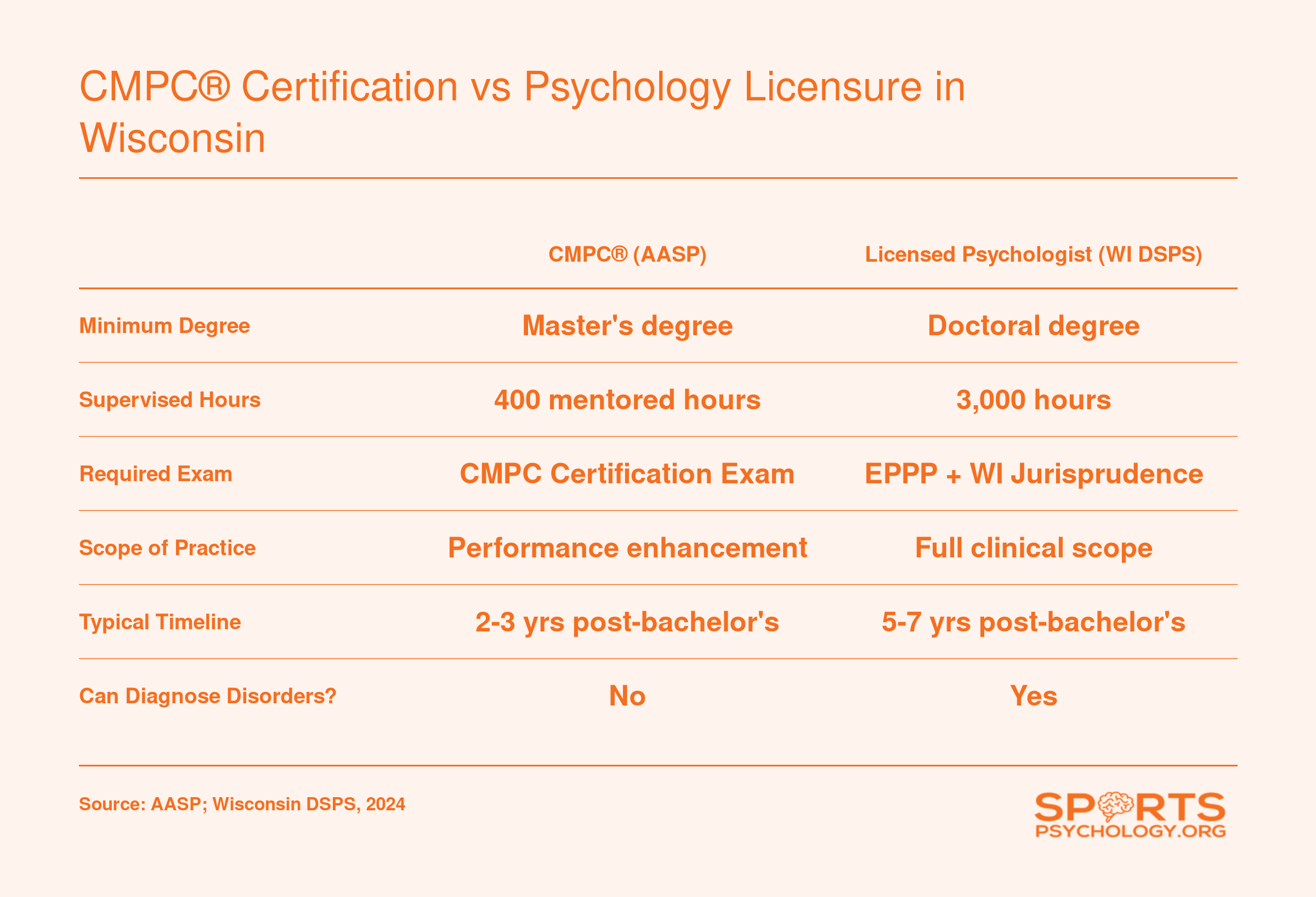
CMPC® Certification vs Psychology Licensure in Wisconsin
Professionals entering sports psychology in Wisconsin typically pursue one of two credential pathways. The CMPC® (Certified Mental Performance Consultant) through AASP focuses on performance enhancement, while a Wisconsin licensed psychologist credential through DSPS provides full clinical scope, including the ability to diagnose and treat mental health disorders. Your choice depends on the type of work you want to do and how long you can invest in training.
How to Become a Sports Psychologist in Wisconsin
Breaking into sports psychology requires deliberate planning, because the pathway you choose determines both the title you can use and the clients you can serve. Wisconsin, like many states, treats "psychologist" as a protected title, meaning only individuals who hold a doctoral degree and a state license may call themselves a sports psychologist. If you earn a master's degree and pursue the Certified Mental Performance Consultant (CMPC) credential instead, you will typically practice under the title "mental performance consultant." Both routes lead to rewarding careers, but the steps differ in important ways.
Step 1: Earn a Relevant Bachelor's Degree
Start with a four-year degree in psychology, kinesiology, exercise science, or a closely related field. Coursework in research methods, human development, anatomy, and introductory counseling will prepare you for graduate study. Many aspiring professionals also gain experience during this stage by volunteering with college athletic departments or campus wellness programs. Students exploring a sports psychology degree at the undergraduate level should focus on building a strong research and applied foundation.
Step 2: Complete a Graduate Program
This is where the two tracks diverge.
Performance consultant track: Enroll in a master's program in sport and exercise psychology or a related concentration. Programs typically take two to three years and emphasize mental skills training, group dynamics, and applied consultation.
Licensed psychologist track: Pursue a doctoral program (Ph.D. or Psy.D.) in clinical or counseling psychology, ideally one that offers coursework or a concentration in sport psychology. Doctoral programs generally require five to seven years, including a predoctoral internship.
Step 3: Accumulate Supervised Experience
CMPC applicants must log mentored hours of direct performance consultation under a qualified mentor, as outlined by the Association for Applied Sport Psychology. Doctoral candidates pursuing licensure need supervised clinical practice hours that meet the Wisconsin Department of Safety and Professional Services requirements, typically including a one-year postdoctoral supervised experience.
Step 4: Pass the Required Examination
Once your supervised hours are complete, sit for the exam that matches your credential path. CMPC candidates take the certification exam administered by the Association for Applied Sport Psychology. Aspiring licensed psychologists must pass the Examination for Professional Practice in Psychology (EPPP) and satisfy any additional state requirements Wisconsin mandates.
Step 5: Maintain and Expand Your Credentials
Both the CMPC and Wisconsin psychology licensure require ongoing continuing education to stay current. You will need to document professional development activities on a regular renewal cycle.
Some practitioners pursue dual credentials over time, first earning the CMPC through a master's program and later completing a doctorate to obtain licensure. This combination broadens scope of practice considerably, allowing you to deliver both mental performance consulting and clinical interventions such as diagnosing and treating mental health conditions. If you are unsure which route fits your long-term goals, the program profiles on sportspsychology.org can help you compare options and map out a timeline that works for your career.
Career Outcomes and Salaries for Wisconsin Sports Psychology Graduates
Wisconsin offers a surprisingly strong labor market for psychology professionals, and graduates of sports psychology programs can tap into a range of career paths that vary widely in both setting and salary. Understanding your earning potential at different stages, and the career doors that open with different credentials, can help you plan your education strategically.
Early-Career and Long-Term Earning Potential
Program-level earnings data for the sports psychology master's programs at the University of Wisconsin-Milwaukee and UW-Green Bay are not yet available through federal reporting, so direct comparisons of what graduates earn in their first or second year after completing these specific programs are not possible at this time. However, institution-wide data offers a useful reference point. UW-Milwaukee graduates report a median salary of approximately $54,990 ten years after enrollment, while UW-Green Bay graduates reach around $52,528 over the same timeframe. Keep in mind that these figures reflect all graduates across every program at each university, not just sports psychology. Graduates who pursue advanced credentials or enter specialized roles in performance psychology can reasonably expect to exceed these benchmarks.
What Wisconsin Psychologists and Counselors Earn
Bureau of Labor Statistics data for Wisconsin paints an encouraging picture for those willing to invest in graduate training. Psychologists classified under the "All Other" category, which includes sport psychologists, earned a mean annual wage of $116,640 statewide as of May 2023.1 Wisconsin employed roughly 770 professionals in this category, and the state's BLS occupational employment and wage data show a location quotient of 2.79, indicating that these roles are significantly more concentrated here than the national average.1 Regional variation is notable: in western Wisconsin nonmetropolitan areas, the mean annual wage reached $153,700, while northeastern Wisconsin nonmetropolitan areas averaged $108,440.1
For graduates who follow a mental health counseling credential path rather than a psychology licensure track, salaries tend to be lower. Mental health counselors in Wisconsin typically earn less than licensed psychologists, so the credential you choose has a direct impact on your long-term earning power. Those who combine a CMPC certification with clinical licensure often position themselves at the higher end of the salary spectrum.
Where Wisconsin Graduates Work
A sports psychology degree opens doors well beyond the therapist's office. Neighboring states such as Michigan offer strong sports psychology programs as well, but Wisconsin's unique concentration of professional and collegiate teams creates distinctive local opportunities. Wisconsin graduates find roles across a diverse set of industries and organizations:
NCAA athletic departments: Wisconsin is home to Division I, II, and III programs that increasingly employ dedicated mental performance staff.
Professional sports organizations: Teams like the Brewers, Bucks, and Packers, along with their minor league and development affiliates, hire performance consultants and sport psychologists.
Private performance consulting: Many graduates establish independent practices working with athletes, coaches, performing artists, and high-stakes professionals.
Collegiate counseling centers: University counseling offices often seek professionals who can bridge clinical mental health support and performance enhancement for student-athletes.
Military performance optimization: Wisconsin's military installations and National Guard units have growing demand for performance psychology specialists trained in resilience and mental skills.
Corporate wellness: Businesses across the state are integrating performance psychology principles into employee wellness programs, leadership development, and executive coaching.
Job Placement Outlook
Federal program-level employment and poverty-threshold outcomes are not yet reported for Wisconsin's ranked sports psychology programs, so published placement rates for these specific degrees are unavailable. That said, the strong statewide demand for psychologists, combined with a location quotient nearly three times the national average, suggests that qualified graduates are entering a favorable job market.1 If you are evaluating programs, ask admissions teams directly about their alumni employment data and where recent graduates have landed. This information, paired with the salary benchmarks above, will give you the clearest picture of what to expect after graduation.
University of Wisconsin-Milwaukee professor Barbara Meyer has served as a sport psychology consultant at every Winter Olympics since 2002, helping elite athletes perform under pressure on the world stage. Her work highlights Wisconsin's deep ties to applied sport psychology at the highest competitive levels (University of Wisconsin System).
Frequently Asked Questions About Sports Psychology Programs in Wisconsin
Choosing the right sports psychology program involves understanding your options, timeline, and career prospects. Below are answers to the most common questions prospective students ask about pursuing sports psychology in Wisconsin.
What colleges in Wisconsin offer sports psychology programs?
Several Wisconsin institutions offer relevant programs. The University of Wisconsin-Milwaukee provides a kinesiology program with sport and exercise psychology coursework. Marquette University and the University of Wisconsin-Madison offer graduate programs in counseling and psychology that can be tailored toward sport psychology concentrations. Viterbo University and UW-La Crosse also offer exercise science or psychology programs with applicable coursework. Check sportspsychology.org for updated program listings.
Can you get a sports psychology degree online in Wisconsin?
Yes. While no Wisconsin university currently offers a fully online sport psychology degree at the doctoral level, several institutions offer online or hybrid master's programs in areas like sport and exercise science, counseling psychology, or applied sport psychology. National programs accredited by recognized bodies are also an option for Wisconsin residents. Online formats can offer flexibility for working professionals, though practicum hours typically require in-person completion.
What is the difference between CMPC certification and psychology licensure in Wisconsin?
The Certified Mental Performance Consultant (CMPC) credential, granted by the Association for Applied Sport Psychology, focuses on performance enhancement skills such as goal setting, imagery, and focus training. Psychology licensure in Wisconsin requires a doctoral degree, supervised clinical hours, and passing the EPPP exam, and it permits diagnosis and treatment of mental health disorders. A licensed psychologist can provide therapy, while a CMPC specializes in mental performance consulting without a clinical scope.
How long does it take to become a sports psychologist in Wisconsin?
The timeline depends on your chosen path. A bachelor's degree takes about four years, followed by a master's degree (two to three years) or a doctoral program (four to seven years). If you pursue full psychology licensure in Wisconsin, plan for a minimum of eight to twelve years of education and supervised experience after high school. Earning the CMPC credential with a master's degree can shorten this to approximately six to seven years total.
What can you do with a sports psychology degree in Wisconsin?
Graduates work in a variety of settings across Wisconsin. Common roles include mental performance consultant for collegiate or professional sports teams, private practice counselor specializing in athlete populations, university researcher or professor, and wellness coordinator for athletic departments. Opportunities also exist in corporate wellness, rehabilitation centers, and youth sport organizations. Wisconsin's strong collegiate athletic culture, especially within the UW System, supports demand for qualified professionals.
Do you need a doctorate to work in sports psychology?
Not necessarily. A master's degree qualifies you for the CMPC credential, which allows you to work as a mental performance consultant helping athletes with focus, confidence, and performance strategies. However, if you want to diagnose or treat clinical mental health conditions such as anxiety or depression in athletes, Wisconsin requires a doctoral degree and state licensure as a psychologist. Your career goals will determine the level of education you need.