Should You Get a Master's or Doctorate in Sports Psychology?

Compare timelines, costs, career outcomes, and licensure paths for each degree level to find your best fit.

By Ryan Marston, MS, BCSReviewed by SportsPsychology.org TeamUpdated May 26, 202622 min read
Master’s vs. Doctorate in Sports Psychology: How to Decide

What you’ll learn in this article…

  • Only doctoral-level licensure lets you legally use the title psychologist and bill insurance independently in most U.S. states.
  • A fully funded PhD still costs roughly $200,000 to $350,000 in forgone earnings over five to seven years on a stipend.
  • Master's graduates can work as mental performance consultants, earn the CMPC credential, and start earning a full salary years sooner.
  • Many doctoral programs welcome applicants who hold a master's degree, so starting at the master's level keeps both paths open.

In most U.S. states, the title "sport psychologist" is legally reserved for doctoral-level, licensed professionals. A master's degree, which typically takes two to three years, can get you into applied mental performance consulting roles far sooner, but it cannot grant you clinical privileges or independent licensure. That distinction shapes almost every downstream decision: scope of practice, earning ceiling, and professional identity.

The right degree depends on what you actually want to do. Applied mental performance consulting, clinical work with athletes, and tenure-track research each demand different credentials and different time commitments. A master's-level consultant can build a strong career without a doctorate, yet certain settings, such as counseling centers and hospital-based sport medicine clinics, require the clinical training only a doctoral program provides.

For many prospective students, the real tension is not preference but opportunity cost: a funded PhD may charge no tuition while still costing $200,000 or more in forgone earnings over five to seven years. Below, we break down both paths side by side so you can weigh credentials, salary ranges, timelines, and career options before committing.

Master's vs. Doctorate in Sports Psychology at a Glance

Before diving into the details, it helps to see the two main degree paths side by side. The table below compares a master's degree and a doctorate in sports psychology across the dimensions that matter most: time investment, cost, credentials, career options, and earning potential.

Side-by-Side Comparison

DimensionMaster's DegreeDoctorate (PhD or PsyD)
Typical duration2 to 3 years4 to 7 years (PhD) or 4 to 6 years (PsyD)2
Estimated total cost$30,000 to $80,000$60,000 to $200,000+
Primary credential earnedCertified Mental Performance Consultant (CMPC)Licensed psychologist (state license)
Common job titlesMental performance consultant, sport psychology consultant, performance coachSport psychologist, clinical sport psychologist, professor of sport psychology
Entry-level salary range$50,000 to $70,0003$65,000 to $85,0002
Mid-career salary range$70,000 to $95,0003$85,000 to $120,0002
Senior-level salary range$90,000 to $130,0003$120,000 to $200,000+2

Salary figures reflect 2024 data from industry compensation surveys and are consistent with ranges reported by the Compensation for Mental Performance Work Infographic and the Bureau of Labor Statistics.

What the Numbers Tell You

A master's degree gets you into the field faster and at a lower cost. Graduates who earn the CMPC credential can work as mental performance consultants with athletes, teams, and organizations. The pathway is well suited to professionals who want to focus on performance enhancement rather than clinical diagnosis and treatment.

A sport psychology doctorate opens a wider set of doors. Licensed psychologists can diagnose and treat clinical mental health conditions in addition to providing performance consulting. They also qualify for tenure-track faculty positions, hospital roles, and senior positions within professional sports organizations. The median annual wage for psychologists reached $94,310 in 2024, which sits above the master's-level median, though the gap narrows when you account for the extra years spent in training.

The Takeaway

Neither degree is universally better. The right choice depends on the scope of practice you want, how much time you can invest, and whether clinical licensure matters for your career goals.

What You Can Do With a Master's in Sports Psychology

A master's degree in sports psychology opens the door to a surprisingly wide range of career paths, even without pursuing a doctorate. The key is understanding exactly what you can and cannot do at this level, so you can build a career that matches your goals.

Career Titles and Roles

Graduates with a master's in sports psychology step into roles across competitive sport, education, corporate settings, and youth development. Some of the most common job titles include:

  • Mental performance consultant: Work one-on-one or with teams to develop mental skills like focus, confidence, and pre-competition routines.
  • Collegiate athletic department staff: Serve within a university's athletic department providing mental performance support to student-athletes.
  • Corporate wellness consultant: Apply performance psychology principles in business settings, helping executives and teams manage stress, set goals, and perform under pressure.
  • Sport science researcher: Contribute to applied research at universities, sport institutes, or private organizations studying the mental side of athletic performance.
  • Youth sport program director: Design and lead mental skills training programs for young athletes, often within clubs, academies, or community organizations.

Common work settings include college athletics departments, private consulting practices, national and regional sport organizations, and military human performance programs, where demand for mental performance professionals has grown steadily.

The CMPC Credential

For master's-level graduates, the Certified Mental Performance Consultant (CMPC) credential through the Association for Applied Sport Psychology (AASP) is the gold-standard professional designation. To earn the CMPC, you need a graduate degree in a related field, specific coursework in sport psychology and its foundations, a supervised mentored experience (typically 400 or more hours of direct client contact), and a passing score on the certification exam. Holding the CMPC signals to employers, coaches, and athletes that you meet a recognized standard of competence in applied sport psychology.

Scope-of-Practice Limits to Keep in Mind

One of the most important distinctions at the master's level involves what falls outside your scope of practice. Master's-level mental performance consultants typically cannot diagnose or treat clinical mental health disorders such as depression, anxiety disorders, or eating disorders. You also cannot use the title "psychologist," which is legally protected in every U.S. state and reserved for doctoral-level, licensed professionals. Billing insurance for psychological services is generally off the table as well.

These boundaries matter. If an athlete you work with presents signs of a clinical disorder, your role is to recognize those signs and refer them to a licensed professional.

Expanding Your Clinical Scope Through Counseling Licensure

Some master's graduates choose to pursue state licensure as a Licensed Mental Health Counselor (LMHC) or Licensed Professional Counselor (LPC), depending on the state. This path requires a master's degree in counseling or a closely related field, supervised post-graduate clinical hours (often 2,000 to 3,000), and passing a licensure exam.

Earning an LMHC or LPC allows you to work with clinical issues, accept insurance, and provide a broader range of mental health services. The important distinction is that you would practice under a counseling title, not as a psychologist. For professionals who want to blend mental performance consulting with clinical work, pairing the CMPC with a counseling license can be a powerful combination that keeps career options flexible without the time and cost commitment of a doctorate.

Questions to Ask Yourself

Do I want to diagnose and treat clinical conditions in athletes, or focus primarily on performance optimization and mental skills training?
This distinction shapes your entire degree path. Diagnosing and treating anxiety, depression, or eating disorders typically requires doctoral-level clinical licensure, while performance consulting and mental skills coaching can often begin with a master's degree.
Am I prepared to invest five to seven years in doctoral training, or do I need to enter the workforce within two to three years?
A master's program lets you start consulting or coaching relatively quickly, whereas a doctorate demands a significantly longer commitment. That timeline affects not only your earning potential during training but also your personal finances and career momentum.
Is conducting original research or becoming a tenured professor part of my long-term vision?
If you see yourself leading published studies, mentoring graduate students, or holding a faculty position at a university, a Ph.D. or Psy.D. is essentially required. A master's degree rarely qualifies candidates for tenure-track roles in higher education.
How important is independent licensure and the ability to use the title 'psychologist' in my career?
In nearly every U.S. state, only doctoral graduates can become licensed psychologists. If practicing independently under that protected title matters to you, a master's alone will not meet that regulatory threshold.

What You Can Do With a Doctorate in Sports Psychology

A doctorate in sports psychology opens doors that a master's degree simply cannot. In most states, the title "sport psychologist" is legally protected, meaning you need a doctoral degree and state licensure to use it and to bill insurance independently. If your long-term goal is to work as a fully licensed practitioner, the doctorate is not optional.

Three Main Career Lanes

Doctoral graduates in sport psychology generally follow one of three professional paths:

  • Licensed sport psychologist: You can open a private practice serving athlete clientele or work as a team-embedded psychologist with professional franchises. Think NFL, NBA, and MLB organizations, where teams increasingly employ full-time licensed sport psychologists on staff.
  • Tenure-track academic and research faculty: A doctorate qualifies you for professorship and principal investigator roles at universities. This lane is ideal if you want to conduct original research, mentor graduate students, and publish in peer-reviewed journals.
  • Organizational leadership: Some doctoral graduates move into executive roles, such as directing sport science departments for professional franchises, the U.S. Olympic and Paralympic Committee, or national governing bodies. These positions blend clinical or consulting expertise with program management.

High-profile settings also include Division I athletics departments, VA hospitals that serve veteran athletes, and elite training centers where interdisciplinary performance teams are the norm.

PhD vs. PsyD: Choosing the Right Doctoral Track

Not all doctorates look the same. The two primary options each carry distinct trade-offs. Understanding the difference between a clinical vs performance sports psychology track can help you decide which path aligns with your strengths.

  • PhD (Doctor of Philosophy): Research-intensive, culminating in a dissertation that contributes new knowledge to the field. PhD programs are more likely to offer funded positions through teaching or research assistantships, which can offset tuition significantly.
  • PsyD (Doctor of Psychology): Practice-focused, with a heavier emphasis on clinical training and applied work. PsyD programs typically involve fewer research requirements but are more often self-funded, so expect higher out-of-pocket costs.

Both degrees lead to licensure eligibility, and both can prepare you for clinical practice. The best fit depends on whether you see yourself spending your career primarily in research or primarily in applied settings.

Stacking Credentials for Maximum Flexibility

One advantage unique to doctoral graduates is the ability to hold dual credentials. After earning licensure as a psychologist, you can also pursue the Certified Mental Performance Consultant (CMPC) credential through the Association for Applied Sport Psychology. Holding both a license and the CMPC signals expertise to athletic organizations and broadens your professional reach, letting you serve clients through insurance-based clinical work while also consulting with teams and organizations under the CMPC framework.

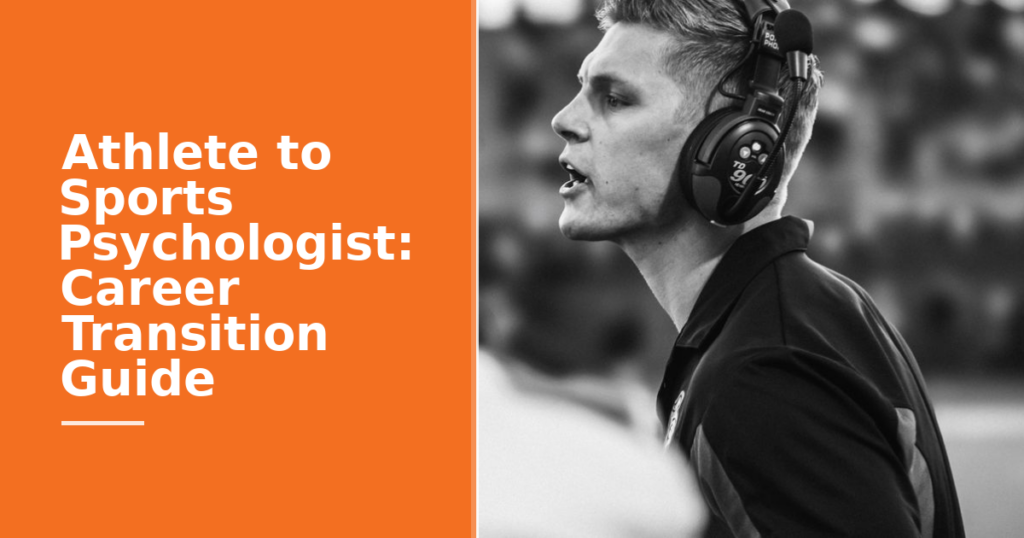
Many professionals who pursue a sport psychology doctorate began their journeys as competitive athletes themselves. If that describes you, learning how others have made the athlete to sports psychologist transition can offer valuable perspective.

If you want the widest range of career options, the greatest autonomy in practice, and the professional standing to work in the most competitive settings in sport, the doctorate is the degree that gets you there.

Licensure, Titles, and Credentials Explained

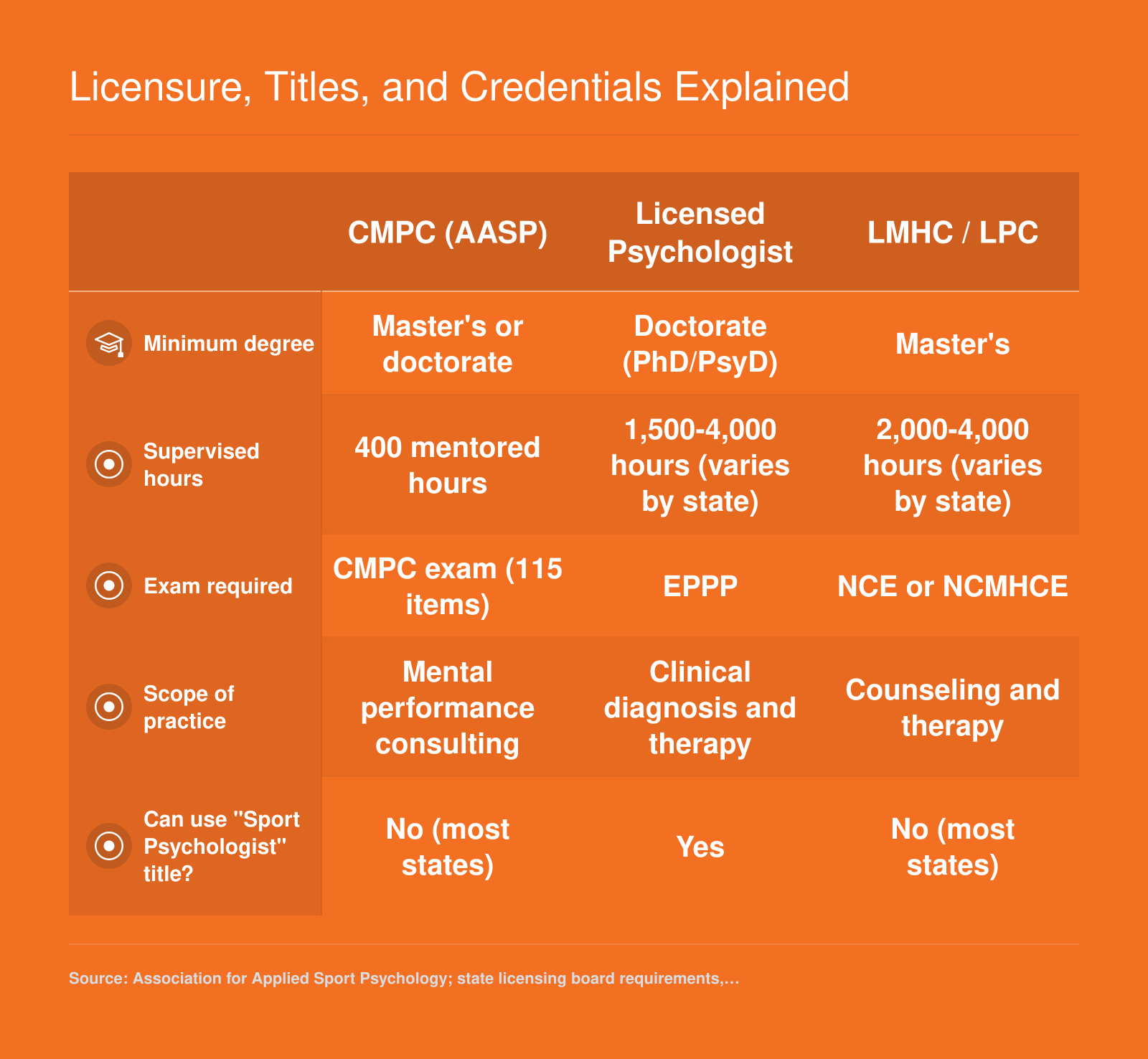
Three main credential pathways exist in sport psychology, and each comes with different education requirements, supervised experience, and scope of practice. The single biggest practical difference: only doctoral-level licensure allows you to use the protected title "psychologist" in most U.S. states. This chart breaks down how the three options compare across the attributes that matter most for your career.

Licensure, Titles, and Credentials Explained

Salary and Earning Potential: Master's vs. Doctorate

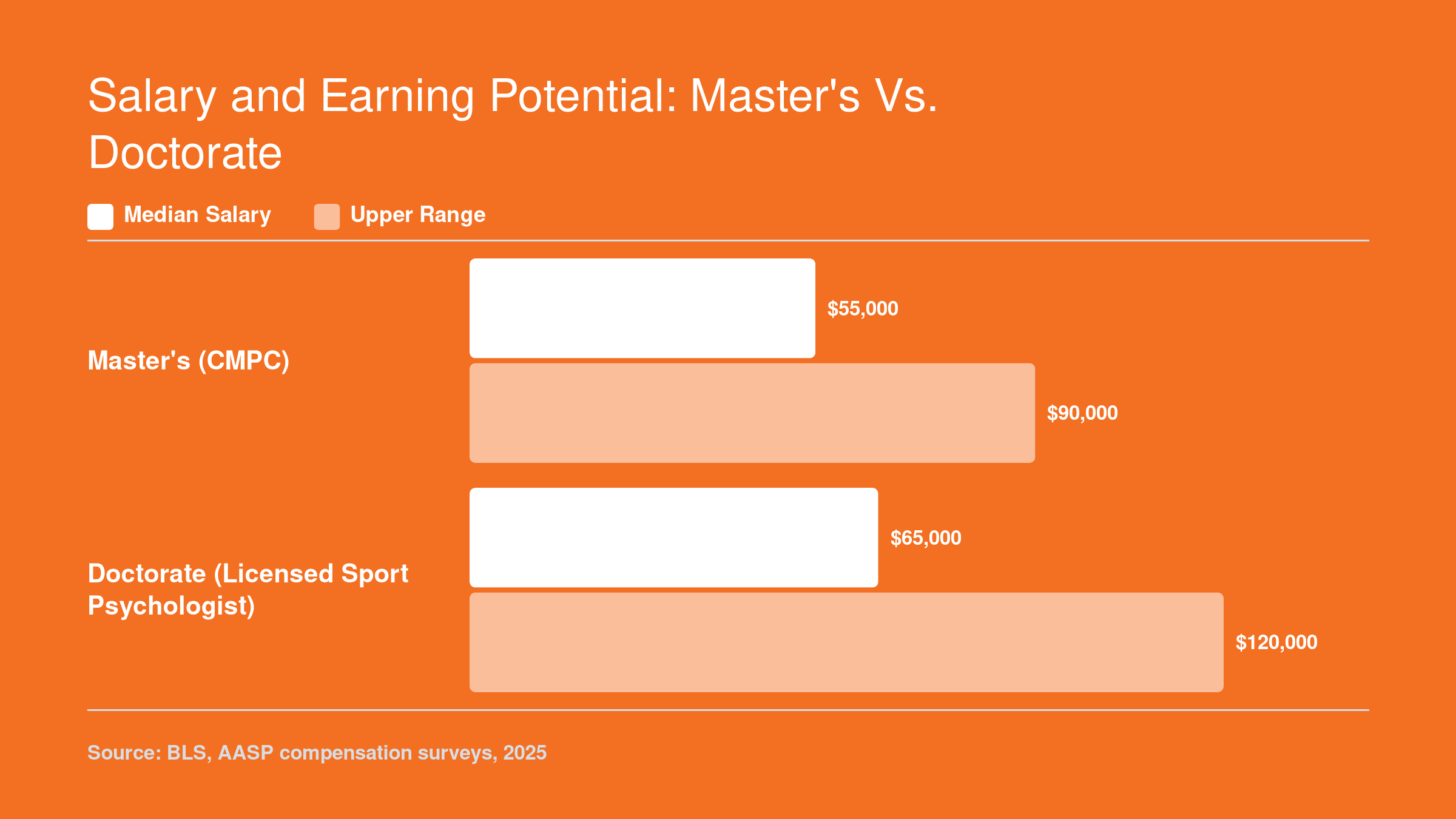
Your degree level influences earning potential, but so does your work setting. Doctoral-level licensed sport psychologists often start with lower earnings due to extended training years, yet they reach a higher ceiling through private practice and tenure-track faculty positions. Master's-level Certified Mental Performance Consultants (CMPCs) can also earn well, especially in professional sports or private consulting. At either level, roles with pro teams and in private practice tend to pay significantly more than university counseling centers or community settings.

Median and upper-range salaries for master's-level CMPCs compared to doctoral-level licensed sport psychologists, showing higher ceiling for doctorate holders

Cost, Funding, and Time to Completion

Tuition is one of the biggest variables in the master's vs. doctorate decision, and the sticker price can vary dramatically depending on the school, delivery format, and whether you qualify for in-state rates. Before you commit, take time to research individual university program pages for current tuition and fee schedules. Most schools list costs per credit hour or as a total program estimate, and those numbers can shift from year to year.

Master's Program Costs

Sport psychology master's degrees generally run two years and range widely in total cost. On the more affordable end, programs at schools like Troy University (about $475 per credit hour) and Adams State University (roughly $7,992 per year for out-of-state students) can keep your total investment well under $20,000. Mid-range options such as PennWest (approximately $10,257 per year out-of-state) offer solid value, while programs at the United States Sports Academy (around $684 per credit hour) or National University (roughly $21,984 per year) climb higher. For context, the average total cost of a master's degree across all fields falls between $44,000 and $71,000, so many sport psychology programs land on the lower side of that national range.2

Doctoral Program Costs and Funding

Doctorates take longer, typically four to seven years, which means both tuition and opportunity cost add up quickly. The good news is that many PhD programs in sport and exercise psychology offer graduate assistantships that include tuition waivers and annual stipends. Typical stipend amounts range from $15,000 to $30,000 per year, meaning some students graduate with little or no debt from tuition alone. PsyD programs, by contrast, tend to offer fewer funded positions and can carry price tags closer to clinical psychology doctorates. If you are specifically looking at affordable PhD sports psychology options, search for "graduate assistantship" or "funding" directly on each program's website so you know exactly what support is available before you apply.

Finding Online or Hybrid Options

If you need scheduling flexibility, filter by delivery method on the Association for Applied Sport Psychology (AASP) graduate program directory or search directly on university sites. Fully online sport psychology doctorates remain rare in 2026; most programs that advertise remote coursework are actually hybrid models requiring periodic on-campus residencies or in-person practica. Online master's programs are more widely available, but always confirm what, if any, in-person requirements exist.

Where to Verify Costs

For reliable cost comparisons, check:

  • University program pages: The most up-to-date source for credit-hour rates, fees, and financial aid packages.
  • APA accreditation database: Useful for confirming whether a doctoral program holds accreditation, which can affect your eligibility for certain funding and licensure pathways.
  • AASP graduate program directory: Lets you browse and compare sport psychology programs by degree level, location, and delivery format.
  • BLS.gov: Helpful for occupational outlook data, though it does not list program-specific tuition figures.

Taking an afternoon to build a simple spreadsheet with each program's per-credit cost, estimated total tuition, available funding, and time to completion can save you years of financial stress down the road.

Can You Start With a Master's and Transition to a Doctorate Later?

Yes, and it is one of the most common paths in the field. Many doctoral programs in sport psychology, counseling psychology, and performance psychology actively welcome applicants who already hold a master's degree. If you are unsure whether you want to commit to a doctorate right away, earning a master's first is a perfectly viable strategy.

How Credit Transfers Work in Practice

Some doctoral programs will accept between 30 and 45 transfer credits from a completed master's degree, potentially shaving one to two years off your doctoral timeline. However, this is far from guaranteed. Many PhD and PsyD programs follow a specific coursework sequence designed to build on itself, and faculty may require you to retake certain foundational courses regardless of what you covered at the master's level. Before applying, ask each program directly how they evaluate transfer credits and whether your prior coursework aligns with their curriculum.

The Strategic Upside of Starting With a Master's

Earning your master's first gives you a chance to test the waters before diving into four to seven additional years of doctoral training. During that time, you can:

  • Gain applied experience: Work directly with athletes or teams as a mental performance consultant, building practical skills that strengthen a doctoral application.
  • Earn income: A master's degree qualifies you for roles in coaching, athletic administration, and performance consulting, so you can reduce financial pressure before re-entering school.
  • Clarify your research interests: Doctoral programs expect you to articulate a focused research agenda. Real-world experience gives you sharper questions to investigate.
  • Build professional relationships: Networking with established sport psychologists and potential doctoral advisors is much easier when you are already working in the field.

The Potential Downside: Time and Cost

The sequential path is not without trade-offs. If a doctoral program accepts few or no transfer credits, you may end up spending eight to ten total years in graduate school rather than the five to seven a direct-entry doctoral program requires. The cumulative tuition, along with the opportunity cost of delayed higher earnings, can add up significantly compared to going straight through. Prospective students who are budget-conscious should explore cheapest sports psychology programs to keep overall costs manageable across both degrees.

Not all doctoral programs weigh prior master's coursework equally, either. A master's in sport psychology from a program with strong research methods training may transfer more smoothly than a degree in general kinesiology or coaching. If you suspect a doctorate may be in your future, choose a master's program whose curriculum overlaps substantially with doctoral-level expectations in areas like statistics, psychopathology, and supervised practicum hours.

Making the Sequential Path Work for You

If you decide to start with a master's, treat it as a deliberate stepping stone rather than a detour. Keep your transcript strong, seek research opportunities, and maintain relationships with faculty who can write doctoral recommendation letters when the time comes. Many successful sport psychologists took exactly this route, and the professional maturity they brought into their doctoral programs gave them a meaningful edge over peers entering straight from an undergraduate degree.

Decision Framework: Which Degree Is Right for You?

Choosing between a master's and a doctorate in sports psychology does not have to feel overwhelming. By filtering your decision through three lenses, you can land on the path that fits your career goals, timeline, and finances.

Start With Your Career Goal

Your end goal should drive the entire decision. Use this simple framework:

  • Clinical work with athletes: If you want to diagnose and treat mental health conditions such as anxiety disorders, depression, or eating disorders in athletic populations, you need a doctorate (PhD or PsyD) and licensure as a psychologist. A master's degree alone will not qualify you for this scope of practice in any U.S. state.
  • Mental performance consulting: If your passion is helping athletes sharpen focus, manage pressure, and build confidence, a master's degree paired with the Certified Mental Performance Consultant (CMPC) credential can open that door without doctoral training.
  • Academic or research career: If you see yourself teaching at a university or leading research programs, a PhD is the standard expectation. A PsyD or a master's degree rarely leads to a tenure-track faculty position.

Factor In Your Timeline

A master's program typically takes two to three years, which means you could be earning a full-time salary relatively quickly. Doctoral programs, on the other hand, generally require five to eight years when you account for coursework, practicum hours, a dissertation, and a postdoctoral fellowship. If you need to be working and generating income within the next three years, the master's route is the more realistic choice. For those leaning toward doctoral study but wanting to minimize time in school, it is worth researching sports psychology doctoral programs that offer accelerated timelines.

Run a Financial Litmus Test

Not all doctorates cost the same. Many PhD programs in sport and exercise psychology offer tuition waivers and stipends, making them far more affordable than self-funded PsyD programs that can exceed $100,000 in total debt. Before committing to a PsyD, model the math honestly: compare projected earnings as a licensed psychologist against the monthly loan payments you would carry for a decade or more. If a funded PhD is available and aligns with your research interests, it often makes better financial sense than borrowing six figures for a PsyD.

Our Recommendation for the Undecided

If you are still unsure, a practical path is to start with a master's degree. Earn your CMPC, work in the field for two to three years, and gain firsthand experience with athletes at different levels. That real-world exposure will clarify whether the additional scope, earning potential, and professional identity of a doctorate are worth the investment for your specific goals. Understanding the distinction between clinical vs performance sports psychology early on can also sharpen your thinking. Many successful sport psychologists followed exactly this route, and it allowed them to make a well-informed decision rather than a speculative one.

Frequently Asked Questions About Sports Psychology Degrees

Choosing between a master's and a doctorate in sports psychology raises a lot of practical questions. Below, we answer the ones prospective students ask most often, drawing on the key distinctions covered throughout this guide.

Do you need a doctorate to be a sport psychologist?
In most U.S. states, you need a doctorate to use the title "psychologist" legally, including "sport psychologist." That typically means earning a PhD or PsyD in psychology, completing supervised clinical hours, and passing the Examination for Professional Practice in Psychology (EPPP). However, you can work in the field under different titles (such as mental performance consultant) with a master's degree and an appropriate credential like the CMPC.
Can you practice sports psychology with just a master's degree?
Yes, but with important limitations. A master's degree qualifies you to work as a mental performance consultant, coaching athletes on focus, confidence, goal setting, and similar performance skills. You can pursue the Certified Mental Performance Consultant (CMPC) credential through the Association for Applied Sport Psychology. What you generally cannot do with only a master's is diagnose or treat clinical mental health conditions, or call yourself a psychologist.
Is a PhD or PsyD better for sports psychology?
It depends on your career goals. A PhD emphasizes research and is a strong fit if you want to teach at a university, publish, or blend science with practice. A PsyD focuses more heavily on clinical training and applied work, making it ideal if your priority is direct client care. Both can lead to licensure as a psychologist. Consider whether you see yourself primarily as a researcher, a clinician, or a combination of both.
How long does it take to get a doctorate in sports psychology?
Plan on four to seven years for most doctoral programs. A PhD typically takes five to seven years, including dissertation research. A PsyD often takes four to six years because the dissertation or doctoral project is usually less extensive. Both paths require a supervised predoctoral internship (commonly one year) and additional postdoctoral hours before you can obtain licensure. Part-time or online formats may extend the timeline further.
How much does a sports psychologist with a doctorate make?
Salaries vary widely based on setting, location, and clientele. According to the Bureau of Labor Statistics, psychologists overall earned a median annual wage of roughly $92,740 as of the most recent data. Sport psychologists in private practice who work with professional or Olympic athletes may earn considerably more, while those in academic or nonprofit roles may earn less. A doctorate generally opens the door to higher earning potential compared to a master's.
Are there online doctorate programs in sports psychology?
A small but growing number of universities offer hybrid or partially online doctoral programs in sport and performance psychology. Fully online options remain limited, especially for programs that lead to clinical licensure, because supervised practicum and internship hours must be completed in person. If flexibility is a priority, look for programs with an online coursework component paired with on-site clinical training requirements, and verify regional accreditation and APA accreditation status before enrolling.

Recent Articles