Blake Griffin quit sport psychology after a confidentiality breach with the Clippers.
Written confidentiality agreements should be signed before the first real session.
Validated tools like the WAI track trust across the therapeutic relationship.
What actually determines whether an athlete opens up in a sport psychology session? Not the practitioner's credentials, framework, or intake questionnaire. It is trust, and trust in this field is uniquely fragile.
Athletes are trained from adolescence to project composure, mask injury, and guard weakness. Sport psychology asks them to do the opposite inside a locker-room culture where information travels fast. A single confidentiality breach, real or perceived, can end an athlete's willingness to seek mental performance support for years. Blake Griffin's 2026 podcast disclosure about a Clippers-era voicemail is a recent, high-profile example of exactly that outcome.
For practitioners entering the field through a sport psychology degree program, the working reality is straightforward: technical skill matters, but ethical discipline and rapport are what keep the athlete in the chair for session two.
Why Trust Is the Foundation of Effective Sport Psychology
Every sport psychology practitioner faces a quiet tension in their work: athletes are often referred by coaches, general managers, or performance staff, yet the person sitting across from you needs to believe the conversation belongs to them alone. That gap between who pays attention to the work and who actually does the work is where trust either takes root or fails to form. Without it, techniques like imagery, self-talk restructuring, or arousal regulation land flat because the athlete is holding back the very material that would make those interventions useful.
Trust Predicts Whether Interventions Work at All
The therapeutic alliance, meaning the collaborative bond between practitioner and client, has been studied for decades in clinical psychology and is consistently linked to better outcomes across modalities. Sport psychology researchers have extended that lens to athletic settings, often using instruments like the Working Alliance Inventory to measure the quality of the practitioner-athlete relationship. The broad finding echoes what clinicians have long observed: the specific technique matters less than whether the athlete feels heard, respected, and safe enough to be honest. An athlete who trusts you will disclose the performance anxiety they have been hiding from teammates. An athlete who does not will nod through your session and leave nothing changed.
Trust Drives Adherence and Reduces Dropout
Sport psychology work is rarely a single conversation. Skills like attentional control or pre-performance routines require weeks of practice, feedback, and refinement. Athletes who feel disconnected from their practitioner tend to skip homework, miss sessions, or quietly disengage, which mirrors patterns seen in general psychotherapy research on alliance and dropout. Those who feel understood stay engaged long enough for the work to compound. Understanding the importance of sports psychology for athletes helps clarify why this sustained engagement matters so much to outcomes.
Where to Read Further
If you want to ground your practice in the underlying evidence, start with databases like PsycINFO, PubMed, and SportDiscus using search terms such as "Working Alliance Inventory sport psychology" or "therapeutic alliance athlete outcomes." The sports psychology organizations that represent the field, including the Association for Applied Sport Psychology, publish position stands and practitioner resources that summarize current thinking on ethics and alliance. University sport psychology programs also make faculty publications available through their department pages, which is a useful way to track ongoing research on rapport, adherence, and athlete-centered practice.
Blake Griffin's Confidentiality Breach: A Cautionary Tale for the Field
On June 30, 2026, Blake Griffin shared a troubling story on the Friends Keep Secrets podcast that illuminates exactly how fragile trust can be in sport psychology. The former NBA star and Hall of Famer recounted an incident from his time with the Los Angeles Clippers when a sports psychologist visited his home after practice for what Griffin believed was a private conversation. After the session ended and Griffin went to take a shower, he discovered a voicemail on his phone. The psychologist had intended to call Griffin's coach to report on their confidential session but had accidentally dialed Griffin's number instead, leaving a detailed account of what they had just discussed.1
The consequence was immediate and lasting. Griffin told podcast hosts Lil Dicky, Kristin Batalucco, and Benny Blanco that he stopped using sports psychologists entirely after that incident. One breach, one accidental voicemail, ended not just a therapeutic relationship but Griffin's willingness to engage with the entire profession.
What Went Wrong from a Practitioner Standpoint
The Griffin case exposes a dual-role conflict that remains common in professional sports. The psychologist was likely employed by the Clippers organization while simultaneously treating individual players. This arrangement creates competing loyalties: the practitioner owes the team (which signs the paycheck) information about player mental health, while also owing the athlete confidentiality under professional ethics codes. The voicemail reveals that session content was being reported directly to coaching staff, a practice that violates the foundational principle of therapeutic alliance.
Understanding what sports psychologists do on a daily basis makes the dual-role tension clearer: practitioners must balance organizational obligations with individual client care. Ethical sport psychology practice requires informed consent about who will have access to session information. If the psychologist intended to share Griffin's disclosures with coaches, Griffin should have been told explicitly before the first session. The home visit likely reinforced Griffin's expectation of privacy, making the breach feel even more personal.
The Ripple Effect Beyond One Athlete
When high-profile confidentiality breaches become public, they discourage other athletes from seeking help. Griffin's story, shared on a widely heard podcast, sends a clear message to current and aspiring athletes: talking to a team-employed psychologist may not be safe. The reputational damage extends far beyond one practitioner or one organization, and it can have serious consequences for athlete mental health support across the sport.
For professionals entering the field with a sport psychology degree, the Griffin incident is required reading. It demonstrates that trust is not abstract, it is operational. Athletes will test whether you keep their words private, and a single failure can close the door permanently. The lesson is unambiguous: clarify your reporting obligations before the first session, never assume athletes understand dual roles, and treat confidentiality as non-negotiable unless the athlete provides explicit, informed consent to share specific information with specific people.
Questions to Ask Yourself
If one of your athletes discovered you had shared session content with their coach, even with good intentions, would they ever come back?
Well-meaning disclosures still register as betrayals. If your answer is 'probably not,' that is your signal to rebuild the wall between clinical work and coaching feedback, no matter how tempting the shortcut feels.
Do your athletes know exactly who has access to what they tell you, and have you put it in writing?
Verbal assurances fade under pressure from front offices and parents. A written confidentiality agreement, reviewed in session one, protects both parties and forces you to clarify your own limits before a crisis tests them.
Could you pass the 'voicemail test'?
If an athlete accidentally heard every call, text, or note you made after their session, would the relationship survive? If not, tighten what leaves the room, because Blake Griffin's story shows how one stray message can end a career-long willingness to seek help.
Confidentiality Agreements and Ethical Boundaries in Sport Psychology
Confidentiality in sport psychology operates under stricter scrutiny than in most clinical settings because the athlete is rarely the only stakeholder in the room. The APA Ethics Code and the Association for Applied Sport Psychology (AASP) Ethics Code provide explicit guardrails, but practitioners who treat these documents as checklists rather than frameworks often find themselves in the exact situation Blake Griffin described: a breach that ends the professional relationship and damages the field's credibility.
APA and AASP Ethics Codes: The Specific Provisions That Govern Your Work
The APA Ethics Code establishes confidentiality as a core obligation under Standard 4.01, requiring psychologists to protect information obtained during professional relationships.1 Standard 4.02 mandates that practitioners discuss the limits of confidentiality with clients at the outset, not when a conflict arises. Standard 4.05 governs disclosures, permitting them only with consent or when legally required. Standard 3.10 covers informed consent broadly, while Standard 10.01 addresses informed consent to therapy specifically, requiring clear communication about who will have access to what information.
The AASP Ethics Code, updated in 2024, dedicates Section 4 to confidentiality and Section 17 to informed consent.2 AASP places particular emphasis on the multi-stakeholder environment common in sport settings. When a team employs the practitioner, the athlete must understand from the first meeting whether performance data, attendance records, or session content will be shared with coaches, general managers, or ownership. The code requires practitioners to clarify these arrangements in writing before any service begins.
Standard 3.11 of the APA Ethics Code addresses services delivered through organizations, obligating psychologists to clarify roles and reporting relationships up front.1 Standard 3.05 (multiple relationships) and Standard 3.06 (conflicts of interest) require practitioners to avoid arrangements that impair objectivity or risk exploiting the client. In sport psychology, this often means declining dual roles where the practitioner reports both to the athlete and to the coach on performance matters.
The Multi-Stakeholder Confidentiality Challenge: Who Gets What Information?
Sport psychology introduces a confidentiality structure unfamiliar to traditional therapy: the person paying the bill is often not the person receiving the service. A professional team may hire you to support an athlete's mental skills, but the athlete's private disclosures about family stress, medication, or past trauma are not the team's property.3 The framework that works in practice involves three tiers of information:
Tier One (fully confidential): Personal history, mental health diagnoses, trauma, family issues, and any content the athlete designates as private. This stays between practitioner and athlete unless the athlete consents in writing to share specific elements.
Tier Two (performance-relevant, shared with consent): Attendance at sessions, general progress on agreed-upon mental skills (focus, pre-performance routines, communication), and broad observations about engagement. The athlete must approve what gets reported and to whom.
Tier Three (administrative): Billing, scheduling, and confirmation that services are occurring. These can be shared with the paying organization without detailed content.
The informed consent document should specify which tier each type of information falls into and give the athlete veto power over Tier Two disclosures. If the team demands more access than the athlete is comfortable granting, the practitioner's obligation is to the athlete, not the employer.
What a Strong Informed Consent and Confidentiality Agreement Must Include
A practitioner working in sport psychology should provide a written agreement that covers:
Who is paying, who is the client: Name the organization funding the service and confirm that the athlete is the client with full confidentiality protections.
What information will be shared, with whom, and when: List the specific reports (if any) that will go to coaches, athletic trainers, or front-office staff, and specify that the athlete can review and approve these reports before they are sent.
The athlete's right to limit disclosure: State plainly that the athlete can refuse to allow any performance or progress information to be shared, and that refusal will not result in termination of services.
Exceptions to confidentiality: Explain the legal and ethical circumstances under which confidentiality must be broken (see below).
How records are stored and who can access them: Clarify whether notes are kept separately from team files, how long they are retained, and whether they are subject to organizational review.
The right to withdraw consent: Confirm that the athlete can revoke consent for information sharing at any point.
This agreement should be signed before the first substantive session. A verbal overview is not sufficient.
Dual-Role Conflicts: When You Work for the Team but Treat the Athlete
The AASP Ethics Code cautions against dual relationships that create conflicts of interest or impair professional judgment. A common scenario: a team employs you as a mental performance consultant, and you deliver group workshops on visualization and goal-setting. An athlete then asks for one-on-one sessions to address anxiety and substance use. If your contract requires you to report individual session content to the coaching staff, you have a dual-role conflict.
The clearest boundary: separate the roles. If you provide confidential individual therapy or counseling, do not also serve as the team's performance consultant who reports to coaches. If the team employs you in a performance role, refer athletes who need confidential mental health support to an independent clinician. Understanding the difference between performance psychology and sports psychology coaching can help clarify which role you are filling and what disclosure obligations come with it. AASP guidelines emphasize role clarity at the outset: define whether you are a consultant (whose work may be transparent to the organization) or a therapist (whose work is confidential), and do not blend the two without explicit, written agreement from all parties.
When dual roles are unavoidable (for example, in a small college program with no other resources), document the conflict, obtain informed consent that specifies what will and will not be shared, and build in regular check-ins with the athlete to ensure the arrangement remains acceptable.
Legal Obligations That Override Confidentiality
Confidentiality is not absolute. Practitioners must break confidence when:
Mandatory reporting laws apply: Suspected abuse or neglect of a minor or vulnerable adult must be reported to authorities, regardless of the athlete's wishes.
Imminent harm to self or others: If an athlete expresses serious intent to harm themselves or another person, the practitioner has a duty to warn or protect, which may include notifying law enforcement, the intended victim, or emergency contacts.1
Court orders or subpoenas: In some jurisdictions, psychologist-client privilege can be overridden by legal process. Practitioners should consult legal counsel before complying and seek to limit disclosure to the minimum required.
Public health emergencies: Certain infectious disease reporting requirements may apply, though these are rare in sport psychology contexts.
The informed consent document should list these exceptions in plain language so athletes understand the boundaries of privacy before they disclose sensitive information. When a mandatory disclosure becomes necessary, inform the athlete of what you are required to report, to whom, and why, unless doing so would increase the risk of harm. For a broader look at how these principles apply across sports psychologist trust and sport psychology trust building, the companion guide on this site offers additional practical context.
Proven Strategies for Building Rapport in the First Three Sessions
The first three sessions with an athlete set the foundation for everything that follows. Rushing into assessments or mental skills training before establishing genuine connection is one of the fastest ways to lose an athlete's engagement. Instead, treat these early meetings as an investment in the relationship itself.
Session 1: Listen First, Learn Everything
Your only goal in the first session is understanding the athlete's world. Ask about their sport, their position or event, what a typical training week looks like, and what pressures they navigate. Avoid assessments, questionnaires, or formal interventions entirely.
Open with something like: "I'd love to hear about your journey in this sport. What drew you to it, and where are you hoping to go from here?"
This question signals that you see them as a person with a story, not a problem to fix. Take notes sparingly so you can maintain eye contact. If they mention a recent competition, ask follow-up questions that show genuine curiosity rather than clinical detachment.
Session 2: Set the Ground Rules Together
Session two is where you establish collaborative goals and, critically, discuss confidentiality in explicit terms. Athletes often assume (sometimes incorrectly) that everything they share gets reported to coaches or team management.
Try opening with: "Before we go further, I want to be clear about what I share and don't share with your coaching staff. Our conversations stay between us unless you give me specific permission to discuss something, or unless there's a safety concern. Does that feel okay to you?"
This script accomplishes two things: it demonstrates respect for the athlete's autonomy, and it creates an opening for them to ask questions or express concerns. After addressing confidentiality, begin identifying two or three goals they want to work toward. Frame these as their priorities, not yours.
Session 3: Offer Value Without Overstepping
By the third meeting, you have permission to introduce your first low-stakes skill. Breathing techniques or a simple visualization exercise works well here because both are practical, easy to practice independently, and don't require deep personal disclosure.
Introduce it with: "Based on what you've told me about pre-competition nerves, I thought we could try a breathing technique today. No pressure to love it. We're just experimenting."
This language removes the expectation of immediate results and positions you as a collaborator rather than an authority figure. Mental techniques elite athletes use often start exactly this simply, building complexity only after a foundation of trust is in place.
Mistakes That Erode Trust Early
Several common missteps can undermine rapport before it even forms:
Asking about trauma prematurely: Save deeper questions about family dynamics, past failures, or mental health history until trust is established.
Name-dropping other athletes: Mentioning famous clients you've worked with can feel like a breach of confidentiality by proxy. Athletes wonder what you'll say about them.
Over-promising outcomes: Phrases like "I can fix that" or "You'll see results immediately" set unrealistic expectations that damage credibility when progress takes time.
Being overly clinical: Using jargon or maintaining rigid professional distance makes athletes feel like subjects, not partners.
Show Up as a Person
Whenever possible, attend a practice or competition before your first session. Learning the sport's terminology, understanding what a "bad rep" looks like, and referencing real moments from their experience demonstrates investment that athletes notice and appreciate. How sports psychologists help athletes balance the demands of sport and life is grounded in exactly this kind of contextual awareness. Trust grows when athletes sense you care about their world, not just their performance metrics.
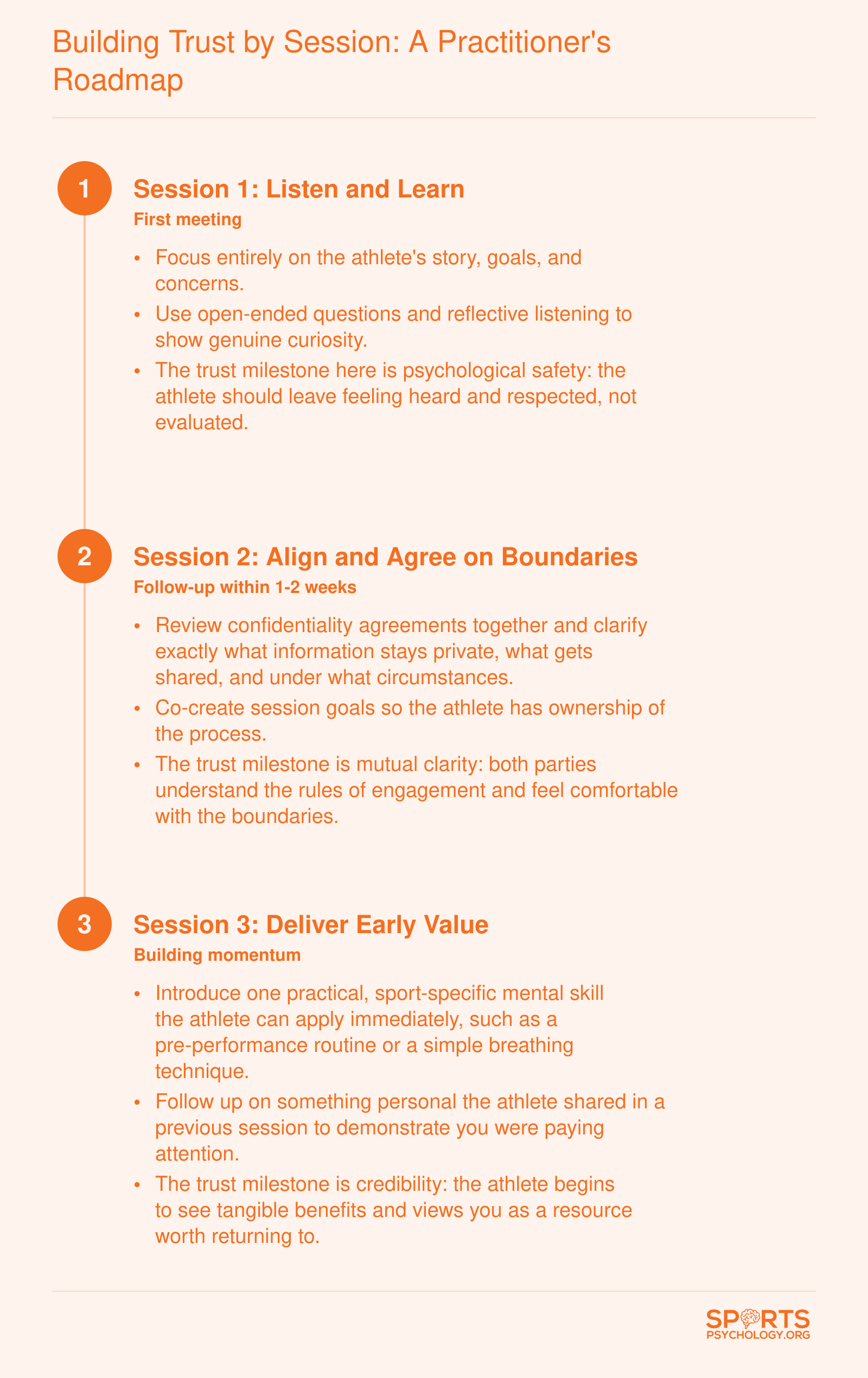
Building Trust by Session: A Practitioner's Roadmap
Trust between a sport psychologist and an athlete does not happen in a single conversation. It develops through deliberate, sequential actions across your earliest meetings. This roadmap outlines the key milestones to aim for in your first three sessions.
Adapting Trust-Building by Age, Level, and Sport
Working with a 14-year-old club soccer player requires a fundamentally different trust-building approach than partnering with a 30-year-old professional golfer, yet both athletes deserve the same quality of psychological support. Context shapes everything: age, competitive level, sport structure, cultural background, and gender all influence how trust develops and what barriers practitioners must navigate.
Youth Athletes: The Three-Way Confidentiality Challenge
With young athletes, trust often runs through the parent first. Before a teenager opens up about performance anxiety or team dynamics, their parents need to feel confident that the practitioner is competent and safe. This creates a three-way confidentiality arrangement involving the athlete, parent, and often a coach.
Navigating this structure requires clarity from the start. Explain to all parties what information will be shared and what remains private. A practical approach is to establish that session content stays with the athlete, while general progress updates (such as attendance and engagement) can be shared with parents. When parents push for specific details about what their child discussed, practitioners must advocate for the young athlete's privacy while validating parental concern. Phrases like "Your daughter is engaged and working hard" satisfy most parents without breaching the athlete's confidence. For more on coach parent coordination in youth sports, including how to navigate sideline dynamics, this tension between transparency and privacy comes up repeatedly.
As youth athletes mature, gradually shift more confidentiality control to them. A 16-year-old preparing for college recruitment deserves more privacy than a 10-year-old just starting competitive sports. Youth sports psychologists who work across age groups often describe this gradual handoff as one of the most nuanced parts of the role.
Elite and Professional Athletes: Higher Stakes, Higher Walls
Professional athletes face unique trust barriers. They worry about roster decisions, contract negotiations, and media leaks. For them, vulnerability could carry real career consequences. The practitioner often holds less organizational power than the athlete, which inverts the typical therapeutic dynamic.
Building credibility in this context requires demonstrating competence quickly. Elite athletes respect expertise and directness. Come prepared with sport-specific knowledge, avoid jargon that feels clinical, and show that you understand the pressures they face. Be transparent about your role: are you employed by the team, or are you an independent contractor? Athletes need to know whose interests you serve before they share anything meaningful.
Team Sport vs. Individual Sport Dynamics
In team sports, practitioners risk being perceived as an extension of coaching staff. Athletes may wonder if session content reaches the front office. Counter this perception by establishing clear independence from team management and demonstrating consistent confidentiality over time.
Individual sport athletes face different challenges. Without teammates as a social buffer, they may feel more exposed when discussing struggles. The one-on-one nature of sports like tennis, golf, or swimming can amplify vulnerability. Move slowly, respect their autonomy, and recognize that these athletes often have highly developed self-reliance that can mask their need for support. Understanding mental toughness in sports and how it manifests differently across individual and team contexts can sharpen a practitioner's ability to read these cues.
Cultural and Gender Considerations
Trust-building norms vary across cultural backgrounds and gender identities. Some athletes come from backgrounds where seeking psychological help carries stigma. Others may expect more formality or hierarchy in professional relationships.
The key is to ask rather than assume. Early in the relationship, invite athletes to share how they prefer to communicate, what confidentiality means to them culturally, and whether any topics feel off-limits initially. This curiosity-driven approach respects individual differences without applying broad generalizations that can feel reductive or patronizing.
When working with youth athletes, your first client is often the parent. Earn their trust while clarifying confidentiality limits: if the child believes everything is reported home, they will never speak openly, undermining the entire therapeutic process.
What Athletes Actually Look for in a Sport Psychologist
Sport knowledge and genuine human connection are rarely in competition, but many practitioners assume athletes prioritize one over the other. In practice, athletes tend to want both, and the absence of either one can quietly erode the working relationship before it ever gets started.
Credibility Rooted in the Sport Itself
Athletes are quick to sense whether a practitioner actually understands their world. That does not mean a sport psychologist needs a competitive athletic background, but it does mean they need to speak the language: the rhythms of a season, the pressure of selection, the specific demands of the athlete's discipline. When a practitioner asks genuinely informed questions rather than generic ones, athletes tend to relax into the conversation rather than spending energy explaining basic context.
This credibility is distinct from clinical competence. An athlete might trust that a practitioner has solid credentials while still feeling that the practitioner does not quite get what it is like to prepare for a championship or manage an injury comeback for athletes. Bridging that gap early, through active listening and sport-specific curiosity, tends to accelerate trust considerably.
Authenticity Over Performance
Athletes who have worked with multiple practitioners often describe a preference for someone who feels real rather than carefully polished. That means a practitioner who admits uncertainty when they are uncertain, who does not over-promise outcomes, and who responds to setbacks in the work with honesty rather than spin. Authenticity is difficult to fake, and athletes who spend their careers reading teammates and opponents tend to detect inauthenticity fairly quickly.
This also extends to how a practitioner handles the power dynamic in the relationship. Athletes appreciate practitioners who treat them as active collaborators in the process rather than passive recipients of technique. Some practitioners who come from an athlete-to-sports-psychologist transition bring firsthand familiarity with exactly this dynamic, which can make the collaborative framing feel more natural from the start.
Confidentiality as a Non-Negotiable
Across qualitative accounts from athletes at various levels, confidentiality consistently appears as a baseline requirement rather than a nice-to-have. Athletes will often withhold the most performance-relevant information if they are not certain it stays in the room. High-profile incidents, like the experience Blake Griffin described publicly in 2026, illustrate how a single breach can close off an athlete's willingness to engage with the field entirely.
Accessibility and Consistency
Finally, athletes value a practitioner who shows up reliably, responds promptly during high-stress periods, and is accessible in ways that fit the rhythms of competition schedules. A practitioner who is hard to reach before a major event or who cancels frequently signals, however unintentionally, that the athlete is not a priority. Consistency in availability reinforces the broader message that the practitioner is genuinely invested in the athlete's progress. Understanding the full scope of careers in sports psychology can help practitioners anticipate these expectations before they enter the field.
How to Repair Trust When Things Go Wrong
What do you do when an athlete stops returning your texts after you were seen having coffee with their coach?
Trust breaks are inevitable in applied sport psychology. Even practitioners with impeccable ethics will face moments when an athlete feels betrayed, whether through a genuine mistake or a misunderstanding. The difference between effective and ineffective sports psychologists often lies not in avoiding every misstep, but in how they respond when trust fractures.
Common Trust Breakers Beyond Confidentiality
While confidentiality breaches grab headlines, most trust erosion happens more subtly. Practitioners lose credibility when athletes perceive bias toward coaching staff, especially if the psychologist seems to prioritize organizational goals over individual well-being. Inconsistency between words and actions ranks high: telling an athlete you have an open-door policy but never making time, or preaching mental health while visibly stressed yourself.
Failing to follow through on commitments, no matter how small, sends a clear signal. If you promise to send a breathing exercise worksheet and forget, the athlete notices. Being dismissive of concerns, particularly when an athlete shares something that feels minor to you but major to them, creates immediate distance. Finally, being seen at social events with team management can trigger suspicion, even when the interaction was perfectly innocent.
A Concrete Repair Framework
Effective repair starts with acknowledgment. Name what happened directly: "I realize I was late to our last two sessions, and I didn't give you advance notice either time." Minimizing ("It was only ten minutes") or deflecting ("Things have been crazy lately") extends the damage.
Take ownership without defensiveness. "That was unprofessional, and it communicated that your time doesn't matter" works better than "I'm usually very punctual." Then ask the athlete what they need: "What would help you feel confident in our work together again?" This shifts the conversation from your guilt to their agency.
Most importantly, demonstrate changed behavior over multiple interactions. Trust is rebuilt through consistent action, not eloquent apologies. If you promised to arrive early, show up fifteen minutes ahead for the next month.
When the Breach Was Organizational
The hardest scenario involves systemic pressure. Perhaps the athletic director asked you to share session notes, or the team culture expects psychologists to report "concerning" behaviors. When an athlete discovers you disclosed information under organizational pressure, honesty matters.
You can acknowledge constraints without blame: "The team's contract requires me to report certain safety concerns to the training staff. I should have explained that boundary more clearly before we started." This names the reality without throwing the organization under the bus or pretending you had no agency.
Sometimes the right move is helping the athlete find a private-practice psychologist outside the organizational structure. Understanding the difference between sports psychologist and sports psychiatrist credentials can help athletes make a more informed choice about who to turn to next.
When Repair Isn't Possible
Sometimes the ethical move is recognizing that the relationship cannot be salvaged. If an athlete no longer feels safe with you, forcing continued sessions serves your need for redemption, not their healing. Facilitating a warm referral to another practitioner demonstrates respect for their autonomy and may, paradoxically, preserve your professional reputation more than clinging to a damaged relationship.
Measuring Trust: Validated Tools and Behavioral Indicators
You cannot improve what you do not track, but trust is slippery. It shows up in what athletes say, what they hold back, and whether they keep booking sessions. Here are the instruments and informal signals that give you a read without turning the work clinical.
Validated Instruments Worth Knowing
Two scales dominate the literature and translate well to practitioner-athlete work.
Working Alliance Inventory (WAI): Built on Bordin's tripartite model of Goal, Task, and Bond, the original WAI is a 36-item, 7-point Likert instrument.1 Most practitioners use the Short Form (WAI-S) or Short Revised (WAI-SR), both 12 items with internal consistency above 0.80.2 A sport-adapted version (wording shifted from therapist-client to coach-athlete or practitioner-athlete) has explained 18% of variance in perceived performance, 12% in self-perception, and 25% in burnout.3 The WAI-S has also been validated in coaching contexts with a confirmed three-factor structure and measurement invariance across sessions, meaning you can compare scores over time without the instrument shifting under you.4
Coach-Athlete Relationship Questionnaire (CART-Q): Grounded in Jowett's 3+1 Cs model (Closeness, Commitment, Complementarity, and Co-orientation), the standard 11-item athlete version uses a 7-point Likert scale with subscale reliabilities ranging from 0.80 to 0.90.3 It correlates positively with athlete satisfaction and adapts reasonably well to practitioner-athlete dyads with minor wording changes.
Both instruments are available through the original validation papers and secondary sources like the Rehabilitation Measures database. Ask permission and cite properly if you use them in applied work.
Behavioral Indicators Between Sessions
Scores are useful quarterly. Behavior tells you what is happening this week. Track:
Depth of self-disclosure (moving from performance logistics to identity, fear, or family)
Athlete-initiated contact between sessions
Willingness to discuss failures, not just wins
Cancellation and no-show rates trending down
Referrals of teammates or training partners
A Three-Question Post-Session Check-In
Instead of handing out a scale after every meeting, try three conversational questions: Did you feel heard today? Is there anything you held back? What would make our next session more useful? It takes ninety seconds and surfaces rupture before it hardens. Practitioners exploring branches of sports psychology will find variations of this approach recommended across applied, clinical, and performance tracks.
Do Not Over-Measure
If trust assessment becomes a ritual of forms and metrics, athletes start performing for the instrument rather than working with you. Use validated scales sparingly, perhaps at intake and every eight to twelve weeks. Let the informal check-ins and behavioral signals carry the week-to-week work.
Common Questions About Trust in Sport Psychology
Trust and confidentiality are among the most common concerns athletes raise before starting work with a sport psychologist. Below are straightforward answers to the questions practitioners and clients ask most often.
How do sports psychologists maintain confidentiality with athletes?
Sport psychologists protect client information through written confidentiality agreements signed before the first session, secure record storage, and clear communication protocols. They discuss limits of confidentiality upfront, such as mandatory reporting for safety concerns, so athletes know exactly what will and will not be shared. As outlined in the confidentiality agreements section of this guide, putting these expectations in writing is essential.
What happens when a sport psychologist breaks confidentiality?
A confidentiality breach can end the working relationship entirely. As Blake Griffin's experience illustrates, a single violation led him to stop working with sport psychologists altogether. Beyond individual consequences, breaches can trigger ethics complaints, license revocation, and lasting damage to the profession's credibility. The cautionary tale section of this article explores the ripple effects in detail.
What ethical guidelines do sports psychologists follow?
Practitioners typically follow the ethical standards set by the Association for Applied Sport Psychology (AASP) and, if licensed, the American Psychological Association (APA). These codes mandate informed consent, confidentiality, competence boundaries, and dual relationship management. The ethics and boundaries section of this guide walks through how these standards translate into everyday practice decisions. Practitioners curious about the full scope of the field can also explore the range of clinical vs. performance sports psychology tracks available to them.
How can a sport psychologist repair trust after a mistake?
Repairing trust starts with taking full responsibility, offering a sincere and specific acknowledgment of the error, and collaboratively creating a concrete plan to prevent recurrence. The practitioner should invite the athlete to set new terms for the relationship going forward. The trust repair section of this article details a step-by-step framework for navigating these difficult conversations effectively.
How is working with a sport psychologist different from seeing a regular therapist?
Sport psychologists specialize in performance enhancement, mental skills training, and the unique pressures of competitive athletics. While traditional therapists focus broadly on mental health, sport psychologists understand locker room dynamics, coach relationships, and performance anxiety in context. Many hold specialized certifications through AASP. For those wondering about the pathway into the field, a guide on how a regular psychologist becomes a sports psychologist explains the additional training and credentials involved. That said, some sport psychologists are also licensed to treat clinical mental health concerns.
Can a team-employed sport psychologist truly keep sessions confidential from coaches?
Yes, but it requires deliberate safeguards. Practitioners should establish written agreements with the organization specifying that session content stays private, while general availability updates (such as whether an athlete attended) may be shared only with the athlete's consent. The confidentiality agreements section of this guide explains how to structure these boundaries so athletes feel genuinely protected.
Trust in sport psychology is not a breakthrough moment; it is the steady accumulation of small, reliable actions: showing up, keeping confidentiality promises, and maintaining boundaries. The Blake Griffin story reminds us that every practitioner is one misdirected voicemail from destroying an athlete's trust. The antidote is structural safeguards, like verifying communication channels and never documenting sensitive details without consent.
Your next step: compare your confidentiality agreement against this article's ethical framework, then consider whether a sport psychology career in applied or performance settings is the right fit for your professional goals. Add a session-by-session trust check-in asking, "What felt safe today, and what felt uncertain?" These small daily practices turn ethical principles into real protection.