Oregon has no in-state accredited graduate sports psychology program, so students rely on top online and hybrid options.
Licensed psychologists in Oregon must hold a doctoral degree, while the CMPC credential offers an applied, non-clinical alternative.
Local practicum sites including university athletic departments and Portland-area clinics let online students build Oregon professional networks.
Oregon psychologist salaries are competitive nationally, and the state's growing sports culture supports rising demand for performance professionals.
Oregon requires a doctoral degree and state licensure through the Oregon Board of Psychology for anyone who wants to use the title "psychologist," yet no in-state university currently offers an accredited graduate program dedicated to sport psychology. That gap sends Oregon students into a national market of online and hybrid programs, many of which are well suited to remote learners completing practicum hours locally. Students in nearby states face a similar landscape; those exploring sports psychology programs nevada or sports psychology degree montana will find comparable dynamics.
The practical tension is real: you need rigorous, accredited training, but you also need flexibility to build clinical or applied experience in Oregon communities where you plan to work. Top-ranked online programs now accept Oregon residents and align with both licensed psychologist and Certified Mental Performance Consultant credential tracks. Oregon's median annual wage for psychologists sits above the national average, and demand for performance-focused mental health professionals continues to grow in collegiate, professional, and youth sport settings across the state.
Best Online Sports Psychology Programs for Oregon Students
Oregon does not currently have accredited in-state graduate programs dedicated to sport psychology, which means students in Portland, Eugene, Bend, and beyond need to look out of state for their training. The good news: nationally recognized online and hybrid programs make it possible to earn a sports psychology degree from anywhere in Oregon without relocating. The programs below are ranked using a mixed quality composite that weighs institutional outcomes, program characteristics, and overall value. Tuition figures reflect out-of-state rates (since Oregon students will be non-residents), and graduation rates are institution-wide, not program-specific. Program-level median earnings are not yet available for these programs.
Factors considered
Institutional graduation and retention rates
Out-of-state tuition and net price
Program delivery format and flexibility
Certification and career alignment
Faculty ratio and student support
Data sources
NCES-IPEDS federal institutional data — nces.ed.gov
Best for: Undergrads building a sport counseling foundation
Arizona State University is a globally recognized research institution that delivers an online Bachelor of Science with a concentration in Sport and Performance Counseling. The program spans 120 credit hours across 40 accelerated 7.5-week courses and includes a required internship in a sport or mental health setting. With an 87% retention rate, a 68% institution-wide graduation rate, and faculty who are recognized researchers in the field, ASU gives Oregon students a strong foundation before entering a graduate program.
Counseling and Applied Psychological Science, Sport and Performance Counseling — Online
Online Bachelor of Science degree, 120 total credit hours
Concentration in Sport and Performance Counseling
40 accelerated classes, each lasting 7.5 weeks
Required internship in a sport or mental health setting
Out-of-state tuition approximately $33,139 per year
Covers motivation, confidence, anxiety, and injury recovery
Earned Admission pathway available for 2.75 GPA applicants
Best for: Budget-focused graduate students seeking CMPC prep
Southern Illinois University-Edwardsville offers a Master of Science in Kinesiology with an Exercise and Sport Psychology specialization that can be completed in as little as 12 months. Coursework aligns with Certified Mental Performance Consultant (CMPC) certification requirements, and the program connects students to Division I athletics resources. At $10,488 per year for all students regardless of residency, SIUE is one of the most affordable graduate options on this list.
MS in Kinesiology, Exercise and Sport Psychology — Hybrid
100% online master's program, 12 to 22 months to complete
Best for: Career changers needing an accelerated bachelor's
California Baptist University provides an online Bachelor of Science in Sport and Performance Psychology that can be finished in just 16 months of full-time study. The 49-unit, fully asynchronous curriculum blends exercise physiology, behavioral sport psychology, and cognitive psychology, with six enrollment entry points each year. CBU integrates a Christian faith perspective and emphasizes ethics and cultural diversity throughout its coursework.
Sport and Performance Psychology, BS — Online
49-unit online bachelor's, completable in 16 months
100% asynchronous coursework, no campus visits required
Six entry points per year with rolling admissions
Tuition of $520 per unit plus fees
Covers exercise physiology and cognitive psychology
Transfer-friendly with year-round enrollment
WSCUC-accredited institution
Emphasis on ethics, diversity, and faith integration
Southern Connecticut State University delivers a hybrid Master of Science in Exercise Science with a Sport Psychology concentration. The 33 to 34 credit interdisciplinary program draws faculty from three departments and prepares students for CMPC certification. SCSU features an 11:1 student-to-faculty ratio, and tuition discounts may be available through the New England Board of Higher Education Flexible Program.
Exercise Science, M.S., Sport Psychology — Hybrid
33 to 34 credit interdisciplinary master's program
Sport Psychology concentration with CMPC prep
Hybrid delivery combining online and on-campus work
Faculty from Health Sciences, Counseling, and Psychology
Out-of-state tuition approximately $21,727 per year
11:1 student-to-faculty ratio for personalized support
Covers health psychology, counseling, and performance strategies
Texas A&M University-Kingsville houses a hybrid M.S. in Kinesiology with a Performance Psychology concentration that aligns with CMPC exam preparation. Students choose from three degree plans: a 36-credit course-only track, a 36-credit plan with a research project or internship, or a 30-credit thesis option. Out-of-state tuition of $14,560 per year keeps costs moderate for Oregon students studying remotely.
M.S. in Kinesiology, Performance Psychology — Hybrid
Performance Psychology concentration within Kinesiology
Three degree plans: course-only, internship, or thesis
36 credit hours (course-only) or 30 credits (thesis)
Curriculum aligned with CMPC exam requirements
Out-of-state tuition approximately $14,560 per year
Some required face-to-face courses in traditional format
Covers sport, exercise, and performance psychology
Troy University offers a Master of Science in Kinesiology with a Sports Psychology concentration through a flexible hybrid format. The curriculum includes courses in sport psychology and motor skills, with hands-on internship opportunities working directly with athletes. Troy has no set application deadline, making it convenient for Oregon students ready to start on their own timeline.
Master of Science in Kinesiology, Sports Psychology — Hybrid
Sports Psychology concentration at the master's level
Hybrid delivery combining online and on-campus elements
Hands-on internships working with athletes
Out-of-state tuition approximately $17,100 per year
No application deadline for flexible enrollment
Covers mental performance and ethical practices in sport
Faculty bring professional sports psychology experience
Kent State University offers a fully online Bachelor of Science in Sport, Exercise and Performance Psychology that covers motivation, mental training, stress management, and sport injury psychology across 120 credit hours. A required practicum gives students applied experience before graduation. The institution's 63.7% graduation rate and 81% retention rate reflect solid student support.
Sport, Exercise and Performance Psychology — Online
100% online Bachelor of Science, 120 credit hours
Covers motivation, mental training, and stress management
Includes sport injury psychology and ethics coursework
Required practicum for hands-on experience
Out-of-state tuition approximately $21,575 per year
Transfer students and international students accepted
National University stands out for offering sport psychology programs at every degree level: a Bachelor of Arts, a Master of Science, two Master of Arts specializations (Applied and Theoretical Mental Performance), and a PhD in Psychology with a Sport and Performance Psychology specialization. All are 100% online with weekly start dates and no application fee. Multiple master's tracks meet CMPC certification academic requirements, and the doctoral program includes a full dissertation.
Master of Science in Sport Psychology — Online
36 credit hours across 12 courses, 18 to 21 months
Adams State University delivers an affordable, fully online Master of Science in Kinesiology with an Applied Sport Psychology emphasis. The 36-credit program is designed for completion in two years and includes coursework in mental strength and conditioning, ethics, case studies, and diversity in sport. Students finish with both internship experience and a capstone project, building a well-rounded applied portfolio.
Master of Science in Kinesiology, Applied Sport Psychology — Online
Springfield College brings its long heritage in sport and movement sciences to a fully asynchronous online Master of Education in Sport and Exercise Psychology. The 36-credit program can be completed in 18 months and includes a 135-hour applied internship with remote supervision. Springfield's 74.2% graduation rate is the highest among the schools on this list, and the 11:1 student-to-faculty ratio supports close mentoring relationships.
MEd in Sport and Exercise Psychology Online — Online
36-credit Master of Education, 100% asynchronous online
Completable in 18 months full-time or part-time option
135-hour applied internship with remote supervision
Courses offered in 7-week and 15-week formats
Out-of-state tuition approximately $33,722 per year
Requires essay, resume, two recommendation letters
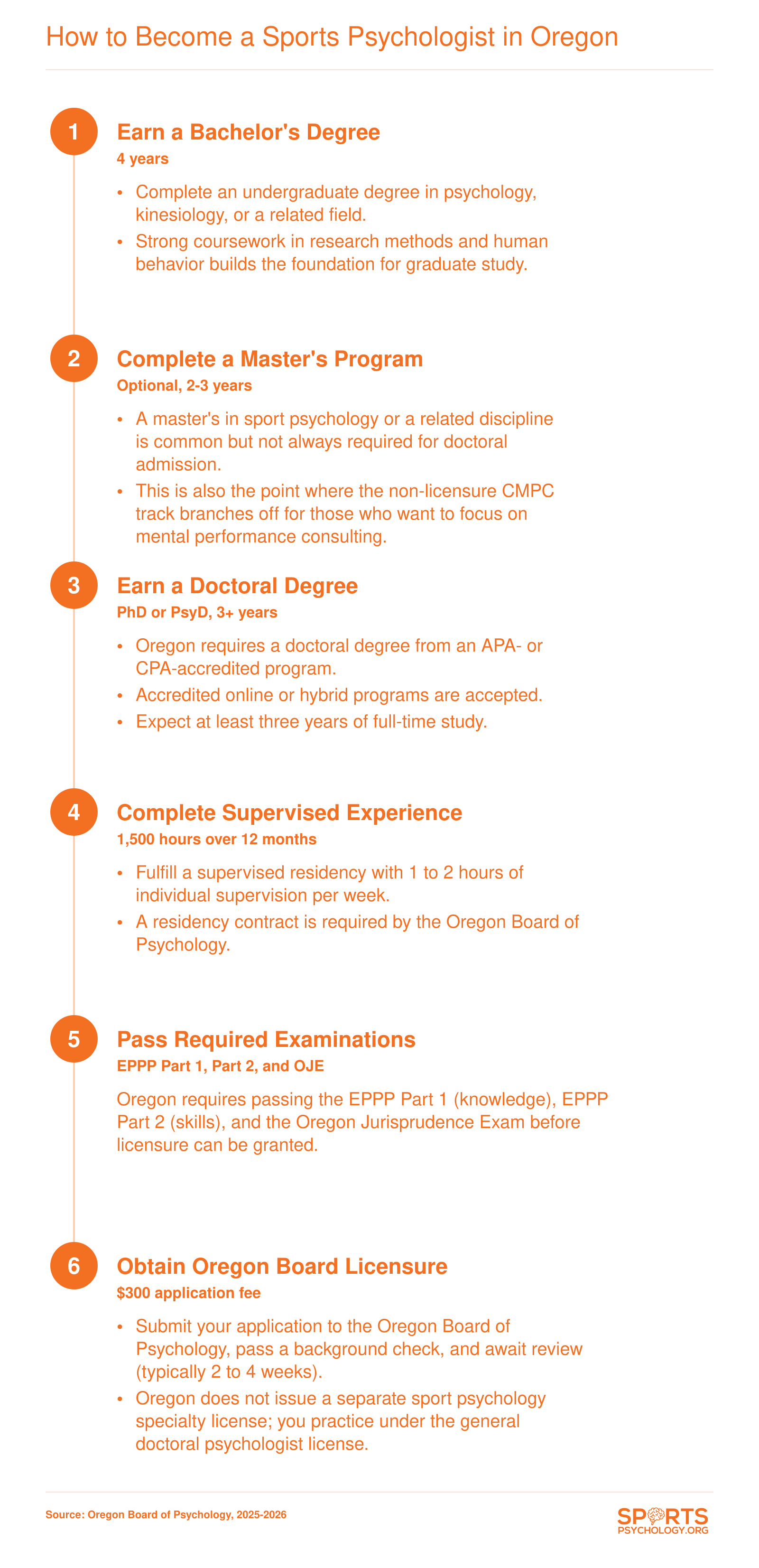
In Oregon, only professionals who hold a doctoral degree and state licensure may use the title "psychologist." The credentialing ladder below outlines the typical path. If you prefer applied mental performance work without licensure, a separate CMPC track branches off after the master's level (covered in the next section).
Oregon Licensure Vs. CMPC Certification: Which Path Is Right for You?
If you're exploring sports psychology programs in Oregon, one of the most important early decisions is choosing between two distinct credential paths. Licensed psychologists work under the Oregon Board of Psychology and can diagnose and treat clinical mental health conditions, while Certified Mental Performance Consultants (CMPCs) focus on performance enhancement and mental skills training. Both credentials serve athletes, but the education, timeline, and scope of practice differ significantly. Here's how they compare side by side.
Category
Licensed Psychologist (Oregon Board of Psychology)
CMPC (AASP Certification)
Education Required
Doctoral degree (Ph.D. or Psy.D.) in psychology from an accredited program
Master's degree or higher in sport science, kinesiology, or a related field
Supervised Experience Hours
Approximately 1,500 supervised postdoctoral hours in Oregon
Approximately 400 mentored hours of performance consulting under an approved mentor
Scope of Practice
Clinical diagnosis and treatment of mental health disorders, including anxiety, depression, and eating disorders in athletes
Mental performance consulting only, such as goal setting, visualization, focus training, and team dynamics (no clinical diagnosis or treatment)
Title Protection
"Psychologist" is a legally protected title in Oregon; using it without a license is prohibited
"CMPC" is a professional credential but not a legally protected title under Oregon state law
Typical Employer Settings
Private practice, hospitals, university counseling centers, professional sports organizations, and the military
College and professional athletic departments, private consulting practices, sport governing bodies, and fitness organizations
Timeline to Credential (After Bachelor's Degree)
Typically 7 to 10 years, including doctoral coursework, internship, and postdoctoral supervision
Typically 2 to 4 years, including a master's degree and mentored consulting hours
Online Program Options for Oregon Students
Programs such as the University of Western States (Psy.D.) may partially fulfill requirements, though doctoral programs typically require in-person components
Several online master's programs from the ranking section, including those at the University of Western States and other nationally accredited options, can prepare students for CMPC eligibility
Questions to Ask Yourself
Do you want to diagnose and treat clinical conditions in athletes, or focus on performance optimization?
This distinction shapes your entire education path. Clinical work with athlete anxiety, depression, or trauma requires a doctoral degree and licensure as a psychologist, while performance consulting (goal setting, focus training, team dynamics) can begin with a master's degree and CMPC certification.
Are you ready for five to seven years of doctoral training plus supervised hours, or would you prefer to start consulting sooner?
A master's plus CMPC route can get you into the field in about two to three years, while a doctorate opens clinical privileges and higher earning potential but demands significantly more time and financial investment before you can practice independently.
Where do you see yourself working: private clinical practice, embedded with a professional team, or inside a university athletics department?
Each setting favors different credentials. Pro teams and university athletic departments often hire CMPC consultants, while private clinical practice treating athlete mental health typically requires a state psychology license, which means a doctoral degree in Oregon.
How to Choose the Right Sports Psychology Program From Oregon
Because Oregon does not currently have a dedicated in-state sports psychology degree program, you will almost certainly be shopping from a national pool of online and hybrid options. That is not a disadvantage, but it does mean you need to evaluate each program through an Oregon-specific lens. Here is what to weigh before you commit.
Match the Accreditation to Your Career Goal
The single most important filter is accreditation alignment. If you plan to practice as a licensed psychologist in Oregon, you need a doctoral program accredited by the American Psychological Association (APA). Oregon's Board of Psychology requires graduation from an APA-accredited program (or its equivalent) for licensure, and not every online doctoral program meets that standard. If your goal is to work as a Certified Mental Performance Consultant (CMPC) instead, look for master's programs whose curriculum aligns with the Association for Applied Sport Psychology (AASP) guidelines. Programs such as East Central University's M.S. in Sport Psychology and Adams State University's M.S. in Kinesiology with an Applied Sport Psychology concentration are specifically designed to prepare students for the CMPC credential. Before enrolling, confirm directly with the Oregon Board or with AASP that your target program qualifies.
Compare Total Cost, Not Just Sticker Price
Tuition for the online programs featured on this site ranges widely. At the graduate level, out-of-state tuition runs from roughly $5,900 per year at Adams State University (which charges the same rate regardless of residency) to around $14,560 per year at Texas A&M University-Kingsville. Undergraduate options through Kent State University's online B.S. in Sport, Exercise and Performance Psychology list at approximately $17,970 per year for non-Ohio residents. However, the net price after financial aid can look very different from the published tuition figure. Always request each school's net-price estimate and compare aid packages side by side before making a decision.
Scrutinize the Practicum Structure
Online programs differ dramatically in how they handle practicum and internship requirements. Some, like East Central University, include a supervised internship built into the curriculum but expect you to complete it in person at a site near you. Others leave it largely to the student to arrange a local placement and find approved supervision. As an Oregon-based student, ask each admissions office three questions: Does the program help place students in Oregon? Will the program accept a self-arranged practicum site? And does Oregon supervision count toward the program's hour requirements? Getting clear answers before you enroll can save months of frustration later. Students in nearby states face similar challenges; those exploring sports psychology programs in Idaho or online sports psychology programs for montana students will find comparable guidance on navigating remote practicum logistics.
Evaluate Cohort Size and Completion Data
Some of these programs are relatively new or highly specialized, and program-level completion counts are not yet available for several of them. A small cohort is not automatically a red flag; it can mean the program is selective or simply niche. But it is worth investigating. Ask the program coordinator how many students typically enroll each year, what the completion rate looks like, and how many graduates have gone on to earn the CMPC or obtain licensure. A program that cannot answer those questions may not have the track record you need.
Factor in Residency and Travel Requirements
All of the programs highlighted here are delivered online or in a hybrid format, which is ideal for Oregon students. Still, some require periodic campus visits. Texas A&M-Kingsville's hybrid M.S. in Kinesiology, for example, includes face-to-face course components. If a program requires even one or two on-campus residencies per year, budget for flights, lodging, and time away from work. Fully online programs like those at Adams State University or the University of West Alabama eliminate that cost entirely, which can be a meaningful advantage when you are studying from the Pacific Northwest. Students considering Adams State may also want to review sports psychology programs in colorado for additional context on the school's offerings.
Sports Psychology Salaries and Job Outlook in Oregon
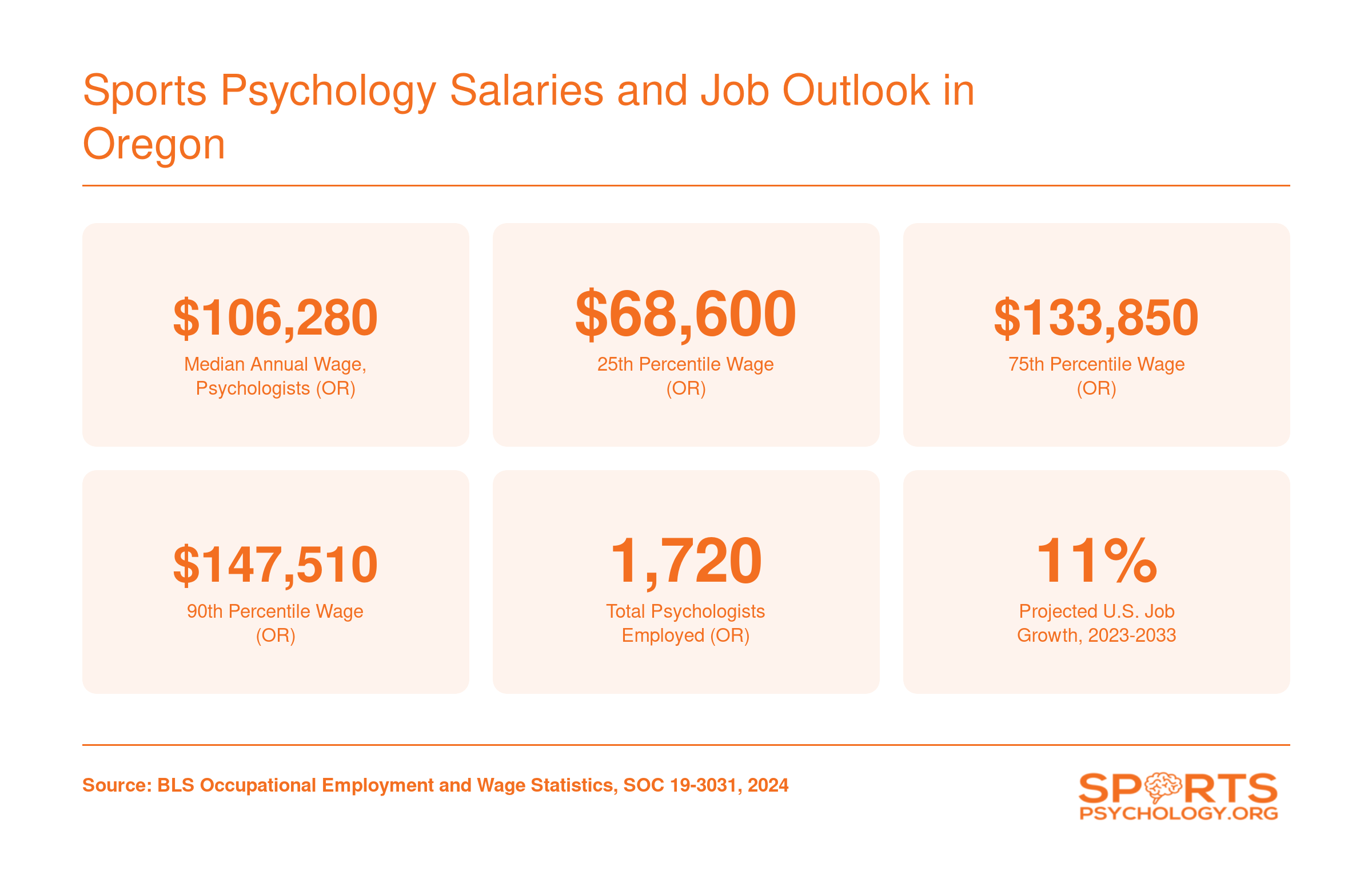
Oregon offers competitive compensation for psychologists working in sports and performance settings. The figures below draw from the most recent Bureau of Labor Statistics wage data for psychologists in Oregon. For the most current state-specific projections, visit the Oregon Employment Department's QualityInfo.org, and check job boards like Indeed or LinkedIn for real-time salary ranges in your target role.
Practicum and Internship Opportunities in Oregon
If you are earning your sports psychology degree through an online program, one of the most important steps is securing a local practicum or internship placement. Oregon offers a surprisingly rich landscape of opportunities, especially if you are willing to be proactive about building professional connections.
How Online Students Arrange Practicum Placements
Most online sports psychology programs expect students to self-arrange their practicum or internship sites. In practice, this means identifying a local organization willing to host you and a qualified supervisor who meets your program's approval criteria. Your program will typically provide guidelines for what counts as an acceptable site and supervisor, but the legwork of reaching out, interviewing, and formalizing the arrangement falls on you. Start early, ideally six to twelve months before your practicum semester begins, so you have time to navigate any credentialing or background check requirements.
Portland Metro: The Hub of Opportunity
The Portland metropolitan area offers the densest concentration of sport psychology settings in the state. Professional teams such as the Portland Trail Blazers, Portland Timbers, and Portland Thorns have invested in mental health and performance support for their athletes. The Trail Blazers, for example, have employed dedicated mental health and wellness professionals including Dr. Chantelle Green as director of mental health and wellness.2 Luke Patrick, a licensed counseling and sport psychologist based in Portland, served as team psychologist for the Trail Blazers (2018 to 2022) and the Portland Thorns (2020 to 2023), and currently works with the University of Portland Pilots while also maintaining a private practice.1 Professionals like these can be valuable contacts when seeking supervised practicum hours.
Beyond pro sports, Portland is home to a growing network of sport performance clinics and private practices where practitioners work with athletes at every level, from youth competitors to collegiate and professional players. These smaller settings can be excellent practicum sites because they often offer more hands-on responsibility and closer mentorship.
University Athletics Departments Statewide
Oregon's major university athletics programs are another strong option. Oregon State University's athletics department and the University of Oregon's athletics department and counseling center both provide mental performance and counseling services to student-athletes. These departments may host interns or practicum students from outside programs on a case-by-case basis.
One question that comes up frequently: does the University of Oregon offer a dedicated sports psychology degree? As of 2026, the answer is no. UO does not have a standalone sport psychology program or concentration. However, its athletics department and campus counseling services can still serve as practicum sites for students enrolled in accredited programs elsewhere. If you are an Oregon-based student pursuing your degree online, reaching out to UO's athletic performance staff about hosting arrangements is well worth the effort.
Tips for Securing a Strong Placement
Start networking early: Attend local sport psychology conferences, Oregon Psychological Association events, or Association for Applied Sport Psychology regional meetups to connect with potential supervisors.
Be flexible on setting: A private sport performance clinic, a university counseling center, or a community sports organization can all provide meaningful clinical hours.
Communicate with your program: Share potential site details with your academic advisor early so they can confirm whether the placement meets program requirements.
Consider rural opportunities: While Portland dominates, smaller college athletics programs in cities like Eugene, Corvallis, Salem, and Bend may have less competition for placement slots.
Oregon's combination of professional franchises, major university programs, and a thriving private practice community gives online students solid options for completing their supervised hours close to home.
Because Oregon currently lacks in-state sports psychology graduate programs, students who earn their degrees through top online programs have a unique opportunity. By completing practicum hours with local teams, clinics, and athletic departments, they can establish professional connections across an underserved market, positioning themselves for a meaningful first-mover advantage when they graduate and begin practicing in the state.
Undergraduate Pathways That Prepare You for Sports Psychology Graduate Study
No Oregon university currently offers a standalone undergraduate sports psychology major, but that is not a setback. Graduate admissions committees, especially those at APA-accredited doctoral programs, focus on prerequisite coursework quality, your GPA in core psychology classes, and meaningful research experience. Choosing the right combination of major, minor, and extracurricular involvement during your bachelor's years puts you in a strong position when application season arrives.
Build the Right Academic Foundation
The most competitive path into a sports psychology graduate program is a psychology major paired with a kinesiology or exercise science minor, or the reverse. Most graduate programs require a prerequisite core in psychology that includes courses in abnormal psychology, research methods, statistics, developmental psychology, and physiological psychology. A kinesiology or exercise science component adds coursework in motor learning, biomechanics, and exercise physiology, which rounds out your understanding of human performance. If you are considering from exercise science to sports psychology, planning your undergraduate coursework strategically makes that transition much smoother.
Three Oregon institutions stand out as solid stepping stones:
University of Oregon (UO): The psychology department offers robust research opportunities and strong coursework in cognitive and behavioral science that aligns well with graduate-level sport psychology study.
Oregon State University (OSU): The kinesiology program gives students hands-on exposure to exercise science, motor behavior, and sport-related research, all directly relevant to graduate prerequisites.
Portland State University (PSU): The psychology department provides flexible scheduling and access to faculty whose work touches on applied behavioral topics, making it a practical option for students in the Portland metro area.
None of these programs are labeled "sports psychology," but each one can fulfill the coursework requirements that graduate admissions committees look for.
Strengthen Your Application Beyond the Classroom
Coursework alone will not set your application apart. Graduate programs want to see evidence that you can think like a researcher and engage meaningfully with sport contexts. Prioritize these experiences during your undergraduate years:
Seek a research assistant position in a faculty lab studying motivation, performance anxiety, or exercise behavior. Even one or two semesters of involvement signals genuine academic curiosity.
Pursue an independent study or honors thesis on a sport-related psychology topic. This demonstrates initiative and gives you a writing sample for applications.
Get involved with campus athletics or recreation departments, whether through volunteer coaching, peer mentoring for student-athletes, or working in a campus wellness center. Direct exposure to athletic environments helps you articulate clear career goals in your personal statement.
A Note on Online Bachelor's Programs
Some nationally available online programs offer bachelor's degrees with a sport psychology concentration. These can be a convenient option for working adults or students in rural parts of Oregon. However, if your goal is admission to an APA-track doctoral program, committees will scrutinize the rigor of your prerequisite courses and want to see in-person research experience. An online degree can work as a foundation, but you will likely need to supplement it with research involvement, whether at a local university, through a summer research program, or via structured volunteer work in a sport science lab. The degree name matters far less than what you actually learned and did along the way.
Frequently Asked Questions About Sports Psychology in Oregon
Oregon students considering a career in sports psychology often have questions about education requirements, licensure, and earning potential. Below are answers to the most common questions we hear from prospective students exploring sports psychology programs in Oregon.
How do I become a sports psychologist in Oregon?
To become a sports psychologist in Oregon, you typically need a doctoral degree in psychology (PhD or PsyD) and must obtain licensure through the Oregon Board of Psychology. This involves completing supervised clinical hours and passing the Examination for Professional Practice in Psychology (EPPP). Alternatively, you can pursue the Certified Mental Performance Consultant (CMPC) credential if you want to focus on performance enhancement rather than clinical treatment.
Does the University of Oregon have a sports psychology program?
The University of Oregon does not offer a standalone sports psychology degree. However, its Department of Human Physiology and College of Education include faculty with research interests in sport and exercise psychology. Students can often tailor coursework and research around sports psychology topics within related graduate programs. For a dedicated sports psychology curriculum, many Oregon students also explore accredited online programs from other institutions.
What degree do you need for sports psychology?
A bachelor's degree in psychology, kinesiology, or a related field is the starting point. For clinical sports psychology roles requiring licensure, a doctoral degree is necessary. For mental performance consulting and the CMPC credential, a master's degree is the minimum requirement. Your career goals will determine which level of education you need, so it helps to map out your intended career path early.
Are online sports psychology programs accepted for Oregon licensure?
Yes, online sports psychology programs can qualify for Oregon licensure, provided the program is regionally accredited and meets the Oregon Board of Psychology's educational requirements. Doctoral programs must include adequate supervised practicum and internship hours. If you are pursuing the CMPC credential instead, the Association for Applied Sport Psychology (AASP) also accepts coursework from accredited online programs that meet its content requirements.
How much does a sports psychologist make in Oregon?
Salaries for sports psychologists in Oregon vary based on setting, credentials, and experience. Psychologists in Oregon generally earn a median annual wage in line with national figures for clinical and counseling psychologists, which the Bureau of Labor Statistics reports near $96,000 to $106,000 nationally. Those in private practice, collegiate athletics, or professional sports settings may earn more, while early career professionals typically start at lower ranges.
What is the difference between a licensed sport psychologist and a CMPC?
A licensed sport psychologist holds a doctoral degree and state licensure, allowing them to diagnose and treat clinical mental health conditions in athletes. A Certified Mental Performance Consultant (CMPC) typically holds a master's degree and focuses on performance enhancement skills such as goal setting, visualization, and focus training. CMPCs cannot provide therapy or diagnose mental health disorders. Your choice depends on whether you want a clinical or performance consulting career.
Can I complete practicum hours in Oregon while enrolled in an out-of-state online program?
In most cases, yes. Many accredited online sports psychology programs allow students to arrange practicum and internship placements in their home state. Oregon offers practicum opportunities through university athletic departments, community sports organizations, high school athletics, and private practices. You will need to coordinate with your program's clinical training office to ensure the site meets all accreditation and supervision requirements.
More Online Sports Psychology Programs to Consider
Beyond our top 10, these additional online programs offer flexible pathways for Oregon students seeking a sports psychology degree. While none are based in Oregon, they are fully available to remote learners and provide diverse options at the bachelor's and master's levels.
Faulkner University
Offers an online Bachelor of Science in Sports Psychology with a Christian worldview and small class sizes. Tuition is $335 per semester hour plus a $75 online course fee.
Provides a fully online Bachelor of Science in Sport Psychology exploring the mind-athletic performance connection, covering exercise physiology, biomechanics, and injury rehabilitation.
Offers an online Master of Science in Sports Psychology focusing on team dynamics, performance enhancement, injury recovery, and emotional obstacles in competition.
Delivers an online Master of Science in Applied Sport Psychology with concentrations for Mental Performance Consultant certification or Limited Psychologist licensure. Asynchronous format.
100% online Master of Science in Sport and Performance Psychology aligning with CMPC certification. No GRE required, with fall, spring, or summer start dates and one-year completion option.
Online Master of Science in Sport Psychology (45 credits) prepares for CMPC certification. Admission requires 3.0 GPA, no entrance exam; costs $400.80/credit in-state, $762.80 out-of-state.
Online Master of Science in Experimental Psychology with a Health and Sports Psychology concentration. GRE not required; 39-54 credit hours at $429/credit plus $75 technology fee.
100% online Bachelor of Science in Sport, Exercise and Performance Psychology. 120 credits, focuses on motivation, mental training, and stress management. No ACT/SAT required.
Online Bachelor of Science in Sport, Exercise and Performance Psychology covering psychological factors, motivation, mental training, and stress management. Includes practicum.
Online Bachelor of Science in Sport, Exercise and Performance Psychology with focus on psychological processes, mental skills training, and injury psychology. 120 credits.
100% online Bachelor of Science in Sport, Exercise and Performance Psychology. Curriculum covers motivation, stress management, sport injury psychology, and ethics.
Online Bachelor of Science in Sport, Exercise and Performance Psychology exploring psychological factors in performance, including motivation, mental training, and stress management.
Full online Bachelor of Science in Sport, Exercise and Performance Psychology. 120 credits, focuses on mental skills training, ethics, and social-psychological concepts.
Online Bachelor of Science in Sport, Exercise and Performance Psychology covering motivation, mental training, stress management, and ethics. Includes practicum.