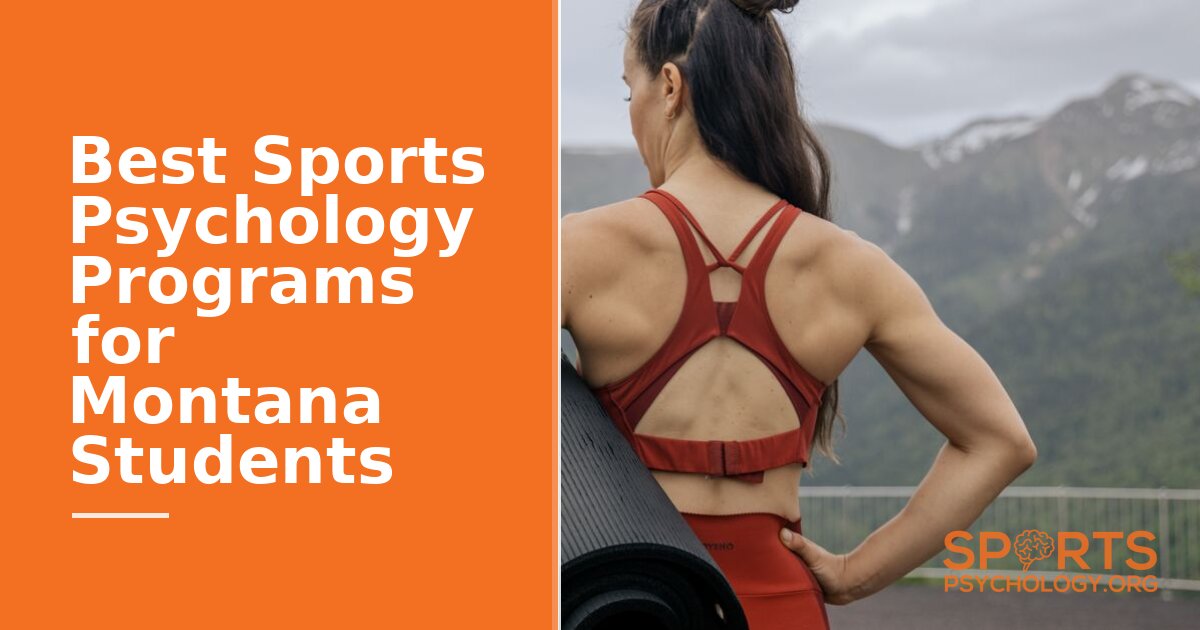
Best Online Sports Psychology Programs for Montana Students

Ranked online programs, licensure pathways, and career guidance for aspiring sport psychologists in Montana.

By Derek Bianchi, CMPCReviewed by SportsPsychology.org TeamUpdated May 19, 202625+ min read
Best Sports Psychology Programs for Montana Students (2026)

What you’ll learn in this article…

  • Montana has no in-state sports psychology degree, so online programs are the most practical route for residents.
  • Licensure as a psychologist requires a doctorate and supervised hours through the Montana Board of Psychologists.
  • CMPC certification offers a master's level alternative for those focused on mental performance consulting.
  • Montana's small but growing outdoor recreation economy is creating new demand for sport psychology professionals statewide.

Montana produces Division I athletes at the University of Montana and Montana State, supports a thriving ski-racing pipeline, and hosts one of the nation's most competitive college rodeo circuits. That athletic culture fuels real demand for mental performance professionals, yet no Montana university currently offers a dedicated sport psychology degree at any level. For residents who want to train without relocating, accredited online programs are the clearest path forward.

The tension is practical: earning a credential that Montana's licensing boards and employers recognize while studying remotely from Missoula, Bozeman, or Billings. Doctoral-level licensure through the Montana Board of Psychologists and the master's-level Certified Mental Performance Consultant (CMPC) credential each carry distinct coursework, practicum, and supervision requirements that shape which program fits. Students in states with similar gaps, such as those researching sports psychology programs in iowa, face comparable decisions. Montana's sport psychology job market remains small, so practitioners who build versatile skill sets across clinical, performance, and telehealth domains tend to sustain the most viable practices.

Best Online Sports Psychology Programs for Montana Students

Montana does not currently have an in-state graduate or undergraduate program dedicated to sports psychology, so online programs are the most practical path for residents who want to stay in the state while earning their degree. The programs below are nationally available online options ranked by a composite of institutional quality factors. Each can be completed remotely from anywhere in Montana, and several allow you to arrange applied fieldwork or internships with local teams, schools, or outdoor sport organizations right in your home community.

Factors considered
  • Institutional graduation and retention rates
  • Net price and student debt
  • Program delivery flexibility
  • CMPC certification alignment
  • Graduate earnings outcomes
Data sources

Arizona State University

#1

Tempe, AZ · $15,000/yr

Best for: Undergraduates seeking a research university experience

Arizona State University is a globally recognized research institution that delivers a fully online Bachelor of Science with a Sport and Performance Counseling concentration through its College of Integrative Sciences and Arts. ASU's 68% institution-wide graduation rate and 87% retention rate are the strongest in this ranking. Montana students benefit from ASU Online's infrastructure built for remote and rural learners, though the standard out-of-state tuition of $33,139 applies since WUE discounts do not cover this online program.

  • Online Bachelor of Science, 120 credits across 40 classes
  • Sport and Performance Counseling concentration
  • Accelerated 7.5-week course format
  • Required internship in a sport or mental health setting
  • Earned Admission pathway available for 2.75 GPA applicants
  • Prepares graduates for behavioral health or counseling careers
  • Faculty include recognized researchers in the field

Southern Illinois University-Edwardsville

#2

Edwardsville, IL · $15,000/yr

Best for: Career changers pursuing CMPC certification quickly

Southern Illinois University-Edwardsville offers a master's-level Exercise and Sport Psychology specialization that can be completed in as few as 12 months. With a 15:1 student-to-faculty ratio and coursework aligned with CMPC certification requirements, SIUE provides strong mentoring for aspiring mental performance consultants. The program charges the same tuition rate ($10,488) regardless of residency, making it one of the more affordable graduate options for Montana students. Faculty supervise CMPC hours for out-of-state students completing applied work in their home communities.

  • Master of Science with Exercise and Sport Psychology focus
  • 100% online with evening and asynchronous options
  • Completable in 12 to 22 months
  • Coursework aligns with CMPC certification requirements
  • Covers sport psychology, coaching psychology, and special populations
  • Connects students to Division I athletics resources
  • Strong faculty mentoring with personalized advising

California Baptist University

#3

Riverside, CA · $25,000 – $30,000/yr

Best for: Faith-oriented students wanting an accelerated bachelor's

California Baptist University offers a 100% asynchronous online Bachelor of Science in Sport and Performance Psychology that requires just 49 units and can be finished in 16 months of full-time study. Six annual start dates and a transfer-friendly design make it accessible for Montana students balancing work or coaching responsibilities. The curriculum integrates exercise physiology, behavioral sport psychology, and cognitive psychology within a faith-based framework. Institution-wide, CBU posts a 61.9% graduation rate and a net price of $26,285.

  • Online BS requiring 49 units, completable in 16 months
  • Asynchronous courses with classes starting every 8 weeks
  • Six entry points per year with year-round admissions
  • Blends exercise physiology, behavioral and cognitive psychology
  • Integrates Christian faith and ethical practice
  • Transfer-friendly with no on-campus requirements
  • WSCUC-accredited with financial aid available

Southern Connecticut State University

#4

New Haven, CT · $21,000/yr

Southern Connecticut State University delivers a 33-to-34-credit Master of Science in Exercise Science with a Sport Psychology concentration taught by faculty from three departments. The interdisciplinary curriculum is specifically designed to prepare graduates for the CMPC exam through the Association for Applied Sport Psychology. While NEBHE tuition discounts do not extend to Montana, SCSU's hybrid format allows most coursework to be completed remotely, and the 11:1 student-to-faculty ratio ensures close faculty interaction. Out-of-state tuition sits at $21,727.

  • 33 to 34 credit interdisciplinary master's program
  • Sport Psychology concentration with CMPC exam preparation
  • Hybrid delivery with online and evening course options
  • Faculty from Health Sciences, Counseling, and Psychology
  • Covers health psychology, counseling, and performance enhancement
  • Curriculum updated to match current AASP CMPC knowledge areas
  • 11:1 student-to-faculty ratio for personalized support

Texas A & M University-Kingsville

#5

Kingsville, TX · $10,000 – $15,000/yr

Texas A&M University-Kingsville houses a Performance Psychology concentration within its M.S. in Kinesiology that offers three flexible degree plans ranging from 30 to 36 credit hours. The curriculum aligns with AASP standards and prepares students for the CMPC exam. Montana students will pay out-of-state tuition of $14,560, but the program's net price of $12,090 is among the lowest in this ranking. Faculty work individually with out-of-state students to structure limited campus visits around applied work completed locally.

  • Performance Psychology concentration, 30 to 36 credits
  • Three degree plans: course-only, internship/project, or thesis
  • Aligned with AASP standards for CMPC exam preparation
  • Hybrid format with increasing remote course availability
  • Applied work can be completed in student's home state
  • Among the lowest net prices in this ranking at $12,090

Troy University

#6

Troy, AL · $15,000 – $20,000/yr

Troy University provides a fully online Master of Science in Kinesiology with a Sports Psychology concentration that features no application deadline, allowing Montana students to enroll on a rolling basis. Hands-on internships can be arranged in your local community with remote faculty oversight, making it practical for students embedded in Montana's coaching or athletic training scenes. Out-of-state tuition is $17,100, and the institution reports a 50.3% graduation rate.

  • Master's with Sports Psychology concentration, fully online
  • No application deadline with rolling enrollment
  • Internships arranged in student's local sport settings
  • Coursework covers sport psychology and motor skills
  • Faculty bring professional sport psychology experience
  • Expanded virtual support services for distance learners

Kent State University

#7

Kent, OH · ~$21,000/yr (est.)

Kent State University's 100% online Bachelor of Science in Sport, Exercise and Performance Psychology covers motivation, mental training, stress management, and injury psychology across 120 credit hours. The program includes a practicum that can be completed in your home state, and Kent State has developed clear graduate-school preparation pathways for students planning to pursue an advanced sport psychology degree. Out-of-state tuition is $21,575, with a 63.7% institution-wide graduation rate.

  • 100% online BS, 120 credits with four-year completion path
  • Covers motivation, stress management, and injury psychology
  • Practicum can be completed in student's home community
  • Built-in graduate school preparation pathways
  • Transfer students and international applicants accepted
  • Minimum 2.0 GPA required for admission

National University

#8

San Diego, CA · ~$23,000/yr (est.)

National University stands out for offering sport psychology programs at every degree level: a Bachelor of Arts, a Master of Science, two Master of Arts specializations (Applied and Theoretical Mental Performance), and a PhD in Psychology with a Sport and Performance Psychology specialization. All are delivered 100% online with weekly start dates, making them highly accessible for Montana residents on any schedule. The institution's net price is $22,878, and median earnings ten years after enrollment reach $67,548, the highest among schools in this ranking. Multiple programs meet CMPC certification academic requirements.

  • 36 credit hours across 12 courses, 18 to 21 months
  • No application fee, essays, or entrance exams required
  • Aligns with AASP certification standards
  • Optional fieldwork for hands-on experience
  • Transfer credits accepted up to 12 hours
  • FastForward pathway to PhD available
  • Online BA requiring 180 quarter units
  • Completable in approximately 40 months
  • No application fee and no entrance exam
  • Courses in applied sport psychology and exercise psychology
  • Transfer-friendly with year-round enrollment
  • Prepares graduates for coaching or graduate study
  • 100% online doctoral program, 60 credit hours
  • 20 courses with estimated 48-month completion
  • Weekly start dates with flexible scheduling
  • Personalized mentoring from doctoral faculty
  • Dissertation required with oral defense
  • Covers motivation, leadership, ethics, and injury psychology
  • Two specializations: Applied and Theoretical Mental Performance
  • Applied track includes 200+ direct client contact hours
  • Theoretical track completable in as few as 14 months
  • Both tracks meet CMPC certification academic requirements
  • No GRE required for admission
  • Scholarships and financial aid available

Adams State University

#9

Alamosa, CO · $13,000/yr (net price)

Adams State University, a small public institution in rural Colorado, offers an online Master of Science in Kinesiology with an Applied Sport Psychology emphasis that was explicitly built for coaches and practitioners in remote communities. The 36-credit program can be completed in two years, and at $5,898 out-of-state tuition it is by far the most affordable option on this list. Practicums and capstone projects can be arranged with local Montana sport organizations under remote faculty supervision, and the curriculum addresses diversity and equity topics relevant to rural and Indigenous populations.

  • 36-credit online program, two-year completion timeline
  • Applied Sport Psychology emphasis with practicum and capstone
  • Designed specifically for rural and remote learners
  • Covers mental strength, ethics, case studies, and diversity
  • Internships arranged in student's home community
  • Out-of-state tuition of $5,898, lowest in this ranking
  • No entrance exam required for admission

Springfield College

#10

Springfield, MA · ~$31,000/yr (est.)

Springfield College brings decades of sport and exercise psychology expertise to a fully asynchronous online Master of Education format. The 36-credit program can be finished in 18 months full-time and includes a 135-hour applied internship supervised remotely by AASP-certified faculty. Springfield's 74.2% institution-wide graduation rate is the highest in this ranking, and the 11:1 student-to-faculty ratio ensures close mentorship. Montana students should note the tuition of $33,722 and net price of $30,587, which are on the higher end, though rolling admissions and flexible full-time or part-time pacing offer scheduling advantages.

  • 36-credit fully asynchronous online master's program
  • Completable in 18 months full-time or extended part-time
  • 135-hour applied internship with remote supervision
  • 7-week and 15-week course format options
  • Supervision from AASP-certified professionals
  • Rolling admissions for domestic applicants
  • No entrance exam required for domestic students

Sports Psychology Education Options in Montana

Montana does not currently offer a standalone sport psychology degree at any of its public or private universities. That reality is exactly why the online programs featured above are so valuable for Montana students. However, the state does offer several academic pathways that can serve as meaningful stepping stones, especially if you plan to pair in-state coursework with an online master's degree in sport psychology.

University of Montana: Sport Psychology Minor

The closest thing to a dedicated sport psychology program in the state is the sport psychology minor at the University of Montana in Missoula.1 Housed within the School of Integrative Physiology and Athletic Training, this 21-credit interdisciplinary minor is open to students in any major.1 Core coursework spans kinesiology and psychology, including courses such as KIN 105, KIN 106, KIN 440, KIN 441, PSYX 100S, and PSYX 383, covering topics like motor behavior, exercise psychology, and foundational psychological science. You will also choose electives from psychology and applied/health categories.1 You will need a C- or better in each course, and all credits must be completed through UM's own curriculum.

This minor pairs well with a psychology or kinesiology major and can give you a strong undergraduate foundation before you move into a graduate-level online sport psychology program. It will not, on its own, qualify you for licensure or certification, but it does signal genuine subject-matter focus on your transcript.

Montana State University Options

Montana State University Billings offers psychology tracks that can help you build prerequisite knowledge in areas like developmental, abnormal, and social psychology. While these are general psychology programs rather than sport-specific ones, they cover core content that graduate admissions committees expect to see on your application.

At MSU Bozeman, graduate programs in areas like coaching science and exercise science touch on performance-related topics. These can complement sport psychology studies, particularly if you are interested in the physical performance side of the field. For students weighing a transition from exercise science, performance psychology, keep in mind that these programs are adjacent to sport psychology rather than direct substitutes for it.

Tribal Colleges and Community Colleges as Entry Points

Montana is home to several tribal colleges and community colleges that offer introductory psychology, human development, and general education coursework at lower tuition rates. Completing your first two years at institutions like Aaniiih Nakoda College, Salish Kootenai College, or Flathead Valley Community College can be a financially smart way to fulfill prerequisite requirements. From there, you can transfer to a four-year institution for your bachelor's degree or move directly into an online master's program once you have earned your undergraduate credentials.

Building a Combined Pathway

The most practical approach for aspiring sport psychologists in Montana often looks something like this:

  • Undergraduate base: Complete a psychology or kinesiology degree at a Montana university, ideally adding the UM sport psychology minor if location allows.
  • Prerequisite coverage: Use community college or tribal college courses to affordably fulfill foundational requirements in statistics, research methods, and introductory psychology.
  • Graduate specialization: Enroll in an accredited online master's or doctoral program in sport psychology to gain the specialized training Montana institutions do not currently provide.

This layered strategy lets you take advantage of Montana's lower in-state tuition costs for your foundational work while accessing nationally recognized sport psychology programs for your advanced degree. It is a common and effective path for students in states where dedicated sport psychology programs do not yet exist.
Questions to Ask Yourself

Do you want to be a licensed psychologist or a certified mental performance consultant?
A licensed psychologist path requires a doctoral degree and several years of supervised clinical hours. A Certified Mental Performance Consultant (CMPC) credential typically requires only a master's degree. Your answer shapes every program decision that follows.
Which setting excites you most: college athletics, private practice, youth sport, or a clinical environment?
College athletics roles often require doctoral training and connections to athletic departments. Private practice and youth sport consulting can be launched with a master's degree and CMPC certification, giving you more flexibility in a smaller market like Montana.
Are you able to complete practicum hours in Montana, or are you open to relocating temporarily?
Montana offers limited supervised practicum sites compared to larger states. If staying local is essential, look for online programs that allow you to arrange fieldwork with approved Montana supervisors rather than requiring on-campus placements elsewhere.
How much time and tuition can you realistically invest in your training?
Doctoral programs typically take five to seven years and cost significantly more than a two-year master's program. Understanding your budget and timeline helps you narrow the list to programs that match your financial and personal circumstances.

How to Become a Sports Psychologist in Montana

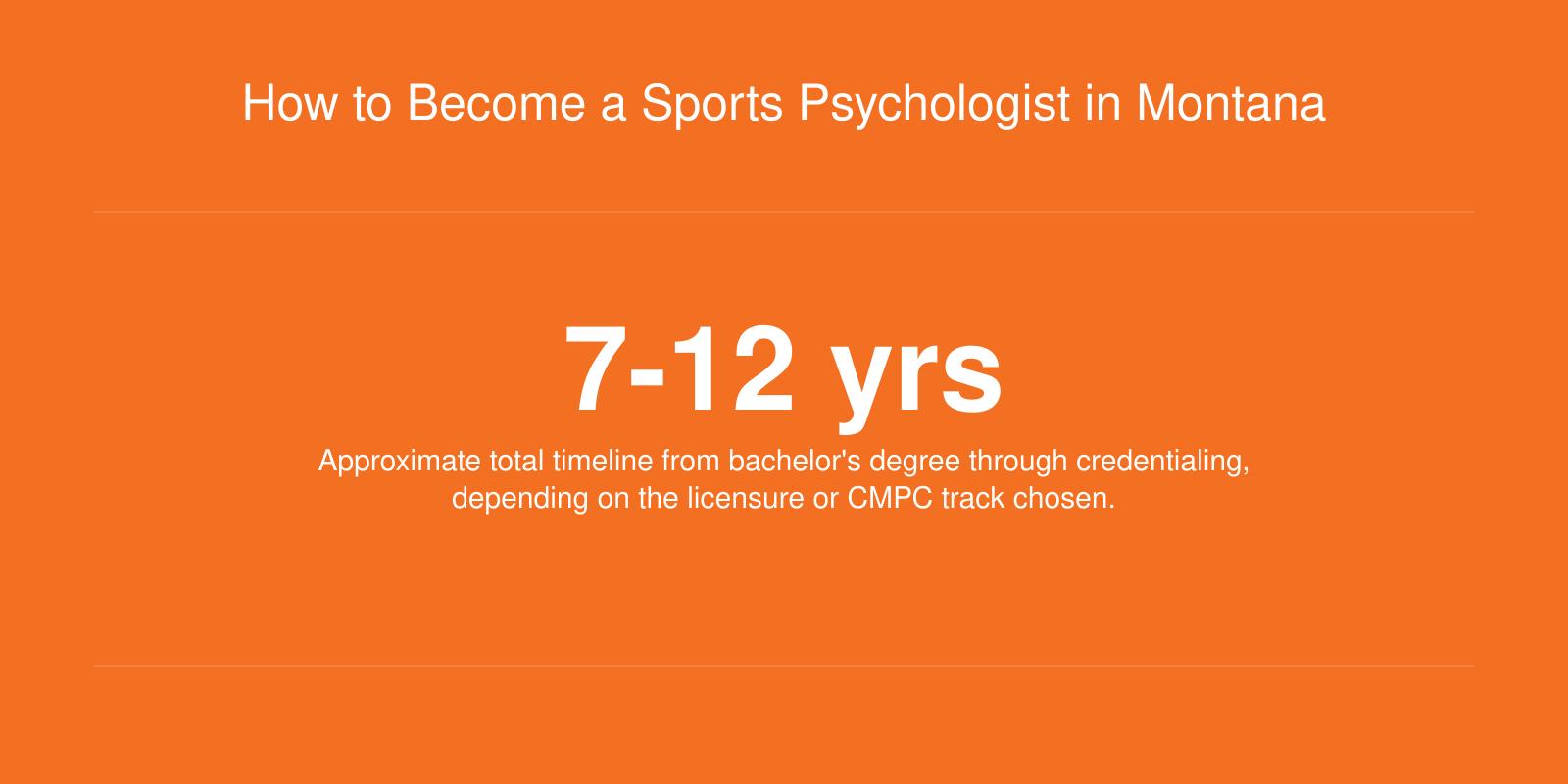
The path to practicing sports psychology in Montana follows one of two main tracks. The licensed psychologist route requires a doctorate (PsyD or PhD), supervised clinical hours, and state licensure through the Montana Board of Psychologists, typically taking 10 to 12 years from your first day of undergrad. The mental performance consultant route, leading to Certified Mental Performance Consultant (CMPC) certification, requires a master's degree and mentored experience, often achievable in 7 to 9 years total. Here is a simplified step-by-step timeline covering both tracks: (1) earn a bachelor's in psychology, kinesiology, or a related field (4 years); (2) complete a master's in sport psychology or a closely related discipline (2 to 3 years); (3) for the licensed psychologist track only, earn a doctoral degree (3 to 5 additional years); (4) accumulate supervised or mentored hours, roughly 1 to 2 years depending on the track; (5) obtain licensure through the Montana Board of Psychologists or earn your CMPC credential through the Association for Applied Sport Psychology; and (6) begin independent practice. A master's degree is sufficient for the CMPC track, making it the faster option for those focused on mental performance consulting rather than clinical psychology.

Infographic showing the seven to twelve year pathway to becoming a sports psychologist or mental performance consultant in Montana.

Montana Licensure and CMPC Certification Requirements

Montana offers two distinct professional pathways for people who want to work in sports psychology, and the one you choose depends on whether you plan to earn a doctoral degree or a master's degree. Understanding the requirements for each track early on will save you years of guesswork and help you pick the right program from the start.

Path 1: Licensed Psychologist in Montana

The title "psychologist" is legally protected in Montana. Only individuals who meet the full licensure requirements set by the Montana Board of Psychologists may use it.1 Here is what that process looks like:

  • Doctoral degree: You must complete a doctoral program in psychology (Ph.D. or Psy.D.) from an APA-accredited or equivalent institution. This typically takes five to seven years after your bachelor's degree.2
  • Supervised experience: You need a minimum of 3,000 hours of supervised professional experience, which most candidates accumulate during a predoctoral internship and a postdoctoral placement.1
  • EPPP exam: You must pass the Examination for Professional Practice in Psychology with a minimum score of 500.3
  • Jurisdictional course: Montana requires completion of an online jurisdictional course covering state-specific laws and ethical standards, which functions as the state's jurisprudence requirement.1
  • Additional criteria: Applicants must be at least 18 years old and demonstrate good moral character.2

Once you gather your documentation, you submit your application to the Montana Board of Psychologists official site in Helena. From the day you start a bachelor's degree, expect roughly 10 to 13 years before you are fully licensed and practicing independently as a sport psychologist in the state. Montana also offers a senior psychologist designation for practitioners who meet additional experience thresholds.1

Path 2: Certified Mental Performance Consultant (CMPC)

If a doctoral degree is not part of your plan, the CMPC credential from the Association for Applied Sport Psychology (AASP) is the gold-standard alternative. It lets you work directly with athletes on mental performance without requiring licensure as a psychologist.1 The requirements include:

  • Master's degree (minimum): You need at least a master's in sport science, psychology, or a closely related field.1
  • Approved coursework domains: Your academic record must cover Sport and Exercise Psychology, Sport Science, Counseling, Psychopathology, Ethics, Psychological Skills Training, Consulting, and Research Methods.1
  • Mentored experience: You must complete 400 hours of mentored applied experience, including at least 50 hours of direct supervision from an approved mentor.1
  • Performance portfolio: AASP requires a portfolio demonstrating your applied consulting competencies with real clients.1
  • Certification exam: The final step is passing the CMPC Certification Exam, which consists of 100 to 150 items.1

From bachelor's entry, the CMPC track typically takes six to eight years: four years for an undergraduate degree, two to three years for a master's, and additional time to accumulate mentored hours if they are not built into your program.

Connecting Your Program Choice to Certification

Several of the online programs featured in our ranking are specifically designed to align with AASP's required coursework domains. Programs that include dedicated courses in sport and exercise psychology, psychological skills training, counseling techniques, and research methods will cover most or all of the CMPC academic requirements. Before enrolling, verify that a program's curriculum maps to every AASP domain so you do not need to take supplemental courses later. Many accredited online master's programs in sport psychology or performance psychology explicitly advertise CMPC alignment on their admissions pages, which makes it straightforward to confirm. Students in neighboring states face similar considerations when evaluating sports psychology programs in Idaho.

For the doctoral route, look for APA-accredited clinical or counseling psychology programs that allow a sport psychology concentration. These programs satisfy Montana's licensure education requirement while also preparing you for sport-specific clinical work.

Timeline at a Glance

  • Licensed Psychologist track: Approximately 10 to 13 years from bachelor's entry to independent practice in Montana.
  • CMPC track: Approximately 6 to 8 years from bachelor's entry to certification and active consulting.

Both timelines assume full-time study and no significant gaps. Part-time enrollment or career changes will extend these estimates. The key takeaway is that the CMPC path gets you into the field faster and at a lower educational cost, while the psychologist license opens the door to clinical diagnosis, therapy, and the legal right to use the "psychologist" title in Montana.

Program Cost Comparison and ROI for Montana Students

Because Montana does not currently offer in-state sports psychology degree programs, most students will enroll in online programs based at out-of-state institutions. The table below compares tuition, approximate net price, institution-wide graduation rates, median earnings ten years after enrollment, and a return-on-investment (ROI) ratio for each school. Keep in mind that net price figures are institution-wide averages and may not reflect the exact cost every student pays. Graduation rates also represent the full institution, not a specific program. Program-level earnings data is not yet available for these programs, so the median earnings column reflects institution-wide figures reported ten years after enrollment.

SchoolDegree LevelPublished Tuition (Annual)Approx. Net PriceInst. Graduation RateMedian Earnings (10 Yr)ROI Ratio
Parker UniversityBachelor's$26,904$29,13574.1%$42,0913.43
Arizona State UniversityBachelor's$33,139$14,96768.0%$62,6683.21
Southern Illinois University EdwardsvilleMaster's$10,488$14,88957.0%$56,3462.75
National UniversityMaster's$16,416$22,87842.9%$67,5482.70
East Central UniversityMaster's$12,236$8,68334.4%$44,9622.54
Southern Connecticut State UniversityMaster's$21,727$20,85749.9%$55,0432.47
California Baptist UniversityBachelor's$41,228$26,28561.9%$61,5042.36
Adams State UniversityMaster's$5,898$12,98039.4%$44,3722.28

Sports Psychology Career Opportunities and Salaries in Montana

Montana's wide-open spaces and deep-rooted outdoor culture create a unique landscape for sport psychology professionals. The state's population is small (roughly 1.1 million), so dedicated sport psychology positions are fewer than what you would find in major metro areas. That said, demand is growing, and practitioners who build versatile, hybrid practices can carve out fulfilling careers.

Where Montana Sport Psychologists Work

The most visible opportunities center on the state's two NCAA Division I programs. The University of Montana Grizzlies and Montana State Bobcats both field competitive athletic departments that increasingly recognize the value of mental performance support for student-athletes. Beyond the college level, several realistic job settings include:

  • Private practice: Serving athletes ranging from weekend warriors to competitive skiers and rodeo competitors in communities like Bozeman, Missoula, and Billings.
  • Youth sport organizations: Groups such as the Bridger Ski Foundation and Montana high school athletics programs need mental performance coaching for young athletes navigating competitive pressure.
  • School counseling with a sport psychology specialization: K-12 counselors who hold additional sport psychology training can fill a valuable niche, especially in districts where athletics play a central role in student life.
  • Telehealth and remote consulting: Many Montana practitioners extend their reach by working with clients across the state (or nationally) through virtual sessions, which is especially practical given the distances between Montana communities.

Salary Expectations in Montana

According to the Bureau of Labor Statistics, the national median annual wage for psychologists in related specialty categories was approximately $117,750 as of May 2023.1 Montana-specific salary data for sport psychologists is limited because the field is small and often grouped with broader psychology or counseling occupations. Mental health counselors in Montana generally earn below the national median for that occupation, reflecting the state's lower cost of living and smaller market.

In practical terms, many sport psychology professionals in Montana supplement their income by combining roles. A typical arrangement might include part-time consulting with a university athletic department, a private caseload of individual athletes, and telehealth sessions with clients in other states. This hybrid model helps practitioners reach a comfortable income even without a single full-time sport psychology position. Aspiring professionals in similarly rural states, such as those exploring sports psychology programs for Alaska students, often adopt the same blended approach.

What Graduates of Online Programs Earn Nationally

Program-level earnings data specific to sport psychology graduates is not yet available for most of the online programs that serve Montana students. However, looking at broader institutional outcomes can offer a general sense of earning potential. For example, graduates of schools like National University and Arizona State University report median earnings in the low-to-mid $60,000 range within ten years of enrollment across all programs. These figures reflect institution-wide outcomes rather than sport psychology specifically, so treat them as rough benchmarks rather than precise predictions for this career path.

Building a Sustainable Career in a Small Market

The honest reality is that Montana will likely never rival markets like Los Angeles or New York for sheer volume of sport psychology jobs. But smaller markets come with distinct advantages: less competition, tighter professional networks, and the chance to become a go-to resource for an entire region. Professionals who earn a credential like the Certified Mental Performance Consultant (CMPC) designation and maintain licensure as a counselor or psychologist position themselves to serve the widest possible client base. Many successful Montana practitioners started by volunteering with local teams, building a referral network through athletic trainers and coaches, and gradually converting that visibility into a sustainable practice.

If you are exploring how to become a sports psychologist in Montana, plan for flexibility. The professionals who thrive here are the ones willing to wear multiple hats and serve diverse populations, from elite skiers to high school football players to weekend trail runners looking for a mental edge.

Practicum and Fieldwork Opportunities in Montana

Hands-on experience is essential for anyone pursuing a career in sport psychology, and Montana offers a surprisingly diverse range of practicum settings despite its smaller population. Whether you are completing an on-campus minor at the University of Montana or enrolled in an online master's program from out of state, you can build meaningful applied hours right here in Big Sky Country.

Where to Find Practicum Placements in Montana

Several organizations across the state can serve as practicum or fieldwork sites:

  • University of Montana Athletic Department: The university's Sport Psychology Minor, housed within the Integrative Physiology and Athletic Training and Psychology departments, gives students proximity to Division I athletes.1 Practicum availability is limited, so early outreach to faculty supervisors is important.2
  • Montana State University Athletics: MSU's athletic programs in Bozeman offer another potential placement for students interested in working with collegiate athletes in a competitive environment.
  • Bridger Ski Foundation: Located near Bozeman, this youth development organization supports competitive skiing and could be an excellent site for students focused on youth sport performance and mental skills training.
  • Montana High School Athletic Association and Local School Districts: Some practicum arrangements have been made with local high schools and school districts, giving students exposure to adolescent athletes in team sport settings.2
  • Private Practices: Organizations such as Montana Peak Performance and similar providers may accept practicum students, particularly those pursuing CMPC certification who need mentored experience across varied populations.

Arranging Fieldwork as an Online Student

If you are enrolled in an online sport psychology master's program, you will typically need to propose your own practicum site and secure program approval. Most accredited online programs have a process for vetting local placements: you identify a site, confirm that a qualified supervisor is available, and submit the arrangement for faculty review. The Association for Applied Sport Psychology publishes resources on structuring internship and practicum experiences that can help guide this process.2 Starting the conversation with potential sites at least one semester in advance gives you the best chance of landing a placement that aligns with your career goals.

Telehealth and Remote Practicum Options

Since 2020, telehealth has become a widely accepted format for mental performance consulting and clinical sport psychology sessions. Some programs now allow a portion of supervised hours to be completed via telehealth, which can be especially helpful in a geographically spread-out state like Montana. If your program permits remote sessions, you may be able to work with athletes in rural communities that would otherwise be difficult to reach in person. Check with your program coordinator to confirm how many telehealth hours count toward your total requirement.

Stacking Hours Across Multiple Settings for CMPC Certification

One advantage of the Certified Mental Performance Consultant credential is that your mentored experience does not need to come from a single site. You can accumulate hours across a combination of university athletics, youth sport organizations, private practice, and telehealth settings. For Montana students, this flexibility is a real asset. You might spend part of your practicum working with high school athletes through a local school district, then log additional hours consulting with skiers at Bridger Ski Foundation, and round out your experience in a private practice. Diversifying your settings not only satisfies certification requirements but also builds a broader skill set that makes you more competitive in the job market.

How to Choose the Right Online Sports Psychology Program

Choosing the right online sports psychology program depends on where you want your career to land. Montana students pursuing licensure as a psychologist will need a very different academic path than those aiming for the Certified Mental Performance Consultant (CMPC) credential. The comparison below breaks down the key decision factors across the two main program types so you can align your education with your professional goals.

Decision FactorCMPC Aligned Master's ProgramClinical Sport Psychology Doctoral Program
Primary Credential EarnedMaster's degree (MA or MS) aligned with AASP standards, preparing you for the CMPC certificationDoctoral degree (PhD or PsyD) from an APA accredited program, preparing you for state licensure as a psychologist
Accreditation to Look ForRegional accreditation is essential; AASP coursework alignment confirms the curriculum covers mental performance consulting competenciesRegional accreditation plus APA accreditation (or CACREP accreditation for counseling psychology tracks) to meet Montana licensure requirements
Typical Curriculum FocusMental performance consulting, sport science, applied sport psychology techniques, and performance enhancement strategiesClinical psychopathology, assessment and diagnosis, therapeutic interventions, research methods, and sport specific clinical applications
Course Format OptionsMany programs offer fully asynchronous or hybrid formats, making them accessible for Montana students in rural areasOften requires synchronous coursework, in person intensives, or residency components due to clinical training demands
Practicum and Fieldwork StructureSome programs provide practicum placement support, while others require you to arrange your own supervised fieldwork with local teams or athletic departmentsPracticum, internship, and predoctoral hours are typically coordinated through the program and must meet APA supervised experience standards
Approximate Program LengthTypically 2 to 3 years for a full time studentTypically 5 to 7 years including dissertation and predoctoral internship
Estimated Total Cost RangeRoughly $20,000 to $60,000 depending on institution type and residency statusRoughly $80,000 to $200,000 or more, though funded positions and assistantships can reduce costs significantly
Best Career FitMental performance consulting with athletes, teams, coaches, or organizations; does not permit diagnosis or treatment of mental health disordersLicensed practice including clinical diagnosis and treatment of mental health conditions in athletes, plus eligibility for CMPC if additional coursework is completed

Frequently Asked Questions About Sports Psychology in Montana

Montana students interested in sports psychology often have questions about local program availability, certification paths, and career prospects. Below are answers to the most common questions we receive, drawing on the latest available data and professional requirements as of 2026.

Are there any sports psychology degree programs in Montana?
Montana does not currently offer a dedicated sports psychology degree at any of its public or private universities. However, some institutions, such as the University of Montana, offer psychology or kinesiology programs with coursework relevant to the field. Most Montana students pursuing a specialized sports psychology degree enroll in accredited online programs from out of state universities, which allow them to study from home while gaining the credentials they need.
How long does it take to become a sports psychologist in Montana?
The timeline depends on your career goal. If you plan to become a licensed psychologist with a sport specialization, expect roughly 8 to 12 years: four years for a bachelor's degree, five to seven years for a doctoral program, and one to two years of supervised postdoctoral hours. If your goal is to work as a Certified Mental Performance Consultant (CMPC), you can typically complete the required master's degree in two to three years, plus additional mentored hours.
Can I get CMPC certified with an online master's degree?
Yes. The Association for Applied Sport Psychology (AASP) accepts online master's degrees from regionally accredited institutions, provided the program includes required coursework in sport science, psychology, and related areas. You will also need to complete mentored experience hours and pass the CMPC certification exam. Many online programs are specifically designed to align with AASP coursework requirements, making the path straightforward for distance learners.
What is the difference between a licensed sports psychologist and a certified mental performance consultant?
A licensed sports psychologist holds a doctoral degree in psychology and a state license, allowing them to diagnose and treat clinical mental health conditions in athletes. A Certified Mental Performance Consultant (CMPC) typically holds a master's degree and focuses on performance enhancement skills such as goal setting, visualization, and focus training. CMPCs do not diagnose or treat clinical disorders. Both professionals work with athletes, but their scopes of practice differ significantly.
How much do sports psychologists make in Montana?
Salary data specific to sports psychologists in Montana is limited due to the state's small market. According to the Bureau of Labor Statistics, psychologists in Montana earn a median annual wage in the range of approximately $75,000 to $85,000, though specialized sports psychologists in private practice or consulting roles may earn more or less depending on their client base. Those who serve collegiate or professional teams may supplement income through contract work.
Do online sports psychology programs accept Montana students for in-state tuition?
Some do. Several universities participating in the Western Interstate Commission for Higher Education (WICHE) or the State Authorization Reciprocity Agreement (SARA) offer reduced or flat rate tuition to Montana residents in online programs. Additionally, some schools set a single online tuition rate regardless of residency. Always confirm tuition policies directly with the institution before enrolling, as rates and reciprocity agreements can change from year to year.
Can I complete practicum hours in Montana while enrolled in an online program?
In most cases, yes. Many online sports psychology programs allow students to arrange practicum or fieldwork placements in their home state. Montana offers opportunities through university athletic departments, high school sports programs, community organizations, and private performance consulting practices. You will need to coordinate with your program's fieldwork office to ensure the site meets accreditation and curriculum requirements. Starting the search early is recommended, as supervised sites in Montana can be competitive.

More Online Sports Psychology Programs for Montana Students

Expand your search beyond the top ten with these additional online programs that welcome Montana students. Each offers flexible remote learning options, making it easier than ever to pursue a sports psychology degree from anywhere.

Faulkner University
Faulkner University offers an online Bachelor of Science in Sports Psychology with a Christian worldview. The program covers mental aspects of sports and prepares students for coaching, athletic counseling, and fitness instruction.
Parker University
Parker University's fully online Bachelor of Science in Sport Psychology explores the mind-athletic performance connection. Coursework includes exercise physiology, biomechanics, and injury rehabilitation, preparing students for graduate studies or careers in coaching and health promotion.
University of the Southwest
The online Master of Science in Sports Psychology at University of the Southwest focuses on team dynamics, performance enhancement, and injury recovery. Graduates gain skills for coaching, mentoring, and athletic careers.
Northern Michigan University
Northern Michigan University offers an online Master of Science in Applied Sport Psychology with concentrations in Mental Performance Consultant certification or Limited Psychologist licensure. The asynchronous format suits working professionals.
Commonwealth University of Pennsylvania
This 100% online Master of Science in Sport and Performance Psychology aligns with CMPC certification. It offers flexible full- or part-time options with no GRE required, preparing graduates for roles as mental performance coaches or athletic advisors.
East Central University
East Central University's online Master of Science in Sport Psychology prepares students for CMPC certification. The 45-credit program includes a supervised internship and can be completed in 1-2 years on a part-time or full-time basis.
University of West Alabama
University of West Alabama offers an online Master of Science in Experimental Psychology with a Health and Sports Psychology concentration. The program includes advanced sports psychology courses, a practicum, and thesis or comprehensive exam options.
Kent State University at Stark
Kent State University offers a 100% online Bachelor of Science in Sport, Exercise and Performance Psychology. The 120-credit program covers motivation, mental training, and stress management, and includes a practicum in sport performance.
Kent State University at Tuscarawas
This online Bachelor of Science in Sport, Exercise and Performance Psychology from Kent State University focuses on psychological factors in performance. Core courses include Psychology of Coaching and Sport Performance Psychological Interventions.
Kent State University at Trumbull
Kent State University at Trumbull offers the same online Bachelor of Science in Sport, Exercise and Performance Psychology. The curriculum emphasizes mental skills training, injury psychology, and ethical practice for careers in coaching or mental performance.
Kent State University at Salem
This online Bachelor of Science in Sport, Exercise and Performance Psychology from Kent State University at Salem covers motivation, stress management, and mental training. The flexible format allows remote completion and prepares graduates for coaching roles.
Kent State University at Ashtabula
Kent State University at Ashtabula provides a 100% online Bachelor of Science in Sport, Exercise and Performance Psychology. The program includes a practicum and courses in exercise psychology, sport injury psychology, and ethics.
Kent State University at East Liverpool
This online Bachelor of Science in Sport, Exercise and Performance Psychology from Kent State University at East Liverpool focuses on psychological factors in athletic success. The curriculum includes a practicum and prepares students for mental performance coaching.
Kent State University at Geauga
Kent State University at Geauga offers a fully online Bachelor of Science in Sport, Exercise and Performance Psychology. Courses cover motivation, mental training, and stress management, with a practicum component for hands-on experience.

Recent Articles