No Utah college or university offers a standalone sports psychology degree at any level as of 2026.
Utah professionals must pursue either a doctoral licensed psychologist path or a master's level CMPC credential to practice.
Online programs from accredited out of state institutions are the primary pathway for Utah residents entering this field.
Doctoral level licensure through the Utah Division of Occupational and Professional Licensing unlocks the highest earning potential.
Utah is home to five major professional sports franchises, two Power Four university athletic programs, and an outdoor recreation industry that contributes over $6 billion annually to the state economy. That concentration of competitive athletes and active residents creates steady demand for sport psychology professionals, yet no Utah college or university currently offers a dedicated sports psychology degree at any level.
For Utah residents, the clearest path into the field runs through accredited online programs based out of state. Students in nearby states face a similar landscape; sports psychology programs in colorado also lean heavily on online and hybrid delivery. Because Utah licenses psychologists through the Division of Occupational and Professional Licensing rather than issuing a standalone sport psychologist credential, program selection directly affects which licensure or certification route you can pursue, and that credential choice sets the ceiling on both scope of practice and earning potential.
Best Online Sports Psychology Programs for Utah Students
As of 2026, no Utah-based college or university offers a dedicated sports psychology degree at the bachelor's, master's, or doctoral level. That means online programs are the primary pathway for Utah residents who want to study sport and performance psychology without relocating. The programs below are online-delivery-eligible sport psychology degrees ordered by a mixed quality composite that weighs institutional outcomes, net price, graduation rates, and program relevance. Program-level earnings data is not yet available for these specific sport psychology concentrations, so institution-wide median earnings ten years after enrollment are provided for context.
NCES-IPEDS federal institutional data — nces.ed.gov
Internal program database
Arizona State University
#1
Tempe, AZ · $15,000/yr
Best for: Undergrads seeking a sport counseling foundation
Arizona State University pairs a strong 68% institution-wide graduation rate with one of the most accessible online sport psychology pathways in the country. Utah students pay the same online tuition as most domestic learners, with a net price around $14,967 after aid. Notably, ASU allows internship placements at approved sites outside Arizona, so Utah-based students can complete their required practicum with local teams or mental health organizations without relocating. The university's Earned Admission option also gives working adults in neighboring states a flexible on-ramp into the program.
Counseling and Applied Psychological Science, Sport and Performance Counseling — Online
Online BS with Sport and Performance Counseling concentration
120 credit hours across 40 accelerated 7.5-week courses
Required internship can be completed at Utah-based sites
Earned Admission pathway available with a 2.75 GPA
Covers motivation, confidence, anxiety, and injury recovery
Prepares graduates for behavioral health and counseling roles
Financial aid available; diploma does not indicate online delivery
Best for: Graduate students preparing for CMPC certification
Southern Illinois University-Edwardsville delivers a fully online master's program with coursework explicitly aligned to Certified Mental Performance Consultant (CMPC) requirements, a credential that is difficult to prepare for in Utah. The net price sits near $14,889, and SIUE's unified e-tuition means Utah residents are not penalized with out-of-state surcharges. Faculty provide virtual mentoring and support remote practicum placements, so students embedded with Utah teams can tie applied projects directly to their local athletic communities.
MS in Kinesiology, Exercise and Sport Psychology — Hybrid
100% online MS with Exercise and Sport Psychology specialization
Completable in 12 to 22 months with evening classes
Coursework aligns with CMPC certification requirements
Covers sport psychology, coaching psychology, and promotion
Strong faculty mentoring with personalized advising
Remote practicum sites approved for out-of-state students
Connected to Division I athletics research opportunities
Best for: Faith-integrated learners in the western U.S.
California Baptist University offers one of the few fully online bachelor's degrees titled explicitly as Sport and Performance Psychology. At $520 per unit, total program cost for the 49-unit major is manageable, though the institution-wide net price of $26,285 reflects the broader campus. CBU's WSCUC accreditation and six annual start dates give Utah students year-round flexibility. The curriculum integrates Christian faith with sport psychology practice, a distinctive approach that sets it apart from the secular kinesiology options more commonly found in the Mountain West.
Sport and Performance Psychology, BS — Online
Online BS completed in as few as 16 months full-time
49 units required; asynchronous course delivery
Six entry points per year with rolling admissions
Blends exercise physiology, behavioral, and cognitive psych
Transfer-friendly for Utah community college credits
Emphasizes ethics, diversity, and faith integration
WSCUC-accredited; no on-campus attendance required
Southern Connecticut State University houses an interdisciplinary master's program that draws faculty from three departments: Health and Movement Sciences, Counseling and School Psychology, and Psychology. The 33 to 34 credit MS prepares students for CMPC certification through the Association of Applied Sport Psychology. Utah residents pay a net price of roughly $20,857, and while NEBHE tuition discounts do not extend to Utah, the program permits remote students to complete applied practica in their home state under approved supervision. The 11:1 student-to-faculty ratio is among the lowest on this list.
Exercise Science, M.S., Sport Psychology — Hybrid
33 to 34 credit MS with Sport Psychology concentration
Hybrid delivery with significant online coursework
Prepares students for CMPC certification via AASP
Interdisciplinary faculty from three academic departments
Remote practica can be completed in Utah
11:1 student-to-faculty ratio for personalized support
Covers health psychology, counseling, and performance enhancement
Texas A&M University-Kingsville offers a Performance Psychology concentration within its MS in Kinesiology, with three flexible degree plans ranging from 30 to 36 credit hours. The net price of approximately $12,090 is among the lowest on this list. Coursework aligns with AASP standards and prepares graduates for the CMPC exam. However, some face-to-face courses are still required, which means Utah students should plan for periodic travel to the Kingsville campus. The program is best suited for students who can accommodate a hybrid schedule.
M.S. in Kinesiology, Performance Psychology — Hybrid
Performance Psychology concentration with CMPC alignment
Three degree plans: 30-credit thesis or 36-credit options
Research project, internship, or thesis completion paths
Some face-to-face courses required on campus in Texas
Among the lowest net prices at roughly $12,090
Covers sport, exercise, and performance psychology domains
Troy University's online MS in Kinesiology with a Sports Psychology concentration charges the same e-tuition rate regardless of state residency, which levels the playing field for Utah students. The program includes internships that can be arranged locally, with video-conferenced supervision designed for students far from the Alabama campus. Troy's institution-wide graduation rate is about 50%, and the median earnings for all graduates ten years out is $42,062. The flexible, no-deadline admissions process makes it easy to start when the timing is right.
Master of Science in Kinesiology, Sports Psychology — Hybrid
Online MS with Sports Psychology concentration
Same e-tuition for Utah residents as in-state students
Internships can be completed locally in Utah
Video-conferenced supervision for remote field experiences
Covers sport psychology, motor skills, and mental performance
No application deadline; rolling admissions year-round
Kent State University offers a named Bachelor of Science in Sport, Exercise and Performance Psychology, one of the few fully online undergraduate degrees with that specific title. The 120-credit program includes a practicum that remote students can fulfill at sites in their home state. Utah students pay close to the non-resident total of approximately $54,900, though the institution-wide net price is about $20,787 after aid. Kent State actively markets this major as a pipeline into CMPC-oriented graduate programs, making it a solid launchpad for Utah students who plan to continue their education.
Sport, Exercise and Performance Psychology — Online
100% online BS with a named sport psychology major
120 credit hours; designed for four-year completion
Practicum can be completed at Utah-based sites
Covers motivation, mental training, and stress management
Includes sport injury psychology and ethics coursework
Serves as a pipeline to graduate sport psych programs
National University stands out for offering a complete bachelor's-to-doctorate ladder in sport and performance psychology, all 100% online. Utah students can progress from the BA in Sport Psychology through the MS or MA and into a PhD without ever leaving the state. The institution's net price is about $22,878, and weekly start dates provide unmatched scheduling flexibility. Multiple master's tracks include an Applied Mental Performance specialization with 200-plus direct client contact hours, meeting CMPC academic requirements. Military-affiliated students near Hill Air Force Base and other Utah installations may benefit from National University's military tuition discounts.
Master of Science in Sport Psychology — Online
100% online; 36 credit hours across 12 courses
Completable in 18 to 21 months for working adults
Aligns with AASP certification standards
No application fee, essays, or entrance exams
Optional fieldwork for practical applied experience
FastForward pathway available into the PhD program
Adams State University in southern Colorado is the geographically closest option to Utah on this list, and its fully online MS in Kinesiology with an Applied Sport Psychology emphasis is one of the most affordable at a net price near $12,980. The 36-credit program can be completed in two years and includes internship and capstone requirements that can be fulfilled at Utah-based organizations. Coursework covers mental strength and conditioning, ethics, case studies, and diversity in sport, all aligned with AASP and CMPC knowledge areas.
Master of Science in Kinesiology, Applied Sport Psychology — Online
Online MS with Applied Sport Psychology emphasis
36 credit hours; completable in two years
Practicum and capstone fulfilled at local Utah sites
Springfield College brings a 74.2% institution-wide graduation rate, the highest on this list, along with an 11:1 student-to-faculty ratio that supports close mentorship. The online MEd in Sport and Exercise Psychology requires 36 credits and a 135-hour applied internship with remote supervision, meaning Utah students can arrange local placements while being guided by certified sport psychology professionals. The net price of $30,587 is the highest here, but the program's strong completion record and structured internship model may justify the investment for students prioritizing hands-on preparation and faculty access.
MEd in Sport and Exercise Psychology Online — Online
Sports Psychology Education Options at Utah Institutions
If you have searched for "university of utah sports psychology" or browsed program catalogs at other schools in the state, you may have noticed that a standalone sport psychology degree is hard to find locally. Utah institutions offer pieces of the puzzle, from research exposure to counseling credentials, but none currently award a dedicated sport psychology degree at any level. Understanding what is available, and what is not, will help you map out a realistic education plan.
University of Utah: Research and Applied Services, but No Dedicated Degree
The University of Utah's Department of Psychology offers a PhD in Psychology, yet the 2025, 2026 catalog does not include a sport psychology concentration or a terminal master's degree in the field.1 That said, students interested in sport and exercise psychology can still find valuable experiences on campus. The university operates a Sport Psychology and Wellness Office (SPWO) that provides applied sport psychology and wellness services for student-athletes.2 For doctoral students in psychology or related programs, this office can serve as a practical training environment, offering supervised contact hours with competitive athletes.
If you are an undergraduate exploring sport psychology as a career, the U of U's kinesiology and psychology course catalogs include topics that overlap with sport and exercise psychology. However, completing individual courses or even clustering them into an informal focus area does not replace an accredited sport psychology degree program. Keep that distinction in mind as you plan.
Utah State University: Exercise Science and Related Pathways
Utah State University houses programs in exercise science and human movement that touch on the physiological and behavioral dimensions of athletic performance. While these offerings can build a strong scientific foundation, the university does not currently list a standalone sport psychology concentration or degree. Students at USU who want to pivot toward sport psychology often pair their undergraduate coursework with a graduate program, sometimes delivered online, that specifically covers sport and performance psychology theory, ethics, and applied practice. Students in neighboring states face similar gaps; for example, sports psychology programs in Idaho also rely heavily on blended or online approaches.
Utah Tech University: Counseling and Sport Performance Coursework
Utah Tech University offers an MS in Sport Management with a Sport Performance Management emphasis, a 30-credit program that includes a course titled SPMG 6400, Psychology of High Performance.3 This course explores psychological principles behind elite performance, but the degree itself is a sport management credential, not a clinical or counseling one.
For students drawn to the clinical side, Utah Tech also offers a master's in clinical mental health counseling. Completing a counseling degree can position you to pursue licensure as a licensed clinical mental health counselor in Utah, and from there you could specialize in working with athletes. This route requires additional sport-specific training, supervision, and potentially certification through an organization such as the Association for Applied Sport Psychology.
How Local Offerings Complement an Online Sport Psychology Degree
Because no Utah institution currently awards a licensable sport psychology credential on its own, many aspiring practitioners combine local resources with an accredited online program. For example, you might:
Practicum placements: Complete supervised hours at a Utah university's athletic department or sports medicine clinic while enrolled in an online master's or doctoral program.
Foundational coursework: Use undergraduate credits in kinesiology, exercise science, or psychology from a Utah school to satisfy prerequisites for a graduate sport psychology program.
Networking: Tap into relationships with professionals at the U of U's Sport Psychology and Wellness Office or local athletic organizations to build mentorship connections early.
This blended approach lets you stay in Utah while earning the specific credential you need.
A Minor or Concentration Is Not a Licensable Credential
This point deserves its own emphasis: completing a minor, a single course in performance psychology, or even a concentration within a management degree does not qualify you to practice as a sport psychologist in Utah. Licensure as a psychologist in the state requires a doctoral degree in psychology from an accredited program, along with supervised experience and passing the required examinations. Certification as a mental performance consultant through national organizations has its own graduate-level education and supervised-hour requirements. A related course or two can enrich your background, but it cannot substitute for the formal credential that governs your scope of practice and career ceiling.
Questions to Ask Yourself
Do you want to become a licensed psychologist who works with athletes, or a certified mental performance consultant (CMPC)?
This single decision determines whether you need a doctoral degree in clinical or counseling psychology or a master's in sport and exercise science. Choosing the wrong track can add years and tens of thousands of dollars to your education.
Are you more drawn to clinical work or performance optimization?
Clinical work addresses anxiety, trauma, and eating disorders in athlete populations and requires licensure. Performance optimization focuses on confidence, focus, and team dynamics and typically falls under the CMPC credential, which has a shorter training path.
Can you complete practicum or supervised hours in Utah while enrolled in an online program?
Many online programs require field placements, and not all allow out of state sites. Before enrolling, confirm that your target program has partnerships or policies that support supervised hours at Utah facilities.
Does the program hold accreditation recognized by the licensing board you plan to use?
Utah's psychology licensing board requires graduation from an APA accredited or equivalent doctoral program. If you pursue the CMPC route, verify the program aligns with AASP certification requirements so your coursework counts toward the credential.
Does your budget and timeline realistically support the degree level you need?
A doctoral program typically takes five to seven years, while a master's degree can be completed in two to three. Mapping out tuition costs, lost income during training, and expected salary outcomes helps you avoid financial strain and stay on track.
How to Become a Sports Psychologist in Utah
Utah does not offer a standalone "sport psychologist" license. Instead, professionals who want to work in this field pursue one of two primary credentialing pathways through the Utah Division of Occupational and Professional Licensing, or they earn a national performance-focused certification. The route you choose determines the scope of services you can legally provide, so understanding the differences now will save you years of misdirected effort.
Pathway 1: Licensed Psychologist Through Utah DOPL
This is the most comprehensive route and the only one that allows you to diagnose and treat clinical mental health conditions in athletes. To earn a psychology license in Utah, you must meet every requirement below:1
Degree: A doctoral degree (PhD or PsyD) in psychology from a regionally accredited institution.
Supervised experience: 4,000 total supervised hours, including at least 1,000 hours of supervised mental health therapy.
Examinations: You must pass the Examination for Professional Practice in Psychology (EPPP) and a separate Utah Law and Ethics exam.
Application fee: $200 submitted to DOPL.
Continuing education: Utah requires ongoing continuing education to maintain your license, so plan on regular professional development throughout your career.
This pathway typically takes five to seven years of post-bachelor's training when you factor in doctoral coursework, a predoctoral internship, and postdoctoral supervised hours. If your goal is to serve as a full-scope sport psychologist who can address both performance concerns and clinical issues like anxiety, depression, or eating disorders, this is the credential you need.
Pathway 2: Licensed Professional Counselor (LPC) With a Sport Psychology Specialization
If you prefer a shorter educational timeline and plan to focus on counseling rather than full diagnostic work, the LPC route is worth serious consideration. Utah's LPC requirements include:2
Degree: A master's degree in counseling or a closely related field.
Supervised experience: 4,000 hours of supervised clinical work.
Examination: You must pass the National Counselor Examination (NCE) or the National Clinical Mental Health Counseling Examination (NCMHCE).
Application fee: $85 submitted to DOPL.
Continuing education: Required on an ongoing basis to keep your license active.
While LPCs can provide mental health counseling, they cannot perform the same diagnostic and assessment functions reserved for licensed psychologists. Many LPCs who work with athletes pair this license with sport-specific graduate coursework or a performance certification to round out their skill set.
The CMPC credential, administered by the Association for Applied Sport Psychology (AASP), is a non-licensure alternative designed specifically for professionals focused on performance enhancement rather than clinical treatment. Requirements include a master's degree (at minimum), completion of defined coursework in sport and performance psychology, a mentored experience component, and passing the CMPC certification exam.
CMPCs help athletes with goal setting, focus, visualization, team dynamics, and other mental skills. They do not diagnose or treat mental health disorders. This distinction matters: if an athlete you are working with presents symptoms of clinical depression, a CMPC must refer that individual to a licensed psychologist or counselor.
The CMPC is popular among former athletes transitioning into coaching or consulting roles, as well as professionals who want to specialize purely in performance optimization without the longer doctoral track. If you already hold a mental health credential and are considering the shift, you can learn more about leveraging your mental health background for a sports psychology career.
Which Pathway Is Right for You?
The choice comes down to scope of practice. Only a licensed psychologist can diagnose mental health conditions and provide the full range of psychological services. An LPC can offer mental health counseling with a sport-specific focus but operates under a narrower scope. A CMPC works exclusively on the performance side and cannot deliver clinical services at all.
Many practitioners eventually hold more than one credential. For example, a licensed psychologist might also earn the CMPC to signal sport-specific expertise to athletic organizations. Conversely, a CMPC who discovers a need to address clinical issues in their client population may return to school for a doctoral degree and pursue full licensure.
Before committing to a program, review the current Utah DOPL requirements directly, as licensing rules can change. Regardless of which path you choose, your credential will define the ceiling of your career in this field.
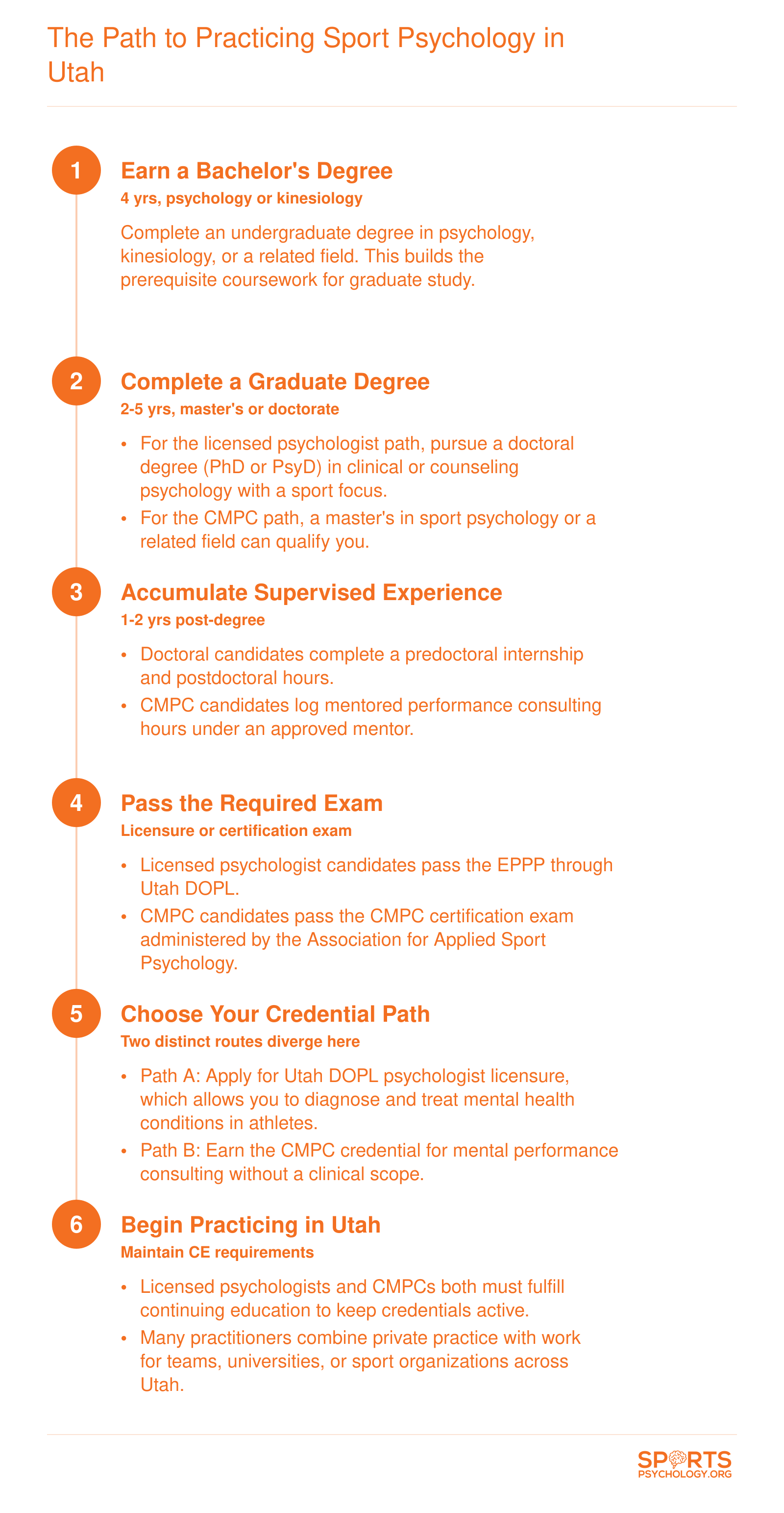
The Path to Practicing Sport Psychology in Utah
Whether you want to become a licensed psychologist or a Certified Mental Performance Consultant (CMPC), the journey begins with the same educational foundation. Here is the credentialing ladder at a glance, including where the two career paths diverge.
Online Vs. On-Campus: Choosing the Right Format for Utah Students
Utah students pursuing a sports psychology degree face a meaningful choice between online and on-campus formats. Each path carries distinct advantages depending on your location, career stage, and learning style. Several nationally ranked programs now offer hybrid options that blend online coursework with intensive on-site residencies, giving Utah students a middle ground worth exploring.
What Works
Online programs let you access nationally ranked sports psychology degrees from anywhere in Utah, including rural areas far from major universities.
Flexible online scheduling supports working professionals who need to balance coursework with jobs, athletics, or family responsibilities.
Online programs often carry a lower total cost when you factor in savings on relocation, housing, and commuting expenses.
On-campus and hybrid formats provide structured practicum placements, removing the burden of independently arranging local clinical experiences.
In-person cohort models foster peer relationships and direct faculty mentorship that can accelerate professional development and networking.
Hybrid programs combine the convenience of remote coursework with periodic on-site residencies for hands-on training and community building.
What to Watch
Online students must independently locate and arrange practica or internships within Utah, which can be challenging depending on your region.
Remote learners may miss out on spontaneous networking opportunities and the professional connections that form naturally in campus settings.
Online formats demand strong self-discipline and time management skills, as there is less external structure to keep you on track.
On-campus programs in sports psychology often require relocation outside Utah, significantly increasing total cost of attendance and disrupting personal routines.
Traditional on-campus schedules offer less flexibility, making it harder for students who are currently coaching, competing, or working full time.
Residential programs may limit your ability to maintain professional ties in Utah while completing your degree in another state.
Program Costs and Return on Investment
Because most sports psychology programs available to Utah students are offered by out-of-state institutions, understanding cost versus earning potential is essential before committing. The table below ranks ten online and hybrid programs by their institution-wide ROI ratio, which compares median earnings ten years after enrollment to the average net price. Net price figures shown are institution-wide averages after financial aid and do not represent a personalized quote; your actual costs will depend on your aid package, residency status, and credits transferred. Across these programs, the average net price ranges from roughly $8,700 at East Central University to about $29,100 at Parker University, a spread of more than $20,000. Meanwhile, median earnings ten years out range from approximately $42,100 to $67,500, showing that a lower sticker price does not always mean lower long-term earnings. Program-level earnings shortly after completion are not yet available for these programs, so the earnings column reflects institution-wide medians reported by the College Scorecard.
School
Degree Level
Avg. Net Price
Median Graduate Debt
Median Earnings (10 Yr)
ROI Ratio
Parker University
Bachelor's
$29,135
$12,288
$42,091
3.43
Arizona State University
Bachelor's
$14,967
$19,500
$62,668
3.21
Southern Illinois University Edwardsville
Master's
$14,889
$20,500
$56,346
2.75
National University
Master's
$22,878
$25,000
$67,548
2.70
East Central University
Master's
$8,683
$17,671
$44,962
2.54
Southern Connecticut State University
Master's
$20,857
$22,250
$55,043
2.47
California Baptist University
Bachelor's
$26,285
$26,063
$61,504
2.36
Adams State University
Master's
$12,980
$19,500
$44,372
2.28
Texas A&M University, Kingsville
Master's
$12,090
$22,934
$51,450
2.24
Northern Michigan University
Master's
$14,085
$21,474
$47,107
2.19
Utah Sports Psychology Career Opportunities and Salary
Utah offers one of the most dynamic sports ecosystems in the Mountain West, and that translates into real career opportunities for trained sport psychology professionals. Whether you earn your sports psychology degree through an online program or relocate for an on-campus track, understanding where the jobs are and what they pay will help you plan a realistic career path.
Utah's Sports Ecosystem and Where You Fit In
Few states pack this much athletic infrastructure into one market. Professional franchises including the Utah Jazz (NBA), Real Salt Lake (MLS), Utah Royals (NWSL), and the Utah Hockey Club (NHL) all maintain performance staffs that increasingly include mental performance professionals. At the collegiate level, the University of Utah and Brigham Young University run large athletics departments with dedicated sport psychology support for student-athletes across dozens of programs.
Beyond traditional team sports, Park City serves as a training hub for Olympic-pipeline athletes in skiing, snowboarding, bobsled, and other winter disciplines. The U.S. Ski and Snowboard organization and the National Ability Center, which provides adaptive sport programming, both represent potential employers or consulting partners for sport psychologists with the right credentials.
Healthcare and Private Practice Settings
Sport psychology careers in Utah are not limited to locker rooms and training facilities. Intermountain Health, one of the largest healthcare systems in the region, operates sports medicine programs where licensed psychologists can work alongside orthopedic surgeons, physical therapists, and athletic trainers. University counseling centers at institutions like the University of Utah and Utah State University also hire professionals who specialize in performance-related concerns. Private practice remains another viable option, particularly in the Salt Lake City and Provo metro areas where demand for specialized mental health services continues to grow.
What the Salary Data Tells Us
Sport-specific salary data is limited because the field spans multiple job classifications, but clinical psychology wages in Utah provide a useful proxy. According to the most recent available data (2023), clinical psychologists in Utah earned a median annual wage of roughly $89,000, with an estimated 1,000 to 1,200 professionals employed statewide. In the Salt Lake City metro area, reported salaries for clinical psychologists ranged from approximately $110,000 to $160,000, reflecting the higher cost of living and concentration of healthcare employers along the Wasatch Front.2
Mental health counselors, which is the classification that captures many master's-level practitioners, typically earn less. These figures provide a general benchmark rather than a sport-psychology-specific salary, so treat them as directional rather than definitive.
Program-level earnings data for recent graduates of the online sport psychology programs featured on this site is not yet available, so we are unable to provide a post-graduation earnings benchmark from those specific programs at this time.
Salary Expectations by Credential Level
Your earning potential in sport psychology is closely tied to the credential you hold. Here is a general framework for Utah:
Doctoral-level licensed psychologist: With a PhD or PsyD and a Utah psychology license, you can diagnose and treat clinical conditions in addition to providing performance consulting. This path commands the highest salaries, generally aligning with the $89,000 to $160,000 range seen for clinical psychologists in the state, depending on setting and experience.
Master's-level Licensed Professional Counselor (LPC): An LPC in Utah can provide therapy and counseling services, including sport-related mental health work, though scope of practice is narrower than a doctoral-level psychologist. Salaries for mental health counselors in Utah typically fall below the clinical psychologist median.
Certified Mental Performance Consultant (CMPC): A CMPC credential through the Association for Applied Sport Psychology qualifies you for performance consulting but does not authorize clinical treatment. Many CMPCs work as independent contractors or consultants, and income can vary widely based on client base, with some professionals supplementing consulting revenue through coaching, speaking, or academic positions.
The key takeaway is that each credential opens a different door. If you want to work clinically with athletes dealing with anxiety, depression, or eating disorders, a doctoral degree and licensure put you in the strongest position. If your goal is pure performance enhancement, such as visualization, goal setting, and focus training, a master's degree paired with CMPC certification can launch your career more quickly and at a lower educational cost.
Utah's growing sports infrastructure means demand for qualified professionals is likely to keep pace with the state's population growth. Positioning yourself with the right credential for your target setting is the single most important career decision you will make.
Accreditation and What to Look for in a Sports Psychology Program
Accreditation is easy to overlook when you are comparing course catalogs and tuition prices, but it is the single factor that can make or break your ability to practice in Utah. Before you enroll in any program, whether online or on campus, you need to understand how accreditation works at multiple levels and what Utah's Division of Professional Licensing (DOPL) actually requires.
Three Layers of Accreditation You Should Know
Not all accreditation is created equal, and sports psychology students need to pay attention to three distinct layers.
Regional (now called institutional) accreditation is the baseline. It confirms that a college or university meets broad academic standards. Every reputable program you will encounter should hold this credential, and it is a minimum requirement for federal financial aid eligibility and credit transferability.
APA accreditation applies specifically to doctoral programs in clinical or counseling psychology. If your goal is to become a licensed psychologist in Utah and provide clinical mental health services to athletes, graduating from an APA-accredited program is either required or strongly preferred. Utah DOPL evaluates doctoral applicants partly based on whether their program meets recognized accreditation standards, so this layer carries real weight for the psychologist licensure path.
CACREP accreditation covers master's-level counseling programs. If you plan to pursue licensure as a Licensed Professional Counselor (LPC) with a sport psychology emphasis, a CACREP-accredited program signals that your training meets national counseling standards and aligns with what Utah requires for the LPC credential.
Why This Matters for Utah Licensure
Utah DOPL requires graduation from an accredited program for both psychologist and counselor licensure. This means an otherwise excellent program that lacks the right accreditation could leave you ineligible to sit for licensing exams or accumulate supervised hours in the state. Online students need to be especially careful here. Confirm that DOPL recognizes your specific program type, not just the institution, before you commit.
A Note on "Accredited Sports Psychology Degrees"
One point that surprises many prospective students: sport psychology as a standalone discipline does not have its own accrediting body. There is no dedicated sport psychology accreditation the way there is APA accreditation for clinical psychology or CACREP accreditation for counseling. Programs in this field fall under the broader umbrella of psychology or counseling accreditation. So when you search for an accredited sports psychology degree in Utah, you are really looking for a psychology or counseling program that holds the appropriate credential and offers sport psychology coursework or a concentration within that framework. The same principle applies whether you are exploring accredited sports psychology programs in other states or staying local.
Your Three-Point Accreditation Checklist
Before enrolling in any program, run through these three questions:
Regional accreditation: Is the institution regionally accredited by a recognized accrediting agency? If not, walk away.
Program-level accreditation: Does the program hold APA accreditation (for doctoral clinical or counseling tracks) or CACREP accreditation (for master's counseling tracks) appropriate to the licensure path you intend to follow?
Utah DOPL approval: Has Utah DOPL confirmed that this program type qualifies for licensure eligibility in the state? Contact DOPL directly or check their published guidelines rather than relying solely on an admissions counselor's assurance.
Taking 30 minutes to verify these three points can save you years of frustration and tens of thousands of dollars. Accreditation is not a box to check after you enroll. It is the first filter you apply when building your shortlist of programs.
Frequently Asked Questions About Sports Psychology Programs for Utah Students
Choosing the right sports psychology program raises a lot of practical questions, from degree requirements to salary expectations. Below are direct answers to the questions Utah students ask most often.
Does the University of Utah have a sports psychology program?
The University of Utah does not offer a standalone sports psychology degree. However, the Department of Educational Psychology and the Department of Health and Kinesiology include coursework and research opportunities related to sport and performance psychology. Students interested in the field often pursue a psychology or kinesiology degree and then seek specialized graduate training at the master's or doctoral level.
How do I become a sports psychologist in Utah?
To practice as a sports psychologist in Utah, you typically need a doctoral degree in psychology (Ph.D. or Psy.D.) and must obtain licensure through the Utah Division of Occupational and Professional Licensing (DOPL). The process includes completing supervised clinical hours, passing the Examination for Professional Practice in Psychology (EPPP), and meeting state-specific requirements. Alternatively, you can pursue certification as a mental performance consultant through AASP.
What degree do you need to be a sports psychologist?
A doctoral degree in clinical psychology, counseling psychology, or a closely related field is generally required to use the title "sports psychologist." Some professionals enter the field with a master's degree in sport and exercise psychology, which qualifies them to work as mental performance consultants rather than licensed psychologists. The degree path you choose determines your scope of practice and career ceiling.
Are there accredited sports psychology programs online?
Yes, several regionally accredited universities offer online master's degrees in sport psychology or closely related concentrations. Programs are available through institutions such as the University of Western States, Ball State University, and others listed on sportspsychology.org. When evaluating online options, verify that the program is regionally accredited and aligns with certification requirements from organizations like AASP or licensure boards in Utah.
How much does a sports psychologist make in Utah?
Salaries for sports psychologists in Utah vary based on credentials, setting, and experience. Licensed psychologists working in sport-related roles can expect earnings in line with clinical or counseling psychologists in the state, with median salaries typically ranging from roughly $80,000 to over $100,000 per year. Mental performance consultants with a master's degree generally earn less, particularly in the early stages of their careers.
What is the difference between a sports psychologist and a mental performance consultant?
A sports psychologist holds a doctoral degree and a state psychology license, allowing them to diagnose and treat mental health conditions alongside performance work. A mental performance consultant (often certified through AASP as a CMPC) typically holds a master's degree and focuses exclusively on performance enhancement, such as goal setting, visualization, and focus training, without providing clinical therapy.
Can I complete practicum hours in Utah while enrolled in an online program?
In most cases, yes. Many online sport psychology programs require practicum or fieldwork hours, and students can often arrange placements in their home state. Utah offers practicum opportunities through collegiate athletic departments, private sport psychology practices, and organizations like the U.S. Ski and Snowboard team. Confirm with your program that local placements meet its specific requirements before enrolling.
More Online Sports Psychology Programs Available to Utah Students
In addition to our top-ranked programs, here are more accredited online sports psychology programs available to Utah students. These schools offer quality education and flexibility for those pursuing a career in sport psychology.
Faulkner University
Faulkner University's online Bachelor of Science in Sports Psychology prepares students for roles in coaching, athletic counseling, and fitness instruction. The program integrates a Christian worldview with small class sizes.
Parker University's online Bachelor of Science in Sport Psychology explores the connection between mind and athletic performance, covering exercise physiology, biomechanics, and injury rehabilitation.
The online Master of Science in Sports Psychology at USW focuses on team dynamics, performance enhancement, and injury recovery, preparing students for coaching and mentoring careers.
Northern Michigan University's online Master of Science in Applied Sport Psychology offers two specialized tracks for certification as a Mental Performance Consultant or licensure as a Limited Psychologist.
This 100% online Master of Science in Sport and Performance Psychology features flexible start dates and no GRE requirement, preparing graduates for roles as mental performance coaches or athletic advisors.
East Central University's online Master of Science in Sport Psychology requires no entrance exam and includes a supervised internship, preparing students for CMPC certification.
UWA offers an online Master of Science in Experimental Psychology with a Health and Sports Psychology concentration, featuring a thesis or comprehensive exam option.
Kent State's online Bachelor of Science in Sport, Exercise and Performance Psychology focuses on motivation, mental training, and stress management, and includes a practicum.
This online program covers psychological factors in athletic success, such as motivation and stress management, preparing graduates for coaching and mental performance roles.
Kent State Trumbull's online program in Sport, Exercise and Performance Psychology includes courses on injury psychology and ethics, and prepares students for graduate study.
This 100% online program emphasizes psychological processes in sports, including motivation and stress management, and does not require ACT or SAT scores.
Kent State East Liverpool's online degree in Sport, Exercise and Performance Psychology prepares students for careers in mental performance coaching or further study.