Best Online Sports Psychology Programs for Nebraska Students

Ranked online degrees and clear pathways to becoming a licensed sport psychologist in Nebraska

Reviewed by SportsPsychology.org TeamUpdated May 14, 202610+ min read
Best Sports Psychology Programs for Nebraska Students (2026)

Key Takeaways

  • Nebraska has no in-state sports psychology degree programs, so most students earn their degrees through accredited online options.
  • Licensed sport psychologists in Nebraska need a doctoral degree, supervised experience, and two exams through the state DHHS Board of Psychology.
  • The CMPC credential offers a master's-level alternative for those who want to work as mental performance consultants without doctoral training.
  • Nebraska salaries for qualified sport psychology professionals are competitive, supported by strong demand from collegiate and youth athletics statewide.

Nebraska does not host a dedicated sports psychology degree program at any of its public or private universities, which means aspiring practitioners in the state face a straightforward but sometimes overlooked constraint: earning a relevant credential requires enrolling in an out-of-state or online program. The good news is that dozens of accredited online sports psychology programs accept Nebraska students at every degree level, from bachelor's through doctorate. Students in neighboring states such as those exploring sports psychology programs in iowa or sports psychology programs in kansas face similar geographic limitations.

For those pursuing clinical licensure, Nebraska's Board of Psychology requires a doctoral degree plus 4,000 hours of supervised experience, a timeline that typically spans seven to ten years post-bachelor's. The CMPC credential offers a faster, master's-level alternative, though it carries a different scope of practice. Understanding that distinction early shapes every decision that follows.

Why Nebraska Students Often Choose Online Sport Psychology Degrees

Nebraska is a state where sports run deep, from the passionate Husker faithful packing Memorial Stadium to the thousands of high school athletes competing through the Nebraska School Activities Association (NSAA) and the thriving youth sports scene across the state. That athletic culture creates real demand for professionals who understand the mental side of performance. Yet as of 2026, no Nebraska university offers a standalone sport psychology degree at any level. Students who want to specialize in this field need to look beyond state borders, and for most, online programs provide the most practical path forward. Neighbors in sports psychology programs in iowa and best sports psychology programs in minnesota face similar geographic challenges.

No Relocation Required

Leaving Nebraska is not always realistic. Many aspiring sport psychology professionals are rooted in their communities through jobs, family responsibilities, or athletic commitments of their own. Online programs eliminate the need to uproot your life for a degree. You can study from Lincoln, Omaha, Kearney, or a small town in the Sandhills and still earn a credential from a respected institution hundreds of miles away.

Flexibility That Fits Nebraska Lifestyles

Online programs are designed for people who are already busy. Whether you are coaching at a local high school, working full time, finishing an undergraduate degree, or still competing as an athlete, asynchronous coursework lets you build your schedule around existing commitments. Many programs offer evening or weekend synchronous sessions to accommodate working professionals, so you rarely have to choose between earning a living and earning your degree.

Access to Nationally Recognized Faculty

Because online programs draw students from across the country, they can attract and retain faculty with deep expertise in sport and exercise psychology, mental performance consulting, and clinical applications. Rather than being limited to whatever program happens to be closest, Nebraska students can learn from leading researchers and practitioners at institutions that have built strong reputations in this niche field.

Local Practicum and Fieldwork Opportunities

One common concern about online degrees is the hands-on component. The good news is that most accredited online programs allow, and even encourage, students to complete practicum hours in their home area. Nebraska offers a rich landscape for applied work:

  • Collegiate athletics: The University of Nebraska system and smaller colleges across the state provide opportunities to work alongside student-athletes.
  • High school sports: NSAA member schools serve tens of thousands of athletes who can benefit from mental performance support.
  • Youth and club sports: Growing travel and club programs in soccer, baseball, volleyball, and other sports create additional fieldwork settings.

Same Academic Standards, Different Delivery

It is worth emphasizing that reputable online sport psychology programs carry the same regional accreditation as their on-campus counterparts. Regional accreditation means the curriculum, faculty qualifications, and student outcomes meet established benchmarks. Employers, licensing boards, and certification bodies (such as those overseeing the Certified Mental Performance Consultant credential) treat these degrees the same as traditional degrees. Students in sports psychology programs in kansas rely on the same accreditation standards. The delivery method is different, but the academic rigor is not.

For Nebraska students motivated by the state's deep sports culture but limited by geography, online programs offer a clear, practical route into a rewarding field without sacrificing quality or leaving the communities they want to serve.

Best Online Sports Psychology Programs for Nebraska Students

Because Nebraska does not currently host a dedicated sports psychology degree program, online and hybrid options from accredited institutions across the country give Nebraska residents a clear path into the field without relocating. The programs below are nationally available, open to Nebraska students, and ranked using a composite that weighs online accessibility, institutional quality indicators, graduation rates, and overall value. Program-level earnings data is not yet available for these specific sports psychology concentrations, so we include institution-wide median earnings at ten years as a general reference point.

Factors considered
  • Online delivery and accessibility
  • Institutional graduation and retention rates
  • Tuition affordability and net price
  • Certification alignment such as CMPC
  • Overall return on investment composite
Data sources

Arizona State University

#1

Tempe, AZ · $15,000/yr

Best for: Undergrads seeking a sport counseling foundation

Arizona State University is a globally recognized research institution that delivers its sport psychology coursework through ASU Online with no out-of-state tuition surcharge for distance learners. The university posts a 68% institution-wide graduation rate and a 10-year median earnings figure of $62,668, the second highest among schools on this list. Nebraska students benefit from an Earned Admission pathway that lets applicants with a 2.75 GPA begin coursework immediately, and the required internship can be arranged locally in Nebraska sport or mental health settings.

  • Online BS with Sport and Performance Counseling concentration
  • 120 credit hours across 40 accelerated 7.5-week courses
  • Required internship in a sport or mental health setting
  • Earned Admission pathway for students with a 2.75 GPA
  • ACT/SAT scores are optional for admission
  • Prepares graduates for behavioral health or counseling roles
  • Diploma does not indicate online delivery

Southern Illinois University-Edwardsville

#2

Edwardsville, IL · $15,000/yr

Best for: Working professionals pursuing CMPC certification

Southern Illinois University Edwardsville pairs graduate-level sport psychology training with a flexible online schedule that fits around full-time jobs. With a 15:1 student-to-faculty ratio and evening class times, SIUE emphasizes personalized mentoring throughout its 12 to 22 month program timeline. The curriculum explicitly aligns with Certified Mental Performance Consultant (CMPC) requirements, making it a strong match for Nebraska students who plan to pursue that credential. Out-of-state tuition is the same as in-state for this program, keeping costs manageable.

  • Master of Science with Exercise and Sport Psychology specialization
  • 100% online with evening and asynchronous course options
  • Completable in 12 to 22 months
  • Coursework aligned with CMPC certification requirements
  • Strong faculty mentoring and personalized advising
  • Connected to Division I athletics for applied context
  • Prepares students for doctoral studies or applied careers

California Baptist University

#3

Riverside, CA · $25,000 – $30,000/yr

Best for: Transfer students wanting accelerated completion

California Baptist University offers a fully asynchronous bachelor's degree in Sport and Performance Psychology that can be completed in as few as 16 months of full-time study. With six entry points per year and a transfer-friendly admissions structure, CBU is well suited for Nebraska students who already hold community college credits and want to finish a sport psychology degree quickly. The institution posts an institution-wide graduation rate of about 62% and median 10-year earnings of $61,504.

  • Online BS requiring 49 units at $520 per unit plus fees
  • Completable in 16 months with full-time study
  • 100% asynchronous with no on-campus requirements
  • Six entry points and year-round admissions
  • Covers exercise physiology, behavioral and cognitive psychology
  • Emphasizes ethics, diversity, and faith integration
  • WSCUC-accredited with financial aid available

Southern Connecticut State University

#4

New Haven, CT · $21,000/yr

Southern Connecticut State University delivers an interdisciplinary master's in Exercise Science with a Sport Psychology concentration, drawing faculty from three departments. The 33 to 34 credit program is one of the most affordable master's options on this list and is specifically designed to prepare graduates for the CMPC exam. Nebraska students should note that the hybrid format may require some on-campus engagement in New Haven, Connecticut, and NEBHE tuition discounts do not apply to residents outside New England.

  • Master of Science with Sport Psychology concentration
  • 33 to 34 credit interdisciplinary program
  • Hybrid delivery combining online and on-campus elements
  • Directly prepares students for CMPC certification
  • Faculty from Health Sciences, Counseling, and Psychology
  • 11:1 student-to-faculty ratio for individualized attention

Texas A & M University-Kingsville

#5

Kingsville, TX · $10,000 – $15,000/yr

Texas A&M University Kingsville offers a Performance Psychology concentration within its M.S. in Kinesiology, with three flexible degree plans ranging from 30 to 36 credit hours. Students can choose a course-only track, a research project or internship option, or a thesis path. The curriculum aligns with AASP standards and prepares graduates for the CMPC exam. Nebraska students should be aware that some face-to-face courses are required in Kingsville, Texas, and standard non-resident tuition applies.

  • Performance Psychology concentration within kinesiology
  • Three degree plans: course-only, project/internship, or thesis
  • 30 to 36 credit hours depending on track
  • Aligned with AASP CMPC examination standards
  • Some face-to-face courses required on campus
  • Research project or internship option for applied experience

Troy University

#6

Troy, AL · $15,000 – $20,000/yr

Troy University combines online coursework with hands-on internship opportunities in its M.S. in Kinesiology with a Sports Psychology concentration. The program has no application deadline, letting Nebraska students start when they are ready. Internship placements can often be arranged near the student's home, which means Nebraskans may build local sport psychology experience while enrolled. Military-connected students may qualify for significant tuition discounts through Troy's established support programs.

  • Sports Psychology concentration delivered primarily online
  • No application deadline for flexible enrollment
  • Hands-on internships with athletes included
  • Courses cover sport psychology, motor skills, and ethics
  • Internships can often be arranged near the student's home
  • Faculty bring professional sport psychology experience

Kent State University

#7

Kent, OH · ~$21,000/yr (est.)

Kent State University offers a fully online Bachelor of Science in Sport, Exercise and Performance Psychology that covers motivation, mental training, stress management, and injury psychology across 120 credit hours. The program is approved for Nebraska residents and includes a practicum that can be completed locally with departmental approval, giving Nebraskans a chance to build connections within their home state's sport community. The institution posts a 64% graduation rate and a 10-year median earnings figure of $45,388.

  • 100% online BS covering 120 credit hours
  • Includes practicum that can be completed locally
  • Covers motivation, mental training, and stress management
  • Addresses sport injury psychology and ethics
  • Transfer students and international applicants accepted
  • Minimum 2.0 GPA required for admission

National University

#8

San Diego, CA · ~$23,000/yr (est.)

National University stands out for offering sport psychology programs at every degree level, from a bachelor's through a doctorate, all available 100% online. Nebraska students can begin with a BA in Sport Psychology, advance to an M.S. or M.A. with Applied or Theoretical Mental Performance specializations, and ultimately pursue a PhD with a Sport and Performance Psychology focus. Admissions are simplified with no application fee, no required essays, and year-round weekly start dates. The institution reports the highest 10-year median earnings on this list at $67,548.

  • 100% online, 36 credit hours across 12 courses
  • Completable in 18 to 21 months
  • Aligned with AASP certification standards
  • No application fee or entrance exam required
  • Transfer credits accepted up to 12 hours
  • Optional fieldwork for hands-on experience
  • FastForward pathway to PhD available
  • Online BA requiring 180 quarter units
  • Completable in approximately 40 months
  • Year-round enrollment with $0 application fee
  • No ACT or SAT entrance exam required
  • Covers motivation, performance enhancement, and exercise psych
  • Transfer-friendly with generous credit acceptance
  • 100% online doctoral program, 60 credit hours
  • Estimated 48-month completion timeline
  • Weekly start dates with flexible scheduling
  • Personalized mentoring from doctoral faculty
  • Dissertation required for completion
  • Covers leadership, ethics, injury psychology, and diversity
  • Applied Mental Performance specialization available
  • 200+ direct client contact hours in mentored training
  • Meets CMPC certification academic requirements
  • No GRE required for admission
  • Theoretical Mental Performance track finishable in 14 months
  • Scholarships and financial aid available
  • Applied Mental Performance specialization available
  • 200+ direct client contact hours in mentored training
  • Meets CMPC certification academic requirements
  • No GRE required for admission
  • Theoretical Mental Performance track finishable in 14 months
  • Scholarships and financial aid available

Adams State University

#9

Alamosa, CO · $13,000/yr (net price)

Adams State University delivers one of the most budget-friendly online master's options for Nebraska students, with a flat online graduate tuition rate that does not penalize out-of-state residents. The 36-credit M.S. in Kinesiology with an Applied Sport Psychology emphasis can be finished in two years and covers mental strength, ethics, case studies, and diversity in sport. Required practicum and capstone work can be completed locally, letting Nebraskans gain supervised experience without leaving the state.

  • Applied Sport Psychology emphasis, 36 credit hours
  • Fully online with two-year completion timeline
  • No entrance exam required for admission
  • Practicum and capstone can be completed locally
  • Covers mental strength, ethics, and case studies
  • Low flat-rate online tuition regardless of state residency

Springfield College

#10

Springfield, MA · ~$31,000/yr (est.)

Springfield College brings decades of sport science heritage to its fully asynchronous online Master of Education in Sport and Exercise Psychology. The 36-credit program blends theory, measurement, and applied practice, culminating in a 135-hour supervised internship that Nebraska students can complete remotely under certified professionals. With rolling admissions and the option to finish in 18 months full-time, it suits working professionals who want a respected credential without relocating. The institution posts the highest graduation rate on this list at 74%.

  • 36-credit fully asynchronous online program
  • Completable in 18 months full-time or extended part-time
  • 135-hour applied internship with remote supervision
  • Courses offered in 7-week and 15-week formats
  • Rolling admissions for domestic applicants
  • No entrance exam required for domestic students
  • Interdisciplinary curriculum bridging theory and practice

Questions to Ask Yourself

Do you want to treat clinical mental health issues or coach athletes on peak performance?
This distinction shapes your entire path. Licensed psychologists diagnose and treat disorders, requiring a doctorate and state licensure, while mental performance consultants focus on skills like focus and motivation, typically needing a master's degree and CMPC certification.
Are you prepared to invest seven or more years in doctoral education, or does a master's level career better fit your timeline?
A doctoral route (Ph.D. or Psy.D.) includes coursework, a dissertation, and supervised clinical hours spanning roughly seven to nine years. A master's in applied sport psychology can be completed in two to three years, letting you enter the workforce much sooner.
Can you secure supervised practicum placements in Nebraska while enrolled in an online program?
Most accredited programs require hands-on hours with athletes or clients under a qualified supervisor. Nebraska's college athletic departments, community sport organizations, and private practices can serve as practicum sites, but availability varies by location, so confirm options early.

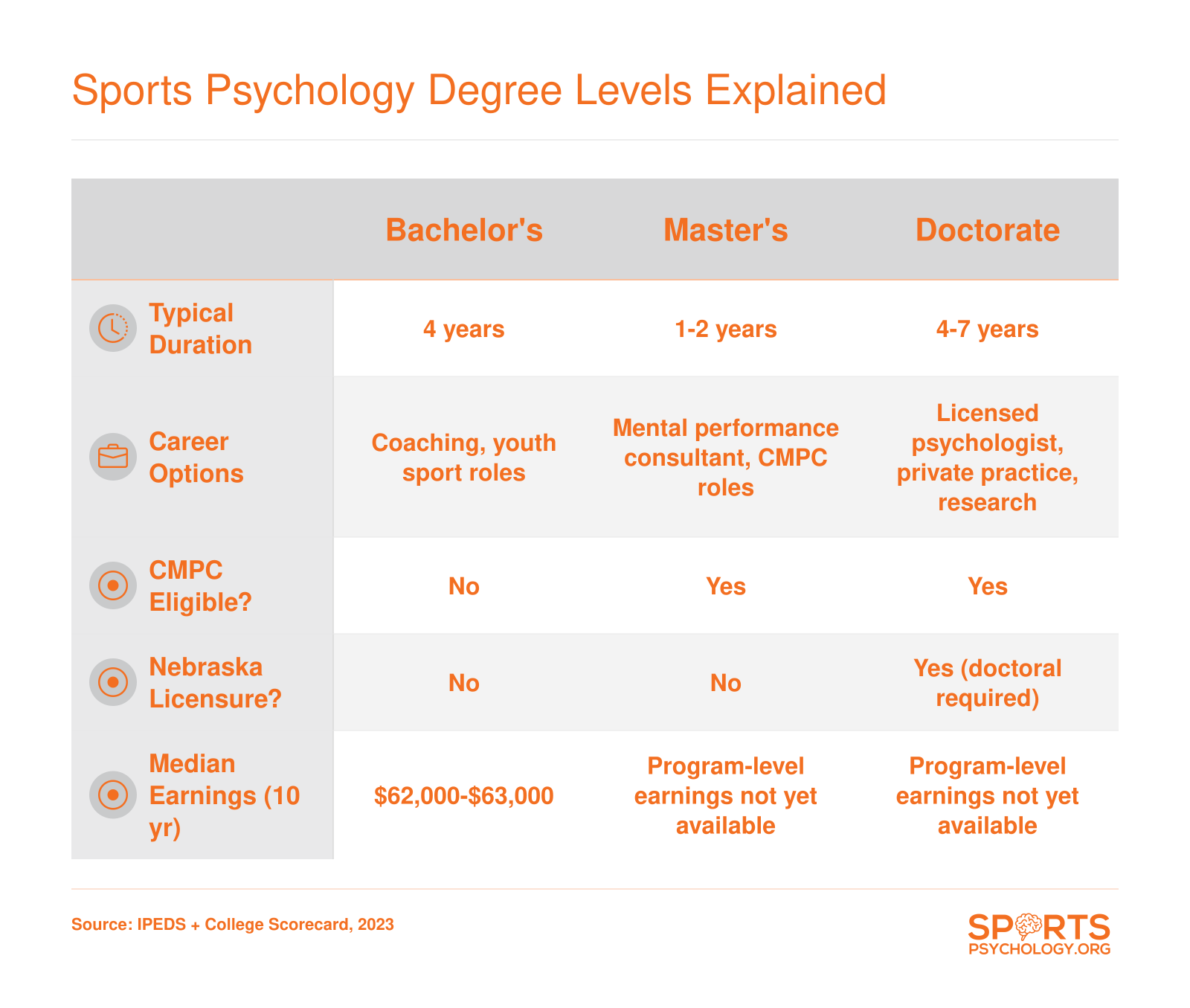
Sports Psychology Degree Levels Explained

Not every sports psychology degree opens the same doors. A bachelor's degree provides a solid foundation in psychology and human performance, but it will not qualify you to call yourself a sport psychologist or work independently with athletes in a clinical capacity. Graduate certificates also exist as add-on credentials for professionals who already hold a degree, but the three levels below represent the primary pathways Nebraska students should evaluate.

Side-by-side comparison of bachelor's, master's, and doctoral sports psychology degrees by duration, career options, CMPC eligibility, and Nebraska licensure qualification

Cost and ROI of Sports Psychology Programs for Nebraska Students

Because Nebraska does not currently offer in-state sports psychology degree programs, students in the state will typically enroll in online programs based at out-of-state schools. That means out-of-state tuition rates and net price after aid become especially important factors in your decision. Across the top-ranked online sports psychology programs available to Nebraska students, net prices range from roughly $8,700 to $13,400 per year, and median graduate debt spans from about $17,700 to $25,000. To help you compare the cost of a sports psychology degree from Nebraska, the table below sorts programs by net price and includes a simple ROI ratio (institution-wide median earnings at ten years divided by median debt at completion). A higher ratio signals stronger long-term value relative to what you borrow.

SchoolDegree LevelOut-of-State TuitionNet Price (After Aid)Median Debt at CompletionMedian Earnings (10 Yr)ROI Ratio (Earnings / Debt)
East Central UniversityMaster's$12,236$8,683$17,671$44,9622.54
Kent State University at StarkBachelor's$17,969$10,897$24,500$45,3881.85
Kent State University at TrumbullBachelor's$17,969$11,135$24,500$45,3881.85
Kent State University at GeaugaBachelor's$17,969$12,044$24,500$45,3881.85
Texas A&M University, KingsvilleMaster's$14,560$12,090$22,934$51,4502.24
Kent State University at AshtabulaBachelor's$17,969$12,205$24,500$45,3881.85
Kent State University at TuscarawasBachelor's$17,969$12,542$24,500$45,3881.85
University of West AlabamaMaster's$13,546$12,684$24,944$44,2321.77
Adams State UniversityMaster's$5,898$12,980$19,500$44,3722.28
Kent State University at East LiverpoolBachelor's$17,969$13,392$24,500$45,3881.85

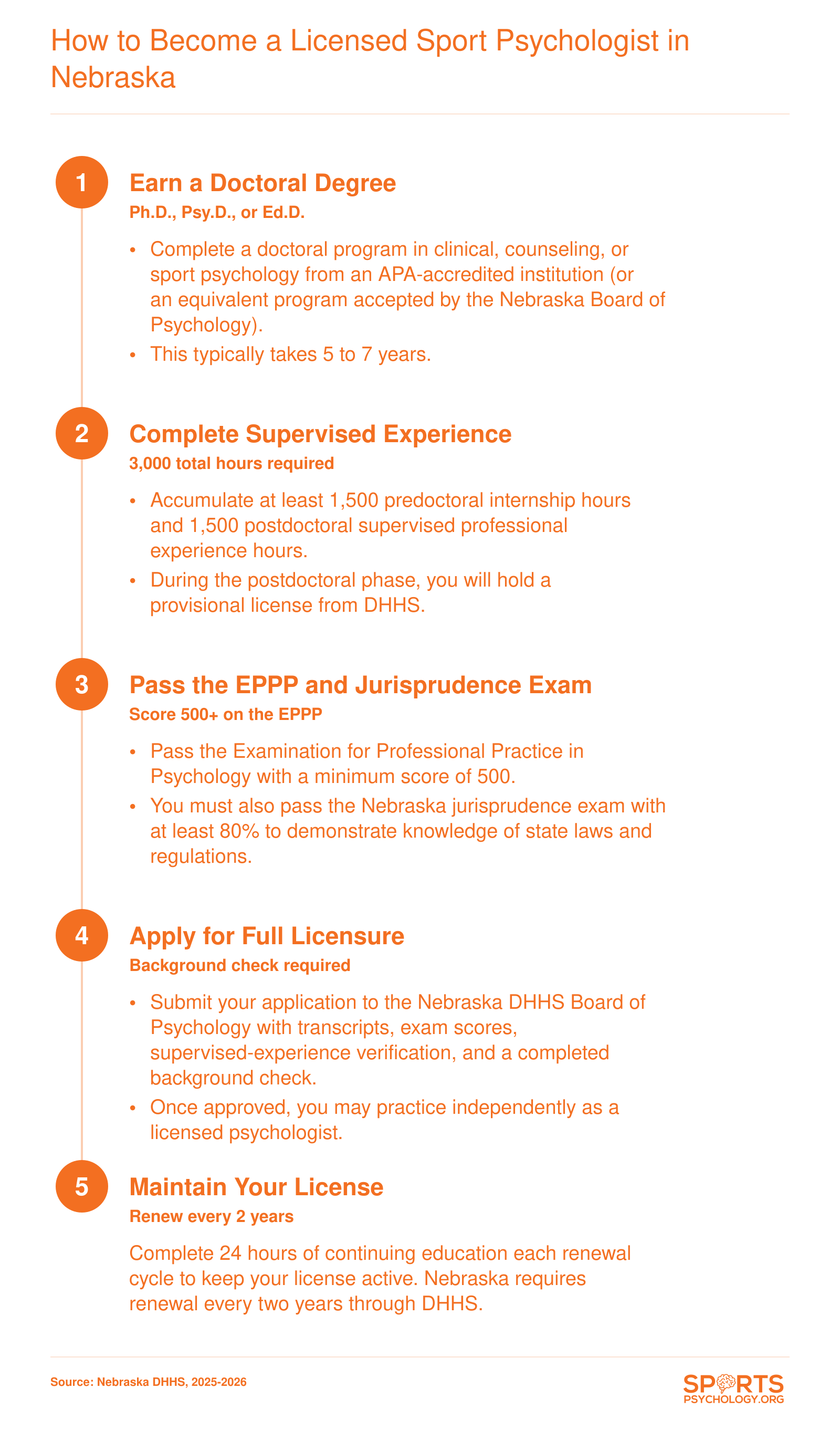
How to Become a Licensed Sport Psychologist in Nebraska

Nebraska licenses sport psychologists through its Department of Health and Human Services (DHHS) Board of Psychology. The process requires a doctoral degree, extensive supervised experience, and two exams. This is the clinical licensure pathway, which is distinct from the master's-level Certified Mental Performance Consultant (CMPC) credential covered in the next section. If your goal is to diagnose and treat mental health conditions in athletes, full psychologist licensure is the route you need.

Five-step Nebraska sport psychologist licensure sequence from doctoral degree through license renewal, requiring 3,000 supervised hours and a 500-point EPPP score

CMPC Certification: The Alternative Path for Nebraska Sport Psychology Professionals

If you are passionate about helping athletes sharpen their mental game but do not want to pursue a doctoral degree or clinical licensure, the Certified Mental Performance Consultant (CMPC) credential offers a practical, respected alternative. Awarded by the Association for Applied Sport Psychology, the CMPC is the gold standard for professionals who focus on performance consulting rather than clinical treatment. For Nebraska-based students, it is an especially appealing option because the entire pathway can be completed alongside, or after finishing, an online master's program.

What Exactly Is CMPC, and How Does It Differ from Licensure?

The CMPC credential signals that a professional has met rigorous education, mentorship, and examination standards in applied sport psychology.1 However, it is not a clinical license. CMPC holders work on the performance side of the field, helping athletes with goal setting, focus, confidence, pre-competition routines, and team cohesion. They do not diagnose or treat mental health disorders.

In Nebraska, anyone who wants to use the title "sport psychologist" generally needs to hold a doctoral degree and obtain psychology licensure through the state. CMPC holders typically use titles such as "mental performance consultant" or "sport performance consultant" instead. The two credentials complement each other well, and some practitioners eventually pursue both, but they serve different professional functions.

Education and Mentored Experience Requirements

To be eligible for the CMPC, candidates must hold at least a master's degree (a doctoral degree also qualifies) from a regionally accredited institution in a field clearly related to sport science or psychology.1 Approved coursework spans both domains, so programs that blend sport science foundations with psychology core courses tend to align well. Students transitioning from an exercise science, performance psychology background may find their prior coursework covers much of what is needed.

Beyond coursework, AASP requires substantial hands-on preparation:2

  • Total mentored experience: 400 hours under an approved mentor.
  • Direct client contact: At least 200 of those hours must involve working directly with clients.
  • Sport context hours: A minimum of 100 hours must take place within a sport setting.
  • Competitive sport population hours: At least 100 hours must be spent working with athletes engaged in competitive sport.
  • Mentorship meetings: 40 total hours of mentorship, including at least 20 hours of individual mentorship and 10 hours focused on direct knowledge application.
  • Support hours: 150 hours of additional support activities such as case preparation, observation, and professional development.

These requirements ensure that CMPC holders enter the field with genuine, supervised experience, not just classroom knowledge.

The Certification Exam

Once education and mentored experience requirements are complete, candidates must receive approval from AASP to sit for the certification exam.3 The exam consists of 115 questions covering applied sport psychology knowledge, ethics, and professional practice. If a candidate does not pass on the first attempt, they must wait 90 days before retaking the exam.3

After earning the credential, CMPC holders maintain certification through ongoing professional development and adherence to AASP's ethical principles and standards.1

Why CMPC Works Well for Nebraska Students

Because CMPC eligibility is tied to coursework content and mentored hours rather than attendance at a specific brick-and-mortar campus, Nebraska students enrolled in accredited online master's programs can work toward this credential from anywhere in the state. Mentored experience can often be arranged locally, whether you are working with athletes at a university in Lincoln, a high school program in Omaha, or a club sports organization in a smaller community. This flexibility makes the CMPC pathway especially accessible for students who want to stay in Nebraska while building their careers.

If you are exploring programs on sportspsychology.org, look for master's degrees whose curricula cover both sport science and psychology coursework. Programs that explicitly reference AASP alignment or CMPC preparation can save you time by ensuring your credits count toward certification eligibility from day one.
Nebraska-Based Resources for Aspiring Sport Psychologists

Even though most accredited sport psychology graduate programs are located outside the state, Nebraska offers a surprisingly strong foundation for students who want to build credentials before applying. From undergraduate coursework to hands-on practicum sites, here is how to take advantage of what is available close to home.

University of Nebraska System: Undergraduate Pipelines

The three main University of Nebraska campuses each offer coursework and departmental resources that feed directly into sport psychology graduate work. Students who ultimately need to enroll out of state can explore sports psychology programs in Missouri or other neighboring options while still building their foundation in Nebraska.

  • University of Nebraska-Lincoln (UNL): The Department of Psychology and the College of Education and Human Sciences both offer relevant undergraduate tracks. Students interested in the physical performance side can explore UNL's Pre-Athletic Training pathway, which builds a foundation in exercise science and human movement.5 Psychology majors can tailor electives toward abnormal psychology, motivation, and research methods, all of which align with graduate admissions expectations.
  • University of Nebraska at Kearney (UNK): The Kinesiology and Sport Sciences Department houses KSS 401, Psychology of Sport, a dedicated upper-level course that introduces core sport psychology theory and application.3 Students pursuing kinesiology or exercise science degrees at UNK can pair this coursework with research or independent study to strengthen a graduate application.
  • University of Nebraska at Omaha (UNO): UNO's Master of Arts in Athletic Training program sits at the intersection of sport science and clinical practice.5 While not a sport psychology degree itself, this program exposes students to the interdisciplinary healthcare model that many sport psychologists work within at the professional level.

UNL Athletics: A Model In-State Practicum Environment

UNL's Husker Sport Psychology program is a dedicated unit within the athletic department whose mission centers on science-driven psychological interventions delivered in an interdisciplinary setting to promote the health and performance of Husker student-athletes.1 The program is directed by Brianna Ward2 and includes Dr. Brett Haskell among its full-time sport psychology professionals, with two full-time sport psychologists and a sports psychiatrist on staff as of 2026.4

For graduate students enrolled elsewhere, UNL Athletics may represent a practicum or externship site worth exploring. Networking with the Husker Sport Psychology staff, attending their programming, or seeking supervised hours through collaborative arrangements can provide high-level applied experience in a Power Four athletic environment.

Practicum and Internship Sites Across the State

Beyond UNL, Nebraska students can look into several types of sites for gaining supervised hours:

  • University athletic departments at UNO, UNK, and smaller colleges across the state
  • Private sport psychology or mental performance consulting practices in Omaha and Lincoln
  • Sports medicine clinics that integrate psychological services into athlete care
  • High school athletics through the Nebraska School Activities Association (NSAA), where mental performance programming is growing
  • Connections to U.S. Olympic and Paralympic Training Center resources, which occasionally offer satellite or remote supervised experiences

Finding Mentors and Supervisors in Nebraska

One challenge for Nebraska-based students is finding locally credentialed supervisors. The pool of AASP Certified Mental Performance Consultants (CMPCs) and APA Division 47 members practicing in the state is relatively small, though it has been growing. The Husker Sport Psychology staff directory is a logical starting point for mentorship conversations. Students can also search the AASP and APA directories to identify Nebraska-based professionals who may be open to informational interviews or supervision arrangements. Building these relationships early, even during undergraduate studies, can make a meaningful difference when it comes time to secure practicum placements and letters of recommendation for graduate school.

Sports Psychology Career Outlook and Salaries in Nebraska

Nebraska may not be the first state that comes to mind when you picture a thriving sports psychology market, but a closer look reveals solid demand and competitive pay for qualified professionals. Whether you earn your sports psychology degree online or relocate after graduation, the Cornhusker State offers a surprisingly diverse set of career opportunities.

What Psychologists Earn in Nebraska

Nationally, psychologists classified under the "All Other" category (which includes sport psychology specialists) earned a median annual wage of $117,750 as of the most recent Bureau of Labor Statistics data.1 The full salary range spans from $47,450 at the 10th percentile to $157,420 at the 90th percentile, with a 25th-to-75th percentile band of $76,550 to $138,280.1 In Nebraska, salary estimates vary by source and specialty, but multiple job-market platforms paint a broadly comparable picture. Salary.com reports a median of about $113,000 for doctoral-level psychologists in Omaha.2 Glassdoor lists a median of roughly $145,779 for psychologists statewide3, while Indeed estimates range from approximately $132,000 to $166,000 at the higher end.4

Keep in mind that these figures reflect psychologists across all specializations, not sport psychology alone. Professionals who work primarily as mental performance consultants, particularly those without a doctoral clinical license, may start at the lower end of the spectrum. Entry-level earnings in the field are not yet tracked at the program level for most sports psychology degrees, so it is difficult to pin down a precise starting salary. As you gain experience, pursue licensure or CMPC certification, and build a client base, your earning potential generally climbs.

Common Job Titles and Work Settings

Sport psychology professionals in Nebraska work under a range of titles and in a variety of environments:

  • Sport Psychologist: Typically requires a doctoral degree and state licensure; found in private practice or integrated health systems.
  • Mental Performance Consultant: Works with athletes on focus, confidence, and competitive preparation; common in university athletic departments and private practice.
  • Behavioral Health Specialist: Employed by sports medicine clinics, hospital wellness programs, or rehabilitation centers.
  • High School Athletic Counselor: Supports student-athletes through performance and developmental challenges within school districts.
  • Military Performance Psychologist: Serves active-duty personnel and veterans at installations such as Offutt Air Force Base near Bellevue, or through VA facilities across the state.

Why Demand Is Growing in Nebraska

Several factors are fueling demand for sport psychology services in Nebraska. The University of Nebraska system fields multiple Division I athletic programs, including the high-profile Huskers, and Creighton University competes at the D1 level as well. These programs increasingly invest in mental performance staff to support student-athletes.

Beyond college athletics, Nebraska's youth sport culture continues to expand. Club sports, travel teams, and high school programs are all recognizing the value of mental skills training, creating opportunities for consultants who specialize in younger populations. Students in neighboring states exploring sports psychology programs in kansas or sports psychology programs in Iowa will find that these regional trends extend across state lines.

Offutt Air Force Base, home to U.S. Strategic Command, represents another employment pipeline. The Department of Defense has steadily expanded its use of performance psychologists to help service members optimize decision-making under pressure, a role that closely mirrors sport psychology practice.

Finally, growing public awareness of athlete mental health, amplified by high-profile conversations at every level of sport, is driving demand across clinical and non-clinical settings alike. For Nebraska students completing an accredited sports psychology degree online, these local and regional trends point toward a career landscape with real momentum.

Frequently Asked Questions About Sports Psychology Programs for Nebraska Students

Nebraska students exploring sports psychology programs often have questions about degree options, licensing, and career paths. Below are answers to the most common questions we receive, drawn from program data and state licensing requirements covered throughout this guide.

Are there sports psychology programs in Nebraska?
Nebraska does not currently have a dedicated sports psychology degree program at the graduate level offered by an in-state university. However, several Nebraska institutions offer related coursework in exercise science, counseling psychology, or kinesiology. Most Nebraska students pursuing a focused sports psychology degree enroll in accredited online programs from schools in other states, which allows them to study from home while accessing quality curricula.
Can you get a sports psychology degree entirely online?
Yes. Multiple accredited universities offer fully online sports psychology degrees at the bachelor's, master's, and even doctoral levels. Some programs may require brief on-campus residencies or in-person practicum placements, but many can be completed remotely. Nebraska students should confirm that any online program they choose is regionally accredited and, if licensure is a goal, meets Nebraska's specific educational requirements for psychology licensure.
What degree do you need to become a sport psychologist?
To use the title "sport psychologist" in Nebraska, you generally need a doctoral degree (Ph.D. or Psy.D.) in psychology from an accredited program, along with supervised clinical hours and a passing score on the Examination for Professional Practice in Psychology (EPPP). Those who pursue the mental performance consultant route instead can qualify with a master's degree and the Certified Mental Performance Consultant (CMPC) credential.
How much does a sports psychology degree cost?
Costs vary widely depending on the institution and degree level. Online master's programs in sports psychology typically range from around $20,000 to $60,000 in total tuition. Doctoral programs can exceed $100,000 over several years. Nebraska residents may find lower tuition at schools participating in the Midwest Student Exchange Program or through other regional tuition reciprocity agreements. Always compare net cost after financial aid.
What is the difference between a sport psychologist and a mental performance consultant?
A sport psychologist holds a doctoral degree in psychology and is licensed to diagnose and treat clinical mental health conditions in athletes. A mental performance consultant (often holding the CMPC credential) typically has a master's degree and focuses on performance enhancement skills such as goal setting, visualization, and focus training. Mental performance consultants do not diagnose or treat clinical disorders, which is a key scope of practice distinction.
How long does it take to become a licensed sport psychologist in Nebraska?
The typical timeline is roughly 8 to 12 years after high school. This includes four years for a bachelor's degree, five to seven years for a doctoral program (which often includes supervised practicum hours), and one to two years of postdoctoral supervised experience required by the Nebraska Department of Health and Human Services before you can sit for the EPPP licensing exam.
Can I complete practicum hours in Nebraska while enrolled in an online program?
In most cases, yes. Many online sports psychology programs allow students to arrange local practicum or internship placements. Nebraska offers opportunities through university athletic departments at schools like the University of Nebraska, as well as through private sports performance clinics and community mental health centers. You will need your program's approval of the site and a qualified local supervisor to oversee your hours.

More Online Sports Psychology Programs Available to Nebraska Students

In addition to the top-ranked programs above, Nebraska students have access to a wide range of accredited online sports psychology degrees from universities across the country. The following schools offer flexible, fully online options that can be completed from Nebraska, covering bachelor's, master's, and certificate levels.

Faulkner University
Faulkner University offers an online Bachelor of Science in Sports Psychology, preparing students for roles like coaching, athletic counseling, and fitness instruction. The program integrates a Christian worldview with small class sizes for personalized learning.
Parker University
Parker University offers a fully online Bachelor of Science in Sport Psychology, exploring the connection between mind and athletic performance. Coursework includes exercise physiology, biomechanics, and injury rehabilitation, preparing students for graduate studies or careers in coaching and health promotion.
University of the Southwest
The University of the Southwest offers an online Master of Science in Sports Psychology, focusing on team dynamics, performance enhancement, injury recovery, and emotional obstacles in competition. The program prepares graduates for careers in coaching, mentoring, athletics, and teaching.
Northern Michigan University
Northern Michigan University offers an online Master of Science in Applied Sport Psychology with two tracks: certification as a Mental Performance Consultant or licensure as a Limited Psychologist. The asynchronous program is designed for working professionals, including coaches and athletes.
Commonwealth University of Pennsylvania
Commonwealth University of Pennsylvania offers a 100% online Master of Science in Sport and Performance Psychology, aligned with CMPC certification. The program features flexible full-time or part-time options, no GRE required, and can be completed in one to two years.
East Central University
East Central University offers an online Master of Science in Sport Psychology, preparing students for Certified Mental Performance Consultant (CMPC) certification. The 45-credit program includes a supervised internship and can be completed in 1-2 years part-time or full-time.
University of West Alabama
The University of West Alabama offers an online Master of Science in Experimental Psychology with a Health and Sports Psychology concentration. The program covers advanced sports psychology, health psychology, and includes a practicum and thesis option, preparing graduates for doctoral studies or careers in health and sports psychology.
Kent State University at Stark
Kent State University offers a 100% online Bachelor of Science in Sport, Exercise and Performance Psychology, focusing on psychological factors in athletic performance. The 120-credit program includes a practicum and prepares graduates for careers as mental performance coaches or further graduate study.
Kent State University at Tuscarawas
Kent State University offers a 100% online Bachelor of Science in Sport, Exercise and Performance Psychology, covering motivation, mental training, and stress management. The program includes a practicum and prepares graduates for careers in coaching or graduate study in sport psychology.
Kent State University at Trumbull
Kent State University offers a 100% online Bachelor of Science in Sport, Exercise and Performance Psychology, focusing on mental skills training, injury psychology, and ethics. The 120-credit program prepares graduates for careers in mental performance coaching or further study.
Kent State University at Salem
Kent State University offers a 100% online Bachelor of Science in Sport, Exercise and Performance Psychology, focusing on psychological factors like motivation and stress management. The program includes a practicum and prepares graduates for careers in coaching or mental performance.
Kent State University at Ashtabula
Kent State University offers a 100% online Bachelor of Science in Sport, Exercise and Performance Psychology, covering motivation, mental training, and stress management. The program includes a practicum and prepares graduates for careers in coaching or graduate study.
Kent State University at East Liverpool
Kent State University offers a 100% online Bachelor of Science in Sport, Exercise and Performance Psychology, focusing on psychological factors in athletic success. The program includes a practicum and prepares graduates for careers as mental performance coaches or for graduate studies in psychology.
Kent State University at Geauga
Kent State University offers a 100% online Bachelor of Science in Sport, Exercise and Performance Psychology, covering motivation, mental training, stress management, and ethics. The program includes a practicum and prepares graduates for careers as mental performance coaches or further graduate study.

Recent Articles