The University of Wyoming is the only in-state institution offering dedicated sport and exercise psychology coursework.
Wyoming recognizes two credential paths: state licensure as a psychologist and CMPC certification through AASP.
Roughly 58 percent of psychologists in rural states like Wyoming already use telepsychology or hybrid service models.
Low competition and niche demand in rodeo, skiing, and adventure sports give early-career practitioners a distinct advantage.
Wyoming has roughly 580,000 residents, one four-year research university, and a growing roster of athletes, from UW's Division I teams to more than 80 high school programs and a deeply rooted rodeo circuit, all increasingly aware that mental performance training matters. The practical challenge is clear: in-state graduate options in sport psychology are nearly nonexistent, yet demand for qualified practitioners is rising across collegiate, prep, and niche sport settings.
Accredited online and regional programs now make it possible to earn a master's or doctoral degree from Wyoming without relocating, though candidates still face decisions about which credential path to pursue. Neighbors like sports psychology programs in montana present similar rural challenges worth comparing. Licensed psychologists and Certified Mental Performance Consultants serve overlapping populations here, but their education requirements, supervised-hour thresholds, and scopes of practice differ significantly.
Best Sports Psychology Programs for Wyoming Residents
Wyoming's small higher-education landscape means your options for sport psychology study start with one clear standout and two affordable community college stepping stones. The University of Wyoming is the only in-state institution with dedicated sport and exercise psychology coursework, research labs, and applied practicum opportunities alongside NCAA Division I athletics. Northwest College and Western Wyoming Community College both offer transfer-ready associate degrees in sociology that can lay social-science groundwork before you move into a bachelor's or graduate program with a sport psychology focus.
Factors considered
Sport psychology curriculum relevance
Tuition and net price
Delivery format flexibility
Applied training opportunities
Transfer pathway strength
Data sources
Independent program research
Internal program database
NCES-IPEDS federal institutional data — nces.ed.gov
Best for: Future sport psychologists seeking applied experience
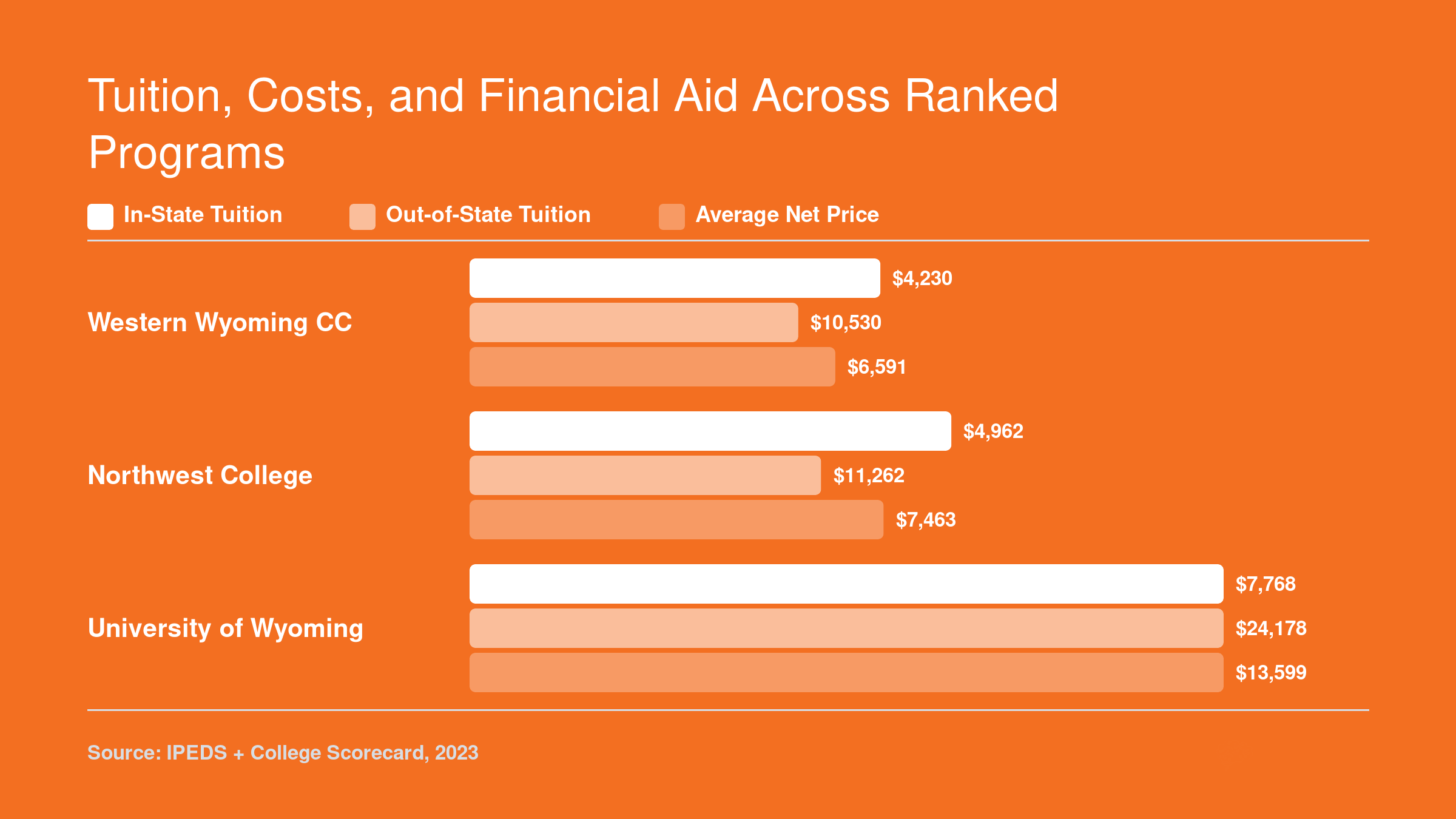
The University of Wyoming is the only four-year public institution in the state and the sole in-state school with identifiable sport and exercise psychology offerings. Its Division of Kinesiology and Health houses a sport and exercise psychology focus area with faculty-led research labs exploring athlete motivation, mental skills training, and exercise adherence. Graduate students can gain hands-on experience through the UW Athletics Sport Psychology unit, which delivers mental performance services to Division I student-athletes across football, basketball, rodeo, and other programs. In-state tuition sits at $7,768, while out-of-state students pay $24,178, though participants in the Western Undergraduate Exchange (WUE) from eligible western states receive reduced nonresident rates. The institution-wide graduation rate is 58.8%, and median earnings ten years after enrollment reach $56,880.
Sociology B.A. — On-Campus
Bachelor of Arts degree in the College of Arts and Sciences
Available on campus in Laramie, online, or in hybrid format
Builds research literacy and critical writing skills
Covers broad topics including social structures and human behavior
Scholarship and undergraduate research opportunities available
Internships offered for academic credit
Prepares students for graduate study in psychology or kinesiology
Best for: Transfer students building a social science foundation
Northwest College in Powell offers an affordable Associate of Arts in Sociology designed as a transfer-ready foundation for students planning to continue at a four-year university. While the college does not offer sport psychology coursework specifically, the 60-credit sociology curriculum introduces core social science concepts, research methods, and electives in areas like criminology and marriage and family that can complement later sport psychology study. In-state tuition is $4,962 and out-of-state tuition is $11,262, with a net price averaging $7,463. The institution-wide graduation rate is 48.7%, and the 14-to-1 student-to-faculty ratio supports close mentoring as students prepare for transfer.
Sociology, A.A. — On-Campus
Associate of Arts requiring 60 minimum credits
9 credits of core sociology coursework required
6 credits of core electives including criminology options
Core courses require a C- or better for completion
Designed for seamless transfer to four-year universities
Focuses on social and cultural dimensions of human behavior
Electives include race and ethnic relations and social work intro
Best for: Budget-conscious online learners in rural Wyoming
Western Wyoming Community College in Rock Springs provides the most affordable entry point on this list, with in-state tuition at $4,230 and an average net price of $6,591. Its Associate of Arts in Sociology is available 100% online, making it a practical choice for working adults or rural Wyoming residents who cannot relocate. The 64-credit program explores inequality, race, gender, and social problems, topics that intersect with sport sociology and equity in athletics. No sport-specific psychology courses are currently offered, so graduates will need to transfer into a kinesiology or psychology program for dedicated sport psychology training. The institution-wide graduation rate is 32.5%, and the 11-to-1 student-to-faculty ratio is the smallest among the three schools listed.
Associate of Arts in Sociology — On-Campus
64 total credit hours across sociology and general education
Available 100% online for maximum scheduling flexibility
Covers sociological principles, social problems, and criminology
Includes statistics for social science coursework
Designed for transfer to four-year university programs
Explores inequality, race, gender, and globalized perspectives
Prepares graduates for roles in nonprofit and research sectors
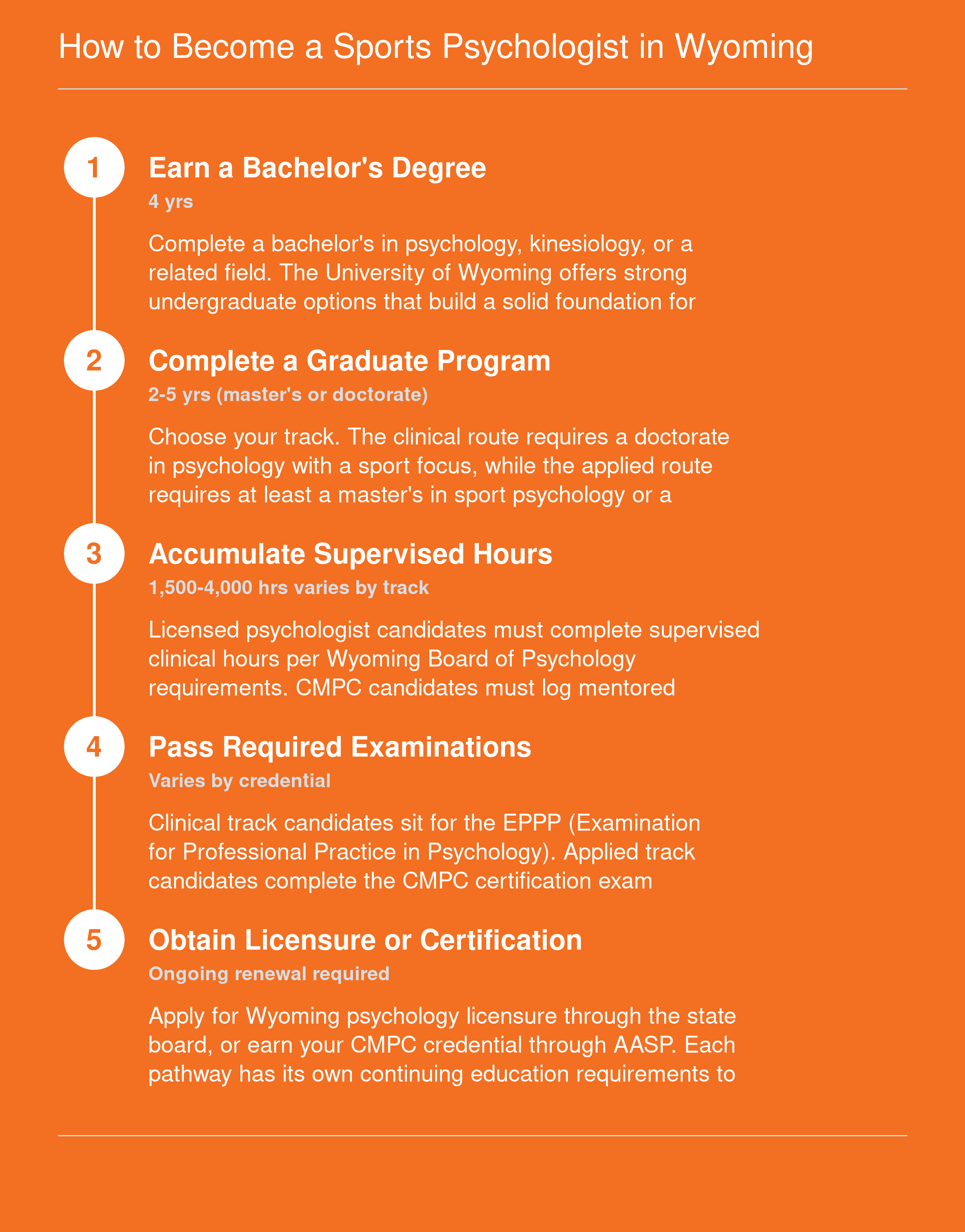
Wyoming does not offer an in-state doctoral program in sport psychology, so most aspiring professionals complete graduate work out of state or online. Two distinct tracks exist: the clinical route (licensed psychologist) and the applied route (Certified Mental Performance Consultant). Both begin with the same undergraduate foundation.
Step-by-Step: Education, Supervised Hours, and Credentialing
Building a career in sports psychology takes deliberate planning at every stage, from your first undergraduate courses through the final credential on your wall. Wyoming offers two distinct professional paths, and the education decisions you make early on will determine which doors open later. Here is how each phase unfolds.
Undergraduate Preparation
A bachelor's degree in psychology, kinesiology, or exercise science provides the strongest foundation. Admissions committees for graduate programs typically look for coursework in research methods, statistics, abnormal psychology, and human anatomy or physiology. Adding electives in sport and exercise psychology, motor learning, or coaching theory signals genuine interest in the field and strengthens your application.
Beyond academics, look for ways to gain practical exposure. Volunteering with university athletic departments, shadowing a mental performance consultant, or working in campus recreation all help you build relevant experience. Strong letters of recommendation from faculty who know your research aptitude or applied skills can also set you apart. Students in neighboring states such as those exploring sports psychology programs in South Dakota or how to become a sports psychologist in Utah often face similar preparation requirements.
Graduate Specialization: Master's vs. Doctorate
The graduate degree you choose shapes your entire career trajectory.
Master's degree: Qualifies you to pursue Certified Mental Performance Consultant (CMPC) certification through the Association for Applied Sport Psychology (AASP). This path focuses on performance enhancement, goal setting, and mental skills training rather than clinical diagnosis.1
Doctoral degree: Required if you want to earn licensure as a psychologist through the Wyoming Board of Psychology. A doctorate allows you to diagnose and treat clinical conditions such as anxiety, depression, or eating disorders alongside performance work.2
If your goal is to work with athletes on mental skills in a non-clinical capacity, a master's program may be the most efficient route. If you want the full clinical scope of practice, including the ability to bill insurance and treat psychopathology, a doctoral program is necessary.
Supervised Experience
Wyoming requires a total of 3,000 supervised hours for psychologist licensure, split evenly between 1,500 pre-doctoral hours and 1,500 post-doctoral hours, completed over a minimum of two years (with at least one year post-doctoral).2 Candidates must also pass the Examination for Professional Practice in Psychology (EPPP) with a minimum score of 500.2
Because Wyoming joined PSYPACT in 2023, residents can practice telepsychology across participating states, and this interstate compact can also expand options for accumulating supervised hours.4 If in-state placements are limited, telehealth supervision arrangements with approved supervisors in other PSYPACT member states may help you fulfill requirements without relocating.
For the CMPC track, the supervised experience looks different. AASP requires a minimum of 400 mentored hours of applied work with athletes or performers, including at least 50 hours of direct supervision from an approved mentor.1 These hours can often be completed through graduate assistantships, campus sport psychology centers, or community-based consulting.
Choosing Your Credential
Think of this as a decision point rather than a single ladder. The two credentials serve different professional roles:
CMPC certification requires a master's degree (at minimum), completion of the mentored experience, and passing the AASP certification exam. It positions you as a mental performance consultant.1
Psychologist licensure in Wyoming requires a doctoral degree in psychology, 3,000 supervised hours, the EPPP exam, and ongoing continuing education of 30 hours every two-year renewal cycle.25
Wyoming also offers a Psychological Practitioner credential with a lower EPPP passing threshold of 450, which may suit professionals with specific scopes of practice.1
Both credentials demand ongoing professional development. Whichever path you choose, plan your timeline early, identify supervisors or mentors before you need them, and stay in regular contact with the Wyoming Board of Psychology or AASP to confirm that your training meets current requirements.
Questions to Ask Yourself
Do you want to diagnose and treat clinical conditions in athletes, or focus on performance optimization?
This question shapes your entire degree path. Treating anxiety, eating disorders, or trauma requires a doctoral degree and clinical licensure, while a performance-focused career centered on goal-setting and visualization can begin with a master's degree and CMPC certification.
Are you prepared to pursue a doctoral program out of state or online, or does a master's-level CMPC path better fit your timeline?
Wyoming does not currently offer a doctoral program in sport psychology. If you need a doctorate, you will study out of state or online, adding years and cost. A master's with CMPC certification can get you practicing sooner.
Could you build a Wyoming-based practice around telehealth, or do you need proximity to a specific athletic community?
Wyoming's low population density means many clients will be spread across rural areas. Telehealth can dramatically expand your reach, but if you want sideline access to collegiate or high school teams, location near places like Laramie or Casper matters.
Are you comfortable navigating a state licensing process that may require supervision hours completed elsewhere?
Because in-state doctoral training and approved supervision sites are limited, many aspiring psychologists in Wyoming accumulate supervised hours in neighboring states before transferring credentials. Planning for this early prevents delays in your career timeline.
Wyoming Licensure vs. CMPC Certification: A Side-by-Side Comparison
Aspiring sports psychology professionals in Wyoming generally pursue one of two credentials: licensure as a psychologist through the Wyoming Board of Psychology, or Certified Mental Performance Consultant (CMPC) certification through the Association for Applied Sport Psychology (AASP). These paths differ significantly in education requirements, scope of practice, and professional title. Only individuals licensed by the Wyoming Board may legally use the title "psychologist" in the state, while CMPC holders work as mental performance consultants. Understanding these distinctions will help you choose the path that fits your career goals.
Dimension
Wyoming Psychologist Licensure
CMPC Certification (AASP)
Required Degree
Doctoral degree (Ph.D. or Psy.D.) in psychology from a regionally accredited institution
Master's degree or higher in sport science, psychology, or a closely related field
Examination
Examination for Professional Practice in Psychology (EPPP) plus any state jurisprudence requirements
CMPC certification exam administered by AASP
Supervised Experience
Minimum of two years (typically 3,000+ hours) of supervised professional experience, including a predoctoral internship
Minimum of 400 mentored hours of direct mental performance consultation under an approved mentor
Scope of Practice
Full scope of psychological services, including clinical diagnosis, psychotherapy, and mental performance work
Mental performance consulting only (goal setting, imagery, focus training, team dynamics); cannot diagnose or treat clinical mental health disorders
Protected Title
May use the title "psychologist" in Wyoming, which is legally protected under state statute
Uses the title "Certified Mental Performance Consultant"; cannot represent oneself as a psychologist
Renewal Requirements
Biennial renewal with continuing education credits as specified by the Wyoming Board of Psychology
Renewal every five years, requiring 75 continuing education credits and ongoing professional development
Typical Work Settings
Private practice, university counseling centers, hospitals, athletic departments, and sports organizations
Tuition, Costs, and Financial Aid Across Ranked Programs
Comparing tuition across Wyoming's ranked programs reveals a wide range of costs, especially for out-of-state students. The net price figures shown below represent institution-wide averages after financial aid and are not guaranteed quotes for individual students. Your actual cost will depend on your financial aid package, residency status, and enrollment details.
Sports Psychology Careers and Salary Outlook in Wyoming
Wyoming's job market for sports psychologists is small but growing, shaped by the state's unique mix of collegiate athletics, rodeo culture, and wide-open spaces. Understanding the salary landscape and employer types will help you set realistic expectations as you plan your career.
What the Salary Data Tells Us
The Bureau of Labor Statistics does not break out a separate category for sport psychology.1 Instead, sport psychologists are captured under broader classifications such as "Psychologists, All Other" (SOC 19-3039).2 Nationally, that group reported a median annual wage of roughly $117,750 as of May 2023, with the 10th percentile near $47,450 and the 90th percentile around $157,420.2
Wyoming-specific percentile data for these roles is often suppressed because the state's employment sample is too small for reliable estimates.3 The most recent published Wyoming figures place total psychologist employment in the range of 50 to 200 professionals statewide.3 An older state wage report listed a mean annual wage of about $53,500 for psychologists in Wyoming, though that figure dates back nearly two decades and should be treated as a rough historical reference rather than a current benchmark.4 Salaries today are likely higher, but definitive state-level medians are not yet available for this occupation.
Program-level earnings data for graduates of related programs at Wyoming institutions are not currently reported, so it is difficult to pin down a starting-salary trajectory specific to sport psychology completers. As a general guide, entry-level practitioners in rural states tend to earn toward the lower end of the national range, while those who build a niche practice or secure a university position can approach or exceed the national median over time.
Who Hires Sport Psychologists in Wyoming
Despite a relatively small population, Wyoming offers several employer categories worth targeting:
University athletics departments: The University of Wyoming fields 17 Division I teams and increasingly values mental performance support for student-athletes.
High school districts: With growing awareness of adolescent mental health in sports, districts across the state are beginning to contract sport psychology consultants.
Private practice: Licensed psychologists can establish independent practices in cities like Cheyenne, Casper, and Laramie, combining clinical work with performance consulting.
Community mental health centers: These organizations sometimes hire psychologists who can integrate sport and exercise psychology into broader wellness programming.
Rodeo and equestrian organizations: Wyoming's deep ties to rodeo create a distinctive client base. Competitive ropers, riders, and barrel racers benefit from mental skills training just as much as any other athlete.
Telehealth platforms: This is an especially important channel in a state where the nearest city may be hours away.
The Telehealth Advantage
Wyoming is the least densely populated state in the country, which makes in-person sessions impractical for many potential clients. Telehealth has become a natural fit. Licensed practitioners based in Wyoming can serve athletes in remote ranching communities, and those holding proper credentials can also work with out-of-state clients through interstate telehealth compacts. If you hold a Certified Mental Performance Consultant (CMPC) credential, you can deliver non-clinical performance consulting across state lines without a psychology license, widening your potential client base considerably. Neighbors like Utah face similar rural-access challenges, and aspiring professionals there are also exploring telehealth-forward models; you can learn more about sports psychology programs in Utah for a comparison.
For aspiring professionals, this means that building a Wyoming-based practice does not limit you to local demand. A well-marketed telehealth service can reach collegiate athletes, weekend competitors, and professional rodeo circuits throughout the Mountain West and beyond.
Even before the pandemic accelerated virtual care, a substantial share of psychologists serving rural patients were already delivering services remotely. By 2020, roughly 24 percent provided care exclusively through telepsychology, and another 34 percent used a hybrid model combining in-person and virtual sessions. For a frontier state like Wyoming, this trend continues to expand access to mental performance services for athletes in communities far from major metro areas.
Practical Training Opportunities for Sport Psychology Students in Wyoming
Hands-on experience is the bridge between coursework and professional competence, and Wyoming offers several pathways to build that experience, even if the options are fewer than what you would find in a larger metro area. Below is a breakdown of the training landscape and some strategies for making it work.
University of Wyoming Athletics and Campus Resources
The University of Wyoming maintains a dedicated sport psychology function within its athletics department, providing individual therapy, educational programming, and workshops for student-athletes.1 For graduate students enrolled in UW's sport and exercise psychology track, this creates a natural practicum setting where you can work alongside licensed professionals in a Division I environment.2 Internship opportunities are built into the program, and graduate assistantship positions within the athletics department or counseling and psychology departments can offset tuition while giving you supervised clinical hours. If you are considering UW, ask early about GA availability, as these positions are competitive and often filled a full academic year in advance.
Community and Fieldwork Settings
Beyond the university, Wyoming's athletic culture opens doors for creative fieldwork placements:
High school athletics: The Wyoming High School Activities Association oversees programs across the state, and many schools welcome practicum students who can support athlete mental health and performance.
Rodeo and equestrian programs: Wyoming's deep ties to rodeo make this a distinctive training niche. Working with rodeo athletes and equestrian competitors provides exposure to performance psychology in high-risk, individual-sport contexts.
Club sports and recreation: Youth club teams in sports like soccer, swimming, and basketball offer group workshop and team-building opportunities.
Adaptive sports organizations: Programs serving athletes with disabilities are growing across the Mountain West and can provide meaningful, underserved practicum experiences.
These settings let you build a diverse applied portfolio that stands out on a credential application.
Arranging Fieldwork as an Online Student
If you are completing a degree through an online or out-of-state program, you will need to confirm that your institution holds proper state authorization to place students in supervised fieldwork within Wyoming. Check with your program's field placement office and with the Wyoming Department of Education or relevant licensing board. Students in neighboring states face similar rural-supervision challenges; those pursuing sports psychology programs in Montana may find useful parallels. You will also need a qualified on-site supervisor. Griffin Richards, an LPC and CMPC practicing in Wyoming, is one of the few AASP-certified consultants in the state and may be a resource.3 Lauren Zimmerman, who earned her doctorate at UW and now works with Premier Sport Psychology, is another professional connected to the Wyoming sport psychology community.4
When Local Supervisors Are Limited
Wyoming's small population means the pool of credentialed sport psychology supervisors is limited. If you cannot find an approved supervisor nearby, consider these options:
Telehealth supervision: Many credentialing bodies, including AASP, now accept remote supervision sessions, which can supplement in-person contact hours.
Cross-state agreements: Some programs allow supervisors licensed in neighboring states to oversee your fieldwork, provided all parties agree in writing.
Regional travel: Cities like Denver (about three hours from Cheyenne) and Bozeman (roughly five hours from Sheridan) have larger concentrations of CMPC holders and licensed psychologists specializing in sport. Periodic travel for face-to-face supervision, combined with telehealth check-ins, is a workable model that many rural trainees use successfully.
Planning ahead is essential. Before committing to a program, map out your supervision plan and confirm that your chosen credential pathway will accept the arrangement. Reaching out to practicing professionals in the state early, even a year before you need a placement, gives you the best chance of securing a good fit.
Online and Regional Programs Worth Considering from Wyoming
Wyoming's limited in-state options for sport psychology graduate study do not have to limit your career path. A growing number of accredited online programs and nearby regional universities make it possible to earn a master's or doctoral degree without relocating. The key is knowing which programs align with your credential goals and which logistical details to confirm before you enroll.
Online Programs and NC-SARA Enrollment
Wyoming participates in the National Council for State Authorization Reciprocity Agreements (NC-SARA), which means most SARA-member institutions can legally enroll Wyoming residents in online coursework. This opens the door to well-regarded online master's and doctoral programs across the country. Before committing, confirm that a program's SARA membership is current and that it can deliver any required practicum or clinical placement hours in Wyoming. SARA covers coursework, but supervised field experiences often require separate state-level approval. Reaching out to a program's field placement coordinator early in the admissions process can save you months of confusion later.
Regional Brick-and-Mortar Options
Students who prefer face-to-face learning or hybrid formats will find several strong programs within reasonable driving distance of Wyoming's population centers.
Colorado: Multiple universities along the Front Range offer graduate degrees in sport and performance psychology, some with weekend-intensive or hybrid scheduling. See our guide to sports psychology programs in colorado for a closer look.
Montana: Programs in the state's university system may appeal to northern Wyoming residents looking for shorter commutes.
Utah: Institutions along the Wasatch Front provide additional options, and some incorporate applied sport psychology concentrations at the master's level.
Hybrid and weekend-intensive formats can be especially practical if you plan to continue working or training athletes in Wyoming while completing your degree.
Matching Your Program to Your Credential Goals
Not every online or regional program will set you up for the credential you want. If you are pursuing the Certified Mental Performance Consultant (CMPC) designation, verify that the program's curriculum satisfies the coursework domains required by the Association for Applied Sport Psychology (AASP). Look for coverage in sport science foundations, psychopathology, counseling techniques, and ethics. If your goal is licensure as a psychologist, the program must meet American Psychological Association (APA) accreditation standards, which adds requirements around supervised clinical hours and a predoctoral internship.
A simple checklist before applying to any distance or regional program:
Confirm SARA membership or direct state authorization for Wyoming.
Ask whether practicum and internship placements can be arranged in Wyoming.
Review the course catalog against AASP coursework requirements or APA accreditation criteria, depending on your credential path.
Clarify residency requirements, such as on-campus intensives, and estimate travel costs.
Taking these steps upfront helps ensure the program you choose moves you toward licensure, CMPC certification, or both, without unexpected detours.
Wyoming's low population density means early-career sport psychologists face far less competition than their peers in major metro areas. At the same time, the state's niche athletic communities, including rodeo, skiing, and outdoor adventure sports, create specialized demand that very few practitioners currently serve. For professionals willing to build relationships in these tight-knit circles, Wyoming offers a rare chance to establish a practice quickly.
Frequently Asked Questions About Sports Psychology in Wyoming
Wyoming's sports psychology landscape is small but full of opportunity, especially for students willing to combine in-state and online resources. Below are the questions prospective students and early-career professionals ask most often, answered as concisely as possible for 2026.
Are there accredited sports psychology programs in Wyoming?
Wyoming does not currently have a standalone, APA-accredited sports psychology degree program within its borders. However, the University of Wyoming offers graduate psychology coursework and kinesiology studies that can serve as a foundation. Many Wyoming residents pair in-state coursework with accredited online programs from institutions in neighboring states or nationally recognized universities to build a complete credential pathway.
Can I get a sports psychology degree online from Wyoming?
Yes. While no Wyoming-based university offers a fully online sports psychology degree as of 2026, residents can enroll in accredited online programs from institutions across the country. Schools such as the University of Western States, Capella University, and others offer master's or doctoral programs in sport and performance psychology that Wyoming students can complete remotely, often with flexible practicum arrangements.
What license do you need to practice sports psychology in Wyoming?
If you plan to provide clinical or counseling services, you need licensure through the Wyoming Board of Psychology, typically as a licensed psychologist (requiring a doctoral degree, supervised experience, and passing the EPPP). Professionals who focus solely on mental performance coaching rather than therapy may practice under the Certified Mental Performance Consultant (CMPC) credential without a psychology license.
What is the difference between CMPC certification and psychologist licensure in Wyoming?
Psychologist licensure in Wyoming is a state-regulated clinical credential requiring a doctoral degree, supervised hours, and the EPPP exam. It allows you to diagnose and treat mental health conditions. CMPC certification, granted by the Association for Applied Sport Psychology, focuses on mental performance optimization and requires a master's degree plus mentored experience. CMPCs cannot provide therapy but can coach athletes on focus, confidence, and performance skills.
What is the salary of a sports psychologist in Wyoming?
Precise salary data specific to sports psychologists in Wyoming is limited due to the small labor market. According to Bureau of Labor Statistics figures, psychologists in Wyoming earn a median that generally aligns with the national range for the broader psychology field, often falling between $70,000 and $100,000 depending on setting and experience. Private practice, collegiate athletics, and consulting roles may offer different compensation structures.
Does the University of Wyoming offer a sports psychology program?
The University of Wyoming does not offer a dedicated sports psychology degree as of 2026. However, the university's psychology department and its College of Health Sciences provide relevant graduate-level coursework in counseling, kinesiology, and human performance. Students interested in sport psychology often use these programs as a launchpad, supplementing with sport-specific training through online or regional institutions.
Can I practice sport psychology in Wyoming with an out-of-state license?
Wyoming participates in the Psychology Interjurisdictional Compact (PSYPACT), which allows licensed psychologists from other PSYPACT member states to practice telepsychology or provide temporary in-person services in Wyoming. If you hold a non-PSYPACT out-of-state license, you would typically need to apply for licensure through the Wyoming Board of Psychology and meet its specific requirements before practicing independently in the state.