Types of Sports Psychology Degrees Available in Indiana
Indiana's sports psychology degree landscape spans four distinct tiers, each opening different career doors. Understanding which level matches your professional goals is the single most important decision you will make before applying.
Bachelor's Degrees: Building the Foundation
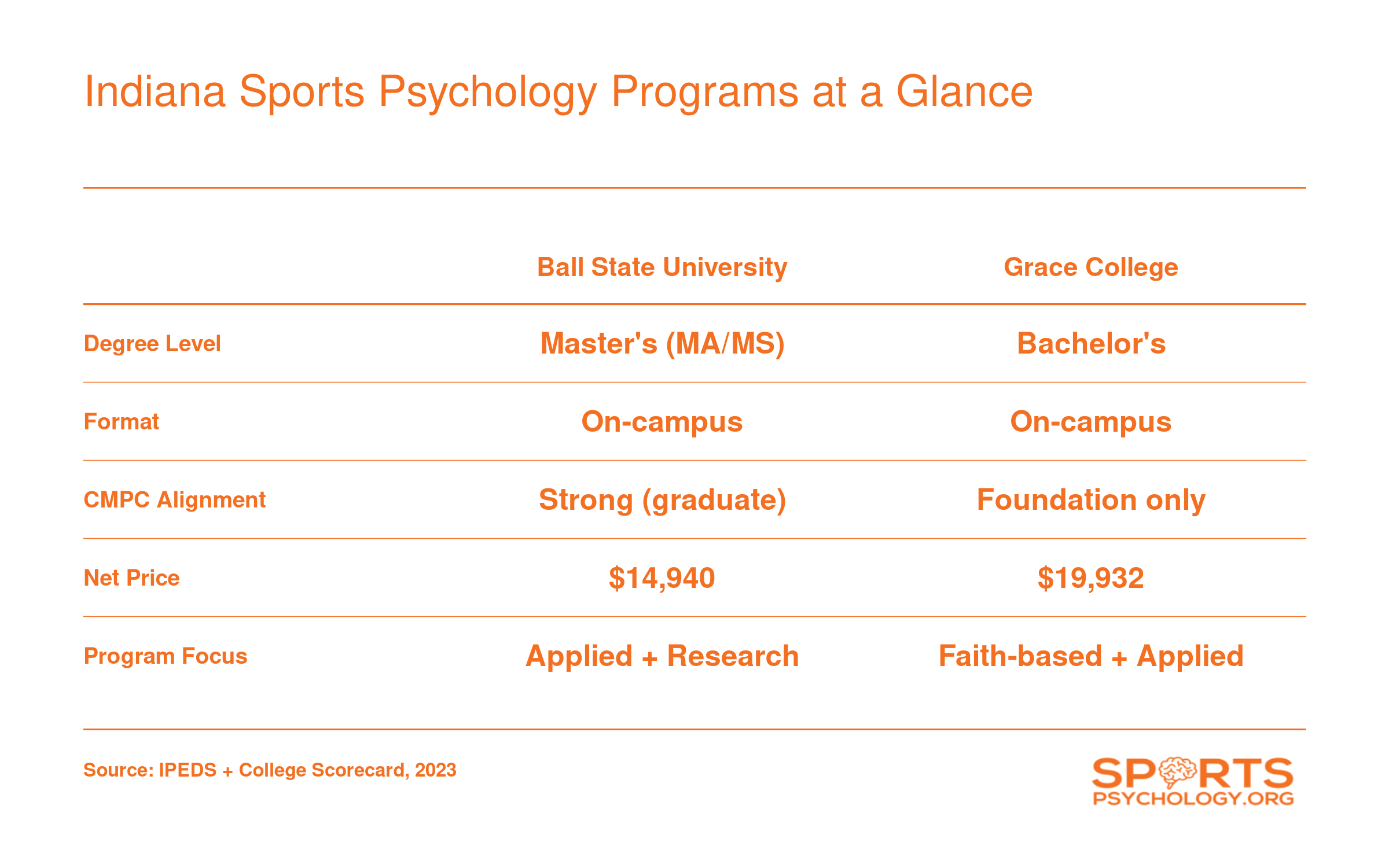
A bachelor's degree in exercise science or psychology with a sport psychology concentration gives you the academic groundwork to enter the field. Grace College and Theological Seminary in Winona Lake offers an on-campus Bachelor's in Sport Psychology rooted in a psychology major foundation. The program blends behavioral science core courses with kinesiology, nutrition, health psychology, and motivation in athletics coursework. Students complete a required practicum or internship, with placement opportunities in sports leagues, athletic centers, and mental health settings.
Grace College is also worth noting as a faith-based option, integrating a biblical worldview throughout its curriculum. If aligning your studies with a Christian perspective matters to you, this is a meaningful differentiator that few competitors in the state offer.
A bachelor's degree alone will not qualify you to practice independently as a sport psychologist or mental performance consultant, but it positions you well for graduate study or entry-level roles in athletics departments, youth sports organizations, or fitness settings.
Master's Degrees: The Most Common Entry Point for Applied Work
For most aspiring practitioners, a master's degree is where applied careers begin. Ball State University in Muncie offers a Master of Arts or Science in Sport and Exercise Psychology through its School of Kinesiology. The 33-credit-hour program includes core coursework in sport psychology, applied sport and exercise psychology, ethical issues in sport, psychology of injury rehabilitation, and psycho-social processes. A thesis or research project is required, along with a practicum, and the program is structured to prepare graduates for Certified Mental Performance Consultant (CMPC) certification.
This tier is critical if your goal is to work directly with athletes as a mental performance consultant. With a master's degree and CMPC credentials through the Association for Applied Sport Psychology, you can legally help athletes with goal-setting, focus, visualization, and performance enhancement in most states, including Indiana.
Doctoral Degrees and the Clinical Distinction
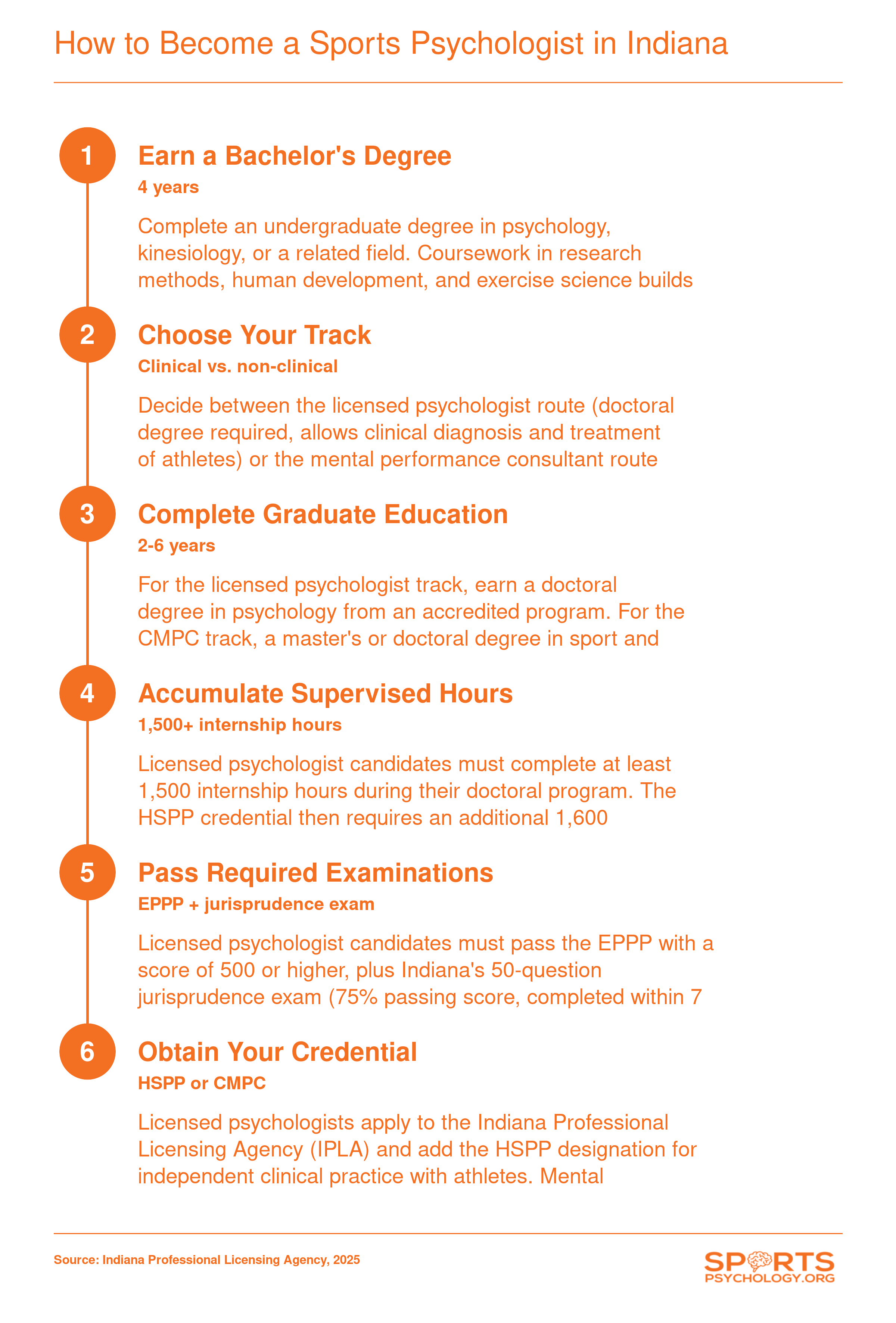
Here is where a common point of confusion needs to be cleared up. The title "sport psychologist" carries a specific legal meaning in Indiana. If you want to provide clinical therapy, diagnose mental health conditions, or treat issues like depression and anxiety in athletes, you need a doctoral degree (PhD or PsyD) in psychology and state licensure as a psychologist. Indiana does not currently house a doctoral program explicitly branded as sport psychology, so students pursuing the clinical route typically earn a doctorate in clinical or counseling psychology and then specialize in sport populations through electives, practica, or postdoctoral work. For a deeper look at how these two pathways compare, see our guide on clinical vs. performance focus.
By contrast, a "mental performance consultant" works on the performance side, helping athletes train their mental game without providing clinical therapy. This path requires a master's degree and CMPC certification but not a doctoral degree or psychology license.
Graduate Certificates
Graduate certificates in sport psychology or mental performance offer a shorter credential for professionals who already hold a master's or doctoral degree in a related field and want to add sport-specific training. As of 2026, dedicated graduate certificate programs in sports psychology are limited in Indiana. Professionals in the state may need to look at accredited online certificate options or neighboring states to fill this gap.
Kinesiology Programs vs. Psychology Department Programs
One final note that trips up many applicants: where a program is housed matters. Ball State's sport and exercise psychology program sits within the School of Kinesiology, which means it emphasizes performance enhancement, exercise behavior, and applied mental skills training. Programs housed in psychology departments, on the other hand, lean toward clinical assessment, counseling theory, and diagnosis. Neither approach is better in absolute terms, but the distinction shapes your coursework, your supervision hours, and ultimately the type of professional you become. Before you apply anywhere, confirm whether a program's home department aligns with the career you actually want.