No Iowa college currently offers a dedicated sports psychology degree, making online programs the most practical option.
Iowa's three NCAA Division I schools plus dozens of smaller programs create steady local demand for sport psychology professionals.
Licensed psychologists need a doctoral degree while earning the CMPC credential requires a master's degree at minimum.
Iowa psychologists in the broader category earn a median annual wage near $97,000, providing a useful salary benchmark.
No college or university in Iowa currently offers a dedicated sports psychology degree, which means aspiring sport psychology professionals in the state face a practical constraint from the start. The good news: accredited online programs from institutions across the country accept Iowa residents, and several rank among the strongest graduate options in the field.
Demand for mental performance services is rising in Iowa, driven by three NCAA Division I athletic departments, a deep bench of Division II and III programs, and a growing youth sports culture that increasingly values psychological skills training. Practitioners who can serve these populations, whether through doctoral licensure or the Certified Mental Performance Consultant credential, are positioning themselves in a market with limited local competition and expanding need.
Best Online Sports Psychology Programs for Iowa Students
Iowa does not currently offer a dedicated sports psychology degree at any in-state college or university. That means online programs are the most practical route for Iowa residents who want to study sport and performance psychology without relocating. Every school on this list accepts students nationwide, and most participate in NC-SARA, so Iowa enrollment is straightforward. Practicums and internships can typically be arranged at local Iowa sites with faculty approval, letting you gain hands-on experience close to home.
NCES-IPEDS federal institutional data — nces.ed.gov
Independent program research
Internal program database
Arizona State University
#1
Tempe, AZ · $15,000/yr
Best for: Undergrads wanting a flexible accelerated format
Arizona State University pairs a strong 68% institution-wide graduation rate with a fully online bachelor's program in sport and performance counseling. Iowa students pay a uniform online tuition rate and can arrange their required internship at sport or mental health sites in Iowa. With an 18:1 student-to-faculty ratio and faculty drawn from recognized researchers, ASU provides a large-university infrastructure that supports flexible, accelerated coursework delivered in 7.5-week blocks.
Counseling and Applied Psychological Science, Sport and Performance Counseling — Online
Online Bachelor of Science with sport and performance counseling concentration
120 credit hours across 40 accelerated 7.5-week courses
Required internship in a sport or mental health setting
Covers motivation, confidence, anxiety, and injury recovery
Admission options include 3.00 GPA or top 25% class rank
ACT/SAT scores are optional for applicants
Financial aid available; diploma does not indicate online delivery
Best for: Graduate students pursuing CMPC certification
Southern Illinois University-Edwardsville offers one of the more affordable master's options on this list, with a flat tuition rate that applies equally to Iowa students. The MS in Kinesiology with an Exercise and Sport Psychology specialization can be completed in 12 to 22 months and aligns coursework with Certified Mental Performance Consultant (CMPC) requirements. Note that some evening or synchronous class sessions may apply, so Iowa students should confirm remote feasibility before enrolling.
MS in Kinesiology, Exercise and Sport Psychology — Hybrid
Master of Science with exercise and sport psychology specialization
Completable in 12 to 22 months
Evening class schedule with some asynchronous options
Coursework prepares students for CMPC certification
Strong faculty mentoring with personalized attention
Covers sport psychology, coaching psychology, and physical activity
Best for: Transfer students needing year-round enrollment
California Baptist University delivers a fully asynchronous online bachelor's degree in Sport and Performance Psychology that Iowa students can finish in as few as 16 months. The 49-unit program features six annual start dates and year-round admissions, making it one of the more flexible options for working adults or transfer students. CBU's curriculum blends exercise physiology, behavioral sport psychology, and cognitive psychology, and the university holds WSCUC accreditation.
Sport and Performance Psychology, BS — Online
Online Bachelor of Science requiring 49 units
Completable in 16 months at full-time pace
100% asynchronous with classes starting every 8 weeks
Covers exercise physiology, behavioral and cognitive psychology
Transfer-friendly with six entry points per year
$520 per unit plus fees; financial aid available
Emphasizes ethics, diversity, and integration of faith with practice
Southern Connecticut State University's interdisciplinary MS in Exercise Science with a Sport Psychology concentration draws faculty from three departments: Health and Movement Sciences, Counseling, and Psychology. The 33-to-34-credit program is designed to meet CMPC certification requirements. Iowa students should be aware that out-of-state graduate tuition applies and that certain hybrid components may require occasional on-site attendance. The school's 11:1 student-to-faculty ratio supports close mentorship.
Exercise Science, M.S., Sport Psychology — Hybrid
33 to 34 credit interdisciplinary master's program
Sport Psychology concentration prepares for CMPC certification
Faculty from three academic departments
Covers health psychology, counseling, and performance enhancement
11:1 student-to-faculty ratio for close mentorship
Hybrid delivery; confirm remote availability for Iowa students
Texas A&M University-Kingsville offers a Performance Psychology concentration within its MS in Kinesiology. Students choose among three degree plans, ranging from a 30-credit thesis track to a 36-credit course-only option with an internship. The program aligns with CMPC exam preparation. However, some face-to-face courses are required on the Kingsville campus, so Iowa students should plan for travel or temporary relocation.
M.S. in Kinesiology, Performance Psychology — Hybrid
Performance Psychology concentration within kinesiology MS
Three degree plans: 30-credit thesis or 36-credit non-thesis options
Coursework aligned with CMPC examination requirements
Internship or research project available in non-thesis tracks
Some required face-to-face courses on campus
Out-of-state tuition of approximately $14,560 per year
Troy University's online MS in Kinesiology with a Sports Psychology concentration is built for working professionals who need scheduling flexibility. The program is NC-SARA authorized in Iowa, and internship placements can be arranged at approved sites in a student's local community. Out-of-state online tuition is approximately $17,100 per year, with no separate surcharge for Iowa residents beyond the standard online rate.
Master of Science in Kinesiology, Sports Psychology — Hybrid
Online master's with a Sports Psychology concentration
Flexible scheduling designed for working professionals
Internships arranged at locally approved sites, including Iowa
Curriculum includes Sport Psychology and Motor Skills courses
No application deadline; rolling admissions
Faculty bring professional sports psychology experience
Kent State University offers a fully online Bachelor of Science in Sport, Exercise and Performance Psychology that Iowa residents can complete in four years. The 120-credit program covers motivation, stress management, injury psychology, and mental skills training, culminating in a practicum experience that can be arranged locally. Non-resident online students pay a reduced rate compared to on-campus out-of-state tuition, with estimated total costs around $54,900.
Sport, Exercise and Performance Psychology — Online
100% online Bachelor of Science, 120 credit hours
Designed for four-year completion with a practicum
Covers motivation, mental training, and stress management
Includes sport injury psychology and ethics coursework
Reduced non-resident online tuition rate available
Prepares graduates for coaching, mental performance, or grad study
National University stands out for the breadth of its sport psychology offerings, spanning a bachelor's, two master's concentrations, and a doctoral specialization, all delivered 100% online. The MS in Sport Psychology is specifically designed to meet AASP certification coursework requirements, a meaningful advantage for Iowa students who lack an in-state AASP-aligned program. Fieldwork can be completed at approved sites in Iowa with remote supervision. The school's institution-wide median earnings ten years after enrollment reach approximately $67,500.
Master of Science in Sport Psychology — Online
36-credit, 100% online MS completable in 18 to 21 months
Aligns with AASP/CMPC certification coursework standards
No application fee, essays, or entrance exams required
Transfer credits accepted up to 12 hours
Optional fieldwork at student-arranged local sites
Covers counseling skills, ethics, diversity, and kinesiology
Adams State University's online MS in Kinesiology with an Applied Sport Psychology emphasis is one of the most budget-friendly graduate options on this list, with a flat online tuition rate that applies equally to Iowa residents. The 36-credit program can be completed in two years and includes internships and a capstone project. Coursework covers mental strength, ethics, and diversity in sport, and all classes are delivered asynchronously.
Master of Science in Kinesiology, Applied Sport Psychology — Online
36-credit online master's completable in two years
Applied Sport Psychology emphasis
Flat online tuition with no out-of-state surcharge
All coursework delivered asynchronously online
Includes practicum, internships, and a capstone project
Covers mental strength, ethics, case studies, and diversity
Springfield College brings a strong institutional graduation rate of about 74% and an 11:1 student-to-faculty ratio to its online MEd in Sport and Exercise Psychology. The 36-credit program features 100% asynchronous delivery and a 135-hour applied internship with remote supervision, making it especially workable for Iowa students who want to complete fieldwork locally without relocating. Full-time students can finish in roughly 18 months.
MEd in Sport and Exercise Psychology Online — Online
36-credit, 100% asynchronous online Master of Education
Completable in 18 months at full-time pace
135-hour applied internship with remote supervision
Flexible 7-week and 15-week course formats
Rolling domestic admissions; fall semester start
Admissions require essay, resume, two recommendation letters
International applicants accepted with TOEFL/IELTS
Do you want to become a licensed psychologist in Iowa or a Certified Mental Performance Consultant (CMPC)?
This choice determines your entire educational path. Licensed psychologists in Iowa must complete a doctoral degree, while the CMPC credential requires a master's degree. The time, cost, and scope of practice differ significantly between the two tracks.
Can you complete practicum hours remotely, or do you need a program with Iowa-based field placement partnerships?
Some online programs leave students responsible for finding their own supervised field placements locally. If you live in a rural part of Iowa, confirming that a program has existing site agreements in the state can save months of logistical headaches.
Is your top priority affordability, program reputation, or alignment with AASP coursework requirements?
Programs vary widely in tuition, name recognition, and whether their curriculum maps directly to Association for Applied Sport Psychology standards. Ranking your priorities early helps you filter options quickly instead of comparing dozens of schools on every metric.
Are you coming from a background in kinesiology, psychology, or an unrelated field?
Your existing coursework affects how many prerequisite credits you may need before starting a graduate program. Some schools offer bridge courses for career changers, while others assume foundational knowledge in both psychology and exercise science.
How to Become a Sports Psychologist in Iowa
If you want to work with athletes on the mental side of performance in Iowa, you have two main professional pathways to consider. The route you choose depends on whether you want to pursue full licensure as a psychologist or focus specifically on mental performance consulting. Iowa does not offer a separate sport psychology license, so practitioners work under either the general psychology license or the Certified Mental Performance Consultant (CMPC) credential. Understanding how to become a sports psychologist can help you weigh these options before committing to a program.
Path 1: Licensed Psychologist with a Sport Focus
This is the clinical route and the only pathway that allows you to use the title "sports psychologist" in Iowa. The Iowa Board of Psychology oversees licensure, and the requirements are substantial.1
Doctoral degree: You must earn a doctorate from a program accredited by the APA, CPA, or one recognized through the ASPPB/National Register designation.2 A doctoral program in clinical or counseling psychology with a sport psychology concentration is ideal.
Postdoctoral supervised experience: Iowa requires 1,500 hours of supervised postdoctoral experience completed over a minimum of 10 months. You need at least one hour of supervision per week and must accumulate a minimum of 45 total supervision hours across the postdoctoral period.2
EPPP exam: You must pass the Examination for Professional Practice in Psychology with a score of 500 or higher.2
No jurisprudence exam: Unlike some states, Iowa does not currently require a separate jurisprudence or state law exam for licensure.1
Continuing education: Once licensed, you must complete 40 hours of continuing education per renewal cycle, including at least 6 hours in law and ethics.
This pathway typically takes 10 to 12 years from the start of your undergraduate degree through the completion of postdoctoral hours.
For many Iowa students, the CMPC credential through the Association for Applied Sport Psychology (AASP) offers a faster, more accessible entry point. A CMPC is not a licensed psychologist and cannot diagnose or treat clinical mental health conditions, but this credential is well recognized across collegiate and professional athletics for performance-focused work.
Education: A master's in sports psychology is the minimum requirement. Your coursework must cover AASP-approved content areas in sport psychology, including performance enhancement, counseling skills, research methods, and the psychosocial aspects of sport.
Mentored experience: You need to complete mentored consulting hours under a qualified mentor, gaining hands-on experience working directly with athletes or performers.
CMPC exam: After meeting the education and mentoring requirements, you sit for the CMPC certification exam.
This route can be completed in roughly five to seven years from the start of undergraduate study, making it a practical option for students who want to enter the field without pursuing a doctorate.
Understanding the Title Distinction in Iowa
This is an important point that often causes confusion. In Iowa, only individuals licensed through the Iowa Board of Psychology may call themselves psychologists.1 If you hold a CMPC but not a psychology license, you can work with athletes on performance enhancement, goal setting, focus, and related skills, but you operate as a mental performance consultant rather than a psychologist. Both roles serve athletes, but the scope of practice differs significantly. A licensed psychologist can address clinical issues like anxiety disorders, depression, and eating disorders alongside performance concerns.
A Note on Interstate Practice
As of 2026, Iowa does not participate in PSYPACT, the interstate compact that allows licensed psychologists to practice telepsychology across participating state lines.1 If you are an Iowa-licensed psychologist hoping to work with athletes in other states via telehealth, you may need to obtain separate licensure in those states or monitor whether Iowa joins PSYPACT in the future. For CMPC holders, the credential is nationally recognized and does not carry the same state-by-state licensing restrictions, since it falls outside the scope of regulated psychology practice.
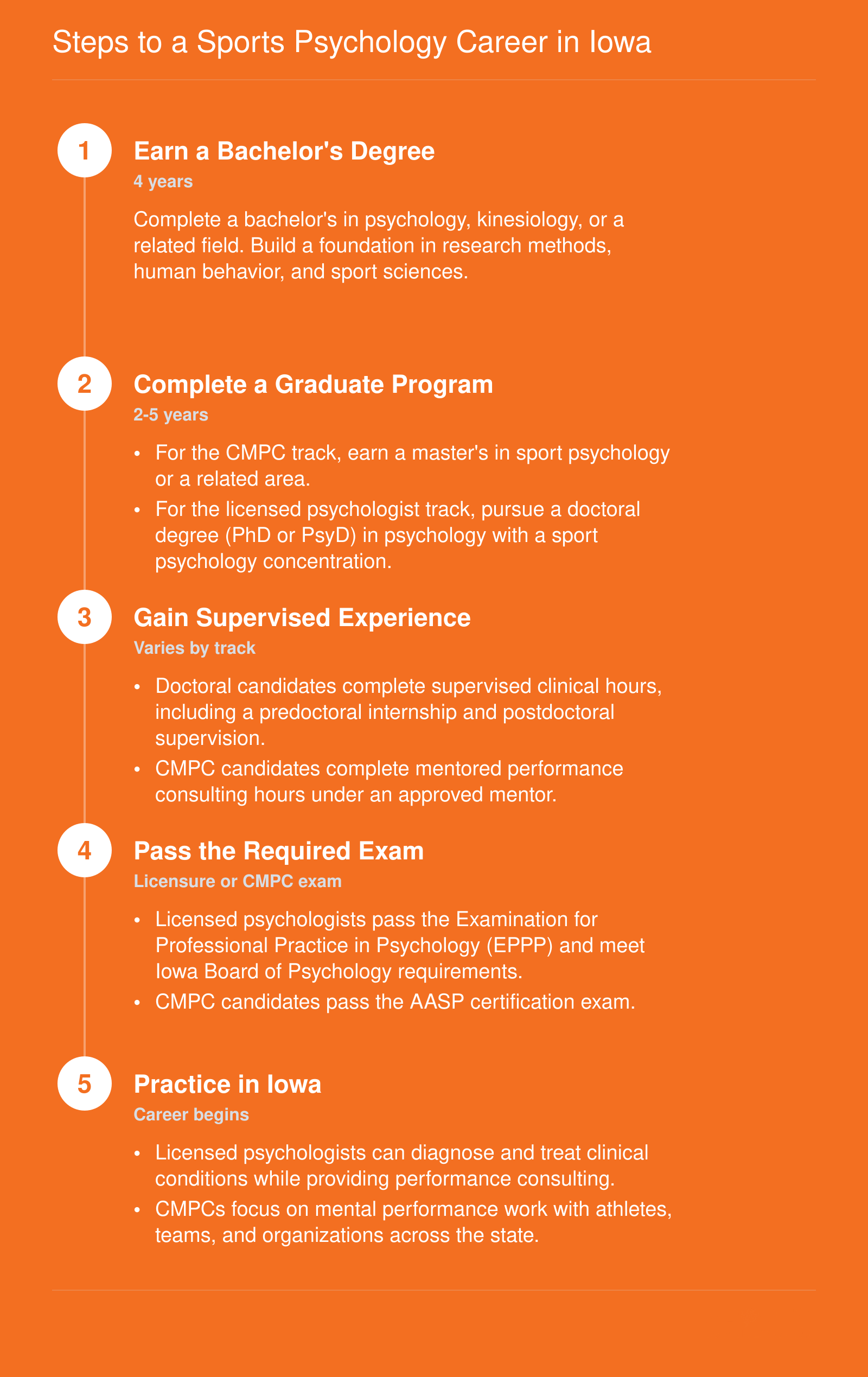
Steps to a Sports Psychology Career in Iowa
There are two parallel pathways into sports psychology practice in Iowa. The licensed psychologist track requires a doctoral degree, while the Certified Mental Performance Consultant (CMPC) track requires a master's degree. Both paths share early steps and converge at professional practice.
How to Choose a Sports Psychology Program From Iowa
Because Iowa does not currently host a dedicated sports psychology degree program, most students in the state will pursue an online (or hybrid) option from an out-of-state school. That is perfectly workable, but it means you need to be more deliberate about vetting each program. Here is what to evaluate before you commit.
Accreditation and Credential Alignment
Not every accreditation carries the same weight, and the one you need depends on your career goals. Understanding the difference between a clinical vs. performance focus early on will help you pick the right accreditation path.
CACREP accreditation: If you plan to combine sports psychology with licensed counseling in Iowa, look for programs accredited by the Council for Accreditation of Counseling and Related Educational Programs. Iowa's licensing board recognizes CACREP-accredited degrees, which streamlines the path to licensure as a mental health counselor.
APA accreditation: Doctoral programs in clinical or counseling psychology accredited by the American Psychological Association are essential if you want to practice as a licensed psychologist in Iowa. The state board expects APA-accredited (or equivalent) training for psychologist licensure.
AASP-aligned coursework: If your primary goal is the Certified Mental Performance Consultant (CMPC) credential, confirm that the curriculum explicitly covers the Association for Applied Sport Psychology's required knowledge areas: sport psychology, health and exercise psychology, psychopathology, research methods, and ethics. Programs like East Central University's M.S. in Sport Psychology and Texas A&M-Kingsville's M.S. in Kinesiology with a Performance Psychology concentration both advertise CMPC exam preparation, which is a helpful signal.
Online vs. On-Campus Tradeoffs for Iowa Students
Online delivery is the primary route for Iowans, and the good news is that several well-regarded programs are built for remote learners. Still, nearly every sports psychology program requires some form of supervised practicum or internship completed in person. Before enrolling, ask each program two specific questions: Does the school help students arrange local practicum placements, and does it already have relationships with any supervisors or sites in Iowa? A program that leaves placement logistics entirely to the student can add months of planning and uncertainty. Other states with limited in-state options, such as Alaska, face similar challenges, and reviewing how sports psychology programs for Alaska students handle remote placements may offer useful comparison points.
Tuition and Cost Considerations
Because you will almost certainly be classified as an out-of-state student, tuition rates vary significantly. Some schools charge a flat online rate regardless of where you live, which can save thousands of dollars. For context, among the top-ranked online programs available to Iowa students in 2026, graduate tuition ranges from roughly $400 to $763 per credit hour, while undergraduate online programs run around $613 to $623 per credit. At the master's level, a 36- to 45-credit program could cost anywhere from approximately $14,400 to $34,300 depending on the school and your residency classification. Always check whether the published per-credit rate applies to all online students or only to in-state residents.
Curriculum Checklist for CMPC Hopefuls
If the CMPC credential is on your radar, do not assume every "sports psychology" program covers what the certification exam requires. Pull up the program's course catalog and verify that you will complete coursework in each of AASP's required knowledge areas:
Sport psychology foundations
Health and exercise psychology
Psychopathology and abnormal psychology
Research methods and statistics
Professional ethics and standards
Missing even one area means you will need to fill the gap with additional coursework before you can sit for the exam. Programs that explicitly map their curriculum to AASP standards, as East Central University and Texas A&M-Kingsville do, reduce that risk. When in doubt, contact the program coordinator and ask for a CMPC alignment guide. A transparent program will have one ready. You can also browse our directory of Sports Psychology Schools Near Me to compare curriculum details side by side.
Sports Psychology Degree Levels Explained
Choosing the right degree level is one of the most consequential decisions you will make on your path into sports psychology. The table below breaks down the four main academic tracks side by side so you can weigh time, cost, and career access before you apply. Keep in mind that a bachelor's degree alone does not qualify you for independent practice in Iowa. It serves as an entry point into coaching roles, strength and conditioning, or graduate school. A master's degree is the minimum credential needed to pursue the Certified Mental Performance Consultant (CMPC) designation, while only a doctoral degree qualifies you for licensure as a psychologist in the state of Iowa.
Dimension
Bachelor's Degree
Master's Degree
Graduate Certificate
Doctoral Degree (PhD or PsyD)
Typical Duration
4 years (full time)
2 to 3 years (full time)
6 to 12 months (often part time)
4 to 7 years (full time, including dissertation or practicum hours)
Career Eligibility
Entry level roles in coaching, youth sport coordination, or athletic administration; stepping stone to graduate study
Supplement to an existing master's or doctoral degree; focused skill building rather than a standalone credential
Licensed psychologist in clinical or counseling settings, academic faculty positions, elite sport consulting, hospital or rehabilitation settings
Certification or Licensure Unlocked
No independent licensure or certification in sports psychology
Eligible for CMPC through the Association for Applied Sport Psychology after meeting supervised experience requirements
Does not independently unlock licensure; may fulfill continuing education or specialization goals
Required for licensure as a psychologist in Iowa through the Iowa Board of Psychology; also eligible for CMPC
Approximate Cost Range
$40,000 to $120,000 total (varies widely by in state vs. out of state and public vs. private)
$20,000 to $70,000 total depending on institution and residency status
$5,000 to $15,000 total
$80,000 to $250,000 or more total; many doctoral programs offer assistantships or tuition waivers that lower net cost
Best Suited For
Students exploring the field who plan to continue to graduate school or pivot into coaching and youth development
Professionals aiming to work directly with athletes as mental performance consultants in the shortest time possible
Working professionals who already hold a graduate degree and want to add a sports psychology specialization
Those pursuing the licensed psychologist title, clinical work with athlete populations, or tenure track academic careers
Iowa-Based Practicum, Internship, and Career Opportunities
Hands-on experience is essential for building the skills and professional network you will need as a sports psychologist, and Iowa offers a surprisingly rich landscape of practicum and internship possibilities. Whether you are enrolled in an online program or studying on campus elsewhere, you can pursue supervised hours close to home by being proactive and strategic in your search.
Tap Into University Resources
Iowa's major universities are among the best places to start. The University of Iowa, Iowa State University, and Drake University each maintain athletic departments with support staff who work directly with student-athletes on mental performance, resilience, and well-being. Check the career centers and athletic department websites at these institutions regularly, as practicum and graduate assistant positions are often posted seasonally. Even if you are not enrolled at one of these schools, reaching out to their counseling or sport science departments can uncover supervised placement opportunities or connect you with faculty who mentor aspiring practitioners.
Explore Professional Associations
The Association for Applied Sport Psychology (AASP) is a go-to resource for anyone pursuing applied sport psychology experience. AASP maintains job boards and internship listings that include opportunities across the Midwest, and its Certified Mental Performance Consultant credential pathway encourages supervised fieldwork. Joining AASP as a student member also gives you access to regional networking events, mentorship programs, and conference presentations where Iowa-based professionals often participate. For a broader look at organizations that support career growth, see our guide to professional organizations for sports psychology professionals.
Connect With Local Sports Organizations
Iowa is home to several professional and semi-professional sports teams that may welcome consulting or internship relationships. Consider reaching out directly to organizations such as:
Iowa Cubs (Triple-A baseball): Player development staff may be open to mental performance consulting partnerships.
Iowa Wolves (NBA G League): Emerging sport psychology roles in basketball development leagues are growing nationwide.
Iowa Wild (AHL hockey): Professional hockey teams increasingly invest in mental skills training for athletes navigating high-pressure competition.
Sports medicine clinics and mental performance consulting practices in Des Moines, Iowa City, and the surrounding metro areas are also worth contacting. Many private practitioners are open to supervising graduate students or bringing on interns, especially if you approach them with a clear proposal for how you can add value to their practice.
Use Government and Industry Resources
The Bureau of Labor Statistics (BLS.gov) provides detailed information about the broader psychology and counseling fields, including employment trends and employer types common in Iowa. Reviewing occupational profiles on BLS.gov can help you identify the kinds of organizations that hire sport psychology professionals, from hospitals and rehabilitation centers to colleges and private practices. State workforce development websites can also point you toward licensed employers in your area.
The key across all of these avenues is to be proactive. Many sport psychology opportunities in Iowa are not formally advertised. A well-crafted email introducing yourself, your training background, and your goals can open doors that a passive job-board search might not.
Iowa is home to three NCAA Division I programs (University of Iowa, Iowa State, and Northern Iowa) along with dozens of Division II and Division III schools, all of which represent potential employers or practicum sites for sport psychology graduates. Even though no in-state sport psychology degree program currently exists, this dense collegiate athletics landscape creates steady local demand for qualified professionals.
Sports Psychology Salaries and Job Outlook in Iowa
Understanding what you can expect to earn is essential when planning your education and career path. Because the Bureau of Labor Statistics does not track sport psychologists as a separate occupation, we rely on the broader "psychologists, all other" category (SOC 19-3039) to frame salary expectations for Iowa practitioners.
Iowa Psychologist Salaries at a Glance
According to BLS data, the national median annual wage for psychologists in this broader category was approximately $94,310 as of 2023.1 Iowa-specific wages generally fall below the national median, which is common for Midwestern states with a lower overall cost of living. In the Iowa City metro area, the mean annual wage for psychologists in this category was roughly $83,800, offering a useful local benchmark.2 BLS does not currently publish detailed wage percentile breakdowns (10th and 90th) specifically for Iowa in this occupational group, so statewide figures should be interpreted cautiously. Entry-level practitioners likely earn less, while those with doctoral credentials and years of experience in specialized settings can earn considerably more.
For the Des Moines metro area, detailed psychologist wage data in the sport-adjacent category is limited in publicly available BLS tables.3 Most Iowa practitioners in this niche work within university systems or private practice, which can affect how wages are captured in federal surveys.
What Do Graduates of Online Sport Psychology Programs Earn?
Program-level earnings data for the online sport psychology programs featured on this site are not yet available through federal reporting. These programs are relatively specialized and newer to federal tracking systems, so graduate earnings one to two years after completion have not been published. As more cohorts complete these degrees and enter the workforce, expect this data to become accessible in future years.
Job Outlook and Demand Drivers
Nationally, the BLS projects about 6 percent job growth for psychologists between 2023 and 2033, which is roughly in line with the average for all occupations.1 Within that broader trend, sport psychology is widely recognized as a growing niche. Several factors fuel demand in Iowa specifically:
NCAA mental health mandates: Updated policies now require Division I, II, and III programs to provide mental health resources, creating new positions at institutions like the University of Iowa, Iowa State University, Drake University, and the University of Northern Iowa.
Youth sports culture: Iowa's strong tradition of high school wrestling, football, basketball, and track generates demand for mental performance consultants who work with younger athletes and their coaches.
Private practice growth: As awareness of sport psychology expands beyond elite athletics, more Iowa-based clinicians are incorporating performance psychology into general counseling practices.
Common Employment Settings in Iowa
Iowa students graduating from online sport psychology programs typically find opportunities in several settings:
University athletic departments, particularly at NCAA member institutions across all three divisions
Private practices in cities like Des Moines, Iowa City, Cedar Rapids, and Ames
Sports medicine clinics affiliated with hospital systems such as UnityPoint Health and the University of Iowa Hospitals
High school athletic programs, often in partnership with school counseling offices
Community-based youth sport organizations
Practitioners interested in working with younger populations will find that Iowa's robust youth athletics scene offers plenty of opportunity; you can explore 10 Places Sports Psychologists Can Work With Kids for a closer look at those career paths. Because Iowa does not have an in-state sport psychology graduate program, completing an accredited sports psychology programs online and building local practicum relationships is one of the most practical routes to entering this field. Salaries will vary based on your degree level, licensure status, and whether you work in an institutional or independent setting, but the combination of growing demand and limited local competition positions Iowa as a promising market for new practitioners.
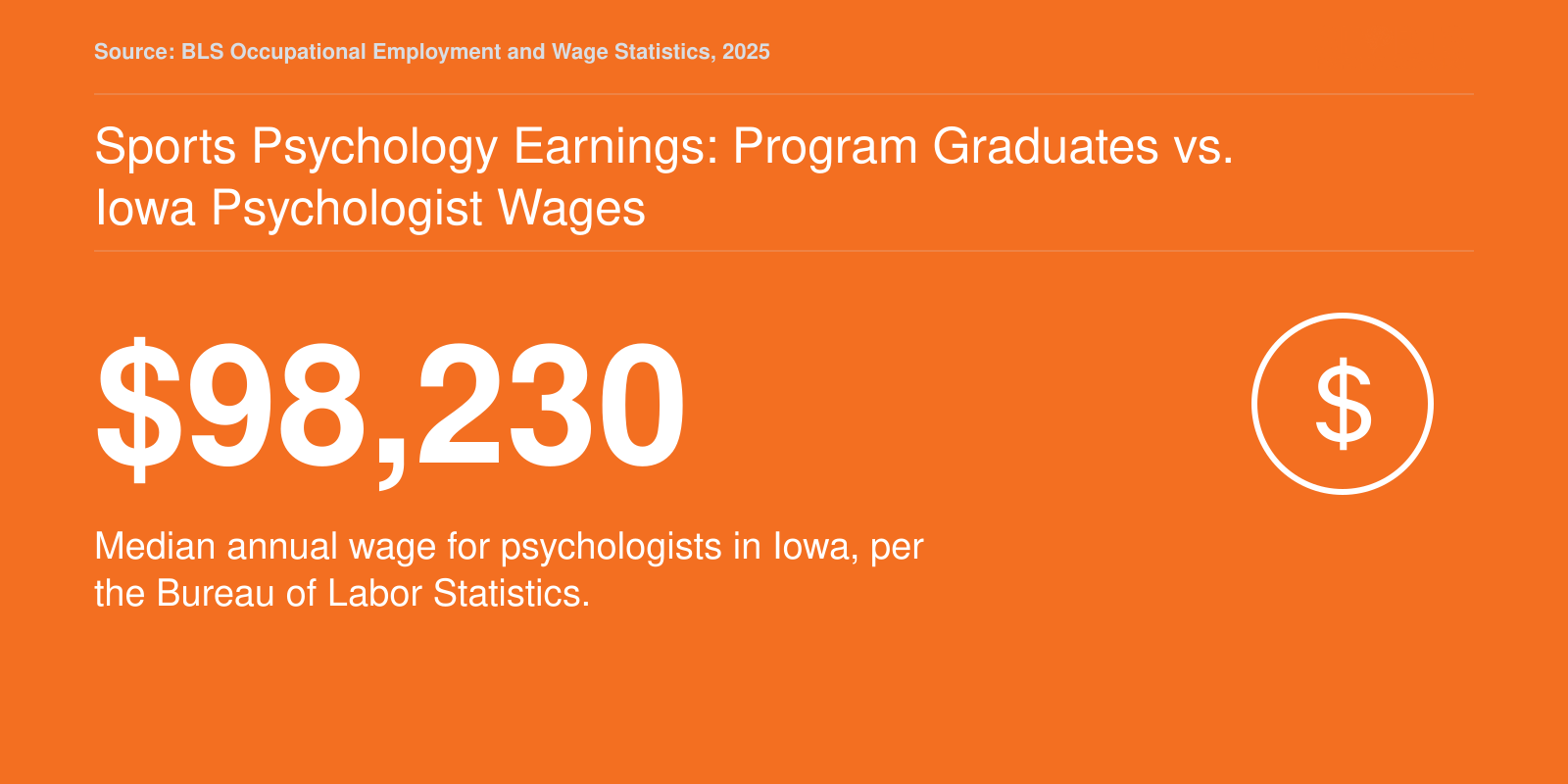
Sports Psychology Earnings: Program Graduates Vs. Iowa Psychologist Wages
Program-level earnings data for graduates of the top-ranked online sport psychology programs are not yet available for a direct comparison. However, Iowa's statewide psychologist wages offer a useful benchmark for students planning careers in the state.
Frequently Asked Questions About Sports Psychology in Iowa
Choosing the right path into sports psychology can raise a lot of practical questions, especially when you are based in Iowa and weighing local versus online options. Below are answers to the questions prospective students ask most often.
Are there any sports psychology programs in Iowa?
Iowa does not currently offer a dedicated sports psychology degree at the graduate level through its in-state universities. However, schools such as the University of Iowa and Iowa State University offer psychology or kinesiology programs with coursework relevant to the field. Many Iowa students supplement these options by enrolling in accredited online sports psychology programs from out-of-state institutions featured on sportspsychology.org.
Can you get a sports psychology degree entirely online?
Yes. Several regionally accredited universities offer fully online master's degrees and doctoral programs in sport and performance psychology. Most online programs include a practicum or internship component that you can arrange locally in Iowa. This makes online study especially practical for students in areas like Des Moines, Cedar Rapids, or Iowa City who want to stay in state while earning a nationally recognized credential.
What is the difference between a sports psychologist and a mental performance consultant?
A sports psychologist typically holds a doctoral degree in psychology, is licensed by the state, and can diagnose and treat clinical mental health conditions in athletes. A mental performance consultant (sometimes called a Certified Mental Performance Consultant, or CMPC) usually holds a master's degree and focuses on performance enhancement skills such as visualization, focus, and goal setting. In Iowa, only licensed psychologists may use the title "psychologist."
How much does a sports psychologist make in Iowa?
Salary data specific to sports psychologists in Iowa is limited because the role often falls under the broader "psychologist" category. According to recent Bureau of Labor Statistics estimates, psychologists in Iowa earn a median annual wage in the range of roughly $80,000 to $95,000, though earnings vary by setting, experience, and whether you hold a doctoral license. Private practice and collegiate athletics roles may pay differently.
What degree do you need for sports psychology?
At minimum, you need a master's degree in sport psychology, kinesiology with a sport psychology concentration, or a closely related field to work as a mental performance consultant. If you want to practice as a licensed psychologist specializing in sports, you will need a doctoral degree (Ph.D. or Psy.D.) in psychology along with supervised clinical hours and state licensure in Iowa.
Can I complete my practicum hours in Iowa while enrolled in an out-of-state online program?
In most cases, yes. Many accredited online programs allow students to arrange practicum and internship placements in their home state. Iowa offers placement opportunities through collegiate athletic departments, sports medicine clinics, and private practices. You should confirm with your program that your chosen site meets its accreditation requirements and that the supervising professional holds appropriate credentials recognized by Iowa's licensing board.
Are there sports psychology jobs in Des Moines?
Des Moines and the surrounding metro area have a growing need for sports psychology professionals. Opportunities exist with collegiate athletic programs at Drake University, in private practice, through sports medicine and rehabilitation clinics, and with youth sports organizations. Iowa's strong high school athletics culture and proximity to Division I programs across the state also create demand for mental performance services in the greater Des Moines region.
More Online Sports Psychology Programs for Iowa Students
Beyond the top-10 ranked programs, these additional schools offer online sports psychology degrees that are accessible to Iowa students. Each institution provides a unique curriculum and flexible format, making them worthwhile additions to your research list.
Faulkner University
Offers an online Bachelor of Science in Sports Psychology with a Christian worldview, small class sizes, and affordable tuition.
Provides a fully online Bachelor of Science in Sport Psychology, emphasizing psychological theory, research, and practical skills for coaching and health promotion.
Offers an online Master of Science in Applied Sport Psychology with tracks for Mental Performance Consultant certification or limited psychologist licensure.
Offers an online Master of Science in Sport Psychology preparing students for CMPC certification, with a supervised internship and flexible part-time options.
Provides an online Master of Science in Experimental Psychology with a Health and Sports Psychology concentration, including a practicum and thesis option.
Delivers the same online Bachelor of Science in Sport, Exercise and Performance Psychology, with curriculum covering mental skills training and ethics.
Provides a 100% online Bachelor of Science in Sport, Exercise and Performance Psychology, covering exercise psychology, sport injury psychology, and ethics.
Offers an online Bachelor of Science in Sport, Exercise and Performance Psychology, preparing graduates for mental performance coaching or graduate study.
Provides a 100% online Bachelor of Science in Sport, Exercise and Performance Psychology, focusing on motivation, mental training, and stress management.