Minnesota offers two main sports psychology paths: an applied graduate program and a bachelor's degree blending coaching science with psychology.
The global sports psychology services market is projected to grow at roughly 11.7 percent annually through 2033.
Licensed psychologist and Certified Mental Performance Consultant (CMPC) credentials serve different career goals and require different timelines.
Minnesota's professional teams, Division I programs, and expanding healthcare landscape create strong local demand for mental performance professionals.
Minnesota is home to five major professional franchises, 16 Division I athletic programs, and one of the highest youth sports participation rates in the country. That density of organized athletics fuels steady demand for mental performance professionals at every level, from peewee hockey rinks to Target Center.
The state's graduate programs split along a key fault line: a master's degree geared toward applied mental performance consulting and Certified Mental Performance Consultant (CMPC) eligibility, versus a doctoral track required for licensure as a psychologist in Minnesota. The distinction matters because it determines your scope of practice, earning potential, and how many years you will spend in training. With the Bureau of Labor Statistics projecting 8 percent growth for psychologists nationally through 2032, Minnesota's concentration of teams and clinics positions the state as a competitive but promising market for either credential.
2026 Best Sports Psychology Programs in Minnesota
Minnesota offers two distinct entry points into sports psychology: a graduate-level applied program built around mental performance consulting and a bachelor's-level major that blends coaching science with psychological theory. Both programs leverage Minnesota's vibrant youth, high school, and collegiate athletics culture to give students meaningful hands-on experience. Below, we break down what each program offers so you can find the right fit for your career goals.
Factors considered
Program relevance and applied training
Tuition and net price affordability
Graduate earnings and debt outcomes
CMPC or licensure pathway alignment
Practicum and internship opportunities
Data sources
NCES-IPEDS federal institutional data — nces.ed.gov
Best for: Future mental performance consultants seeking CMPC eligibility
Minnesota State University, Mankato is a public university in southern Minnesota that serves as a regional hub for applied sport and exercise psychology training. Its graduate program is deeply embedded in the state's sport ecosystem, placing students with local high school athletic departments, Division II intercollegiate teams, and community wellness organizations. With a 21:1 student-to-faculty ratio, the university balances accessibility with personalized mentorship, and its median graduate debt of approximately $21,106 paired with median earnings of roughly $56,922 ten years after enrollment provides a solid return-on-investment picture at the school level.
Sport, Exercise, and Performance Psychology — On-Campus
Master of Science degree requiring 36 credits
Two-year on-campus program based in Mankato
Coursework aligned with CMPC certification requirements
Applied hours through the Center for Sport and Performance Psychology
Practicum placements with Minnesota schools, teams, and clinics
Prepares graduates for applied careers or doctoral study
Fall-only start with a February 1 application deadline
In-state tuition approximately $10,449; out-of-state approximately $19,989
Best for: Undergrads preparing for coaching and graduate study
Concordia University, Saint Paul is a private Lutheran university in the Twin Cities that pairs psychological theory with hands-on coaching preparation. Its location provides direct access to a dense network of Minnesota high school programs, club teams, and health care organizations for internship and field experiences. The school-level graduation rate sits at about 46%, and with a 16:1 student-to-faculty ratio, students benefit from smaller class sizes. Median graduate debt is roughly $17,832, while median earnings ten years after enrollment reach approximately $59,871, offering encouraging long-term financial outcomes at the institutional level.
Coaching & Sport Psychology — On-Campus
Bachelor of Arts requiring 40 credits in the major
On-campus delivery in Saint Paul's Twin Cities setting
Curriculum covers biomechanics, exercise physiology, and health psychology
Internships with local sport and health organizations
Can be paired with Minnesota teacher-licensure pathways
Strong foundation for graduate study in sport psychology or counseling
Integrates faith, ethics, and service into sport psychology practice
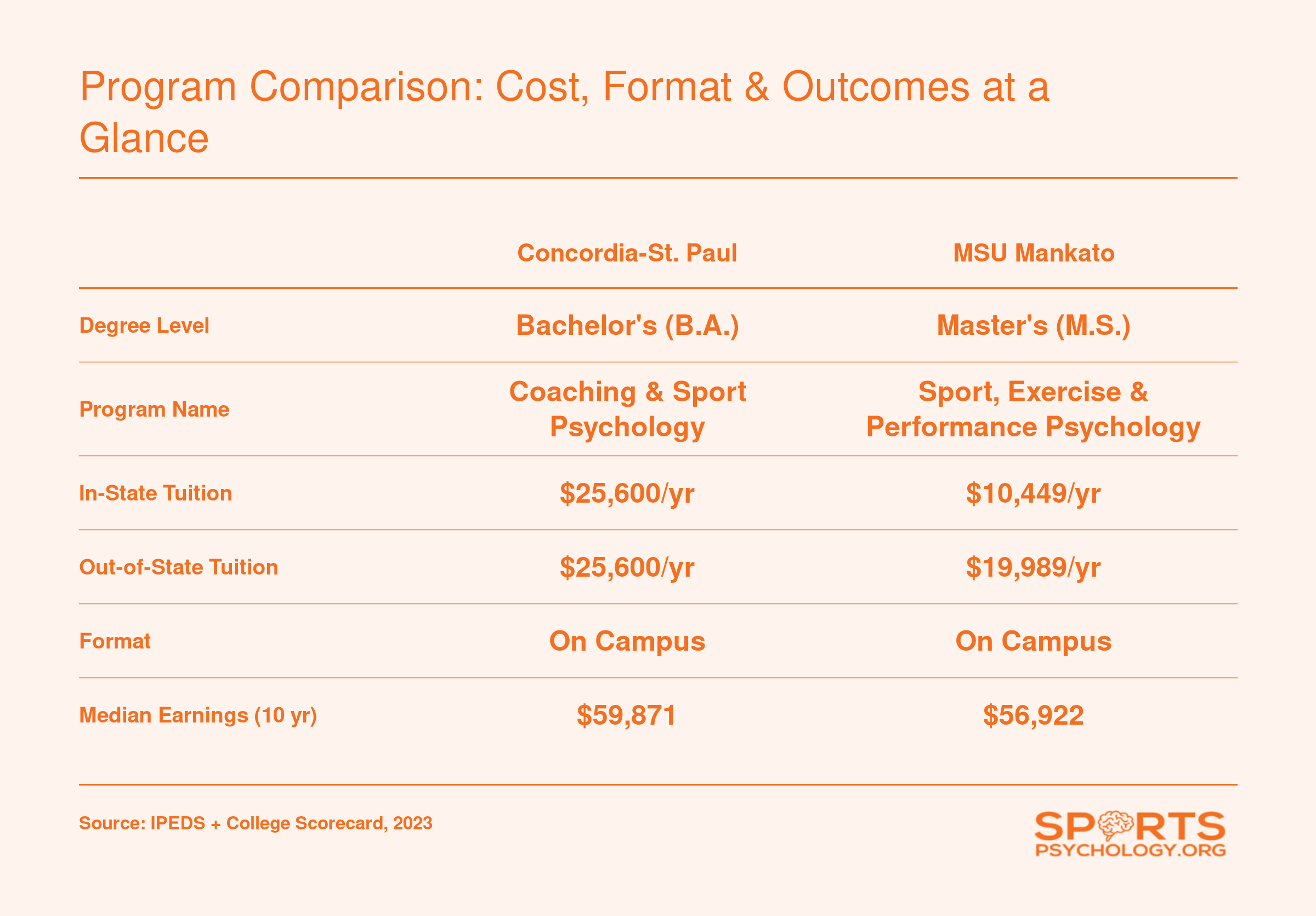
Program Comparison: Cost, Format & Outcomes at a Glance
Choosing between Minnesota's sports psychology programs? This side-by-side snapshot highlights the key differences in cost, format, and degree level so you can quickly narrow your options. Note that program-level earnings after completion are not yet available for either program, so we include institution-wide median earnings at 10 years as a general reference point.
How to Become a Sports Psychologist in Minnesota
Breaking into sports psychology in Minnesota involves a clear sequence of educational milestones, but the exact path depends on whether you want to carry the title of licensed psychologist or work as a mental performance consultant. Here is how each route unfolds.
Step 1: Earn a Bachelor's Degree
Start with a four-year degree in psychology, kinesiology, exercise science, or a closely related field. Courses in research methods, abnormal psychology, and human physiology will lay the groundwork for graduate study. Many aspiring sports psychologists also gain early experience by volunteering with college athletic departments or community sport organizations during this stage. If you are still exploring whether a sports psychology degree is right for you, comparing programs across states can help clarify your options.
Step 2: Complete a Graduate Program
A master's degree in sport psychology, exercise and sport science, or a related discipline is the next milestone. Programs like those highlighted on sportspsychology.org typically include coursework in performance enhancement, counseling techniques, and applied sport science. A master's degree qualifies you to pursue certification as a mental performance consultant, but it does not, on its own, qualify you for psychologist licensure in Minnesota.
If your goal is to hold the protected title of licensed psychologist, you will need to continue to a doctoral program (Ph.D. or Psy.D.) in psychology with a sport psychology emphasis. The Minnesota Board of Psychology requires a doctoral degree for licensure, and no master's-level practitioner may use the psychologist title in the state.2
After completing a doctoral degree, Minnesota requires the following before you can practice as a licensed psychologist3:
Supervised experience: At least 1,800 hours of supervised practice under a licensed psychologist, including a required postdoctoral experience component.4
Examinations: You must pass both the Examination for Professional Practice in Psychology (EPPP) and the Professional Responsibility Examination (PRE).5
Application: Submit all documentation to the Minnesota Board of Psychology for review.
This process typically adds one to two years beyond the doctoral degree itself.
The Master's-Level Alternative: CMPC Certification
No, you cannot become a licensed sports psychologist in Minnesota with just a master's degree. However, you can build a rewarding consulting career by earning the Certified Mental Performance Consultant (CMPC) credential through the Association for Applied Sport Psychology (AASP). The CMPC allows you to work directly with athletes, coaches, and teams on performance enhancement, goal setting, and mental skills training. You would practice as a mental performance consultant rather than a psychologist, which means you focus on performance optimization rather than clinical diagnosis or treatment of mental health disorders.
Many successful professionals in the field choose this route, especially those whose primary interest is applied performance work rather than clinical therapy. The CMPC pathway is also faster and less costly than a doctoral program, making it an attractive option for career changers and former athletes entering the field.
Choosing Your Path
Consider what kind of work excites you most. If you want to diagnose and treat clinical conditions alongside performance consulting, the doctoral and licensure route is essential. If your passion centers on coaching athletes through mental skills and peak performance strategies, a master's degree paired with CMPC certification offers a more direct entry point. Both paths can lead to meaningful, impactful careers in Minnesota's growing sports psychology landscape.
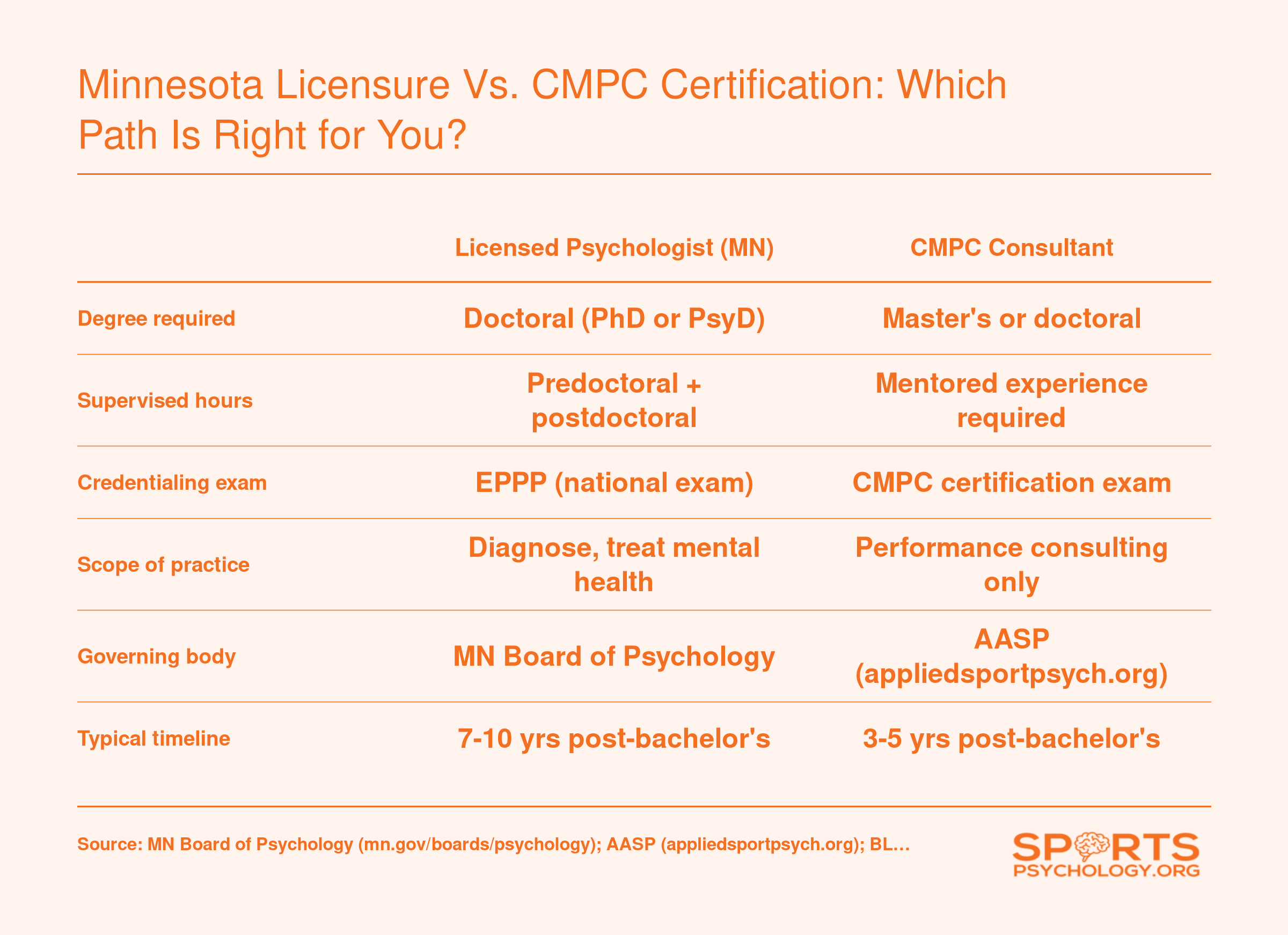
Minnesota Licensure vs. CMPC Certification: Which Path Is Right for You?
Choosing between becoming a licensed psychologist in Minnesota and earning the Certified Mental Performance Consultant (CMPC) credential depends on your career goals, how long you want to be in school, and the type of work you want to do. Below is a side-by-side look at the key differences to help you decide.
Questions to Ask Yourself
Do you want to diagnose and treat clinical conditions in athletes, or focus on performance enhancement and mental skills training?
This distinction shapes your entire education path. Clinical work with issues like anxiety or eating disorders requires a doctoral degree and state licensure, while performance consulting and mental skills training can begin after a master's program with CMPC certification.
Are you prepared to invest six to eight years in graduate education, or would you prefer to start consulting after a two-year master's degree?
A doctoral route (Ph.D. or Psy.D.) opens doors to clinical practice and hospital settings but demands significantly more time and tuition. A master's degree lets you enter the field faster, though it limits you to non-clinical consulting roles.
Do you see yourself working with professional sports teams, or does a career in a university, private practice, or youth sports setting appeal to you?
Pro team positions are highly competitive and often require both doctoral training and extensive applied experience. University counseling centers, private practices, and youth sport organizations hire at the master's level more frequently and offer broader job availability across Minnesota.
Is geographic flexibility important, or are you committed to building your career specifically in Minnesota?
Minnesota's programs prepare you for national credentials like the CMPC, but state licensure requirements vary. If you plan to stay local, understanding Minnesota's specific licensing board expectations early will save you time and ensure your coursework qualifies.
How important is program format to your current lifestyle?
Some Minnesota programs offer fully online or hybrid options that accommodate working professionals and athletes still competing. In-person programs typically provide richer practicum experiences and direct mentorship, so weigh schedule flexibility against hands-on training opportunities.
Online & Hybrid Sports Psychology Programs Available in Minnesota
Flexibility matters when you are balancing coursework with a job, family obligations, or an athletic schedule of your own. If you are exploring sports psychology programs in Minnesota, you will want to know which options let you learn remotely and which require you to be on campus.
Minnesota-Based Programs and Their Delivery Formats
Both of the ranked Minnesota programs featured on sportspsychology.org are delivered in a traditional campus format as of 2026. Minnesota State University-Mankato's Master of Science in Sport, Exercise, and Performance Psychology is an on-campus program based in Mankato. Concordia University-Saint Paul's Bachelor of Arts in Coaching and Sport Psychology is likewise offered on campus in Saint Paul. Neither program currently advertises a fully online or hybrid delivery option.
That does not mean Minnesota residents are without remote learning choices. Several regionally accredited universities offer online sports psychology degrees that residents can complete from anywhere in the state.
Nationally Available Online Options for Minnesota Residents
Capella University, headquartered in Minneapolis, is one well-known online institution that offers graduate programs in psychology-related fields. Other regionally accredited sports psychology programs across the country provide online master's or doctoral programs in sport and performance psychology. When evaluating any online program, confirm that it holds regional accreditation and that its curriculum aligns with the coursework requirements set by the Association for Applied Sport Psychology (AASP) if you plan to pursue Certified Mental Performance Consultant (CMPC) certification.
Keep in mind that programs not based in Minnesota may not appear in state-specific rankings, but they can still be a strong fit for your goals.
The Flexibility vs. Practicum Trade-Off
Online coursework offers obvious scheduling advantages, yet sports psychology is a hands-on field. Here are the key trade-offs to weigh:
Practicum requirements: Clinical and licensure-track programs in Minnesota typically require a set number of in-person practicum or internship hours, regardless of how you complete your academic coursework. You will need to arrange supervised placements in your local area.
Supervised experience for CMPC: AASP does accept mentored hours completed through placements arranged by online programs, provided the mentoring meets its published standards. Your mentor must hold the CMPC credential, and the hours must include direct, supervised contact with athletes or performers.
Networking and mentorship: Campus-based programs often provide built-in access to faculty mentors, sport teams, and peer cohorts. Online students may need to be more proactive in building these relationships.
Licensure considerations: If your goal is to become a licensed psychologist in Minnesota, you will need to complete a doctoral program with an APA-accredited internship. These internships are almost always conducted in person, so even students enrolled in online doctoral programs should plan for a significant on-site commitment.
Choosing the Right Format for Your Goals
If you are pursuing CMPC certification through an applied, non-clinical track, an online master's program paired with local mentored experience can work well. If you are aiming for clinical licensure as a psychologist, expect to spend substantial time in supervised, face-to-face settings no matter where your coursework lives. Students in neighboring states face similar decisions when weighing sports psychology programs in iowa or other regional options. Either way, verify that the program's curriculum, practicum structure, and accreditation status support the credential you plan to earn before you enroll.
Sports Psychology Career Opportunities & Salaries in Minnesota
Minnesota offers a surprisingly robust job market for sports psychology professionals, thanks to a dense concentration of professional teams, Division I programs, and a healthcare landscape that increasingly values mental performance services. Here is what you can expect as you plan your career in the state.
What Graduates Earn: Setting Realistic Expectations
Program-level earnings data for sports psychology completers at Minnesota institutions are not yet available through federal reporting, so we need to look at broader benchmarks. Across all graduates of Concordia University-Saint Paul, the ten-year median earnings figure sits at roughly $59,900, while Minnesota State University-Mankato graduates land near $56,900 over the same horizon. These institution-wide numbers reflect all majors, not just sports psychology, so treat them as general context rather than a direct prediction for your specialty.
For a sharper picture, Bureau of Labor Statistics data for the Minneapolis-St. Paul metro area shows that psychologists in specialty roles (outside clinical and counseling) earned a mean annual wage of about $80,570 as of 2023.1 Nationally, the median for this same category reached $117,750, with the 25th percentile at roughly $76,550 and the 75th percentile near $138,280.1 Clinical and counseling psychologists in the Twin Cities metro earned a mean annual wage of approximately $94,180.2 The national median for all psychologists was about $94,310 in 2024, with projected job growth of 6 percent through 2032.3
Keep in mind that early-career sports psychology professionals, particularly those working toward CMPC certification or licensure, often start at the lower end of these ranges. Earnings tend to climb as you build a client roster, gain credentials, and move into higher-profile settings.
Where the Jobs Are: Minnesota's Employer Landscape
Few states pack this much opportunity into one region. If you are exploring sports psychology programs in illinois or other neighboring states, it is worth comparing those markets to what Minnesota offers. Potential employers and practice settings include:
Professional sports teams: The Vikings (NFL), Twins (MLB), Timberwolves and Lynx (NBA/WNBA), Wild (NHL), and Minnesota United (MLS) all employ or contract with mental performance professionals.
Collegiate athletics: The University of Minnesota fields 25 Division I programs, and schools like Minnesota State University-Mankato compete at the Division II level, creating demand for sport psychology consultants across tiers.
Healthcare systems: Major networks such as Mayo Clinic, Allina Health, and Fairview operate sports medicine clinics that are integrating psychological services more frequently.
Private consulting practices: Many CMPC-certified professionals in the Twin Cities run their own performance consulting businesses, working with athletes ranging from youth club competitors to Olympic hopefuls.
Notably, the Minneapolis-St. Paul metro area carries a location quotient of 2.43 for specialty psychologist roles, meaning the region employs these professionals at more than double the national average rate.1 That concentration signals genuine, sustained demand rather than a handful of isolated openings.
Emerging Demand Areas Worth Watching
Three growth areas are creating new roles that did not exist a decade ago:
Youth athlete mental health: Parents and club organizations are investing in mental skills training earlier than ever, driven by rising awareness of burnout and anxiety among young competitors.
Collegiate NIL stress: Name, image, and likeness deals have introduced financial pressures and public scrutiny that college athletes are not always equipped to handle. Athletic departments are responding by hiring or contracting dedicated mental performance staff.
Corporate performance coaching: Techniques developed in sport psychology, such as visualization, goal setting, and pressure management, are migrating into executive coaching and workplace wellness programs, broadening the career options available to graduates.
If you are weighing whether Minnesota can sustain a full-time career in sports psychology, the data and the employer landscape both point toward yes. The key is choosing the right credential path (licensure, CMPC, or both) and building applied experience while you are still in school.
The global sports psychology services market is projected to grow at a rate of roughly 11.7 percent annually through 2033, according to industry research from Marketintelo. That surge reflects rising demand for mental performance professionals across collegiate, professional, and youth sports, making this an especially promising time to pursue a sports psychology degree in Minnesota.
Frequently Asked Questions About Sports Psychology Programs in Minnesota
Choosing the right sports psychology program involves many practical questions, from licensing requirements to cost and career outcomes. Below, we answer the most common questions prospective students ask about pursuing sports psychology in Minnesota.
Can I become a licensed sports psychologist in Minnesota with just a master's degree?
No. In Minnesota, the title 'licensed psychologist' requires a doctoral degree (Ph.D. or Psy.D.), supervised postdoctoral hours, and passing the Examination for Professional Practice in Psychology (EPPP). A master's degree alone does not qualify you for psychologist licensure in the state. However, master's graduates can pursue the Certified Mental Performance Consultant (CMPC) credential, which allows you to work in applied sport and performance psychology settings.
What is the best school for sports psychology in Minnesota?
The University of Minnesota is widely regarded as the top choice, offering a doctoral program in sport and exercise psychology through its School of Kinesiology. Minnesota State University, Mankato also stands out with its master's program in Sport, Exercise, and Performance Psychology, which is well suited for students pursuing CMPC certification. The best fit depends on whether you plan to pursue licensure at the doctoral level or applied consulting at the master's level.
How much do sports psychology programs cost in Minnesota?
Costs vary by institution and degree level. At the University of Minnesota, doctoral students in kinesiology can expect resident tuition around $10,000 to $12,000 per year, though many receive assistantships that offset costs significantly. Master's programs at Minnesota State University, Mankato generally run lower, with resident tuition in the range of $8,000 to $10,000 per year. Out of state and online students should expect higher rates. Always check each program's latest tuition schedule for current figures.
What is the difference between CMPC certification and psychologist licensure in Minnesota?
CMPC certification, offered by the Association for Applied Sport Psychology, focuses on mental performance consulting and requires a master's degree, mentored experience, and passing an exam. It does not authorize you to diagnose or treat mental health disorders. Psychologist licensure in Minnesota requires a doctoral degree, postdoctoral supervision, and passing the EPPP. Licensed psychologists can diagnose and treat clinical conditions alongside performance work. Your choice depends on whether you want a clinical or purely performance focused career.
Are there online sports psychology degree programs available in Minnesota?
Capella University and Walden University, both headquartered in Minnesota, offer online doctoral and master's programs with concentrations in sport psychology or performance coaching. These fully online options provide flexibility for working professionals. Some traditional programs, like those at the University of Minnesota, may incorporate hybrid elements, but their core sport psychology tracks are primarily on campus. Check sportspsychology.org for updated listings of online and hybrid options.
What jobs can you get with a sports psychology degree in Minnesota?
Graduates work in a variety of roles across the state. Common positions include mental performance consultant for collegiate or professional sports teams, university professor or researcher, wellness coordinator in corporate or healthcare settings, and private practice consultant. Minnesota is home to several professional franchises and Division I athletic programs, creating steady demand. Those with doctoral degrees and licensure can also provide clinical therapy to athletes dealing with anxiety, depression, or injury recovery.
How long does it take to complete a sports psychology degree in Minnesota?
A master's degree in sport and exercise psychology typically takes two to three years of full time study. Doctoral programs generally require five to seven years, including coursework, a dissertation, and supervised clinical or applied hours. If you plan to pursue CMPC certification after a master's program, add roughly one year for mentored experience. For full psychologist licensure following a doctoral degree, expect an additional one to two years of postdoctoral supervised practice before you can sit for the licensing exam.