Two Missouri universities offer dedicated undergraduate sports psychology programs, both campus-based bachelor's degrees.
Professionals must pursue either an LPC credential for clinical work or a CMPC certification for performance consulting.
Missouri's job market includes professional sports franchises, Division I programs, and a growing network of private performance clinics.
Online and hybrid graduate options let Missouri residents earn advanced degrees while balancing work or coaching commitments.
Missouri is home to five major professional sports franchises, three Division I athletic conferences, and a growing network of private performance clinics, yet the state's dedicated sports psychology degree options remain surprisingly narrow. Only two ranked campus-based bachelor's programs exist in 2026, at Southwest Baptist University and Columbia College, and neither institution currently offers a graduate degree in the field.
That gap creates a real tension for Missouri residents. Earning a bachelor's locally is straightforward, but advancing to the master's or doctoral work required for licensure as an LPC or certification as a CMPC means looking beyond state lines or turning to online programs. Students near Kansas City, for example, may also consider sports psychology programs in Kansas to expand their options. Demand from pro and collegiate teams continues to outpace the local pipeline of credentialed practitioners.
Best Sports Psychology Programs in Missouri, 2026 Rankings
Missouri's sports psychology landscape is compact but purposeful, with two institutions offering dedicated undergraduate pathways that blend psychology and sport performance. Both programs are campus-based bachelor's degrees designed to prepare students for graduate study or entry-level applied work with athletes. Because the ranked universe is small, we encourage prospective students to also explore related psychology, kinesiology, and exercise science programs across the state for additional options.
Factors considered
Program relevance to sport psychology
Institutional graduation and retention rates
Net price and student debt
Graduate earnings outcomes
Faculty ratio and program structure
Data sources
NCES-IPEDS federal institutional data — nces.ed.gov
Best for: Hands-on learners blending psychology and kinesiology
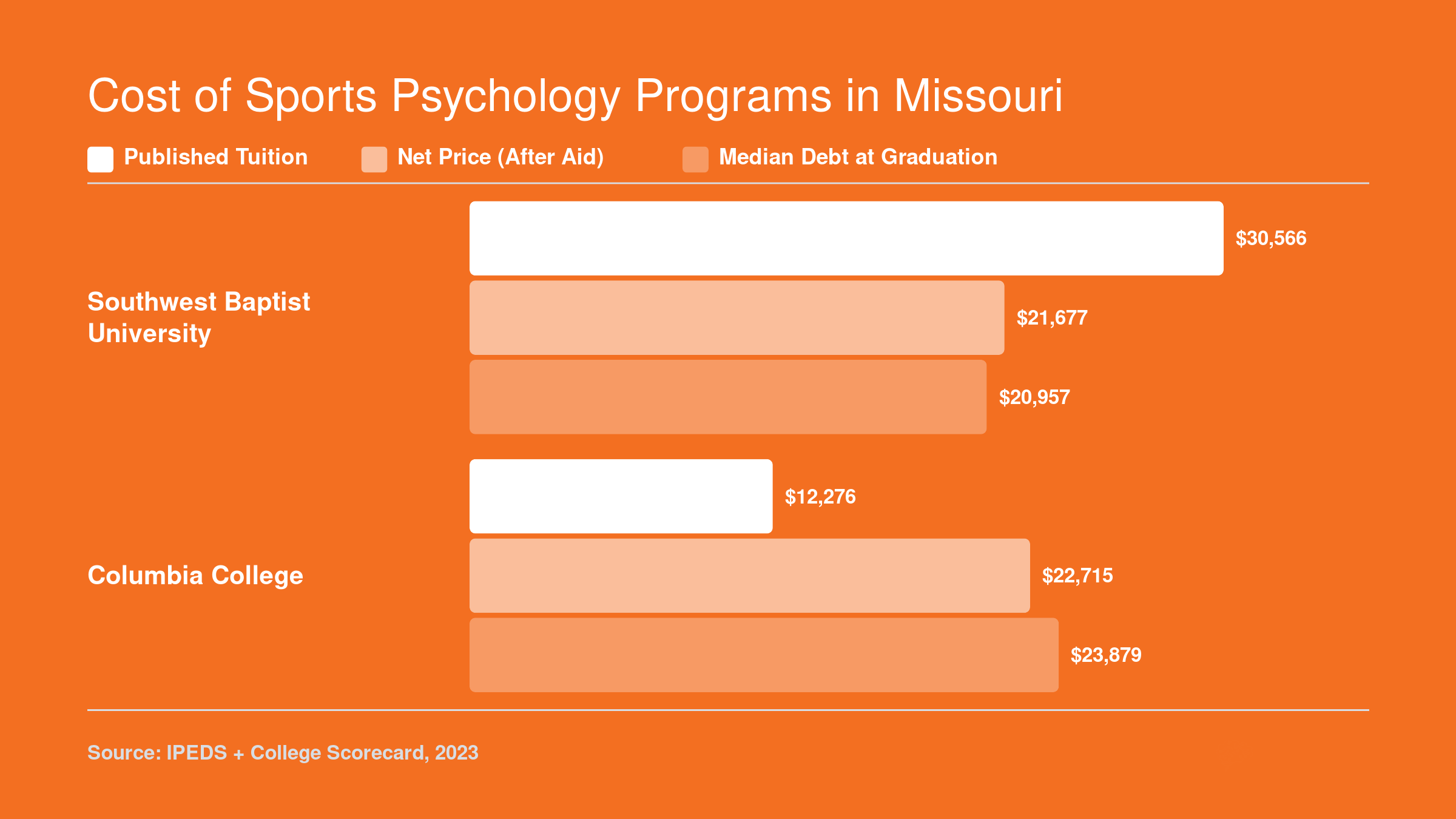
Southwest Baptist University in Bolivar is a private institution that intentionally merges psychology and kinesiology into one undergraduate curriculum focused on sports performance enhancement. With a 10:1 student-to-faculty ratio, students benefit from individualized advising, hands-on practicum experiences with regional athletes, and a clear pipeline into graduate programs including SBU's own Doctor of Physical Therapy. Schools offering this program have a graduation rate of 55.3%, and median graduate debt sits at approximately $20,957, offering a reasonable entry point for students committed to the field.
Psychology with Sports Performance Enhancement — On-Campus
Bachelor's degree integrating psychology and kinesiology coursework
Focus on mental skills training and sports performance enhancement
Practicum and faculty-guided internship opportunities included
Prepares students for graduate study in sport psychology or counseling
Psi Chi honor society chapter and Behavioral Sciences Club access
Small class sizes with 10:1 student-to-faculty ratio
Scholarships available specifically for psychology students
Pathway into SBU's Doctor of Physical Therapy program
Best for: Research-minded students exploring sport psychology
Columbia College, located in the heart of Columbia, offers a research-oriented Bachelor of Arts in Psychology with a formal Sport Psychology Emphasis. The program requires 120 semester hours and builds a strong empirical foundation through statistics, neuroscience, and research methods courses before layering in sport-specific content. The institution-wide graduation rate is 42.2%, and median graduate debt is approximately $23,879, while median earnings ten years after enrollment reach about $45,378. Program-level earnings data is not yet available for this emphasis.
Psychology, B.A., Sport Psychology Emphasis — On-Campus
Sport Psychology Emphasis with 33 dedicated credit hours
Required Psychology of Sport and Social Psychology courses
Neuroscience and Cognitive Psychology in the core curriculum
Mandatory psychology internship for applied experience
Strong emphasis on APA-style research design and reporting
Clinical and Counseling Psychology coursework included
Master's vs. Bachelor's Programs: Choosing the Right Degree Level
Choosing between a bachelor's and a master's degree in sports psychology is one of the most consequential decisions you will make on this career path. Each level opens different doors, and understanding what lies behind those doors will help you invest your time and tuition wisely.
What a Bachelor's Degree Gets You
A bachelor's degree in sport psychology, exercise science, or a related field gives you a solid grounding in human performance, motivation, and the psychological principles that influence athletic outcomes. It typically takes four years and positions you for entry-level roles such as coaching, athletic administration, fitness programming, or youth sport development. Think of it as the launchpad: valuable on its own but designed to set you up for graduate study if you want to work directly with athletes in a clinical sports psychology or consultative capacity.
Most employers and licensing bodies do not consider a bachelor's degree sufficient for practicing as a sports psychologist. If your goal is to provide mental performance consulting or counseling to athletes, plan on continuing your education.
Why a Master's Degree Is the Standard
The majority of sports psychologist roles, especially those that involve mental health counseling or clinical work, require at least a master's degree.1 A graduate program deepens your expertise in areas like performance enhancement, psychopathology, and evidence-based intervention while qualifying you for certification through organizations such as the Association for Applied Sport Psychology. In Missouri, master's programs are available and offer a realistic two-to-three-year timeline beyond your bachelor's. The University of Missouri, for example, offers a Master of Education in Educational, School, and Counseling Psychology with an emphasis in Positive Coaching and Athletic Leadership, blending sport-specific training with counseling foundations.
From an earnings perspective, master's-level practitioners generally command higher salaries than those with only an undergraduate degree, and they gain access to a broader range of professional settings, from collegiate athletic departments to private consulting practices.
The Doctoral Gap in Missouri
Here is something worth knowing before you map out your full academic timeline: as of 2026, Missouri does not have a doctoral program specifically branded as sport psychology.3 If you decide a doctorate is right for you, whether for licensure as a psychologist, academic research, or advanced clinical work, you will need to look at related pathways. A common route is enrolling in a counseling psychology PhD program and pursuing a sport-focused concentration or dissertation. Some students complete their master's in Missouri and then relocate for doctoral work, while others find programs at sports psychology programs near me that allow them to maintain professional connections in the state.
Comparing the Two Tracks at a Glance
Time investment: A bachelor's typically requires four years; a master's adds two to three years beyond that.
Career access: Bachelor's holders qualify for support and coaching roles; master's graduates can pursue applied sport psychology consulting and, with additional credentials, counseling positions.
Licensure eligibility: Independent licensure as a psychologist in Missouri requires doctoral-level education, but master's-level professionals can obtain licensure as professional counselors and pursue sport psychology certification.
Earning potential: Graduate-level practitioners generally earn more and enjoy greater job stability than those entering the field with only an undergraduate degree.
If you are early in your academic journey, the clearest path is to earn a bachelor's degree in psychology, kinesiology, or exercise science, then apply to a master's program that aligns with your professional goals. For those already holding a bachelor's, a Missouri-based master's program can prepare you for meaningful, credentialed work in sports psychology without requiring you to leave the state.
Questions to Ask Yourself
Do you want to work directly with athletes in a clinical or counseling role, or focus on coaching, performance consulting, or research?
Clinical and counseling work with athletes requires at least a master's degree and, in most cases, licensure in Missouri. If your goal is performance consulting or research, your program requirements and timeline will look quite different.
Are you open to completing your coursework online, or do you need in-person access to Missouri's sports teams and athletic departments?
Online programs offer flexibility, but hands-on practicum placements with college or professional teams in Missouri are easier to secure through on-campus programs that already have relationships with local athletic departments.
Have you mapped out whether you will pursue LPC licensure, CMPC certification, or both?
Not every Missouri program aligns with both pathways. LPC licensure requires specific clinical coursework and supervised hours, while CMPC certification through AASP has its own mentored-experience requirements. Confirm your target program covers the track you need.
Does your budget and timeline allow for a graduate degree, or would a bachelor's program be a better starting point?
A master's typically takes two to three years and opens more career doors, but a bachelor's in a related field can position you for entry-level roles while you decide whether to continue your education.
Online Sports Psychology Programs Available in Missouri
If you are juggling a career, coaching responsibilities, or family life, an online or hybrid sports psychology degree can make graduate education far more realistic. Here is what the landscape looks like for Missouri residents in 2026.
In-State Program Formats
Among the Missouri programs featured on sportspsychology.org, both Southwest Baptist University and Columbia College currently deliver their sports psychology offerings on campus rather than through an online format. That means students pursuing these particular bachelor's-level programs should plan on attending classes in Bolivar or Columbia, respectively. If you are set on staying with a Missouri institution and need remote flexibility, contact each school's admissions office directly, as hybrid options and individual online courses can change from semester to semester.
Out-of-State Online Options for Missouri Residents
The good news is that Missouri residents have access to a growing number of accredited online master's programs in sport psychology and related fields from institutions across the country. Schools in states that participate in the National Council for State Authorization Reciprocity Agreements (NC-SARA) can enroll Missouri students without additional regulatory hurdles. Programs commonly found online include master's degrees in sport and performance psychology, applied sport psychology, and clinical mental health counseling with a sport psychology concentration. Students in neighboring states face similar decisions; those exploring sports psychology programs in iowa, for example, also weigh in-state campus options against nationally available online degrees. When evaluating out-of-state options, confirm the program holds regional accreditation and check whether its curriculum aligns with the credential you plan to pursue.
Practicum and Internship Considerations
One of the most common concerns about online programs is how you complete hands-on training. Most accredited master's programs, whether online or campus-based, require supervised practicum or internship hours. Online students typically arrange these experiences at a local site, such as a university athletic department, private practice, or community sports organization in Missouri. Approval from your program's faculty supervisor is usually required before you begin. If you plan to seek the Certified Mental Performance Consultant (CMPC) credential through the Association for Applied Sport Psychology, you will need mentored experience hours regardless of your program's delivery format. For those pursuing Licensed Professional Counselor (LPC) status in Missouri, your degree must come from a CACREP-accredited counseling program, and online programs that hold this accreditation do satisfy the educational requirement.
Part-Time Pacing and Completion Timelines
Many online master's programs in sport psychology offer part-time enrollment tracks specifically designed for working professionals. A full-time student can typically finish in about two years, while part-time students should expect a timeline closer to three to four years. Some programs use accelerated terms of seven or eight weeks, allowing you to take one course at a time while still progressing at a steady pace. Before enrolling, ask whether the program locks you into a cohort schedule or allows you to move through coursework at your own speed. Flexibility on this front can make a significant difference if your work schedule shifts seasonally, as it often does for coaches and athletic trainers.
Cost of Sports Psychology Programs in Missouri
Understanding the full cost picture is essential before committing to a sports psychology program. Below, we compare tuition, net price, and median graduate debt for the two ranked Missouri programs. Southwest Baptist University carries higher sticker-price tuition but a slightly lower net price after aid, while Columbia College posts a lower published tuition rate. Both schools produce median earnings in the low-to-mid $40,000s within ten years of enrollment, translating to estimated return-on-investment ratios near 2:1 (debt-to-earnings).
Admission Requirements and Application Deadlines for Missouri Programs
Getting into a sports psychology graduate program in Missouri requires careful planning, but the requirements are approachable if you know what to expect. Admission selectivity varies across institutions, so understanding each program's expectations will help you put together a competitive application.
GPA and Test Score Expectations
Most master's programs in sport and exercise psychology at Missouri universities expect a minimum cumulative GPA of 3.0 on a 4.0 scale. For example, both Northwest Missouri State University's M.S. in Sport and Exercise Psychology and the University of Missouri's MEd in Positive Coaching and Athletic Leadership list a 3.0 GPA floor for applicants.12
GRE requirements have shifted in recent years. The University of Missouri does not require standardized test scores for its MEd program, which aligns with a broader trend toward test-optional admissions in graduate education.2 Other programs may still request GRE scores, so check each school's current requirements before assuming you can skip the exam.
Prerequisite Coursework and Experience
Graduate programs typically expect applicants to hold a bachelor's degree, though the specific major can vary. A background in psychology, kinesiology, exercise science, or a related field is common. If you are coming from a different undergraduate discipline, the From Exercise Science to Sports Psychology: Making the Graduate School Transition article offers useful guidance. Some programs may ask you to complete foundational coursework in areas like research methods, statistics, or introductory psychology before enrolling.
Practicum or fieldwork experience is not always a formal prerequisite for admission, but it can strengthen your application. Programs that emphasize applied training, such as Northwest Missouri State's 45-credit M.S. program, which includes a research project and preparation for AASP certification, tend to value candidates who have already gained some hands-on exposure to sport psychology settings.1
Application Materials
Expect to submit the following with most Missouri program applications:
Transcripts: Official copies from all undergraduate institutions attended.
Letters of recommendation: Typically two or three letters from faculty or professionals who can speak to your academic ability and potential.
Personal statement: A narrative explaining your interest in sport psychology and your career goals.
Resume or CV: Highlighting relevant academic, athletic, or professional experience.
Deadlines and Admission Cycles
Application deadlines differ significantly across programs. Northwest Missouri State University lists a March 1 deadline for its M.S. in Sport and Exercise Psychology, which suggests a fixed admission cycle for fall enrollment.1 Online programs like the University of Missouri's MEd may offer more flexible timelines, though you should verify current deadlines directly with the admissions office.
Some programs use rolling admissions, meaning they review applications as they arrive until seats are filled. Others have firm cutoff dates. Starting your application well ahead of posted deadlines gives you the best chance, especially for programs with limited cohort sizes.
If you are still completing prerequisite courses or building your experience, consider reaching out to program coordinators early. Many are happy to discuss whether your background is a good fit and what steps you might take to strengthen your candidacy before formally applying.
How to Become a Sports Psychologist in Missouri
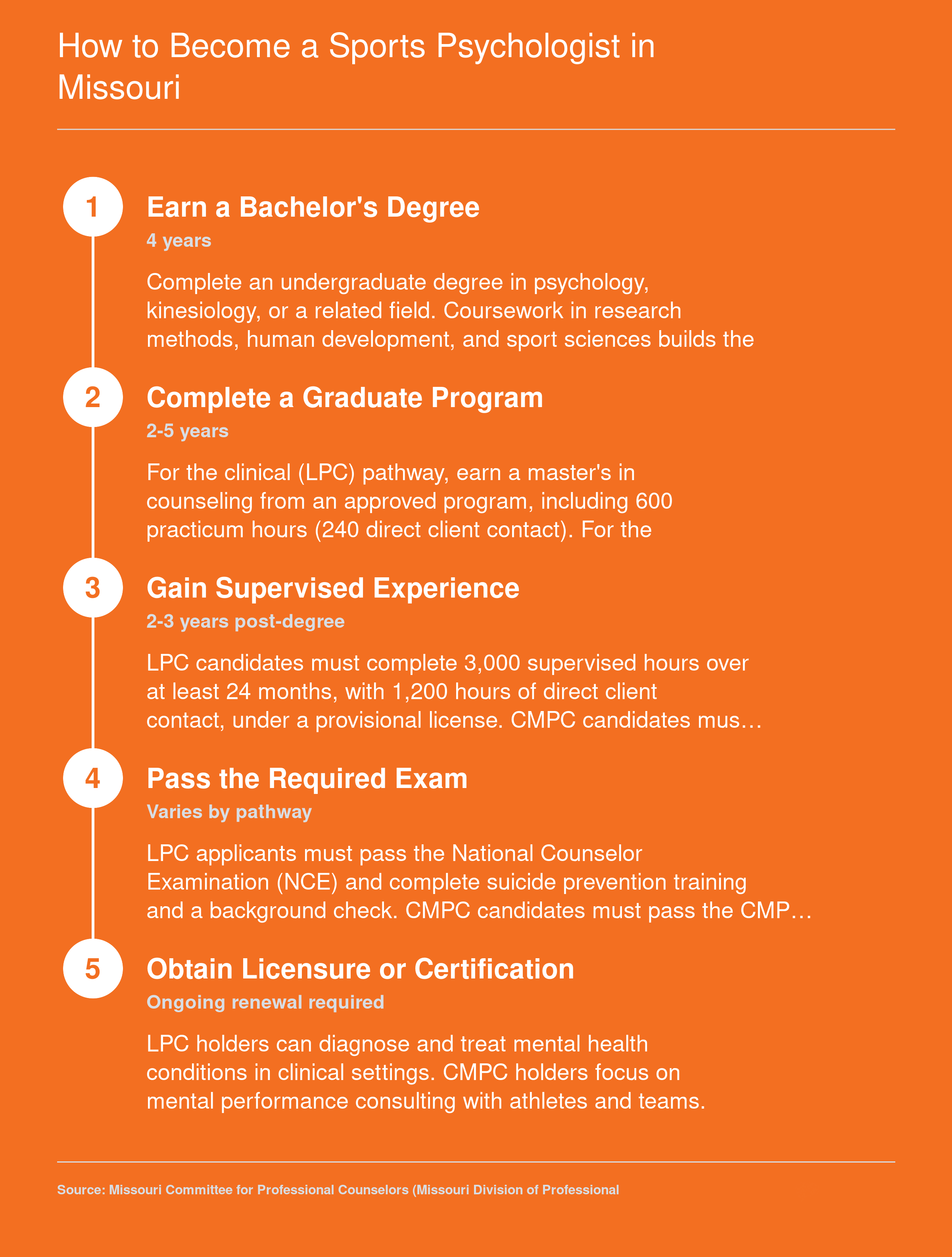
There are two main routes into sports psychology in Missouri: the clinical pathway, which leads to Licensed Professional Counselor (LPC) status, and the performance consulting pathway, which leads to Certified Mental Performance Consultant (CMPC) credential. Both begin with the same educational foundation but diverge at the graduate level and beyond.
Sports Psychology Licensure and Certification in Missouri
One of the most important things to understand before choosing a program is that Missouri does not offer a standalone "sports psychologist" license. Instead, professionals working in this field operate under one of three credential frameworks: Licensed Professional Counselor (LPC), Licensed Psychologist, or Certified Mental Performance Consultant (CMPC). The credential you pursue shapes what you can do in practice, who you can treat, and which program best prepares you.
The LPC Pathway in Missouri
If you want to provide clinical mental health services to athletes, including diagnosing and treating conditions like anxiety, depression, or eating disorders, you will need clinical licensure. The most common route for master's-level graduates is the Licensed Professional Counselor credential. Missouri's requirements include:
Master's degree: You must hold a graduate degree in counseling or a closely related field from a regionally accredited institution.
Supervised experience: A minimum of 3,000 hours of post-degree supervised professional experience is required, completed under a board-approved supervisor.
National Counselor Examination (NCE): You must pass this standardized exam administered by the National Board for Certified Counselors.
State application: Submit your application and supporting documentation to the Missouri Committee for Professional Counselors, which oversees LPC credentialing in the state.
Programs at institutions like the University of Missouri and Missouri State University that are structured around CACREP-accredited counseling curricula tend to align directly with LPC requirements. If clinical work with athletes is your goal, prioritize programs that include practicum and internship placements in sport or performance settings while still meeting counseling accreditation standards.
The CMPC Pathway Through AASP
If your focus is on performance enhancement rather than clinical therapy, such as helping athletes with goal setting, visualization, focus, and confidence, the Certified Mental Performance Consultant credential offered through the Association for Applied Sport Psychology (AASP) may be a better fit. This pathway requires:
Graduate-level coursework covering both sport science and psychology foundations
A mentored experience under an AASP-approved mentor, where you apply mental performance techniques in real settings
Passing the CMPC certification exam
CMPC holders typically work in athletic departments, private consulting practices, or with professional and Olympic teams. However, they cannot diagnose or treat clinical mental health conditions unless they also hold a clinical license. Students in neighboring states face similar credentialing decisions; for example, those exploring sports psychology programs in illinois will find comparable LPC and CMPC frameworks.
Which Missouri Programs Prepare You for Which Credential?
This is the key differentiator when choosing where to apply. Some Missouri programs are designed primarily around the LPC track, embedding clinical training and CACREP-aligned coursework into their curriculum. Others lean more heavily toward sport science and performance psychology, aligning coursework with AASP's requirements for the CMPC.
A smaller number of programs structure their curriculum so graduates can pursue both credentials. These dual-track programs typically require additional electives or practicum hours, but they offer the broadest scope of practice upon graduation. When researching programs on sportspsychology.org, pay close attention to whether a program's coursework, practicum options, and faculty mentorship align with the specific credential you plan to pursue. Choosing a program that matches your intended career path from the start can save you significant time and expense compared to filling gaps after graduation.
Understanding Scope of Practice
The distinction between these credentials is not just academic. In Missouri, an LPC can provide therapy and bill insurance for clinical services. A CMPC can consult on mental performance but cannot offer therapy. A Licensed Psychologist (which requires a doctoral degree) has the broadest scope, including assessment, diagnosis, therapy, and performance consulting. Before you enroll in any program, get clear on the type of work you want to do with athletes, then choose the credential and program that maps directly to that goal.
Missouri offers two distinct professional paths in sports psychology, and understanding the difference matters. An LPC (Licensed Professional Counselor) credential allows you to provide clinical therapy and counseling to athletes dealing with mental health concerns. A CMPC (Certified Mental Performance Consultant) credential focuses on performance enhancement skills like focus, confidence, and motivation without clinical therapy. Many Missouri practitioners pursue both credentials to serve athletes across the full spectrum of mental wellness and peak performance.
Sports Psychology Career Opportunities in Missouri
Missouri offers a surprisingly deep job market for sports psychology professionals, thanks to its concentration of professional sports franchises, Division I athletic programs, and a growing network of private performance clinics. Whether you hold a bachelor's degree or a doctoral credential, understanding where the opportunities are can help you plan your education strategically.
Professional Sports Teams
Missouri is home to several high-profile organizations that employ or contract mental performance professionals. The Kansas City Chiefs (NFL), St. Louis Cardinals (MLB), and Sporting Kansas City (MLS) all maintain player development infrastructures that increasingly include mental performance consultants. These roles typically require a master's degree at minimum, and many consultants hold certification through the Association for Applied Sport Psychology (CMPC). Landing a position with a pro team often starts with practicum or internship connections made during graduate school, so choosing a Missouri program with strong placement pipelines matters. Students near the Kansas City metro may also want to explore sports psychology programs in Kansas for additional practicum options across the state line.
University Athletic Departments and Research
Mizzou's athletic department (University of Missouri) is one of the state's largest employers of sports psychology professionals, with roles ranging from athletic counselor to mental performance coordinator embedded in team operations. Saint Louis University, Missouri State University, and other Division I programs also staff or contract sport psychologists to support student-athletes. For those drawn to the academic side, university positions as sport psychology researchers or tenure-track faculty combine teaching with applied consulting, often through campus performance labs.
Common job titles across these settings include:
Mental performance consultant: Works directly with athletes on focus, confidence, and competition readiness.
Sport psychologist in private practice: Provides clinical or counseling services with a sport-specific focus, typically requiring licensure.
Athletic counselor: Supports student-athlete well-being, addressing issues like transition stress, identity, and performance anxiety.
Academic sport psychology researcher: Conducts and publishes research while mentoring graduate students.
Salary Context
Salary expectations depend heavily on your credential level, setting, and metro area. According to the Bureau of Labor Statistics, clinical and counseling psychologists nationally earned a median annual wage of roughly $96,100 as of 2023, with the middle 50% earning between about $66,050 and $129,020.1 The broader "Psychologists, All Other" category, which captures many sport-focused roles, reported a national median of approximately $117,750.2 In the Kansas City metro area, mean annual wages for clinical psychologists have been reported above $150,000, though this figure reflects experienced practitioners and should be treated as aspirational rather than entry-level.3
Program-level earnings data specifically for sports psychology graduates in Missouri is not yet available for most programs, so prospective students should consider broader psychology salary benchmarks as a starting point.
From Practicum to Paycheck
Many Missouri programs build career pipelines directly into their curricula. Southwest Baptist University, for example, offers faculty-guided internships that connect students with applied settings. Graduate programs at schools like Mizzou and SLU often place practicum students within athletic departments, private clinics, or community organizations, and these placements frequently convert into job offers or professional referrals.
If you are exploring sports psychology programs in Missouri, look closely at each program's practicum partners, alumni employment networks, and proximity to the Kansas City or St. Louis metro areas. These factors often matter as much as coursework when it comes to landing your first role in the field.
Frequently Asked Questions About Sports Psychology in Missouri
Below are answers to the most common questions prospective students ask about sports psychology programs in Missouri. Whether you are exploring degree options, licensure steps, or career paths, these responses will point you in the right direction.
Does the University of Missouri have a sports psychology program?
Yes. The University of Missouri (Mizzou) offers graduate coursework in sport and exercise psychology through its College of Education and Human Development. Students can pursue research and applied training at the doctoral level, and the program is well regarded for its faculty expertise in performance psychology. Check the department's current catalog for the latest concentrations and degree tracks available in 2026.
Can you get a sports psychology degree online in Missouri?
Several Missouri institutions and nationally accredited universities offer online master's programs in sport psychology or closely related fields such as performance psychology. These programs typically blend asynchronous coursework with supervised practicum hours you complete locally. When evaluating online options, confirm that the curriculum aligns with certification requirements from the Association for Applied Sport Psychology (AASP) or your intended licensure board.
What licensure do sports psychologists need in Missouri?
Missouri does not issue a standalone "sports psychologist" license. Practitioners who provide clinical services must hold a license as a psychologist through the Missouri Committee for Professional Counselors, Therapists, and Psychologists, which requires a doctoral degree, supervised hours, and passing the EPPP. Non-clinical performance consultants often pursue AASP's Certified Mental Performance Consultant (CMPC) credential instead.
What are the admission requirements for sports psychology master's programs in Missouri?
Most Missouri master's programs expect a bachelor's degree (often in psychology, kinesiology, or a related field), a minimum GPA around 3.0, letters of recommendation, a personal statement, and GRE scores (though some programs have adopted test-optional policies). Relevant experience in athletics, coaching, or research strengthens an application. Always verify each program's specific deadlines, as they can vary from early December to late spring.
What jobs can you get with a sports psychology degree in Missouri?
Graduates work as mental performance consultants for collegiate and professional teams, counselors in university athletics departments, researchers at sports science labs, and wellness coordinators in corporate or military settings. Missouri's professional sports franchises (Kansas City Chiefs, St. Louis Cardinals, Sporting Kansas City) and its many Division I athletic programs create steady demand. A doctoral degree opens additional clinical and academic roles.
Are there doctoral sports psychology programs in Missouri?
Yes. The University of Missouri offers doctoral training with a sport and exercise psychology emphasis, and other institutions such as the University of Missouri, Kansas City, provide doctoral programs in counseling psychology where students can specialize in performance and sport-related work. A doctoral degree is essential if you plan to pursue clinical licensure as a psychologist in Missouri.