Washington, D.C. has no in-state sport psychology degree program, making online programs the primary path for local students.
Only doctoral-level psychologists licensed by the DC Board of Psychology may legally use the title sport psychologist in the District.
D.C. area psychologists earn well above the national average, and the field is projected to grow 11 percent through 2032.
The D.C. metro area offers exceptional practicum access through professional sports teams, military installations, and federal agencies.
Washington, D.C. has no accredited sport psychology graduate programs within its borders, yet the metro area employs one of the highest concentrations of psychologists in the nation and pays them accordingly, with a median above $115,000 for clinical and counseling roles. For aspiring sport and performance psychologists, that gap between local demand and local training options makes online programs the most practical path forward.
The District also offers something few other cities can match: four major professional sports franchises, dozens of Division I athletic departments within commuting distance, and federal employers like the Department of Defense and Veterans Affairs that increasingly hire performance psychologists. Practicum sites are abundant even when the classroom is virtual.
D.C. students should note that the District restricts the title "sport psychologist" to doctoral-level licensed psychologists, while master's-level graduates can pursue the Certified Mental Performance Consultant credential through the largest sport psychology organization, AASP.
Top Online Sport Psychology Programs for Washington, D.C. Students
Washington, D.C. does not currently have an in-state sport psychology degree program, which makes online delivery an especially strong option for D.C. students looking to enter this growing field. The 10 programs below were selected from a national pool of accredited online and hybrid offerings and ranked using a quality composite that weighs institutional outcomes, program depth, and affordability. Because D.C. residents are considered out-of-state at every school on this list, we report out-of-state tuition figures throughout.
NCES-IPEDS federal institutional data — nces.ed.gov
Internal program database
Independent program research
Arizona State University
#1
Tempe, AZ · $15,000/yr
Best for: Undergrads wanting a research-backed program
Arizona State University is a large public research university in Tempe, Arizona, known for its expansive online catalog and strong student support infrastructure. ASU's online sport psychology offering sits within the College of Integrative Sciences and Arts, giving students access to faculty who are recognized researchers in counseling and performance science. The institution's 68% graduation rate and 87% retention rate rank among the highest on this list, and its median earnings for graduates ten years out reach approximately $62,700.
Counseling and Applied Psychological Science, Sport and Performance Counseling — Online
Online Bachelor of Science degree
Sport and performance counseling concentration
120 credit hours across 40 classes
Each class runs 7.5 weeks for accelerated pacing
Required internship in a sport or mental health setting
Out-of-state tuition approximately $33,139 per year
Earned Admission pathway for students with a 2.75 GPA
Best for: Working professionals seeking CMPC preparation
Southern Illinois University-Edwardsville is a public university that offers a master's-level sport psychology track designed for busy professionals. The program can be completed in as few as 12 months, with evening and asynchronous class options that work well for D.C. students in different time zones. SIUE's coursework is aligned with Certified Mental Performance Consultant (CMPC) certification requirements, and the school charges a flat tuition rate of roughly $10,488 regardless of residency, making it one of the most affordable graduate options on this list.
MS in Kinesiology, Exercise and Sport Psychology — Hybrid
Master of Science with Exercise and Sport Psychology specialization
Completable in 12 to 22 months
Evening classes with some asynchronous options
Curriculum covers sport psychology and coaching psychology
Coursework prepares students for CMPC certification
Flat tuition rate of approximately $10,488 for all students
Southern Connecticut State University is a public institution in New Haven offering an interdisciplinary master's program that draws faculty from three departments: Health and Movement Sciences, Counseling and School Psychology, and Psychology. The 33 to 34 credit curriculum is specifically designed to prepare graduates for CMPC certification through the Association of Applied Sport Psychology. SCSU's 11:1 student-to-faculty ratio ensures personalized mentoring, and out-of-state tuition runs approximately $21,727 per year.
Exercise Science, M.S., Sport Psychology — Hybrid
Master of Science with a Sport Psychology concentration
33 to 34 credit interdisciplinary program
Faculty from three academic departments
Prepares graduates for CMPC certification
Covers health psychology, counseling, and performance
Out-of-state tuition approximately $21,727 per year
NEBHE tuition discounts may apply for select states
Texas A&M University-Kingsville provides a performance psychology concentration within its M.S. in Kinesiology that offers three flexible degree plans: a course-only track, a research project or internship track, and a thesis option. The program aligns with CMPC exam preparation and covers sport, exercise, and performance psychology. Out-of-state tuition is approximately $14,560 per year, making it a budget-friendly graduate choice for D.C. students. Note that some face-to-face courses are required.
M.S. in Kinesiology, Performance Psychology — Hybrid
Performance Psychology concentration
Choose from 36-credit or 30-credit thesis plans
Research project, internship, or course-only options
Aligned with CMPC examination requirements
Out-of-state tuition approximately $14,560 per year
Some required face-to-face courses in traditional format
California Baptist University offers a fully online Bachelor of Science in Sport and Performance Psychology that can be completed in just 16 months of full-time study. The 49-unit curriculum covers exercise physiology, behavioral sport psychology, and cognitive psychology, with asynchronous coursework and six enrollment start dates per year. CBU is a private institution with tuition of $41,228, though financial aid is available. The school's 62% graduation rate reflects solid institutional support.
Sport and Performance Psychology, BS — Online
Online Bachelor of Science, 100% asynchronous
49 units with 16-month accelerated timeline
Cost of $520 per unit plus fees
Six entry points per year for flexible enrollment
Covers exercise physiology and cognitive psychology
Emphasizes ethics, diversity, and faith integration
Troy University is a public institution in Alabama whose online M.S. in Kinesiology with a Sports Psychology concentration provides flexibility for students balancing careers or family commitments. The program includes hands-on internships working directly with athletes, and there is no application deadline, so D.C. students can start when they are ready. Out-of-state tuition runs approximately $17,100 per year, and faculty bring professional experience in mental performance coaching.
Master of Science in Kinesiology, Sports Psychology — Hybrid
Master of Science with Sports Psychology concentration
Fully online delivery format
Hands-on internships working with athletes
No application deadline for rolling admission
Out-of-state tuition approximately $17,100 per year
Kent State University offers a 100% online Bachelor of Science in Sport, Exercise and Performance Psychology that covers motivation, mental training, stress management, and sport injury psychology. The program requires 120 credit hours and includes practicum experience. Kent State's 64% graduation rate and 81% retention rate reflect strong institutional support. Out-of-state tuition is approximately $21,575 per year, and graduates are prepared for coaching, mental performance roles, or graduate study.
Sport, Exercise and Performance Psychology — Online
100% online Bachelor of Science degree
120 credit hours with practicum experience
Covers motivation, mental training, and stress management
Includes sport injury psychology and ethics coursework
Out-of-state tuition approximately $21,575 per year
Adams State University, a small public school in Colorado, delivers an entirely online M.S. in Kinesiology with an Applied Sport Psychology emphasis. The 36-credit program can be completed in two years and includes internships, a capstone project, and coursework in mental strength, ethics, and case studies. Adams State charges a flat tuition rate of approximately $5,898 regardless of residency, making it the most affordable master's option on this list for D.C. students.
Master of Science in Kinesiology, Applied Sport Psychology — Online
Applied Sport Psychology emphasis
36-credit program completable in two years
Flat tuition of approximately $5,898 for all students
100% online delivery for maximum flexibility
Includes internship and capstone project requirements
Coursework covers mental strength, ethics, and case studies
National University in San Diego stands out for offering sport psychology programs at every degree level: a Bachelor of Arts, two distinct Master of Arts concentrations, a Master of Science, and a PhD with a Sport and Performance Psychology specialization. All programs are 100% online with weekly start dates and no application fee, making enrollment convenient for D.C. students on any timeline. The MS program aligns with AASP certification standards, while the MA Applied Mental Performance track requires 200+ direct client contact hours. Tuition is approximately $16,416 per year.
Master of Science in Sport Psychology — Online
100% online, 36 credit hours across 12 courses
Completable in 18 to 21 months
Aligned with AASP certification standards
No application fee, no essays or exams for admission
Springfield College in Massachusetts has a long history in sport and exercise science and brings that legacy to its online Master of Education in Sport and Exercise Psychology. The 36-credit program is 100% asynchronous with 7- and 15-week course formats, allowing D.C. students full scheduling flexibility. A 135-hour applied internship with remote supervision provides real-world experience. Springfield's 74% graduation rate is the highest among all schools on this list, and its 11:1 student-to-faculty ratio supports individualized attention. Out-of-state tuition is approximately $33,722 per year.
MEd in Sport and Exercise Psychology Online — Online
36-credit Master of Education, 100% asynchronous
Completable in 18 months full-time
135-hour applied internship with remote supervision
Flexible 7-week and 15-week course formats
11:1 student-to-faculty ratio for personal attention
Rolling admissions for domestic applicants
International applicants accepted with TOEFL or IELTS
Why Washington, D.C. Students Often Choose Online Sport Psychology Programs
One of the first things prospective students in the District discover is a notable gap: no accredited sport psychology master's or doctoral programs are physically located in Washington, D.C. If you live in the metro area and want to specialize in sport and performance psychology, an online program is not just a convenience. It is often the most practical path to a degree.
Coursework From Anywhere, Practicum Right at Home
Online sport psychology programs let D.C. students complete didactic coursework on a flexible schedule while remaining in one of the country's richest practicum environments. The metro area is home to multiple professional sports franchises, Division I university athletic departments, and a large military community that increasingly values performance psychology services. Students enrolled in an online program can often arrange local fieldwork placements, gaining supervised hours without relocating. That combination of remote learning and hands-on experience in a major metro market is difficult to replicate elsewhere. If you are still comparing programs nationwide, our guide to the best online master's in sports psychology is a good starting point.
Tuition Considerations for D.C. Residents
Because the accredited programs D.C. students enroll in are located out of state, out-of-state tuition rates apply as the baseline cost. That said, some public universities offer reduced rates for online learners or participate in regional reciprocity agreements that can lower the sticker price. Reviewing our list of the most affordable online master's in sports psychology can help you identify programs with competitive pricing. It is worth checking each program's tuition structure carefully, as savings can be significant when they are available. Always confirm whether a given discount applies to fully online students before making enrollment decisions.
A Networking Hub for Sport Psychology Professionals
Living in the nation's capital provides a built-in networking advantage that few other cities can match. The Association for Applied Sport Psychology (AASP) and APA Division 47 (Society for Sport, Exercise, and Performance Psychology) regularly hold conferences and events in the D.C. area. Our overview of professional organizations for sports psychology professionals explains how membership in groups like these can accelerate your career. Federal agencies, military installations, and national governing bodies for Olympic sports all maintain a presence in or near the District, creating organic opportunities to connect with sport psychology professionals in government, defense, and elite athletics. Online students who attend local meetups, guest lectures, and professional development events can build a robust professional network long before they graduate.
For all of these reasons, D.C. students frequently find that pairing an online sport psychology degree with the metro area's career infrastructure is the smartest route into the field.
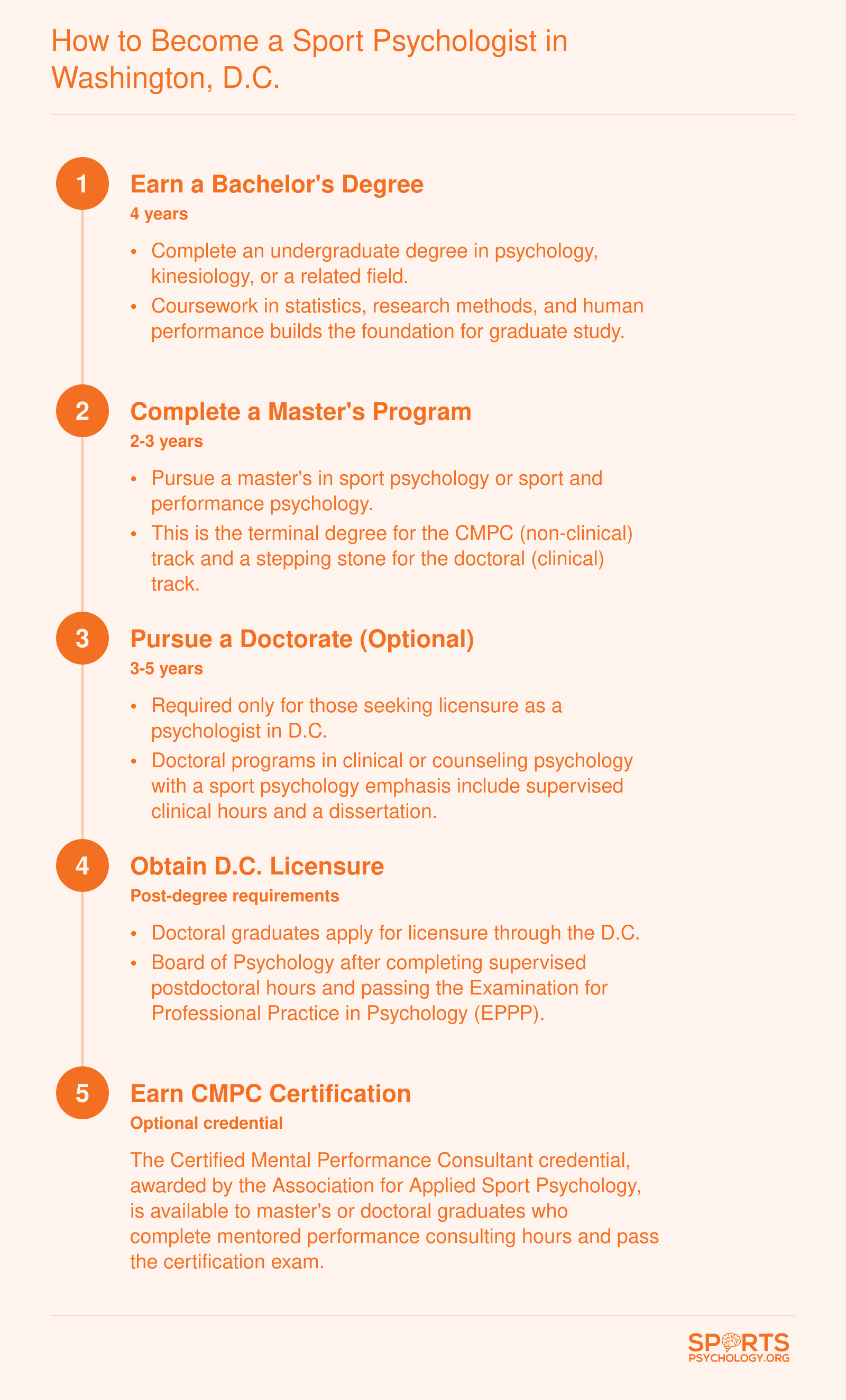
How to Become a Sport Psychologist in Washington, D.C.
There are two main professional tracks in sport psychology. The licensed psychologist track requires a doctorate, focuses on clinical work, and typically takes 9-10 years from undergraduate entry to independent practice. The certified mental performance consultant (CMPC) track requires a master's degree, focuses on non-clinical performance enhancement, and can be completed in roughly 6-7 years. Both paths begin with the same foundational steps.
Sport Psychology Licensure & Certification in Washington, D.C.
If you plan to practice sport psychology in Washington, D.C., your credentialing path depends on the services you want to offer. The District draws a clear legal line: only individuals licensed by the DC Board of Psychology may use the title "psychologist." Understanding the three main credential tracks will help you choose the right program and build a compliant practice.
Psychologist Licensure Through the DC Board of Psychology
The most comprehensive route is full psychologist licensure, which authorizes you to diagnose, treat, and provide clinical services to athletes and performers. Requirements set by the DC Board of Psychology include:1
Doctoral degree: You must hold a doctoral degree in psychology from a program that meets board standards.
Supervised experience: A total of 4,000 supervised hours completed within a three-year period, including at least 200 hours of immediate supervision (100 of which must be with a licensed psychologist) and 150 hours of individual supervision.
EPPP: You must pass the Examination for Professional Practice in Psychology.
Jurisprudence exam: D.C. requires a separate jurisprudence exam covering District-specific laws and ethical standards governing psychological practice.
This pathway is ideal for practitioners who want to integrate clinical sports psychology, psychological assessment, and performance consulting into a single practice.
Licensed Professional Counselor (LPC) Pathway
Master's-level graduates who want to provide therapeutic services to athletes can pursue licensure as a Licensed Professional Counselor through the DC Board of Professional Counseling. Key requirements include:
Degree: A master's or doctoral degree in counseling.
Supervised experience: 3,500 hours of post-degree supervised practice completed within two to five years, with at least 100 hours of immediate supervision at a ratio of no more than one supervisor to 35 supervisees.
NCE: Passing the National Counselor Examination.
An LPC can provide therapy, including work with athletes dealing with anxiety, burnout, or transition issues, but may not use the title "psychologist."
Certified Mental Performance Consultant (CMPC)
For graduates who focus on performance enhancement rather than clinical treatment, the Certified Mental Performance Consultant credential through the Association for Applied Sport Psychology (AASP) is the industry standard. CMPC holders work on goal setting, visualization, focus, and team dynamics without providing clinical diagnoses or therapy. Eligibility generally requires a master's or doctoral degree in sport science or a related field, coursework in specific sport psychology competency areas, and completion of mentored experience hours under an approved mentor. You can explore other credentials in our guide to sport psychology certification.
CMPC holders in D.C. typically practice as mental performance consultants or coaches. They do not need a psychology license as long as they stay within a non-clinical scope of practice.
Do Sport Psychologists Need to Be Licensed in D.C.?
The short answer: it depends on what you do. If you offer clinical services such as psychotherapy, diagnosis, or psychological testing, you must hold a DC psychology license or an LPC. If your work centers on mental performance consulting, such as helping athletes sharpen focus or manage competitive pressure, a CMPC allows you to practice without a clinical license. Many sport psychology professionals in the D.C. area hold both a clinical license and the CMPC to maximize their flexibility across clinical and performance domains. Before you choose a program, clarify which scope of practice aligns with your career goals so you can build the right combination of education and credentials from the start. For a broader look at these pathways, see our overview on how to become a sports psychologist.
Practicum & Fieldwork Opportunities in the D.C. Metro Area
One of the biggest advantages of studying sport psychology as a Washington, D.C. student is the extraordinary density of practicum and fieldwork sites right in your metro area. Whether you are enrolled in an online program or a hybrid format, you can fulfill your supervised hours locally, building hands-on experience while completing coursework remotely.
Professional Sports Organizations
D.C. is home to a remarkable cluster of professional teams, many of which employ or contract mental performance professionals. The Washington Commanders, for example, have a licensed clinical psychologist on staff, Dr. Barbara Roberts, who works with professional athletes in the organization.1 The Washington Nationals (MLB), Washington Wizards and Mystics (NBA/WNBA), and D.C. United (MLS) round out a roster of franchises that increasingly invest in sport psychology support. While the Commanders' 2026 coaching staff does not include a dedicated sport psychologist position2, the trend across professional sports is clearly moving toward expanded mental performance departments. That shift makes these organizations worth exploring for practicum placements or networking, especially as you consider how many sport psychologist work with a sports team.
Military and Federal Performance Psychology
Few cities in the country can match D.C.'s concentration of military and federal performance psychology opportunities. Walter Reed National Military Medical Center has long maintained psychology training programs, and the Department of Defense has invested significantly in performance optimization through initiatives like the Comprehensive Soldier and Family Fitness program and related Total Force Fitness efforts headquartered in the D.C. area. These programs blend sport and performance psychology principles with resilience training for service members, offering practicum students a unique applied setting that is difficult to find elsewhere.
University Athletics Departments
The metro area is also rich with college athletics programs that can serve as practicum hosts. Georgetown University, George Washington University, American University, Howard University, and the University of Maryland all field Division I athletic programs. Student-athletes at these institutions benefit from mental performance support, and their athletics departments can be excellent sites for accumulating supervised hours in applied sport psychology.
Beyond the Playing Field
D.C. opens doors to performance psychology work that extends well past traditional sports. The Kennedy Center draws world-class performers who face many of the same mental challenges as elite athletes, from pre-performance anxiety to sustained focus under pressure. Federal law enforcement agencies such as the FBI and the U.S. Secret Service also utilize performance psychology principles to train agents for high-stakes scenarios. These non-sport placements can broaden your clinical skill set and make you a more versatile practitioner after graduation, whether you ultimately pursue a sports psychology phd or enter the workforce with a master's degree.
Why This Matters for Online Students
If you are pursuing your sport psychology degree through an online program, D.C.'s practicum density is a genuine differentiator. Rather than relocating or traveling long distances for fieldwork, you can tap into a deep local network of professional teams, military installations, universities, and federal agencies. This means you can complete your supervised hours on a schedule that fits your life while gaining exposure to an unusually wide range of performance psychology applications.
Sport Psychology Salary & Career Outlook in Washington, D.C.
Washington, D.C. is one of the strongest labor markets in the country for psychologists, and sport psychology professionals who settle in the metro area can expect compensation well above the national average. Whether you complete an online sport psychology degree from out of state or relocate after graduation, the D.C. market offers a compelling combination of diverse employers and competitive pay.
Psychologist Salaries in the D.C. Metro Area
According to 2024 Bureau of Labor Statistics data for the Washington-Arlington-Alexandria metropolitan area, psychologists classified under the broader "all other" category earn a median annual wage of roughly $100,740.1 Clinical, counseling, and school psychologists in the same metro area earn a median of about $81,080.1 The region employs approximately 790 psychologists in the "all other" category and nearly 2,460 clinical, counseling, and school psychologists, reflecting steady demand across multiple sectors.1
D.C.'s cost of living is admittedly high, but psychologist salaries here consistently outpace the national median. Federal pay scales add another layer of stability: psychologists employed by government agencies typically fall within the GS-12 to GS-14 range, which translates to base salaries from roughly $99,000 to over $150,000 depending on step and locality pay adjustments for the D.C. area.
Who Hires Sport Psychologists in D.C.?
The capital region's employer landscape is unusually varied for this specialty, and understanding where sports psychologists are most needed can help you target your job search. Major employer types include:
Federal agencies: The Department of Defense and the Department of Veterans Affairs maintain large behavioral health staffs and increasingly integrate performance psychology into service member readiness and rehabilitation programs.
Professional sports organizations: D.C. is home to teams across every major league, all of which invest in mental performance support staff.
Private performance consulting practices: A growing number of independent consultancies serve elite athletes, executives, and performing artists throughout the metro.
Collegiate athletics departments: Multiple Division I programs in the region hire or contract sport psychology professionals.
Hospitals and clinics: Medical centers with sports medicine divisions regularly employ psychologists who specialize in injury recovery and return-to-play mental health.
What Can You Do With a Master's in Sport Psychology?
A master's degree opens several career paths, even before pursuing doctoral-level licensure. Common roles for master's-level graduates include:
Mental performance consultant: Working directly with athletes and teams on goal setting, focus, and competitive anxiety management.
Sports counselor: Addressing well-being, transitions out of sport, and identity concerns.
Research coordinator: Supporting studies at universities, think tanks, or federal research agencies.
Wellness program director: Designing and overseeing mental health and performance initiatives for organizations, military units, or athletic departments.
Graduates interested in applying sport psychology principles outside of athletics may also find rewarding opportunities in corporate wellness, where demand for mental performance expertise continues to grow.
What About Program-Level Earnings?
Program-specific earnings data for the online sport psychology programs featured on this site are not yet available at the graduate level. As federal reporting expands to cover more specialized credentials, this information should become accessible in coming years. In the meantime, the metro-area wage data above gives D.C. students a reliable benchmark for what the local market pays psychologists across related roles.
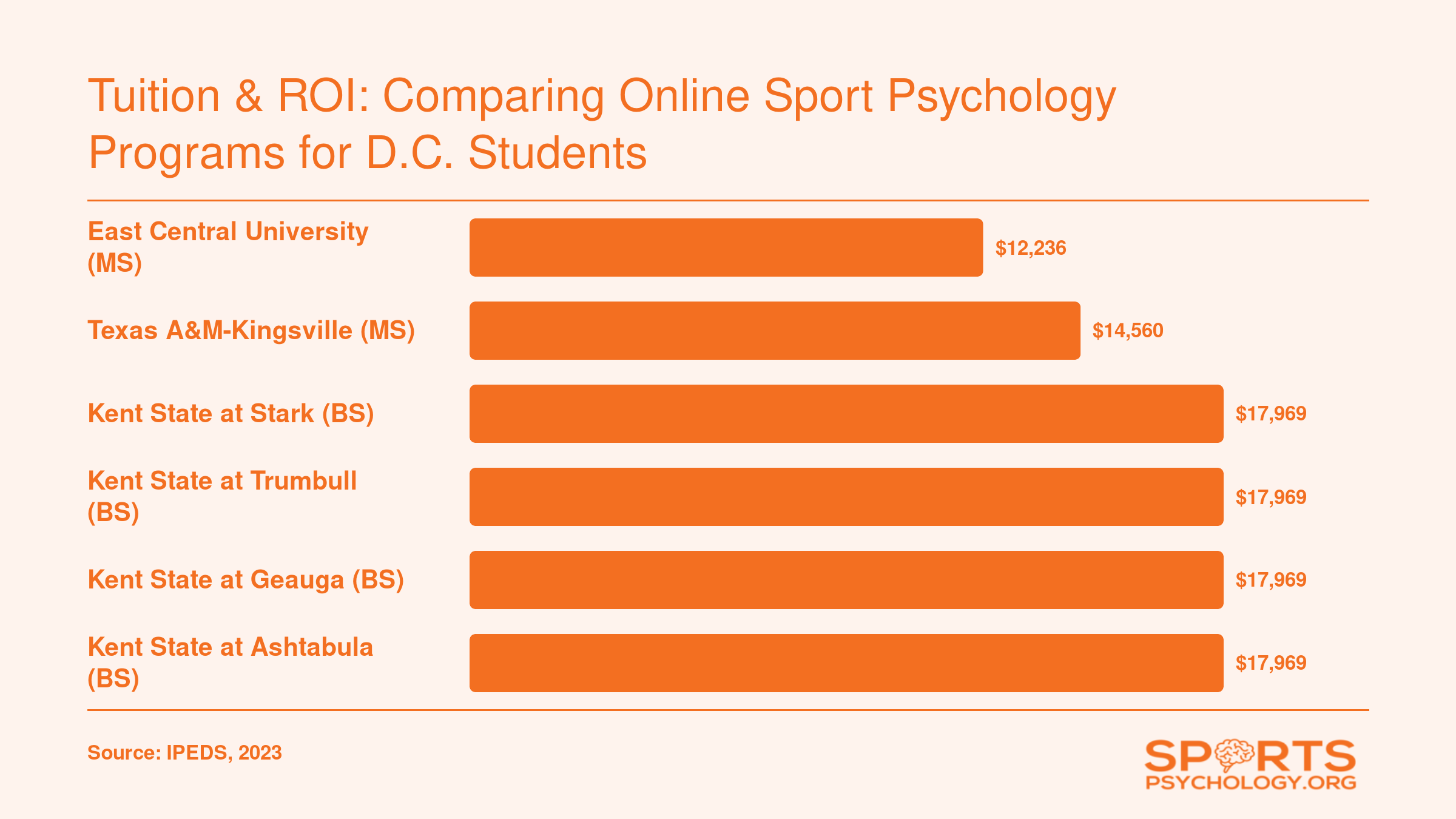
Tuition & ROI: Comparing Online Sport Psychology Programs for D.C. Students
Because Washington, D.C. has no in-state sport psychology programs, students enroll in online programs headquartered in other states, so out-of-state tuition is the most relevant price tag. The chart below compares annual out-of-state tuition at six programs open to D.C. residents. Program-level earnings and debt data are not yet published for these specific sport psychology tracks, but institution-wide median earnings ten years after enrollment range from roughly $45,000 to $51,500, and median graduate debt ranges from about $17,700 to $24,500, offering a broad sense of long-term return on investment.
Did You Know?
The Bureau of Labor Statistics projects that employment for clinical and counseling psychologists will grow by 11 percent between 2022 and 2032, a pace well above the national average for all occupations. This surge reflects rising demand for mental health services, including the growing use of sport and performance psychology by athletes at every level.
Frequently Asked Questions About Sport Psychology in D.C.
Below are answers to the most common questions prospective students ask about pursuing sport psychology in the Washington, D.C. area. Each response is a quick standalone summary, but you can explore earlier sections of this guide for deeper detail on licensure, career paths, and program comparisons.
Are there sport psychology graduate programs in Washington, D.C.?
Washington, D.C. is home to several universities that offer graduate coursework related to sport and exercise psychology, though dedicated sport psychology degree programs in the District are limited. Many D.C. students choose accredited online sport psychology masters programs that allow them to study from the capital while completing local practicum hours. Nearby Maryland and Virginia institutions also expand the options available to D.C. residents.
How do I become a sport psychologist in Washington, D.C.?
The typical path starts with a bachelor's degree in psychology, kinesiology, or a related field, followed by a master's or doctoral program in sport psychology or a closely aligned discipline. After completing supervised clinical hours, you would pursue licensure through the D.C. Board of Psychology. Many practitioners also earn the Certified Mental Performance Consultant (CMPC) credential through the Association for Applied Sport Psychology.
What is the difference between a sport psychologist and a performance psychologist?
A sport psychologist typically focuses on the mental health and performance needs of athletes, often holding a doctoral degree and clinical license. A performance psychologist applies similar mental skills training to a broader range of high performers, including military personnel, surgeons, and executives. In the D.C. metro area, performance psychology roles are especially common given the concentration of military and government organizations.
How long does it take to get a sport psychology degree?
A master's degree in sport psychology generally takes two to three years of full time study. Doctoral programs usually require five to seven years, including dissertation research and supervised clinical hours. Some online programs offer accelerated or flexible scheduling that can shorten the timeline for working professionals. The total length depends on your chosen degree level and whether you attend part time or full time.
Do sport psychologists need to be licensed in Washington, D.C.?
If you plan to provide clinical or counseling services, you must hold a license issued by the D.C. Board of Psychology, which typically requires a doctoral degree, supervised professional experience, and passing the Examination for Professional Practice in Psychology (EPPP). Practitioners who focus solely on mental performance consulting rather than therapy may operate under the CMPC credential without a clinical license, though scope of practice rules still apply.
What can you do with a master's in sport psychology?
A master's degree opens doors to roles such as mental performance consultant, collegiate athletic department staff, sports research coordinator, and wellness program director. In the D.C. area, graduates also find opportunities with military human performance programs, government agencies, and private consulting firms. While a master's does not qualify you for clinical licensure in D.C., it provides a strong foundation for performance consulting careers.
Can I complete a sport psychology degree entirely online?
Yes, several accredited institutions offer fully online master's programs in sport psychology or applied sport and performance psychology. Most programs do require some form of practicum or fieldwork, but D.C. students can often arrange these placements locally with athletic organizations, military installations, or university athletic departments in the metro area. Check each program's residency requirements before enrolling.
More Online Sport Psychology Programs for Washington, D.C. Students
In addition to the top-ranked programs, the following accredited online sport psychology degrees are available to Washington, D.C. students. These programs offer flexibility for remote learners and cover a range of degree levels from bachelor's to master's.
Faulkner University
Offers an online Bachelor of Science in Sports Psychology with a Christian worldview, small class sizes, and tuition at $335 per semester hour plus a $75 online course fee.
Provides a Master of Science in Sports Psychology online, focusing on team dynamics, performance enhancement, and injury recovery to prepare graduates for coaching and mentoring roles.
Delivers a Master of Science in Applied Sport Psychology online asynchronously, with tracks for Mental Performance Consultant certification or limited psychologist licensure, designed for working professionals.
Offers a fully online Bachelor of Science in Sport Psychology covering psychological theory, exercise physiology, and injury rehabilitation, preparing students for coaching or graduate studies.
Features a 100% online Master of Science in Sport and Performance Psychology with flexible start dates, no GRE required, and alignment with CMPC certification requirements.
Provides an online Master of Science in Sport Psychology (45 credits) that prepares students for CMPC certification, with a curriculum including a supervised internship and flexible part-time or full-time options.
Offers an online Master of Science in Experimental Psychology with a Health and Sports Psychology concentration, including courses in advanced sports psychology and a practicum.
Provides an online Bachelor of Science in Sport, Exercise and Performance Psychology covering motivation, mental training, and stress management, with a practicum component.
Delivers the same online Bachelor of Science in Sport, Exercise and Performance Psychology as other Kent State campuses, focusing on psychological factors in performance.
Offers the online Bachelor of Science in Sport, Exercise and Performance Psychology, requiring 120 credits and covering mental skills training and ethics.
Provides the online Bachelor of Science in Sport, Exercise and Performance Psychology with courses in psychology of coaching and sport performance interventions.
Offers the online Bachelor of Science in Sport, Exercise and Performance Psychology, focusing on motivation, stress management, and mental training for athletic success.
Delivers the online Bachelor of Science in Sport, Exercise and Performance Psychology, preparing graduates for careers in mental performance coaching or further study.
Provides the online Bachelor of Science in Sport, Exercise and Performance Psychology, covering motivation and mental training, with a practicum experience.