Fully online programs now let you earn a sports psychology degree from anywhere, making geography irrelevant to program quality.
CMPC certification requires specific graduate coursework and mentored experience, so confirm your program aligns before enrolling.
Earning potential varies widely by degree level, with doctoral graduates in clinical roles often exceeding six figures annually.
Net price after financial aid, not sticker price, is the most reliable way to compare tuition across top programs.
Demand for mental performance professionals is accelerating across every level of sport. The NCAA now permits institutions to count sport psychology staff toward athlete welfare requirements, youth travel organizations are hiring mental skills coaches at record rates, and major professional leagues have expanded performance psychology departments significantly since 2023. That growth has made sports psychology programs more competitive and more varied than at any point in the past decade.
When prospective students search for sports psychology schools near me, they are usually looking for flexible, often fully online options that fit around a job or athletic schedule. Geography matters less than it used to, but program structure, CMPC certification alignment, and total cost still vary widely. Choosing the wrong degree level or an unaligned curriculum can add years and tens of thousands of dollars to your path.
Best Fully Online Sports Psychology Programs for 2026
Every program below is 100% online, meaning you can complete coursework from anywhere in the country without setting foot on campus. We ranked them using a composite that weighs post-graduation earnings, program cost, completion metrics, and overall institutional quality. Whether you are searching for "sports psychology schools near me" or simply the strongest remote option, these programs bring the classroom to you.
NCES-IPEDS federal institutional data — nces.ed.gov
Arizona State University
#1
Tempe, AZ · $15,000/yr
Best for: Career changers wanting a bachelor's-to-master's pipeline
Arizona State University pairs a large research university's resources with flexible online delivery. Its sport and performance counseling concentration lives within the College of Integrative Sciences and Arts, and a newer online Master of Science in Psychology with a sport psychology concentration creates a clear bachelor's-to-master's pipeline. Institutional median earnings ten years after enrollment reach roughly $62,700, and the average net price for undergraduates sits near $14,967.
Bachelor of Science in Counseling and Applied Psychological Science, Sport and Performance Counseling — Online
120 credit hours across 40 accelerated 7.5-week classes
Sport and performance counseling concentration within psychology
Required internship in a sport or mental health setting
Admission options include 3.00 GPA, top 25% rank, or test scores
In-state tuition around $12,223; out-of-state around $33,139
Diploma does not indicate online delivery
Financial aid and Earned Admission pathway available
Best for: Students seeking an accelerated faith-based format
California Baptist University offers an accelerated online Bachelor of Science in Sport and Performance Psychology that can be finished in about 16 months of full-time study. With six start dates per year and asynchronous coursework, CBU is built for students who need scheduling flexibility. The curriculum blends exercise physiology, cognitive psychology, and behavioral sport psychology within a faith-integrated framework.
Bachelor of Science in Sport and Performance Psychology — Online
49 units required; completable in roughly 16 months full-time
$520 per unit plus fees; financial aid available
100% asynchronous online with no campus visits
Six entry points per year with 8-week course cycles
Covers exercise physiology, cognitive psychology, and ethics
WSCUC-accredited with transfer-friendly admissions
Best for: Ohio residents leveraging in-state tuition savings
Kent State University houses its sport, exercise, and performance psychology major within its well-established kinesiology and health sciences ecosystem. The 120-credit online bachelor's program covers motivation, mental training, stress management, and sport-injury psychology. Ohio residents benefit from notably lower total tuition (approximately $53,700 versus $54,900 for non-residents), and graduates are prepared for coaching roles or further graduate study.
Bachelor of Science in Sport, Exercise and Performance Psychology — Online
120 credit hours; designed for four-year completion online
Covers motivation, mental skills training, and injury psychology
Includes a practicum experience for hands-on application
Ohio-resident tuition around $12,920 per year; non-resident around $21,575
Minimum 2.0 GPA required; transfer students accepted
Prepares graduates for coaching or graduate-level study
Adams State University delivers an online Master of Science in Kinesiology with an Applied Sport Psychology emphasis, one of the most affordable graduate-level options on this list. The 36-credit program is housed in the kinesiology department and can be finished in about two years. Coursework spans mental strength and conditioning, ethics, diversity in sport, and research methods, and students complete both an internship and a capstone project.
Master of Science in Kinesiology, Applied Sport Psychology — Online
36 credit hours; approximately two-year completion timeline
Housed in kinesiology department with sport psychology emphasis
Tuition listed at $5,898 (same rate in-state and out-of-state)
Internship and capstone project required
Covers mental strength, ethics, case studies, and diversity
Research methods and statistical methods courses included
National University stands out for offering sports psychology programs across three degree levels, all online: a Bachelor of Arts, a Master of Science, and a PhD. Its master's-level tracks explicitly meet AASP certification requirements for the Certified Mental Performance Consultant (CMPC) credential. Students can complete optional applied training and fieldwork in their own communities, making it a strong fit regardless of location. Median institutional earnings ten years out are roughly $67,548, the highest on this list.
Bachelor of Arts in Sport Psychology — Online
180 quarter units; completable in about 40 months
$0 application fee; no essays or entrance exams required
Covers foundation, applied, and social psychology of sport
PhD in Psychology, Sport and Performance Psychology — On-Campus
60 credit hours across 20 courses; estimated 48 months
100% online with no scheduled lecture hours
Dissertation with oral defense required
Personalized doctoral faculty mentoring
Covers advanced applied skills, ethics, and diversity
Requires a master's degree for admission
Springfield College
#6
Springfield, MA · ~$31,000/yr (est.)
Springfield College, long associated with physical education and human services, offers an online Master of Education in Sport and Exercise Psychology. The 36-credit program blends 7-week and 15-week asynchronous courses and includes a 135-hour applied internship that students complete in their own community under remote, certified supervision. Full-time students can finish in about 18 months, and the college's 11-to-1 student-to-faculty ratio signals personalized attention.
Master of Education in Sport and Exercise Psychology — On-Campus
36 credits; 18-month completion at full-time pace
100% asynchronous with 7-week and 15-week course formats
135-hour applied internship completed locally with remote supervision
Certified supervision available for CMPC-related experience
Requires essay, resume, two recommendation letters, and transcripts
Rolling domestic admissions; fall semester start
Faulkner University
#7
Montgomery, AL · $22,000/yr
Faulkner University provides an online Bachelor of Science in Sports Psychology grounded in a Christian liberal arts tradition. Tuition is $335 per semester hour plus a $75 online course fee, placing it among the more budget-conscious private options. Small class sizes (averaging 15 students) and faculty mentorship define the experience, and the curriculum emphasizes the mental dimensions of athletic performance, coaching preparation, and fitness instruction.
Bachelor of Science in Sports Psychology — Online
$335 per semester hour plus $75 online course fee
Average class size of 15 students for personalized learning
Christian worldview integrated into curriculum
Prepares for coaching, athletic counseling, and fitness roles
High school diploma or GED required; ACT/SAT for recent grads
Financial aid available; transfer applicants need 24 credit hours
University of the Southwest offers a fully online Master of Science in Sports Psychology that targets working coaches, teachers, and athletic professionals. The curriculum covers team dynamics, performance enhancement, injury recovery, and emotional challenges in competition. With a net price near $16,927 and uniform tuition for in-state and out-of-state students, the program is a cost-effective graduate path in a region rich with K-12 and collegiate athletics opportunities.
Master of Science in Sports Psychology — Online
Fully online delivery; same tuition for all students ($11,682 listed)
Focuses on team dynamics, performance enhancement, and recovery
Prepares graduates for coaching, mentoring, and teaching careers
Covers psychological and physical effects of competition
Practical methods for helping teams and individual athletes
Parker University, rooted in Dallas's health-sciences community, offers a fully online Bachelor of Science in Sport Psychology that emphasizes the link between psychological training and physical performance. Coursework spans exercise physiology, biomechanics, and injury rehabilitation alongside core sport psychology theory. Median graduate debt is notably low at about $12,288, and the 8-to-1 student-to-faculty ratio is the smallest on this list.
Bachelor of Science in Sport Psychology — Online
Fully online with flexible scheduling for working adults
Covers exercise physiology, biomechanics, and injury rehab
8-to-1 student-to-faculty ratio for close mentorship
Median graduate debt approximately $12,288
SACSCOC accredited; career services and professional network
Foundation for graduate study or direct entry into coaching and health roles
Northern Michigan University's online Master of Science in Applied Sport Psychology is notable for offering two distinct tracks within one program: one preparing students for CMPC certification and another structured to meet Michigan's requirements for licensure as a Limited Licensed Psychologist. Both tracks are fully asynchronous and housed in the School of Health and Human Performance, making them accessible to working coaches and professionals nationwide.
Master of Science in Applied Sport Psychology, Mental Performance Consultant Track — Online
Fully online, asynchronous delivery
Tailored to meet AASP CMPC certification coursework and experience
Interdisciplinary curriculum within Health and Human Performance
Designed for coaches, athletes, and sport professionals
In-state tuition around $12,196; out-of-state around $15,652
Core courses plus certification-specific electives
Most listicles ranking sports psychology programs offer little or no explanation of how they arrived at their picks. That lack of transparency makes it difficult for prospective students to trust the recommendations or compare programs on an equal footing. On sportspsychology.org, we take a different approach: every program in our ranking was evaluated using a composite quality score built entirely from publicly available federal data.
What Goes Into the Composite Score
Our scoring model weighs five dimensions drawn from the U.S. Department of Education's College Scorecard:
Online delivery: Only programs offered 100 percent online were eligible. Hybrid formats and on-campus-only options were excluded so the list stays relevant no matter where you live.
Post-graduation earnings: We looked at reported median earnings for graduates, which helps you gauge return on investment after completing the program.
Net program cost: This captures the typical out-of-pocket price after grants and scholarships, giving a more realistic picture than sticker-price tuition alone.
Graduation and completion rates: Higher completion rates often signal stronger student support, advising, and curriculum design.
Student debt load: Programs that leave graduates with lower median debt relative to their earning potential score higher in this category.
Each factor is normalized and weighted to produce a single composite score, which determines a program's position in the ranking. Because the underlying data comes from a federal source updated on a regular cycle, you can be confident the numbers reflect real institutional outcomes rather than self-reported marketing claims.
Why Only Fully Online Programs?
The search phrase "sports psychology schools near me" implies geography matters, but the reality in 2026 is that fully online programs effectively erase location as a barrier. By limiting our list to 100 percent online options, we ensure every program is accessible to students anywhere in the country, whether you live near a major research university or in a rural area with limited local options.
A Note on CMPC Certification
Alignment with the Certified Mental Performance Consultant credential is important for many students, but we chose not to fold it into the composite ranking score. Certification requirements involve specific coursework, mentored experience, and a qualifying exam, which are better evaluated on a case-by-case basis. That is why we address CMPC alignment in its own dedicated section below, so you can cross-reference ranked programs with the certification pathway that fits your career goals.
Questions to Ask Yourself
Do you want to work directly with athletes, or are coaching, wellness, and research roles a better fit?
Working one on one with athletes as a mental performance consultant typically requires a master's or doctoral degree. If you are drawn to coaching psychology, sport science research, or wellness programming, a bachelor's degree can open those doors sooner and at lower cost.
Is earning the Certified Mental Performance Consultant (CMPC) credential part of your career plan?
Not every program satisfies the coursework and supervised experience hours required by the Association for Applied Sport Psychology. If CMPC certification is your goal, verify alignment before you enroll so you do not need extra classes later.
Have you compared each program's net price after financial aid rather than its published tuition rate?
Sticker prices can differ from what you actually pay by thousands of dollars per year. Use each school's net price calculator and factor in scholarships, assistantships, and federal aid to build a realistic monthly budget before committing.
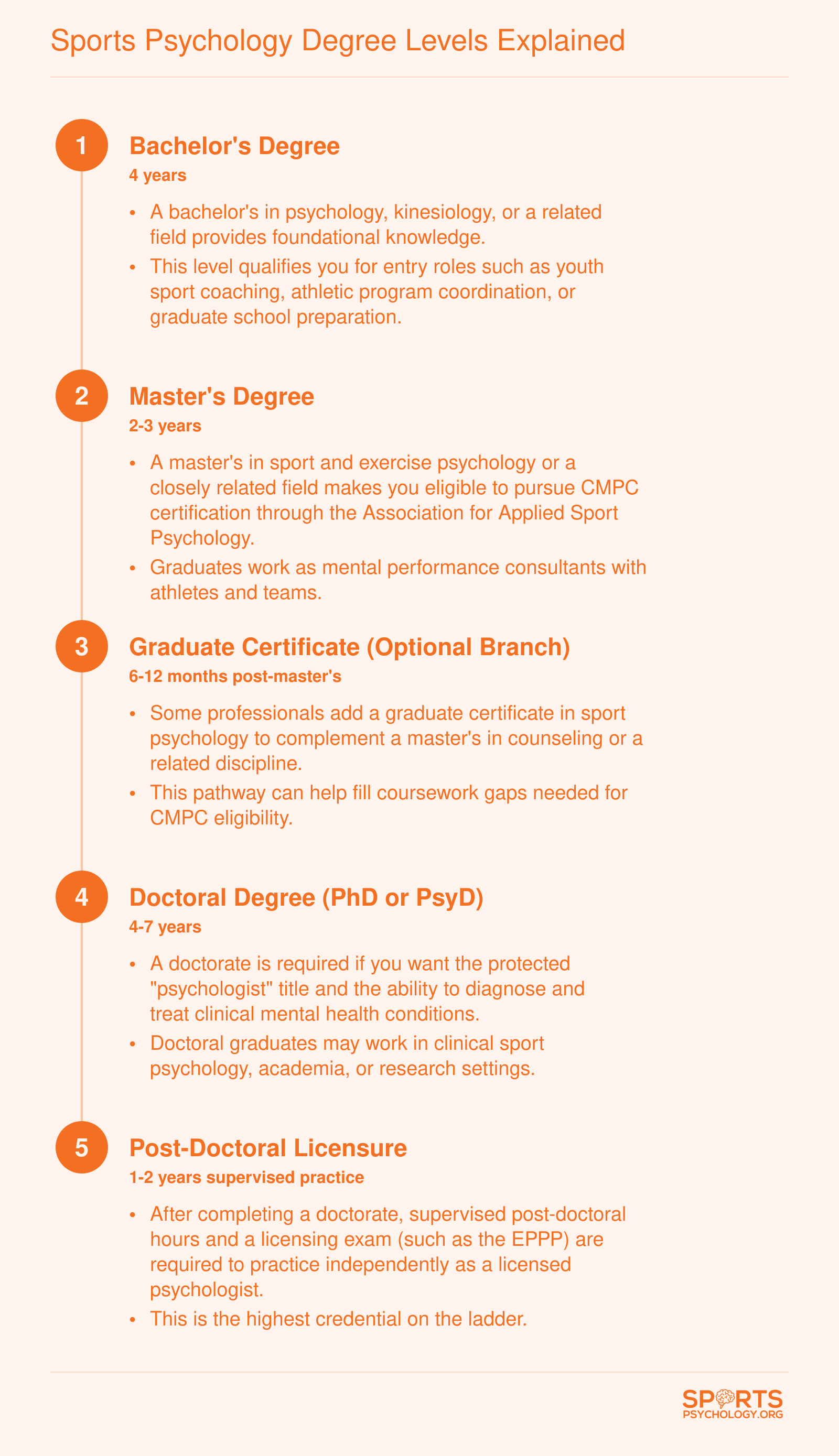
Sports Psychology Degree Levels Explained
Sports psychology careers follow a credentialing ladder, where each degree level opens different professional doors. A common question is whether you need a PhD to work in the field. The short answer: if you want the legally protected title of "psychologist," yes, a doctorate and licensure are required. However, you can build a rewarding career as a Certified Mental Performance Consultant (CMPC) with a master's degree.
Programs Aligned With CMPC Certification Requirements
If you plan to work directly with athletes as a mental performance consultant, the Certified Mental Performance Consultant (CMPC) credential should be on your radar from day one of your program search. Offered by the Association for Applied Sport Psychology (AASP) and accredited by the NCCA (most recently reaccredited in February 2026)1, the CMPC is widely considered the gold-standard certification for non-licensed professionals who provide mental performance services in sport, exercise, and performing-arts settings. Choosing a program that aligns with CMPC requirements can save you years of backfilling coursework after graduation.
What CMPC Certification Requires
To sit for the CMPC exam, candidates must hold a master's or doctoral degree in a field clearly related to sport science or psychology.2 Beyond the degree itself, AASP requires documented coursework across eight knowledge areas, covering topics such as sport psychology foundations, professional ethics, psychopathology, research methods, and diversity/cultural competence.2
The supervised-experience component is equally rigorous. As of 2025 and 2026, candidates must complete a minimum of 400 total mentored hours, broken down as follows:2
Direct client contact: At least 200 hours working face-to-face (or virtually) with athletes or performers.2
Competitive sport hours: At least 100 of those direct hours must occur in a competitive sport environment.2
Support activities: A minimum of 150 hours dedicated to case preparation, consultation, professional development, and related tasks.2
Mentorship sessions: At least 40 hours of structured mentorship, including a minimum of 20 individual mentorship hours and up to 20 group mentorship hours.3
All mentorship must come from a professional listed on the AASP Approved Mentor Registry, and hours are now verified through a digital tracking system called Certemy.1 Virtual hours are accepted, which is helpful for students in online or hybrid programs.1
Which Program Types Align Best
Not every graduate degree in psychology or kinesiology automatically covers all eight knowledge areas. Programs that most commonly align with CMPC requirements include master's and doctoral degrees specifically in sport and exercise psychology, applied sport psychology, or performance psychology housed within kinesiology or sport science departments. Some clinical or counseling psychology programs also align, though students in those tracks may need to add electives to fill gaps in sport-specific coursework.
One important nuance: the department housing your program can affect whether your supervised hours count toward CMPC eligibility. Programs based in kinesiology or sport science departments tend to structure practica around mental performance consulting in athletic settings, which maps directly onto the 200 direct-client-hour and 100 competitive-sport-hour requirements. Programs housed in traditional psychology departments may emphasize clinical practica that do not always satisfy those specific categories. This is not a dealbreaker, but it means you may need to seek additional applied experiences outside your program's standard practicum sequence.
Your Action Step
AASP does not currently publish an official list of approved or pre-aligned programs2, so the responsibility falls on you to verify alignment before you enroll. Here is what to do:
Review the eight CMPC knowledge areas and the mentored-hours structure outlined in the CMPC Certification Program Candidate Handbook on the AASP website.4
Contact the program director at any school you are considering and ask specifically which knowledge areas their curriculum covers and how their practicum hours map onto the CMPC mentorship requirements.
Cross-reference each program's coursework with the ranked list earlier in this article. Schools that explicitly advertise CMPC-aligned curricula or that have faculty on the AASP Approved Mentor Registry are strong candidates.
Confirm that the program can connect you with an AASP-approved mentor, or that you have a plan to secure one independently.
Planning around CMPC requirements from the start is one of the most efficient moves you can make. It keeps your timeline on track and ensures that every credit hour and practicum placement counts toward both your degree and your professional credential.
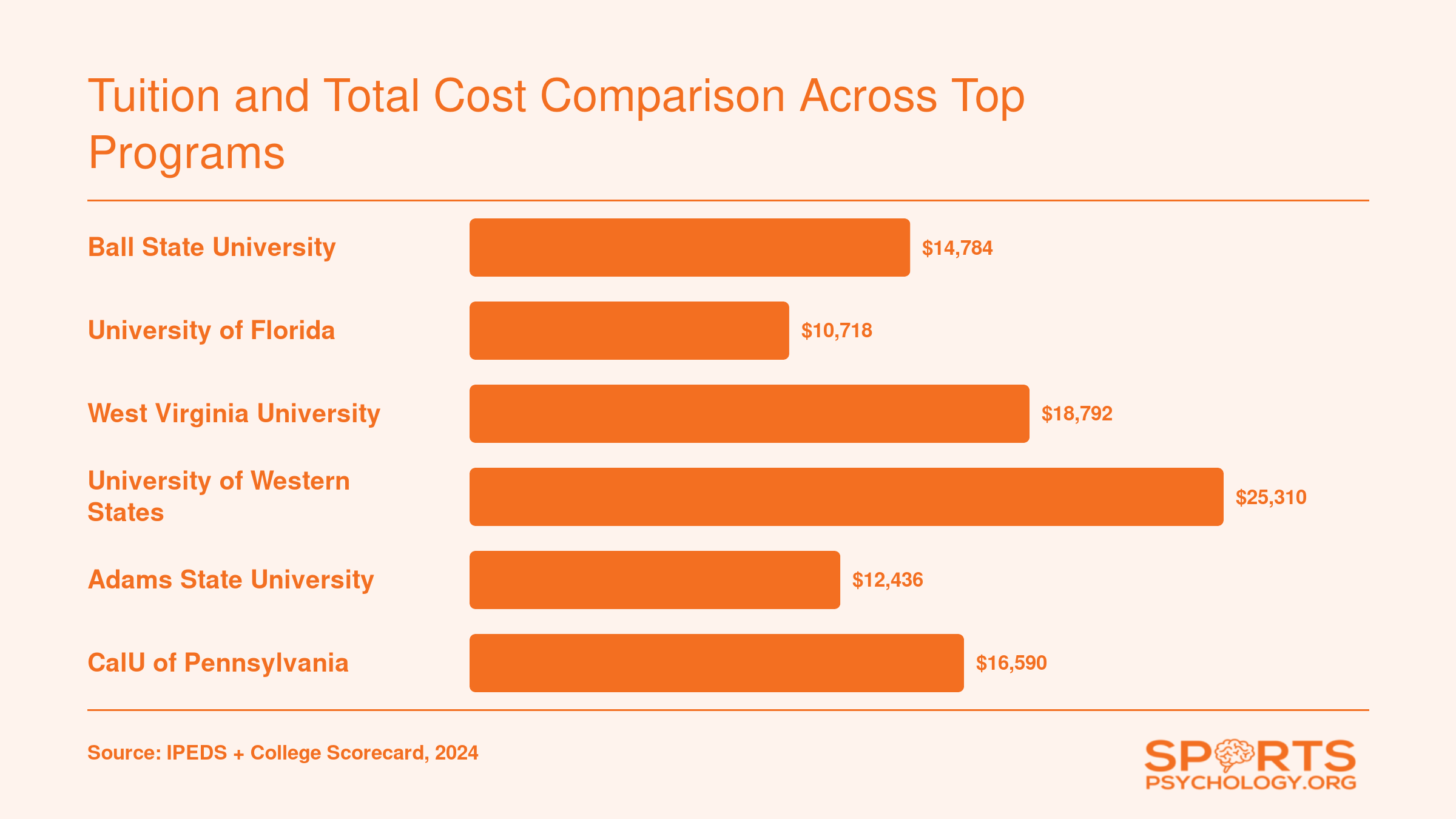
Tuition and Total Cost Comparison Across Top Programs
Net price, the average cost after financial aid, gives you a more realistic picture than sticker price alone. This is especially important for online students, who may not qualify for the same campus-based aid packages (such as on-campus housing grants or institutional scholarships tied to in-person attendance). Keep in mind that tuition at public universities can vary significantly by residency status, though many now offer in-state tuition rates to online students regardless of where they live.
Online Vs. On-Campus Sports Psychology Programs
Choosing between an online and on-campus sports psychology program is one of the most consequential decisions you will make during your education journey. Both formats can lead to the same credentials and career outcomes, but each comes with trade-offs worth weighing carefully against your personal circumstances, budget, and professional goals.
What Works
Online programs offer full geographic flexibility, letting you enroll in top sports psychology schools regardless of where you live.
Studying online makes it easier to maintain employment or coaching roles while completing your degree, reducing lost income.
Fully online programs often carry lower total costs because you avoid relocation, campus housing, and commuting expenses.
On-campus programs typically include structured practicum pipelines with local athletic teams, clinics, and sports organizations.
In-person cohorts foster immersive peer networking and spontaneous mentorship opportunities with faculty and visiting professionals.
Campus-based students benefit from direct access to university athletic departments for hands-on applied experience.
What to Watch
Online students usually need to self-source local practicum and internship placements, which can require extra coordination and planning.
Remote learners may experience less spontaneous peer interaction, making it harder to build a professional network organically.
Some employers or supervisors still perceive online degrees differently, though this gap continues to narrow across the field.
On-campus programs often require relocation, adding housing, moving, and cost-of-living expenses that can significantly raise your total investment.
Rigid class schedules on campus can make it difficult to hold a job or manage family responsibilities while enrolled.
If no strong sports psychology program exists near you, limiting yourself to on-campus options dramatically shrinks your choices.
Career Outcomes and Salary Expectations for Sports Psychology Graduates
One of the most common questions prospective students ask is whether a sports psychology degree leads to a stable, well-paying career. The short answer: yes, but your earning potential depends heavily on the career path you choose, the degree level you complete, and the professional relationships you build along the way.
What the Salary Data Tells Us
Because the Bureau of Labor Statistics does not track sport and performance psychology as a standalone occupation, the closest reference points come from broader psychology categories.1 As of the most recent BLS data (May 2023), the "Psychologists, All Other" category, which captures many sport psychologists, reported a median annual wage of approximately $117,750.2 The range is wide: workers at the 10th percentile earned around $47,450, while those at the 90th percentile earned roughly $157,420.2 Clinical and counseling psychologists, a pathway relevant to licensed sport psychologists, reported a median of about $96,100 per year.3
Across all psychology specializations, the BLS projects about 6% job growth from 2024 to 2034, which is roughly in line with the average for all occupations.1 That steady demand reflects growing awareness of mental health in athletics, corporate settings, and the military.
Early-career earnings for recent graduates of sport psychology programs tend to be more modest, particularly for those who are still accumulating supervised hours toward licensure or certification. Program-level earnings data for the schools ranked in this guide are limited, so treat starting salaries as variable depending on your geographic market and employment setting.
Main Career Paths After Graduation
Sports psychology graduates do not all follow the same trajectory. The field branches into several distinct career paths:
Mental performance consultant (CMPC route): A master's degree paired with Certified Mental Performance Consultant credentials qualifies you to work directly with athletes and teams on focus, confidence, and competitive readiness.
Licensed sport psychologist (doctoral route): Earning a doctorate and obtaining state licensure allows you to diagnose and treat clinical conditions such as anxiety, depression, and eating disorders within athletic populations.
Coaching and athlete development: Some graduates integrate sport psychology principles into roles as coaches, athletic directors, or player development coordinators.
Academic research: A doctoral degree opens doors to university faculty positions where you can teach, publish, and mentor the next generation of practitioners.
Corporate wellness and high-performance consulting: Organizations outside of sport increasingly hire professionals trained in performance psychology to support executive resilience, team dynamics, and employee well-being.
Why Practicum Partnerships Matter
Not all programs deliver the same placement outcomes, and one of the biggest differentiators is the strength of a program's practicum partnerships. Schools that maintain formal relationships with professional sports teams, Olympic training centers, or NCAA athletic departments give students direct, supervised access to high-level athletes. That hands-on experience is difficult to replicate through coursework alone.
Programs housed within universities that have Division I athletic departments, for example, may offer practicum hours embedded within their own sports teams. Others partner with external organizations to place students in applied settings. When evaluating a program, ask specifically about where recent graduates completed their supervised hours and where they landed their first professional roles. Programs that can name specific partner organizations tend to produce graduates with stronger professional networks and more competitive resumes.
Keep in mind that salary ceilings in this field are often tied to private practice income, high-profile consulting contracts, or senior academic positions, all of which take years of experience and credentialing to reach. If you are early in your decision-making process, focus less on peak earning potential and more on choosing a program that positions you for the specific career path that aligns with your goals.
Admission Requirements and How to Qualify
Knowing what programs expect before you apply saves time and prevents last-minute scrambles for missing transcripts or prerequisite courses. Requirements shift depending on the degree level, and a few surprises catch even well-prepared applicants off guard.
Bachelor's Level
Undergraduate admission to a psychology or kinesiology program is the most straightforward path. Most schools look for a high school GPA of 2.5 or above, and the test-optional trend that gained momentum after 2020 continues in 2026, meaning many institutions no longer require the SAT or ACT. If your scores are strong, submitting them can still strengthen a borderline application.
Master's Level
Online master's programs in sport psychology typically require a minimum cumulative GPA of 3.0 on a 4.0 scale. Both Saybrook University's M.S. in Sport Performance Psychology and Northern Michigan University's Online M.S. in Applied Sport Psychology list that same 3.0 threshold.23 The GRE is increasingly optional at this level. Many fully online master's programs now offer GRE waivers or have dropped the requirement altogether, a shift that accelerated after 2020 and shows no sign of reversing.
Beyond grades and test scores, expect to submit a personal statement, letters of recommendation (some programs ask for as few as one3), and official transcripts from every institution you have attended.
Doctoral Level
Doctoral admissions are more competitive. West Virginia University's Ph.D. in Sport, Exercise, and Performance Psychology program catalog recommends a GPA of 3.3, requires the GRE General Test, and expects a bachelor's or master's degree in psychology or a related field.4 Most doctoral programs also ask for a writing sample, a research statement, and a formal interview. Prior research experience, whether through an undergraduate thesis, a lab assistantship, or published work, can meaningfully strengthen your candidacy.
The Prerequisite Courses That Catch Applicants Off Guard
Even if your bachelor's degree is in kinesiology or exercise science, many graduate programs require specific undergraduate coursework in statistics, research methods, and foundational psychology (think abnormal psychology, developmental psychology, or cognitive psychology). If those courses are missing from your transcript, you may need to complete them at a community college or as a non-degree student before you can enroll. If you are making the leap from exercise science to sport psychology, checking prerequisite lists early ensures you are not delayed by a semester or more.
Your Readiness Checklist
Use this quick self-assessment to gauge where you stand right now:
GPA: At or above 3.0 for master's programs, ideally 3.3 or higher for doctoral programs.
Prerequisite courses: Undergraduate statistics, research methods, and at least two foundational psychology courses completed and on your transcript.
Standardized tests: Confirm whether your target program requires the GRE or offers a waiver. Most online master's programs do not require it; most doctoral programs still do.
Letters of recommendation: Identify one to three faculty members or supervisors who can speak to your academic ability and professional potential.
Personal statement or writing sample: Draft a clear, specific essay explaining your interest in sport psychology and your career goals.
Application deadlines: Mark them early. Some programs have firm cutoffs (Saybrook's next deadline, for example, is April 13, 20262), while others use rolling admission.
If any item on that list needs work, you still have time to address it. Completing a missing prerequisite or strengthening your GPA by a few tenths of a point can make the difference between an acceptance and a waitlist.
Frequently Asked Questions About Sports Psychology Schools
Choosing a sports psychology program raises a lot of practical questions, from degree requirements to certification timelines. Below are straightforward answers to the questions prospective students ask most often.
What is a sports psychology degree?
A sports psychology degree prepares you to help athletes and performers optimize mental skills such as focus, motivation, and resilience. Programs exist at the bachelor's, master's, and doctoral levels. Coursework typically blends psychology foundations with sport science topics like performance enhancement, team dynamics, and exercise behavior. Master's programs can be completed in as little as 12 months, as seen with West Virginia University's online option.
How do I become a sports psychologist?
Most paths start with a bachelor's degree in psychology, kinesiology, or a related field, followed by a master's or doctoral program in sport and exercise psychology. After completing your degree, you pursue supervised practical hours and then apply for a credential such as the Certified Mental Performance Consultant (CMPC) designation. If you want to provide clinical therapy to athletes, most states require a doctoral degree and licensure as a psychologist.
Are there fully online sports psychology programs?
Yes. Several accredited universities now offer fully online master's degrees in sports psychology. For example, West Virginia University offers a 12 month online Master's in Sport and Performance Psychology, and Commonwealth University in Pennsylvania offers an online MS in Sports Performance Psychology. These programs let you study from anywhere, which is especially helpful if you are balancing work or athletic commitments.
Do you need a PhD to be a sports psychologist?
Not necessarily. A master's degree is sufficient for many roles, including mental performance consulting and coaching in athletic departments or private practice. However, if you want to diagnose and treat clinical mental health conditions in athletes, you will typically need a doctoral degree (PhD or PsyD) and state licensure. Your ideal degree level depends on whether you plan to focus on performance consulting or clinical psychology.
What is the best school for sports psychology?
The best program depends on your goals, budget, and preferred format. Schools like the University of Florida, University of Kentucky, and West Virginia University each offer well regarded programs with different strengths. On sportspsychology.org, we rank programs based on factors like accreditation, curriculum alignment with CMPC requirements, cost, and career outcomes to help you find the right fit.
What's the difference between a sports psychology program in a psychology department vs. a kinesiology department?
Psychology department programs tend to emphasize clinical training, mental health assessment, and therapeutic techniques. Kinesiology department programs focus more on performance enhancement, motor learning, and sport science. If your goal is CMPC certification and performance consulting, either path can work. If you want clinical licensure as a psychologist, you generally need a program housed in a psychology department with appropriate accreditation.
What salary can I expect with a sports psychology degree?
Salaries vary widely based on degree level, setting, and experience. Entry level mental performance consultants with a master's degree may earn in the range of $50,000 to $70,000 annually, while doctoral level sports psychologists in clinical or professional sport settings can earn significantly more. Private practice consultants set their own rates, which can range from $100 to $300 or more per session. Exact figures depend on location and clientele.
How long does it take to earn CMPC certification?
After completing a qualifying graduate degree, you need a minimum of 400 hours of mentored experience in mental performance consulting. Most candidates complete this mentorship within one to two years after graduation. Combined with a master's program that may take one to two years, you could realistically hold the CMPC credential within three to four years of starting graduate school, assuming you meet all coursework and experience requirements.