No Arkansas university currently offers a dedicated sport psychology degree, making online programs the most practical option.
Arkansas lacks a standalone sport psychology license, so professionals pursue either doctoral-level clinical licensure or the CMPC credential.
National median salaries for psychologists provide the best available benchmark, with higher earnings possible in private practice or Division I athletics.
A master's degree qualifies you for CMPC certification and mental performance consulting, while a doctorate opens the clinical therapy pathway.
No university in Arkansas currently offers a dedicated sport psychology degree at any level, a gap that affects every student in the state weighing this career path. The practical workaround is straightforward: accredited online programs from institutions outside Arkansas provide the same coursework, practicum hours, and eligibility for credentials like the Certified Mental Performance Consultant (CMPC) designation or doctoral-level licensure.
The real tension for Arkansas residents is not access to programs but choosing the right credential track. A master's degree positions you for performance consulting, while a doctorate opens the door to clinical work with athletes. Employer expectations and state licensing rules make that distinction more than academic, especially in a market where most sport psychology roles are still tied to private practice or university athletics. Understanding the full range of specializations of sports psychology can help you identify which track fits your goals before you commit to a program.
Top Online Sports Psychology Programs for Arkansas Students
Because Arkansas does not currently have in-state sport psychology degree programs, online programs offer the most practical route for aspiring professionals in the state. The programs below are ranked by a composite of institutional quality factors, including graduation and retention rates, student outcomes, and program depth, with a boost for online delivery accessibility. Every program on this list accepts Arkansas residents and can be completed remotely, so you can build your career without relocating.
Our ranking methodology
What went into the score
Graduation and retention rates
Program depth and specialization
Online delivery accessibility
Institutional earnings outcomes
Student affordability indicators
Where the data comes from
Independent program research
NCES-IPEDS federal institutional data — nces.ed.gov
Best for: Undergrads seeking a sport counseling foundation
Arizona State University is a globally recognized research institution offering one of the few fully online bachelor's degrees focused specifically on sport and performance counseling. The program is built around 120 credit hours delivered in accelerated 7.5-week courses, making it manageable for working students. With an institution-wide graduation rate of 68% and a 14:1 student-to-faculty ratio in the online division, ASU combines scale with solid academic support, and the diploma does not indicate online delivery.
Counseling and Applied Psychological Science, Sport and Performance Counseling — Online
Online Bachelor of Science degree
Concentration in Sport and Performance Counseling
120 credit hours across 40 accelerated courses
Each class runs 7.5 weeks
Required internship in a sport or mental health setting
Covers motivation, confidence, anxiety, and injury recovery
Out-of-state tuition approximately $33,139 per year
Financial aid and an Earned Admission pathway available
Best for: Budget-minded graduate students pursuing CMPC
Southern Illinois University Edwardsville delivers a master's-level Exercise and Sport Psychology specialization that can be completed fully online in as few as 12 months. The program is notable for its direct alignment with CMPC certification requirements and its connection to Division I athletics, giving students potential exposure to high-level competitive environments. At an out-of-state tuition of $10,488, it is one of the most affordable graduate options on this list, with a net price around $14,889.
MS in Kinesiology, Exercise and Sport Psychology — Hybrid
Master of Science with Exercise and Sport Psychology specialization
100% online with evening and asynchronous options
Completable in 12 to 22 months
Coursework aligns with CMPC certification requirements
Covers sport psychology, coaching psychology, and special populations
Strong faculty mentoring and personalized attention
Best for: Transfer students wanting an accelerated bachelor's
California Baptist University offers an online Bachelor of Science in Sport and Performance Psychology designed for maximum flexibility, with six enrollment entry points per year and fully asynchronous coursework. The 49-unit program can be completed in just 16 months of full-time study, making it one of the fastest undergraduate paths available. CBU's curriculum integrates exercise physiology, cognitive psychology, and ethical practice within a faith-based framework. The institution-wide graduation rate is approximately 62%.
Sport and Performance Psychology, BS — Online
Online Bachelor of Science, 100% asynchronous
49 units, completable in 16 months full-time
Cost of $520 per unit plus fees
Six entry points per year with rolling admissions
Curriculum covers exercise physiology and cognitive psychology
Southern Connecticut State University's M.S. in Exercise Science with a Sport Psychology concentration is a compact 33 to 34 credit interdisciplinary program that draws faculty from three departments. The curriculum is specifically designed to prepare graduates for the CMPC examination through the Association for Applied Sport Psychology. With an 11:1 student-to-faculty ratio, SCSU provides an unusually high level of individual attention for a public institution. Out-of-state tuition is approximately $21,727.
Exercise Science, M.S., Sport Psychology — Hybrid
Master of Science, 33 to 34 credits
Sport Psychology concentration
Interdisciplinary faculty from three departments
Prepares students for CMPC certification exam
Covers health psychology, counseling, and performance enhancement
11:1 student-to-faculty ratio institution-wide
Tuition discounts possible through NEBHE Flexible Program
Texas A&M University Kingsville houses a Performance Psychology concentration within its M.S. in Kinesiology that offers three flexible degree plans: a 36-credit course-only track, a 36-credit plan with a research project or internship, and a 30-credit thesis option. The program aligns with CMPC examination preparation and covers sport, exercise, and performance psychology. Some face-to-face courses are required, which makes this a hybrid option. Out-of-state tuition stands at $14,560, and the net price is roughly $12,090.
M.S. in Kinesiology, Performance Psychology — Hybrid
Performance Psychology concentration
Three degree plan options (30 to 36 credit hours)
Course-only, internship, or thesis tracks available
Aligns with CMPC examination preparation
Some face-to-face courses required (hybrid format)
Out-of-state tuition approximately $14,560
Covers sport, exercise, and performance psychology
Troy University provides a fully online Master of Science in Kinesiology with a Sports Psychology concentration that features no set application deadline, allowing Arkansas students to start on their own timeline. Coursework covers sport psychology theory, motor skills, and mental performance, while hands-on internships with athletes provide real-world experience. Out-of-state tuition is $17,100, and the institution-wide graduation rate is about 50%. Faculty members bring professional experience from applied sport settings.
Master of Science in Kinesiology, Sports Psychology — Hybrid
Sports Psychology concentration, online delivery
No application deadline, flexible start
Includes internships with athletes for hands-on experience
Coursework in Sport Psychology and Motor Skills
Out-of-state tuition approximately $17,100
Faculty with professional sport psychology experience
Prepares graduates for mental skills coaching roles
Kent State University offers a 100% online Bachelor of Science in Sport, Exercise and Performance Psychology that covers motivation, mental training, stress management, and the psychology of sport injury across 120 credit hours. The program includes a practicum component and can be completed in four years. Kent State's institution-wide graduation rate is approximately 64%, and the 20:1 student-to-faculty ratio reflects its large research university setting. Out-of-state tuition is roughly $21,575.
Sport, Exercise and Performance Psychology — Online
100% online Bachelor of Science
120 credit hours, four-year completion timeline
Covers motivation, mental training, and stress management
Includes practicum experience
Addresses sport injury psychology and ethics
Out-of-state tuition approximately $21,575
Prepares for coaching, mental performance, or graduate study
National University stands out for sheer program variety, offering sport psychology degrees at the bachelor's, master's, and doctoral levels, all available 100% online. With weekly start dates and no application fee, enrollment is designed for working adults. The M.S. in Sport Psychology (36 credits) and M.A. in Sport and Performance Psychology each align with AASP or CMPC certification standards, while the Ph.D. specialization in Sport and Performance Psychology provides a research-focused doctoral path. The institution-wide graduation rate is about 43%, and tuition is the same for in-state and out-of-state students at $16,416.
Master of Science in Sport Psychology — Online
100% online, 36 credit hours across 12 courses
Completable in 18 to 21 months
Aligns with AASP certification standards
No application fee and transfer credits accepted (up to 12)
Adams State University offers one of the most affordable fully online master's options for Arkansas students. Its M.S. in Kinesiology with an Applied Sport Psychology concentration requires 36 credits and can be finished in two years. Coursework emphasizes evidence-based mental skills training, case studies, and ethical practice, culminating in a capstone project and internship. Out-of-state tuition is just $5,898 thanks to the university's flat-rate online pricing, and no entrance exam is required.
Master of Science in Kinesiology, Applied Sport Psychology — Online
Applied Sport Psychology concentration
36 credits, completable in two years online
Out-of-state tuition approximately $5,898
Covers mental strength, ethics, and case studies
Includes practicum, internship, and capstone project
Springfield College, widely known as the birthplace of basketball, offers an online Master of Education in Sport and Exercise Psychology built around 36 credits of fully asynchronous coursework. The program features a 135-hour applied internship with remote supervision, making it feasible for Arkansas students who want hands-on training without relocating. Springfield boasts the highest institution-wide graduation rate on this list at roughly 74% and an intimate 11:1 student-to-faculty ratio. Tuition for graduate programs is $33,722.
MEd in Sport and Exercise Psychology Online — Online
36-credit Master of Education, 100% asynchronous
Completable in 18 months full-time
135-hour applied internship with remote supervision
Flexible 7-week and 15-week course formats
Institution-wide graduation rate of approximately 74%
Why Arkansas Students Should Consider Online Sport Psychology Programs
If you have been searching for a standalone sport psychology degree at an Arkansas college, you have probably noticed the gap. No university in the state currently offers a dedicated sport psychology program at either the undergraduate or graduate level. That does not mean Arkansas institutions lack relevant coursework. The University of Arkansas offers well-regarded programs in exercise science and kinesiology, and the University of Arkansas at Little Rock provides graduate training in counseling and psychology. These programs can build a strong foundation in human performance or clinical skills, but they are not designed to prepare you specifically for a career as a sport psychology consultant or mental performance professional.
This is exactly why online programs deserve serious consideration.
Accredited Credentials Without Relocating
Online sport psychology programs let you earn the same accredited credentials that campus students receive, often from the same faculty using identical curricula. Many nationally recognized programs in sport and performance psychology now deliver their masters in sports psychology and doctorate in sports psychology online coursework entirely online or in a hybrid format. For Arkansas students, this means you can pursue a degree tailored to your career goals without uprooting your life, leaving a coaching position, or abandoning ties to the local sports community.
Key advantages include:
Flexibility: Most online programs use asynchronous coursework, letting you study around a work schedule, athletic commitment, or family responsibilities.
Equal accreditation: Reputable online programs hold the same regional and programmatic accreditation as their on-campus versions, so your degree carries the same weight with employers and credentialing bodies.
Cost efficiency: Avoiding out-of-state living expenses can significantly reduce the total cost of your degree.
Local Practicum Opportunities Still Apply
One concern students often raise about online programs is the hands-on component. The good news is that practicum and supervised field hours can typically be arranged in your home state. Arkansas offers a variety of settings where you can gain applied experience:
University athletic departments at schools like the University of Arkansas, Arkansas State University, or the University of Central Arkansas
Private counseling or sport psychology practices across the state
Youth and amateur sports organizations, including AAU programs and high school athletics
Professional or semi-professional teams and facilities in the region
Most online programs have dedicated practicum coordinators who help you identify and secure approved sites near you, so you can complete supervised hours without traveling far from home.
Pairing In-State Foundations With Specialized Online Training
A practical path for many Arkansas students is to complete foundational coursework in exercise science or counseling at a local university, then pursue a specialized online program in sport psychology. For those coming from a kinesiology or exercise science background, making the graduate school transition from exercise science to sports psychology is a well-traveled route. This combination gives you both the broad academic grounding and the focused sport psychology training that credentialing bodies, including CMPC certification through the Association for Applied Sport Psychology, look for in applicants. You get the best of both worlds: in-person mentoring during your early education and nationally recognized specialization through an online program designed for working professionals.
Questions to Ask Yourself
Do you want to provide clinical mental health services to athletes, or focus on performance consulting?
This choice shapes your entire academic path. A clinical route requires a licensure-eligible counseling or psychology degree, while a performance consulting route typically leads to the Certified Mental Performance Consultant (CMPC) credential through a focused sport psychology curriculum.
Can you complete supervised practicum hours in or near Arkansas, or will you need remote and travel-based placements?
Some online programs arrange local practicum sites with college athletic departments or clinics in Arkansas, while others may require you to travel or coordinate your own placement. Confirming this early prevents costly surprises and delays in meeting graduation requirements.
What is your total budget, and does the program's net price after financial aid fit within it?
Tuition varies widely across online programs. Factor in program fees, practicum travel costs, and lost income during supervised hours. Comparing net price after scholarships and aid gives you a realistic picture of what you will actually pay.
Does the program's curriculum align with CMPC eligibility requirements if that credential is your goal?
Not every sport psychology degree covers the specific coursework and mentored experience hours required for CMPC certification. Choosing a program with an approved curriculum saves you from needing extra courses after graduation.
How flexible is the program's schedule for working professionals or student athletes still competing?
Some programs offer asynchronous coursework with no set class times, while others require live sessions on a fixed schedule. Matching the format to your daily routine helps you stay on track without sacrificing work or athletic commitments.
How to Choose the Right Sports Psychology Program
Because Arkansas does not currently have an in-state sports psychology degree program, online programs are the most practical route for students in the state. The three programs compared below all accept Arkansas residents and can be completed remotely. When evaluating your options, focus on four pillars: accreditation (regional accreditation is non-negotiable for licensure and certification eligibility), practicum requirements (hands-on experience is essential for CMPC certification and clinical readiness), cost versus outcomes (weigh tuition and net price against graduation rates and median earnings), and format flexibility (look for asynchronous coursework, part-time options, and manageable course lengths that fit around work or athletic schedules).
Decision Factor
East Central University (OK), M.S. in Sport Psychology
Kent State University at Stark (OH), B.S. in Sport, Exercise and Performance Psychology
Kent State University at Trumbull (OH), B.S. in Sport, Exercise and Performance Psychology
Degree Level
Master's
Bachelor's
Bachelor's
Program Format
Online with some synchronous sessions and an in-person internship component
100% online with a practicum in sport performance
100% online with a practicum experience
Out-of-State Tuition
$12,236 per year
$17,969 per year
$17,969 per year
Net Price (after aid)
$8,683
$10,897
$11,135
Total Credits Required
45 credit hours
120 credit hours
120 credit hours
Estimated Program Length
1 to 2 years
4 years
4 years
Graduation Rate
34.4%
36.7%
32.2%
Student to Faculty Ratio
18:1
24:1
32:1
Median Graduate Debt
$17,671
$24,500
$24,500
Median Earnings (10 years after entry)
$44,962
$45,388
$45,388
CMPC Certification Preparation
Yes, program explicitly prepares students for CMPC
Prepares students for graduate study, which is typically required for CMPC
Prepares students for graduate study, which is typically required for CMPC
Minimum GPA for Admission
3.0
2.0
2.0
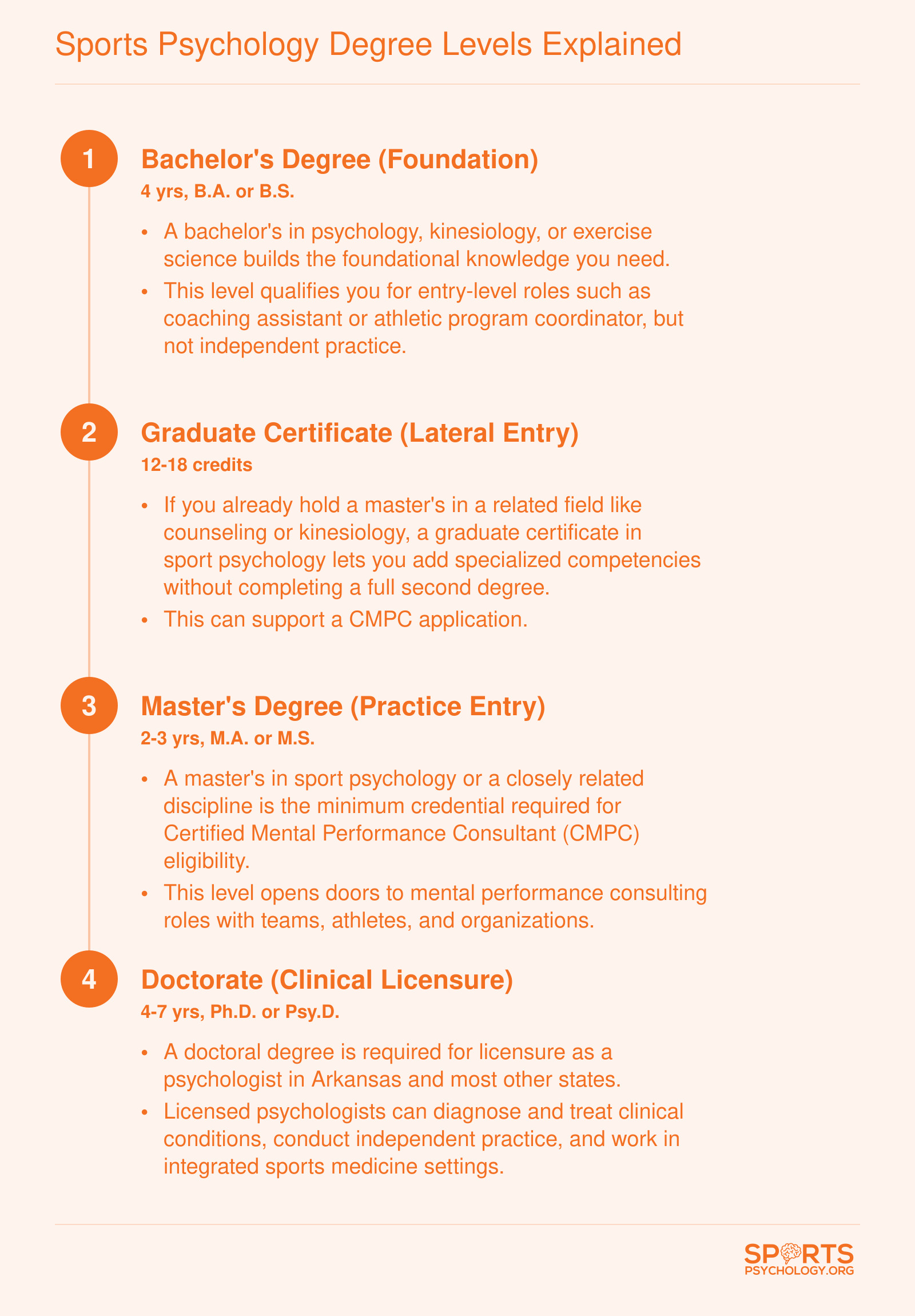
Sports Psychology Degree Levels Explained
Sports psychology offers multiple entry points depending on your career goals. Here is a clear look at the educational pipeline, from foundational coursework through advanced clinical practice, plus a lateral option for professionals pivoting from a related field.
Sport Psychology Licensure and Certification in Arkansas
Understanding how licensure and certification work in Arkansas is essential before you commit to a degree path. The state does not offer a standalone sport psychology license1, so the credentials you pursue will depend on whether you plan to provide clinical mental health services or focus exclusively on mental performance consulting.
Becoming a Licensed Psychologist in Arkansas
If you want to diagnose and treat clinical conditions such as anxiety disorders, depression, or eating disorders in athletes, you will need full licensure as a psychologist through the Arkansas Psychology Board.2 The requirements include:
Doctoral degree: You must hold a PhD, PsyD, or equivalent from an accredited program.2
Supervised experience: A minimum of 2,000 hours of supervised professional experience, structured as one year of 50 full-time (40-hour) work weeks.3
Licensing exam: You must pass the Examination for Professional Practice in Psychology (EPPP), which is administered by the Association of State and Provincial Psychology Boards.2
Accreditation: Your doctoral program must meet the board's accreditation standards.2
Once licensed, you can legally use the title "psychologist" and specialize in sport psychology within your clinical practice. This path allows you to work with athletes on both performance enhancement and diagnosable mental health concerns. If you are weighing whether this clinical sports psychology route is right for you, consider how much of your work you want centered on therapy versus on-field consulting.
Earning the Certified Mental Performance Consultant (CMPC) Credential
The CMPC, offered through the Association for Applied Sport Psychology (AASP), is the gold-standard sport psychology certification for non-clinical mental performance work. It signals to coaches, athletic departments, and athletes that you have specialized training in performance psychology. The certification process involves:
Education: A master's degree at minimum, with graduate coursework covering sport psychology, research methods, and related areas defined by AASP.
Mentored experience: Supervised hours working directly with athletes or performers under a qualified mentor.
Portfolio review: A professional portfolio demonstrating your applied competencies, ethical reasoning, and consulting philosophy.
Exam: A certification examination testing your knowledge of performance psychology principles and professional practice.
The CMPC is a professional certification, not a state license. It does not authorize you to provide clinical services such as psychotherapy or psychological assessment in Arkansas or any other state.2
Does Arkansas Protect the "Sport Psychologist" Title?
Arkansas does not have title protection specific to sport psychology.1 The state regulates the use of the word "psychologist," meaning you cannot call yourself a sport psychologist unless you hold a doctoral-level psychology license. However, non-licensed professionals who hold the CMPC or similar credentials can offer mental performance consulting services under titles like "mental performance consultant" or "sport performance coach" without running afoul of state regulations.
This distinction matters. If you hold only a master's degree and a CMPC, you can work with athletes on goal setting, visualization, focus, and confidence, but you cannot independently treat clinical conditions or present yourself as a psychologist. If an athlete needs clinical care, you would refer them to a licensed professional.
Choosing Your Path
Your career goals should drive your credential decisions. Students who want to integrate clinical therapy with sport-specific performance work should plan for a doctoral program and full licensure. Those drawn primarily to the mental performance side of sport, working on the field or in the locker room with healthy athletes, may find the CMPC pathway through a master's degree to be the most efficient route. For a broader look at how these two tracks compare, see our guide on sports psychologist requirements. Many professionals eventually pursue both credentials, combining clinical depth with performance specialization to serve athletes at every level.
Sports Psychology Career Opportunities and Salary in Arkansas
Arkansas may not be the first state that comes to mind when you think of sport psychology careers, but a growing appreciation for mental performance training across collegiate athletics, minor league sports, and private practice is creating real opportunities. The demand for sports psychologists is climbing nationally, and Arkansas is no exception. Below is a practical, step-by-step approach to finding roles and understanding what you can expect to earn.
What the Salary Data Tells You
The Bureau of Labor Statistics publishes wage data for psychologists nationally, and these figures offer a useful benchmark. According to the May 2023 Occupational Employment and Wage Statistics report, psychologists in the broader "all other" category (SOC 19-3039) earned a national median annual wage of $117,750.1 The middle 50 percent earned between roughly $76,550 and $138,280, while those at the 90th percentile reached $157,420.1 Clinical and counseling psychologists, a category that captures many practitioners who incorporate sport psychology into their work, reported a national median of $95,830.2
Arkansas-specific wage data for the "all other" psychologist category is not currently published due to small sample sizes.1 To get the most current numbers, visit the BLS Occupational Employment and Wage Statistics page, select Arkansas, and search for the relevant psychologist occupation codes. Even when state-level data is suppressed, the national percentiles give you a solid frame of reference for salary negotiations.
Where to Look for Sport Psychology Roles in Arkansas
Sport psychology positions in Arkansas tend to cluster around a few key employers and settings:
University athletic departments: The University of Arkansas at Fayetteville, with its large Division I athletics program, is the most prominent employer. Other schools such as Arkansas State University and the University of Central Arkansas also maintain athletic departments that may contract sport psychology consultants.
Minor league and professional teams: Organizations like the Arkansas Travelers (Minor League Baseball) and the Little Rock Rangers (USL soccer) occasionally seek mental performance support, either as full-time staff or through consulting arrangements. Check their employment or staff pages regularly, or reach out to their front offices directly.
Private practice and performance centers: Many sport psychology professionals in the state build a client base through private practice, serving high school athletes, weekend competitors, and corporate clients interested in sports psychology in corporate wellness.
Tap Into Professional Networks
The Association for Applied Sport Psychology (AASP) maintains a resource directory and job board that lists open positions and certified professionals across the country. Searching for Arkansas-based listings can help you identify potential mentors, supervisors, or employers. Connecting with practitioners already working in the state is one of the most effective ways to learn about unlisted opportunities, since many sport psychology roles are filled through word of mouth rather than formal job postings.
Check the Arkansas Psychology Board
If you are pursuing the licensed psychologist pathway, the Arkansas Psychology Board maintains records of licensed professionals in the state. Reviewing this directory can help you identify psychologists who advertise sport psychology as a specialty. Reaching out to these practitioners is a smart move: they may have openings for associate-level psychologists, know of consulting opportunities, or be willing to provide the supervised hours you need for full licensure.
Whether you are planning to work with Razorback athletes, build a private consulting practice, or join a multidisciplinary performance team, starting your search with these concrete steps will put you ahead of most candidates. The demand for mental performance services in Arkansas is still developing, which means early movers have a genuine chance to shape the field in the state.
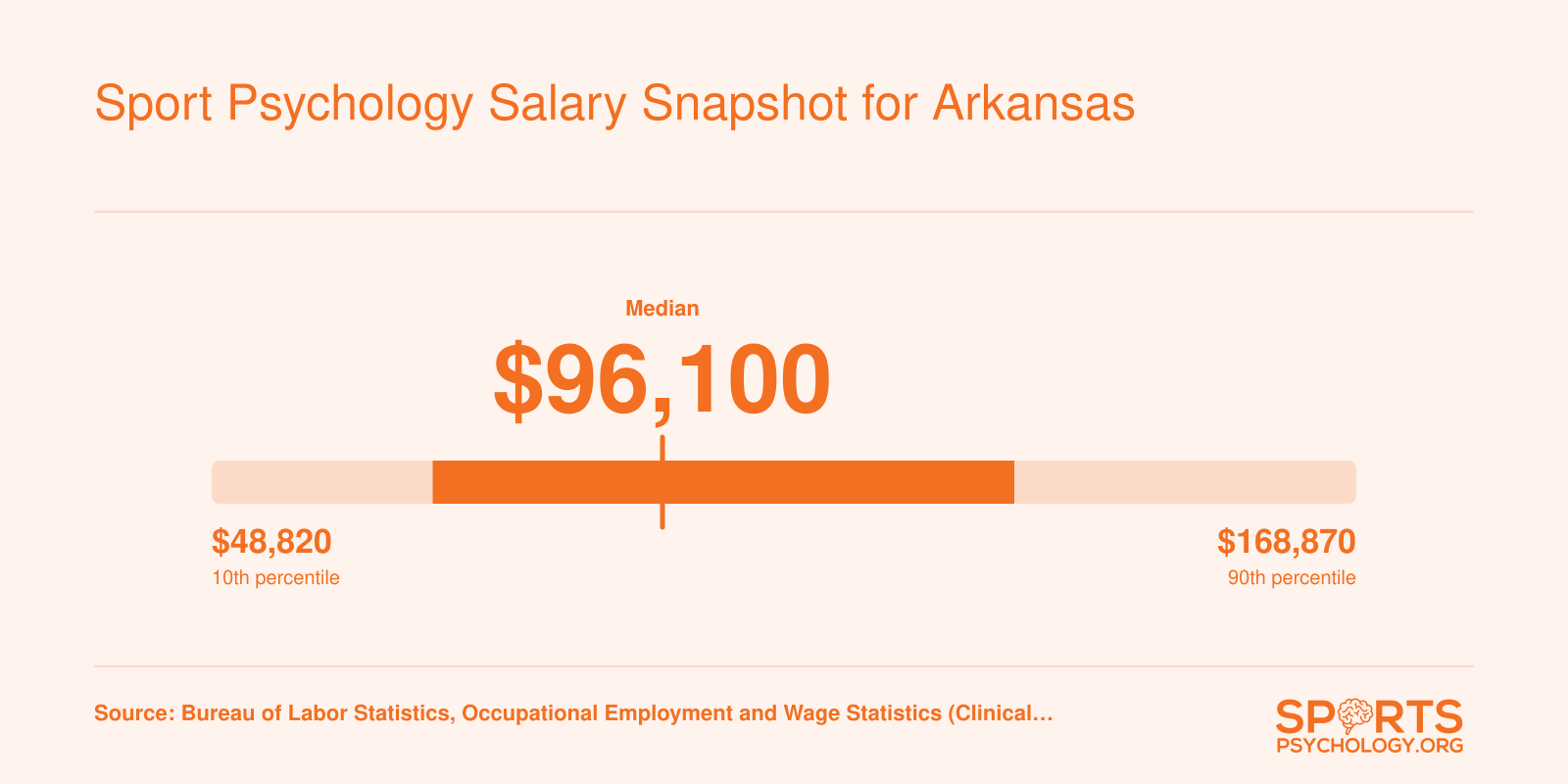
Sport Psychology Salary Snapshot for Arkansas
Arkansas-specific salary data for sport psychology specialists is not published separately by the Bureau of Labor Statistics, so the national figures for psychologists offer the best available benchmark. Keep in mind that professionals in private practice or working with Division I athletics programs may earn above the national median, while early-career roles typically fall closer to the lower end of the range.
Frequently Asked Questions About Sports Psychology in Arkansas
Below are some of the most common questions prospective students ask about pursuing sports psychology education and careers in Arkansas. If you still have questions after reading, sportspsychology.org offers additional guides and program comparisons to help you plan your next step.
Are there sports psychology degree programs in Arkansas?
Arkansas does not currently offer a standalone sports psychology degree at most of its universities. However, students can find related programs in kinesiology, exercise science, or counseling psychology with sport-focused coursework at schools like the University of Arkansas and the University of Central Arkansas. Many Arkansas students also enroll in accredited online programs from out-of-state institutions that accept practicum placements within the state.
How do you become a licensed sports psychologist in Arkansas?
To practice as a licensed psychologist in Arkansas, you must earn a doctoral degree in psychology from an accredited program, complete supervised clinical hours, and pass the Examination for Professional Practice in Psychology (EPPP). Licensure is managed by the Arkansas Psychology Board. There is no separate sports psychology license, so practitioners who use the title 'psychologist' must hold a general psychology license and then specialize in sport and performance work.
What is CMPC certification and do you need it in Arkansas?
The Certified Mental Performance Consultant (CMPC) credential is offered by the Association for Applied Sport Psychology (AASP). It requires a graduate degree, specific coursework in sport psychology, and supervised mentorship hours. While CMPC certification is not legally required in Arkansas, it is widely recognized by athletic organizations and can strengthen your credibility. It is the preferred credential for professionals who focus on performance enhancement rather than clinical diagnosis.
What degree do you need to be a sports psychologist?
If you want to use the title 'sports psychologist,' you typically need a doctoral degree (Ph.D. or Psy.D.) in clinical or counseling psychology, along with state licensure. If your goal is to work as a mental performance consultant instead, a master's degree in sport psychology, kinesiology, or a related field can qualify you to pursue CMPC certification and work with athletes in a non-clinical capacity.
How much does a sports psychologist make in Arkansas?
Salary data specific to sports psychologists in Arkansas is limited because the Bureau of Labor Statistics groups them under broader psychology categories. Licensed psychologists in Arkansas generally earn between roughly $60,000 and $90,000 per year, though those in private practice or working with collegiate and professional teams may earn more. Mental performance consultants without doctoral licensure often start at a lower range, particularly when building a client base.
Can I complete practicum hours in Arkansas while enrolled in an online program?
Yes, many accredited online programs allow students to arrange supervised practicum or internship placements in their home state. Arkansas offers potential practicum sites at university athletic departments, community sports organizations, and private practices. It is important to confirm with your program that your chosen site and supervisor meet the school's accreditation and hour requirements before you begin.
What is the difference between a sports psychologist and a mental performance consultant?
A sports psychologist holds a doctoral degree and a state psychology license, which allows them to diagnose and treat clinical mental health conditions in athletes. A mental performance consultant, often holding CMPC certification and a master's degree, focuses on performance enhancement skills such as goal setting, visualization, and focus training. Mental performance consultants cannot diagnose or treat psychological disorders unless they also hold a separate clinical license.
More Online Sports Psychology Programs for Arkansas Students
In addition to our top-ranked programs, these online options also welcome Arkansas students and offer quality pathways into sports psychology. Each program is delivered fully online, allowing you to study from anywhere in Arkansas while gaining the skills needed for careers in coaching, mental performance, and related fields.
Faulkner University
Faulkner University offers an online Bachelor of Science in Sports Psychology, with tuition at $335 per semester hour plus a $75 online course fee. The curriculum emphasizes mental aspects of sports within a Christian worldview, preparing students for coaching, athletic counseling, and fitness instruction.
Parker University's Bachelor of Science in Sport Psychology is fully online, exploring the mind-athletic performance connection through psychological theory, scientific research, and practical skills. The program prepares students for graduate studies or careers in coaching, education, or health promotion.
University of the Southwest offers an online Master of Science in Sports Psychology, focusing on team dynamics, performance enhancement, and injury recovery. The program equips graduates for careers in coaching, mentoring, athletics, and teaching.
Northern Michigan University's online Master of Science in Applied Sport Psychology offers two tracks: Mental Performance Consultant certification or Limited Psychologist licensure. The asynchronous format is designed for working professionals, including coaches and athletes.
Commonwealth University's 100% online Master of Science in Sport and Performance Psychology offers flexible full- or part-time options and aligns with CMPC certification requirements. The curriculum covers mental skills training and psychosocial factors, with no GRE required.
East Central University offers an online Master of Science in Sport Psychology designed for students from diverse backgrounds. The 45-credit program prepares graduates for CMPC certification and includes a supervised internship.
University of West Alabama's online Master of Science in Experimental Psychology offers a concentration in Health and Sports Psychology. The program includes core research methods, theory courses, and a practicum, preparing graduates for doctoral studies or careers in health and sports psychology.
Kent State University offers an online Bachelor of Science in Sport, Exercise and Performance Psychology, focusing on motivation, mental training, and stress management. The 120-credit program typically takes four years and prepares students for careers in mental performance coaching or further graduate study.
Kent State University's online Bachelor of Science in Sport, Exercise and Performance Psychology covers psychological factors in athletic success, including motivation and mental training. The program requires 120 credits and prepares graduates for coaching or mental performance roles.
Kent State University's 100% online Bachelor of Science in Sport, Exercise and Performance Psychology emphasizes mental skills training and injury psychology. The program typically takes four years and is open to first-year and transfer students.
Kent State University's online Bachelor of Science in Sport, Exercise and Performance Psychology provides flexibility with a 100% online format. The program covers psychological processes in sport and prepares graduates for careers in coaching or mental performance.
Kent State University offers an online Bachelor of Science in Sport, Exercise and Performance Psychology, focusing on psychological factors in athletic and performance success. The program includes a practicum and prepares students for mental performance coaching roles.
Kent State University's 100% online Bachelor of Science in Sport, Exercise and Performance Psychology covers motivation, mental training, and stress management. The 120-credit program typically takes four years and prepares graduates for further study or careers in coaching.
Kent State University's online Bachelor of Science in Sport, Exercise and Performance Psychology focuses on psychological factors in athletic success, including motivation and mental training. The program prepares graduates for careers as mental performance coaches or for further graduate study.